
No products in the cart.
-9%


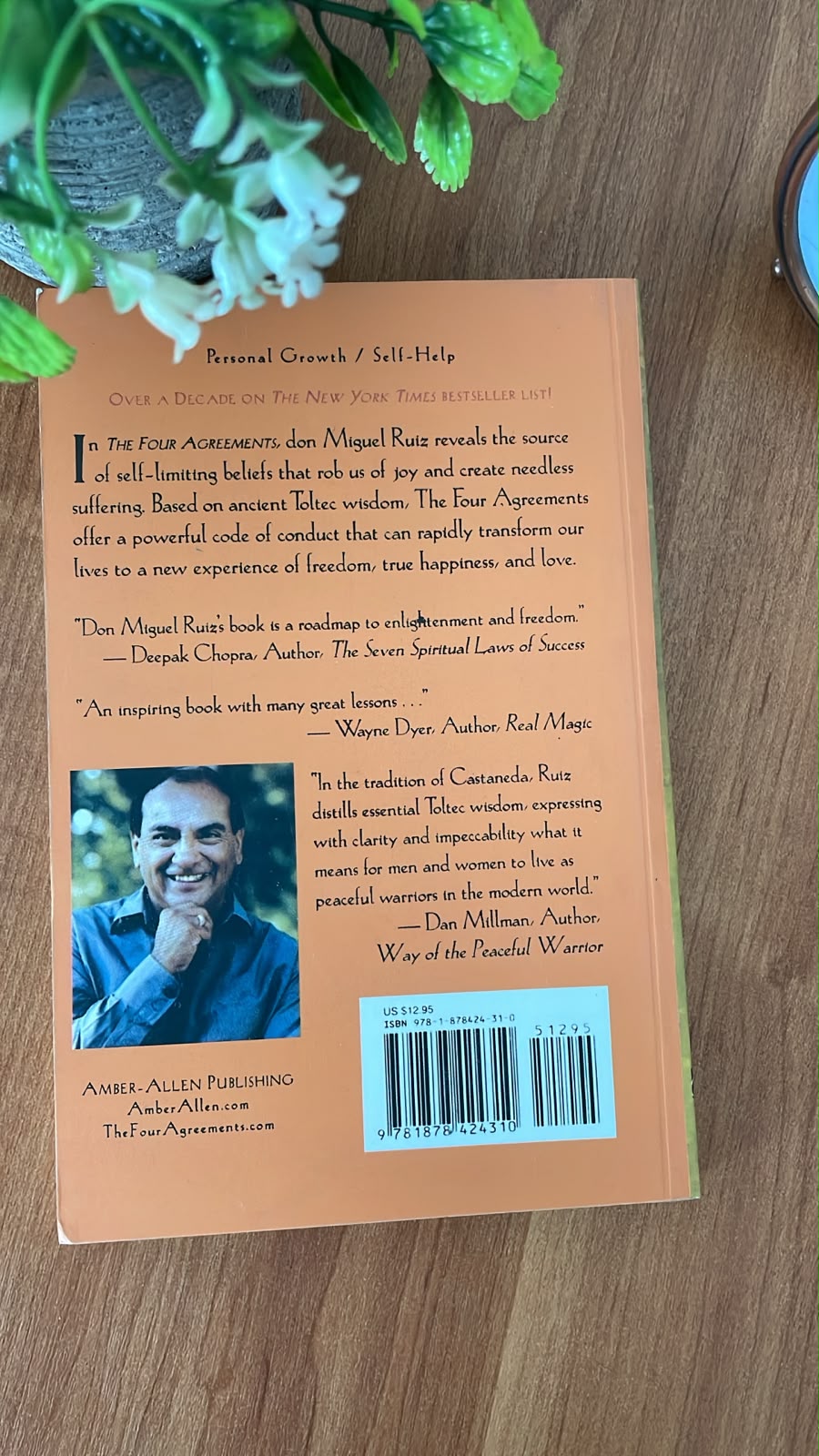







The Four Agreements by Don Miguel Ruiz


Original price was: රු1,750.00.රු1,600.00Current price is: රු1,600.00.
3 X Rs. 533.33 or 8% Cashback with


or 3 X රු533.33 with


or up to 4 X රු400.00 with


Discover personal freedom with “The Four Agreements” by Don Miguel Ruiz. This paperback reveals powerful principles to transform your life: Be impeccable with your word, don’t take anything personally, don’t make assumptions, and always do your best. Order now and embark on a journey of authenticity, joy, and meaningful relationships.
5 in stock
The Four Agreements by Don Miguel Ruiz is a simple but thought-provoking guide to changing the beliefs and habits that create unnecessary stress, conflict, and unhappiness.
Why do we take criticism so personally?
Why do we make assumptions about what other people think?
Why do words sometimes hurt for years?
Why do we expect ourselves to perform perfectly every day?
And how much of our unhappiness comes from beliefs we learned without ever questioning them?
These questions sit at the heart of The Four Agreements.
Rather than offering hundreds of complicated rules, Don Miguel Ruiz presents four principles readers can use to become more aware of how they speak, think, react, and behave.
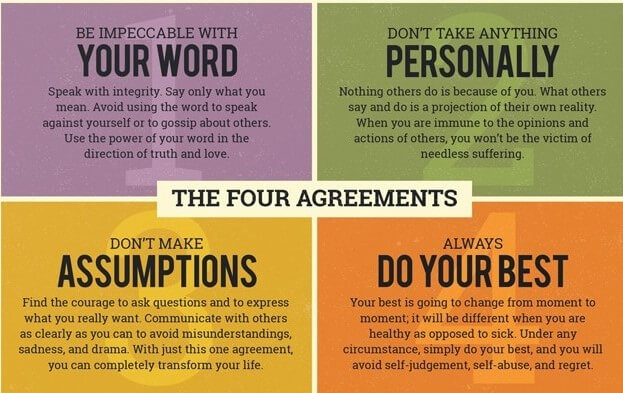
The official author site identifies the four agreements as:
- Be Impeccable with Your Word
- Don’t Take Anything Personally
- Don’t Make Assumptions
- Always Do Your Best
Why Read The Four Agreements?
The Four Agreements is ideal for readers interested in personal growth, emotional awareness, relationships, communication, and inner freedom.
The book explores:
- Self-limiting beliefs
- Personal responsibility
- Communication
- Emotional reactions
- Assumptions
- Relationships
- Self-respect
- Happiness
- Awareness
- Personal freedom
- Stress
- Forgiveness
- Behaviour
- Spiritual growth
Its biggest strength is simplicity.
The ideas are easy to remember.
Practising them consistently is much harder.
The Four Agreements and Personal Freedom
The full subtitle is A Practical Guide to Personal Freedom.
That phrase explains the book’s larger goal.
Ruiz argues that people create many psychological limitations through agreements they make with themselves and others.
Some are conscious.
Others are learned during childhood.
For example:
“I must always make everyone happy.”
“I am not good enough.”
“People will reject me if I fail.”
“I cannot change.”
These beliefs can become so familiar that people stop recognizing them as beliefs.
The Four Agreements encourages readers to examine those internal rules and replace harmful patterns with more conscious choices.
The First Agreement: Be Impeccable with Your Word
The first agreement is:
Be Impeccable with Your Word.
Words have power.
They can encourage.
Damage.
Teach.
Comfort.
Mislead.
Inspire.
Or destroy trust.
Ruiz encourages readers to become more responsible with language.
That includes how you speak to other people.
But it also includes how you speak to yourself.
The Four Agreements and Self-Talk
Consider how often people say things like:
“I’m stupid.”
“I always fail.”
“I can’t do anything right.”
“I’m ugly.”
“I’ll never succeed.”
Repeated often enough, these statements can begin feeling like facts.
The Four Agreements asks readers to become more careful about the language they use internally.
A mistake does not automatically mean you are a failure.
A rejection does not prove you are worthless.
Words can shape identity.
That makes them worth choosing carefully.
Speak With Integrity
Being impeccable with your word does not mean saying only pleasant things.
Sometimes honesty is uncomfortable.
The deeper idea is to speak with greater integrity.
Avoid unnecessary gossip.
Avoid deliberately hurting people.
Avoid saying things you know are false.
Avoid using language against yourself.
This can improve both relationships and self-respect.
The Second Agreement: Don’t Take Anything Personally
The second agreement is:
Don’t Take Anything Personally.
This is one of the book’s most memorable ideas.
Someone criticizes you.
Someone ignores your message.
Someone becomes angry.
Someone does not invite you somewhere.
The mind may immediately conclude:
“They don’t respect me.”
“They hate me.”
“I did something wrong.”
But another person’s behaviour may have far more to do with their own emotions, experiences, expectations, and problems.
The Four Agreements and Emotional Reactions
Taking everything personally gives other people enormous control over your emotional state.
One compliment makes you happy.
One criticism destroys your day.
One rude comment stays in your head for a week.
The Four Agreements encourages readers to create more psychological distance.
Listen.
Evaluate.
Learn when necessary.
But do not automatically accept every opinion as a definition of who you are.
Criticism Can Still Be Useful
Not taking things personally does not mean ignoring all feedback.
Some criticism is valuable.
Your manager may identify a genuine weakness.
A friend may point out behaviour that hurts others.
The important distinction is this:
You can examine feedback without turning it into your entire identity.
Instead of:
“I received criticism, therefore I am worthless.”
Try:
“Is there something useful here?”
That creates room for growth without unnecessary self-attack.
The Third Agreement: Don’t Make Assumptions
The third agreement is:
Don’t Make Assumptions.
Humans dislike uncertainty.
When information is missing, the brain often invents an explanation.
Someone does not reply.
You assume they are angry.
A colleague looks serious.
You assume you made a mistake.
Your partner is quiet.
You assume something is wrong with the relationship.
The assumption may be completely incorrect.
But the emotional reaction feels real anyway.
The Four Agreements and Communication
Many relationship problems begin because people assume instead of asking.
We expect others to know what we want.
Then feel disappointed when they do not.
We assume we understand someone’s intention.
Then become angry.
We believe another person should automatically understand our feelings.
Then blame them when they do not.
The Four Agreements recommends clearer communication.
Ask questions.
Clarify.
Explain what you need.
Confirm what the other person meant.
That sounds simple.
But it can prevent enormous amounts of unnecessary conflict.
Ask Instead of Guessing
Imagine receiving a short message:
“Okay.”
You may interpret it as:
Angry.
Cold.
Dismissive.
But perhaps the person is simply busy.
Without more information, you do not know.
A quick clarification may solve what hours of overthinking cannot.
That is the practical value of the third agreement.
The Fourth Agreement: Always Do Your Best
The fourth agreement is:
Always Do Your Best.
At first, this may sound like pressure.
Work harder.
Push yourself.
Never fail.
But Ruiz presents it differently.
Your best changes.
Your best when rested may be excellent.
Your best when sick may be much lower.
Your best during a difficult period may not match your performance during an easy one.
The goal is effort without constant self-punishment.
The Four Agreements and Perfectionism
Perfectionism often creates impossible expectations.
You must always perform at 100%.
Never make mistakes.
Never have bad days.
Never lose motivation.
That is unrealistic.
The Four Agreements offers a healthier alternative.
Do the best you reasonably can under current conditions.
Then release unnecessary regret.
If you genuinely did your best with the knowledge and energy available, you can learn from the result without endlessly attacking yourself.
Your Best Changes From Day to Day
This idea can be surprisingly freeing.
Some days you may work for four deeply focused hours.
Another day, one good hour may be your best.
Some days exercise feels easy.
Other days a short walk is enough.
Consistency matters.
But self-awareness matters too.
Doing your best does not require pretending you are a machine.
How the Four Agreements Work Together
The four principles reinforce one another.
If you are careful with your words, relationships may improve.
If you stop taking everything personally, emotional reactions may become easier to manage.
If you stop making assumptions, communication becomes clearer.
If you consistently do your best, you may experience less guilt about imperfect outcomes.
Together, they create a simple framework for greater awareness.
The Four Agreements and Relationships
Relationships are one area where these ideas become immediately useful.
Consider a typical argument.
Someone says something harsh.
You take it personally.
You assume what they meant.
You respond with another harsh statement.
Conflict grows.
Now apply the agreements.
Speak carefully.
Do not immediately personalize everything.
Ask what the other person actually meant.
Do your best to communicate constructively.
The disagreement may still exist.
But it is less likely to become unnecessarily destructive.
The Four Agreements and Work
The same principles apply professionally.
Be impeccable with your word: communicate honestly and clearly.
Don’t take anything personally: separate professional feedback from personal worth.
Don’t make assumptions: clarify expectations before beginning important work.
Always do your best: deliver consistent effort without expecting perfection.
That makes the book useful beyond spiritual or personal-growth contexts.
The Four Agreements and Social Media
The principles may be even more relevant today than when the book appeared in 1997.
Social media exposes people to:
Opinions.
Arguments.
Comparisons.
Criticism.
Gossip.
Misunderstandings.
Anonymous comments.
It becomes easy to take strangers’ words personally.
Easy to assume what someone meant.
Easy to respond impulsively.
The four agreements offer a simple filter before reacting.
The Four Agreements and Self-Limiting Beliefs
The publisher describes the book as identifying self-limiting beliefs that reduce joy and create unnecessary suffering.
These beliefs may include:
“I’m not talented.”
“I always ruin relationships.”
“I’m too old.”
“I could never do that.”
“People like me cannot succeed.”
Sometimes these conclusions come from one old experience.
A parent.
A teacher.
A relationship.
A failure.
But one past event does not necessarily deserve permanent control over the future.
The Four Agreements and Awareness
Awareness comes before change.
You cannot change a habit you never notice.
That is why the book repeatedly encourages readers to observe:
How they speak.
How they react.
What they assume.
What they believe.
And how they treat themselves.
The agreements then become practical reminders.
Is The Four Agreements Religious?
The book draws on what Ruiz presents as ancient Toltec wisdom and uses spiritual language.
However, it is generally written as a personal-development framework rather than requiring readers to join a particular religion.
Penguin Random House categorizes it within self-improvement, philosophy, and spiritual nonfiction.
Readers can therefore approach it spiritually, philosophically, or simply as a set of personal-growth principles.
The Four Agreements Is a Short Read
One reason the book became so popular is its accessibility.
The standard paperback edition is only 160 pages.
That makes it relatively quick to read.
But the principles are designed to be practised repeatedly rather than understood once and forgotten.
Knowing the agreements is easy.
Living them consistently is the real challenge.
4 Powerful Agreements From The Four Agreements
1. Be Impeccable with Your Word
Use language with integrity.
Avoid harmful gossip and unnecessary negativity.
Speak more carefully to yourself and others.
2. Don’t Take Anything Personally
Other people’s behaviour often reflects their own world.
Consider feedback, but do not allow every opinion to define your self-worth.
3. Don’t Make Assumptions
Ask questions.
Clarify intentions.
Communicate directly instead of building stories from incomplete information.
4. Always Do Your Best
Give the best effort available under current circumstances.
Your best will change, and perfection is not required.
These are the four official agreements presented by Don Miguel Ruiz.
7 Powerful Lessons From The Four Agreements
- Words shape relationships. Speak more deliberately because language can create trust or damage it.
- Not every reaction is about you. Other people carry their own fears, beliefs, and experiences.
- Assumptions create unnecessary conflict. Ask instead of guessing.
- Your internal language matters. Constantly insulting yourself can reinforce harmful beliefs.
- Perfection is not required. Doing your best is different from demanding flawless performance.
- Awareness creates choice. Recognizing old agreements makes it easier to replace them.
- Personal freedom begins internally. The Four Agreements encourages readers to question the beliefs and reactions that quietly control everyday life.
What You Can Expect From The Four Agreements
Readers can expect:
- Personal development
- Self-awareness
- Communication advice
- Relationship lessons
- Emotional resilience
- Spiritual philosophy
- Personal responsibility
- Self-limiting beliefs
- Toltec-inspired teachings
- Inner freedom
- Happiness
- Simple practical principles
Who Should Read The Four Agreements?
The Four Agreements is ideal for:
Readers interested in self-help.
People who overthink conversations.
People who take criticism personally.
Readers struggling with assumptions.
People interested in better relationships.
Readers exploring spirituality.
Anyone interested in emotional awareness.
People working on confidence and self-respect.
Fans of short personal-development books.
Readers interested in Don Miguel Ruiz.
A Powerful Guide to Personal Freedom
The Four Agreements does not ask readers to memorize a complicated philosophy.
Its message can be summarized in four lines.
Speak carefully.
Do not make everything about you.
Stop inventing explanations when you do not know the truth.
Give your best without demanding perfection.
Simple?
Yes.
Easy?
Not necessarily.
The power of the book comes from applying these ideas during real situations.
When someone criticizes you.
When you are angry.
When your mind begins assuming the worst.
When you make a mistake.
When you are tempted to speak harshly.
Those are the moments when the agreements become useful.
For readers interested in self-awareness, communication, relationships, happiness, and greater emotional freedom, The Four Agreements remains a short and highly influential personal-development classic.
Book Details
Title: The Four Agreements
Full Title: The Four Agreements: A Practical Guide to Personal Freedom
Author: Don Miguel Ruiz
With: Janet Mills
Series: Toltec Wisdom
Genre: Self-Help / Personal Growth / Spirituality / Philosophy
Original Publication: November 7, 1997
Original Paperback Length: 160 pages.
Paperback Edition Details
ISBN-13: 9781878424310
Format: Paperback
Publication Date: November 7, 1997
Pages: 160
Publisher listing: Tarcher.
2025 Hardcover Edition
A newer hardcover edition is listed as:
ISBN-13: 9781934408650
Format: Hardcover
Publication Date: September 30, 2025
Pages: 160
Dimensions: approximately 5 × 7¼ inches.
Edition Note
Different editions of The Four Agreements may have different ISBNs, covers, publisher/imprint information, and page counts.
Use the ISBN printed on your physical copy before entering exact edition details on your website.
Learn more about The Four Agreements by Don Miguel Ruiz on Don Miguel Ruiz’s official website.
Explore more personal development books at Bargain Books.
| Author | Don Miguel Ruiz |
|---|---|
| Type | Paperback Printed Book |
| ISBN/ISSN | 1878424483 |
| Language | English |
| Pages | 225 |
Be the first to review “The Four Agreements by Don Miguel Ruiz”
Related products
-34%

Non-Fiction & Knowledge
Original price was: රු2,250.00.රු1,490.00Current price is: රු1,490.00.
3 X Rs. 496.67 or 8% Cashback with
or 3 X රු496.67 with
or up to 4 X රු372.50 with

Non-Fiction & Knowledge
රු1,800.00
3 X Rs. 600.00 or 8% Cashback with
or 3 X රු600.00 with
or up to 4 X රු450.00 with
Non-Fiction & Knowledge
රු2,450.00
3 X Rs. 816.67 or 8% Cashback with
or 3 X රු816.67 with
or up to 4 X රු612.50 with
-26%

Non-Fiction & Knowledge
Original price was: රු2,000.00.රු1,490.00Current price is: රු1,490.00.
3 X Rs. 496.67 or 8% Cashback with
or 3 X රු496.67 with
or up to 4 X රු372.50 with

Non-Fiction & Knowledge
රු1,550.00
3 X Rs. 516.67 or 8% Cashback with
or 3 X රු516.67 with
or up to 4 X රු387.50 with
Non-Fiction & Knowledge
රු2,250.00
3 X Rs. 750.00 or 8% Cashback with
or 3 X රු750.00 with
or up to 4 X රු562.50 with

Out of stock
Autobiography
රු2,750.00
3 X Rs. 916.67 or 8% Cashback with
or 3 X රු916.67 with
or up to 4 X රු687.50 with
-26%
Non-Fiction & Knowledge
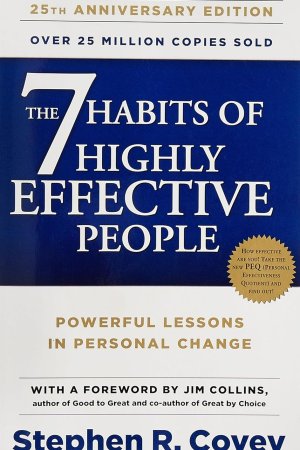
The 7 Habits of Highly Effective People by Stephen R. Covey – Blue Cover
Original price was: රු2,300.00.රු1,700.00Current price is: රු1,700.00.
3 X Rs. 566.67 or 8% Cashback with
or 3 X රු566.67 with
or up to 4 X රු425.00 with
Reviews
There are no reviews yet.