
No products in the cart.
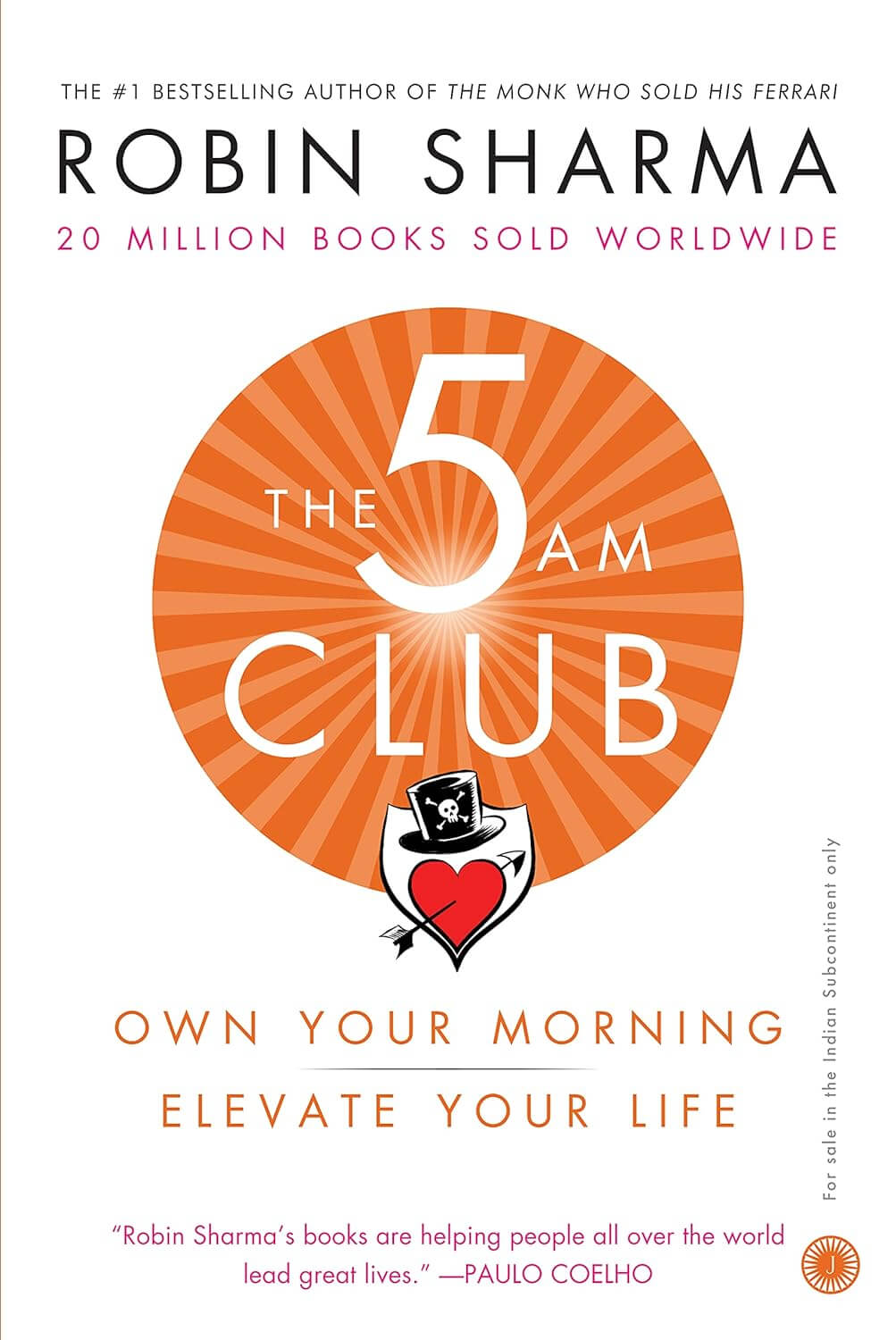



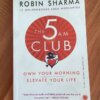



The 5 AM Club by Robin Sharma

රු1,550.00
3 X Rs. 516.67 or 8% Cashback with


or 3 X රු516.67 with


or up to 4 X රු387.50 with


5 AM Club by Robin Sharma is a bestselling personal-development book built around one central idea: how you begin your morning can strongly influence how you approach the rest of your day.
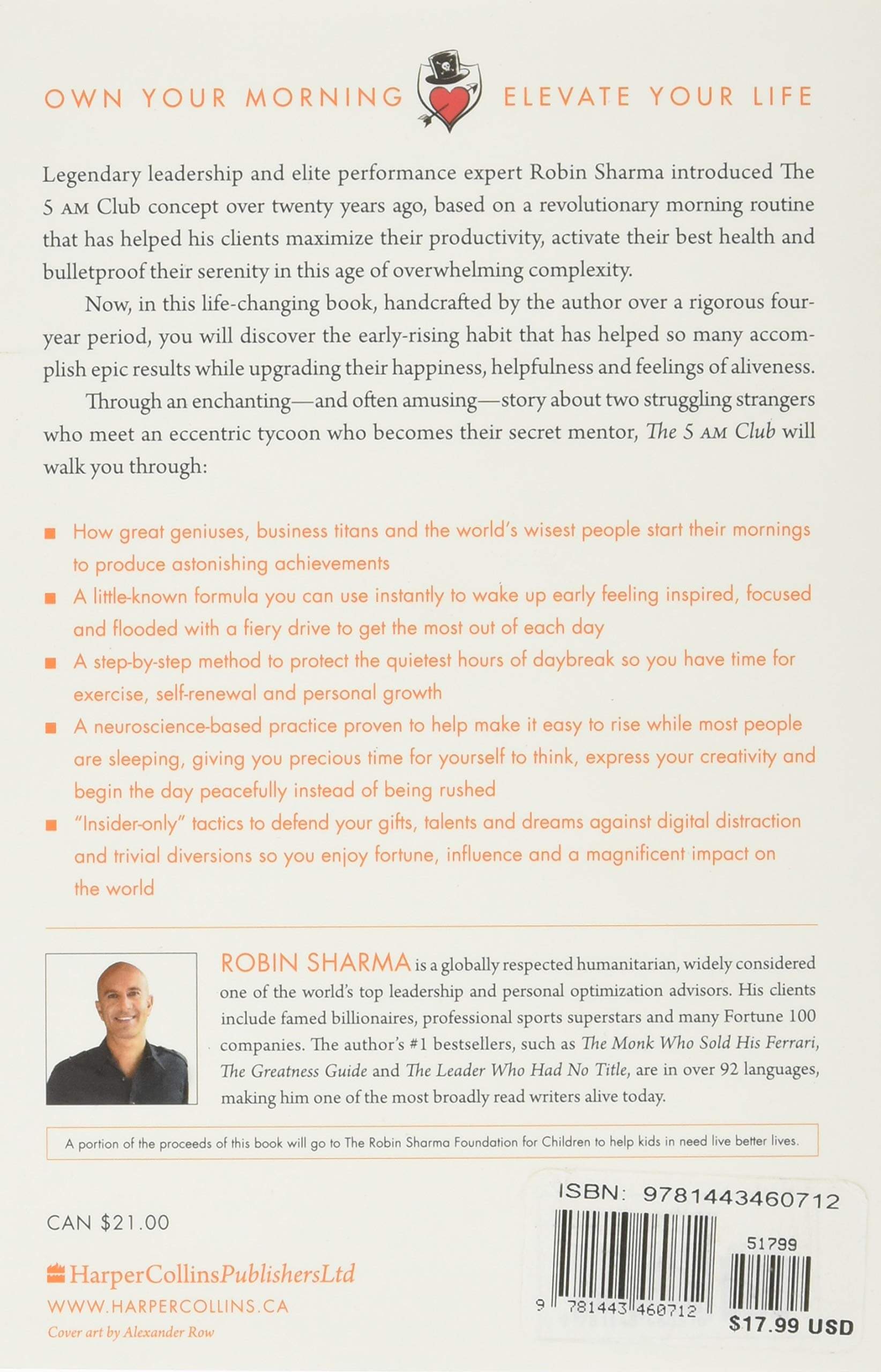
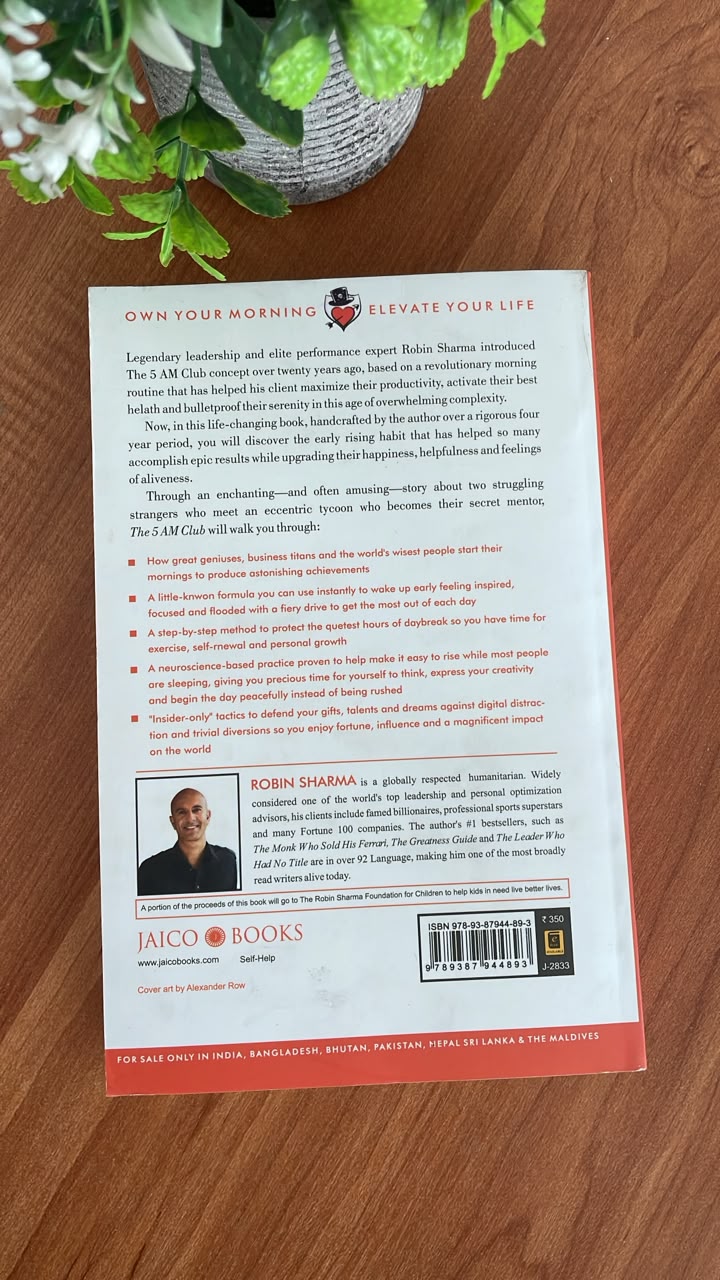
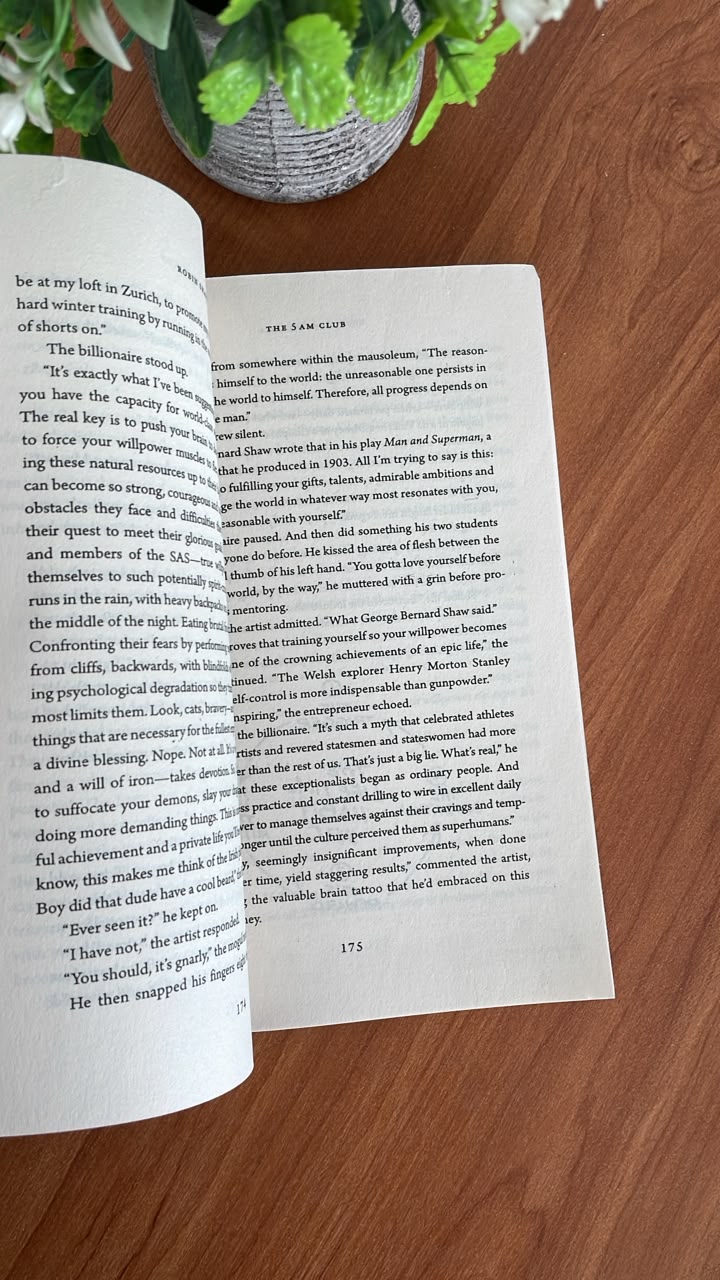
Through a fictional story involving an entrepreneur, an artist and an eccentric billionaire mentor, Sharma introduces practical frameworks for early rising, greater focus, personal mastery and reducing digital distraction.
One of the book’s best-known ideas is the 20/20/20 Formula, which divides the first hour of the morning into three twenty-minute periods for movement, reflection and personal growth.
The book also explores what Sharma calls the Four Interior Empires: Mindset, Heartset, Healthset and Soulset, encouraging readers to develop themselves mentally, emotionally, physically and personally.
Product details:
- Title: The 5 AM Club
- Subtitle: Own Your Morning. Elevate Your Life.
- Author: Robin Sharma
- Publisher: HarperCollins Publishers
- Imprint: Harper Thorsons
- Format: Paperback
- Pages: 336
- Language: English
- ISBN-13: 9780008312831
- ISBN-10: 0008312834
- Publication year: 2018
- Dimensions: Approximately 23.4 × 15.3 × 2.5 cm
- Weight: Approximately 420 g
- Categories: Self-Help, Personal Development and Productivity
- Key themes: Morning routines, productivity, focus, discipline, personal growth and intentional living
26 in stock
The 5 AM Club by Robin Sharma
5 AM Club by Robin Sharma is a personal-development and productivity book about creating a deliberate morning routine before the distractions of everyday life begin.
Rather than presenting the ideas as a traditional instruction manual, Sharma communicates much of the book through a fictional story involving two struggling individuals who meet an unusual billionaire mentor.
Through their journey, readers are introduced to routines, frameworks and ideas about focus, discipline, productivity and personal mastery.
5 AM Club
The central philosophy of 5 AM Club is that the beginning of the day can become protected time for personal development.
Instead of waking up and immediately checking messages, emails or social media, Sharma encourages readers to create a period with fewer distractions.
The goal is not simply to wake up earlier.
It is to use the early hour deliberately.
The Victory Hour
Sharma describes the period from 5:00 AM to 6:00 AM as the Victory Hour.
This hour is intended to provide space before work, messages, meetings and responsibilities begin demanding attention.
Readers can use this time to work on themselves.
That might involve exercise, planning, reflection, reading or another activity that supports long-term goals.
The idea is to become proactive before the day becomes reactive.
The 20/20/20 Formula
One of the most memorable concepts in 5 AM Club is the 20/20/20 Formula.
The first hour is divided into three twenty-minute sections.
These are commonly described as:
- Move
- Reflect
- Grow
Each section has a different purpose.
Together, they create a structured morning routine.
First 20 Minutes – Move
The first twenty minutes focus on physical movement.
This could involve activities such as:
- Walking
- Running
- Strength exercises
- Stretching
- Cycling
- Another suitable form of exercise
The exact activity can depend on the individual.
The larger principle is to begin the day with intentional physical activity rather than immediately becoming absorbed in digital distractions.
Second 20 Minutes – Reflect
The next twenty minutes focus on reflection.
This part of the morning can be used for:
- Journaling
- Planning
- Reviewing goals
- Meditation
- Quiet thinking
- Gratitude
- Personal reflection
Sharma’s official material also connects this part of the routine with reviewing the day’s plan.
Reflection creates an opportunity to decide what matters before other people’s demands begin shaping the schedule.
Final 20 Minutes – Grow
The final twenty minutes focus on learning.
Readers might:
- Read a book
- Listen to educational material
- Study a new skill
- Review professional knowledge
- Take notes
- Work through a course
Twenty minutes can seem small.
Repeated every day, however, regular learning can accumulate into significant development.
Protect Your Morning from Distraction
Digital distraction is an important theme throughout 5 AM Club.
Many people begin the day by reaching for their phones.
Messages, social media, news and notifications can immediately compete for attention.
Sharma encourages readers to protect the earliest part of the morning from these interruptions.
This creates a period where attention can be directed intentionally.
Start Proactively Instead of Reactively
The difference between proactive and reactive mornings can be significant.
A reactive morning begins with other people’s requests.
A proactive morning begins with your priorities.
For example, instead of immediately answering messages, a person may first exercise, review goals and identify the day’s most important work.
This does not eliminate responsibilities.
It changes the order in which attention is given.
The Four Interior Empires
Another major framework in 5 AM Club involves what Sharma calls the Four Interior Empires.
These are:
- Mindset
- Heartset
- Healthset
- Soulset
The idea is that personal development involves more than positive thinking alone.
Different parts of life require attention.
Mindset
Mindset relates to thinking.
Readers are encouraged to examine beliefs, assumptions and mental habits.
Useful activities may include:
- Reading
- Learning
- Setting goals
- Challenging limiting beliefs
- Practising concentration
A stronger mindset can help people approach problems with greater clarity.
Heartset
Heartset focuses more on emotions.
A person may understand what they should do intellectually while still being affected by fear, frustration or unresolved emotional patterns.
Reflection can help people become more aware of these responses.
Emotional awareness can also improve relationships and decision-making.
Healthset
Healthset focuses on physical well-being.
Energy affects productivity.
A person who is constantly exhausted may find concentration and disciplined work more difficult.
The framework therefore treats movement, recovery and healthy routines as important parts of personal performance.
Soulset
Soulset relates to values, purpose and inner reflection.
Readers are encouraged to think about what matters beyond immediate achievement.
Questions may include:
- What do I value?
- What kind of person do I want to become?
- Why does my work matter?
- What contribution do I want to make?
These questions can give daily routines a larger sense of direction.
Build Consistency
5 AM Club is also strongly focused on consistency.
A single productive morning will not completely transform someone’s life.
The value comes from repeating useful habits.
Small behaviours become more powerful when they become routine.
A reader might begin with only a few days per week rather than attempting an immediate dramatic change.
Consistency is more valuable than creating an ambitious routine that lasts only three days.
Prepare the Night Before
Early rising becomes difficult when bedtime remains extremely late.
A sustainable morning routine therefore also requires attention to the evening.
Readers can prepare by:
- Reducing late-night distractions
- Planning tomorrow’s priorities
- Preparing clothes or equipment
- Setting a reasonable bedtime
- Avoiding unnecessary screen time before sleep
The morning routine begins partly with decisions made the previous evening.
Create a Distraction-Free First Hour
The first hour can be treated as protected personal time.
This means avoiding unnecessary:
- Social media
- Work chats
- News
- Notifications
- Random browsing
The purpose is not to avoid technology permanently.
It is to delay external demands long enough to create space for focused personal activity.
Focus on High-Value Work
5 AM Club also connects morning discipline with productivity.
Not every task deserves equal attention.
Readers can use the quiet morning period to think about the work that genuinely matters.
Ask:
- What is the most important thing I need to complete today?
- Which task would create the biggest result?
- What can wait?
- Which activities are merely distractions?
- What should I stop doing?
Clarity can help protect the rest of the day.
Develop a Morning Routine Gradually
Not everyone can comfortably move directly from waking at 7 AM to waking at 5 AM.
A gradual approach may be more practical.
Someone might first move their waking time earlier by fifteen or thirty minutes.
Once that feels sustainable, another adjustment can be made.
The objective is to build a routine that can actually be maintained.
Early Rising Is Not the Only Lesson
The title may make the book sound as though waking at exactly 5 AM is the entire message.
It is not.
The broader lessons involve:
- Protecting focused time
- Reducing distraction
- Building disciplined routines
- Investing in learning
- Exercising consistently
- Reflecting regularly
- Creating clearer priorities
Readers whose work schedules make 5 AM impractical can still consider how these principles might apply at another protected time.
Personal Mastery
Sharma uses the concept of personal mastery throughout his work.
Personal mastery involves becoming more capable through repeated development.
That development may involve professional skills, emotional awareness, health and self-discipline.
The morning becomes a daily opportunity to invest in these areas.
Build Your Day Before It Builds You
Busy days often seem to happen automatically.
Meetings appear.
Messages arrive.
Problems need solving.
A deliberate morning gives people a short period to decide what they want from the day before those demands take over.
A simple planning routine could include:
- Review your main goals.
- Choose the day’s most important task.
- Identify likely distractions.
- Schedule focused work.
- Decide one personal priority.
This creates direction.
Use Journaling for Clarity
Journaling appears naturally within the reflection portion of the morning routine.
Writing can help readers clarify thoughts that otherwise remain vague.
Useful prompts include:
- What am I grateful for?
- What matters most today?
- What am I avoiding?
- What did I learn yesterday?
- What should I improve?
- What kind of person do I want to be today?
The purpose is not producing perfect writing.
It is creating greater awareness.
Balance Performance and Recovery
Productivity should not mean working continuously.
Sharma’s broader frameworks also discuss the importance of renewal and recovery.
Focused work becomes difficult when people never allow themselves to recover.
Readers can therefore think about both sides of performance:
Effort and recovery.
Focus and rest.
Discipline and renewal.
Who Should Read This Book?
5 AM Club may appeal to:
- Professionals
- Entrepreneurs
- Managers
- Students
- Business owners
- Productivity enthusiasts
- Personal-development readers
- People struggling with morning routines
- Readers interested in Robin Sharma
- Anyone wanting greater structure in their day
It may particularly appeal to readers who enjoy self-development lessons presented through a fictional story.
About Robin Sharma
Robin Sharma is an author and leadership and personal-development teacher.
His other well-known books include The Monk Who Sold His Ferrari, The Leader Who Had No Title and The Greatness Guide.
His work frequently explores leadership, discipline, productivity and personal mastery.
The 5 AM Club expands on a morning-routine philosophy he had been teaching for many years before the book’s publication.
Product Details
Product title: The 5 AM Club
Subtitle: Own Your Morning. Elevate Your Life.
Author: Robin Sharma
Publisher: HarperCollins Publishers
Imprint: Harper Thorsons
Format: Paperback
Language: English
Page count: 336 pages
ISBN-13: 9780008312831
ISBN-10: 0008312834
Publication year: 2018
Dimensions: Approximately 234 × 153 × 25 mm
Weight: Approximately 420 grams
Categories: Self-Help, Personal Development and Productivity
Key themes: Morning routines, productivity, focus, discipline, learning and personal mastery
Why Choose 5 AM Club?
5 AM Club offers a memorable framework for readers who want to become more intentional about the beginning of their day.
The 20/20/20 Formula provides a simple structure combining movement, reflection and learning.
The Four Interior Empires broaden the idea beyond productivity by encouraging attention to mental, emotional, physical and personal development.
Readers do not necessarily have to apply every idea exactly as written.
The larger value is learning to protect focused time, reduce unnecessary distraction and build routines that support meaningful goals.
For readers interested in productivity, morning routines and personal development, 5 AM Club is a popular addition to a self-improvement bookshelf.
Explore our complete self-help and personal development books collection to discover more titles about habits, productivity, discipline and personal growth.
Learn more about the
5 AM Club morning routine by Robin Sharma
.
| Weight | 0.33 kg |
|---|---|
| Dimensions | 3 × 3 × 3 cm |
| Author | Robin Sharma |
| Language | English |
| Type | Paperback Printed Book (Second Quality Copy) |
| ISBN/ISSN | 9387944891, 978-9387944893 |
| Pages | 336 |
Be the first to review “The 5 AM Club by Robin Sharma”
Related products
-33%

Self-Help & Psychology
Original price was: රු2,300.00.රු1,550.00Current price is: රු1,550.00.
3 X Rs. 516.67 or 8% Cashback with
or 3 X රු516.67 with
or up to 4 X රු387.50 with
-34%
Non-Fiction & Knowledge
Original price was: රු2,250.00.රු1,490.00Current price is: රු1,490.00.
3 X Rs. 496.67 or 8% Cashback with
or 3 X රු496.67 with
or up to 4 X රු372.50 with
-24%
Out of stock
Non-Fiction & Knowledge
Original price was: රු2,100.00.රු1,600.00Current price is: රු1,600.00.
3 X Rs. 533.33 or 8% Cashback with
or 3 X රු533.33 with
or up to 4 X රු400.00 with
-26%
Non-Fiction & Knowledge
The 7 Habits of Highly Effective People by Stephen R. Covey – Blue Cover
Original price was: රු2,300.00.රු1,700.00Current price is: රු1,700.00.
3 X Rs. 566.67 or 8% Cashback with
or 3 X රු566.67 with
or up to 4 X රු425.00 with

Out of stock
Autobiography
රු2,750.00
3 X Rs. 916.67 or 8% Cashback with
or 3 X රු916.67 with
or up to 4 X රු687.50 with
-13%
Non-Fiction & Knowledge
Original price was: රු3,850.00.රු3,350.00Current price is: රු3,350.00.
3 X Rs. 1,116.67 or 8% Cashback with
or 3 X රු1,116.67 with
or up to 4 X රු837.50 with
-24%
Out of stock
Non-Fiction & Knowledge
Original price was: රු2,100.00.රු1,600.00Current price is: රු1,600.00.
3 X Rs. 533.33 or 8% Cashback with
or 3 X රු533.33 with
or up to 4 X රු400.00 with
-28%
Self-Help & Psychology
Original price was: රු1,800.00.රු1,300.00Current price is: රු1,300.00.
3 X Rs. 433.33 or 8% Cashback with
or 3 X රු433.33 with
or up to 4 X රු325.00 with
Reviews
There are no reviews yet.