
No products in the cart.
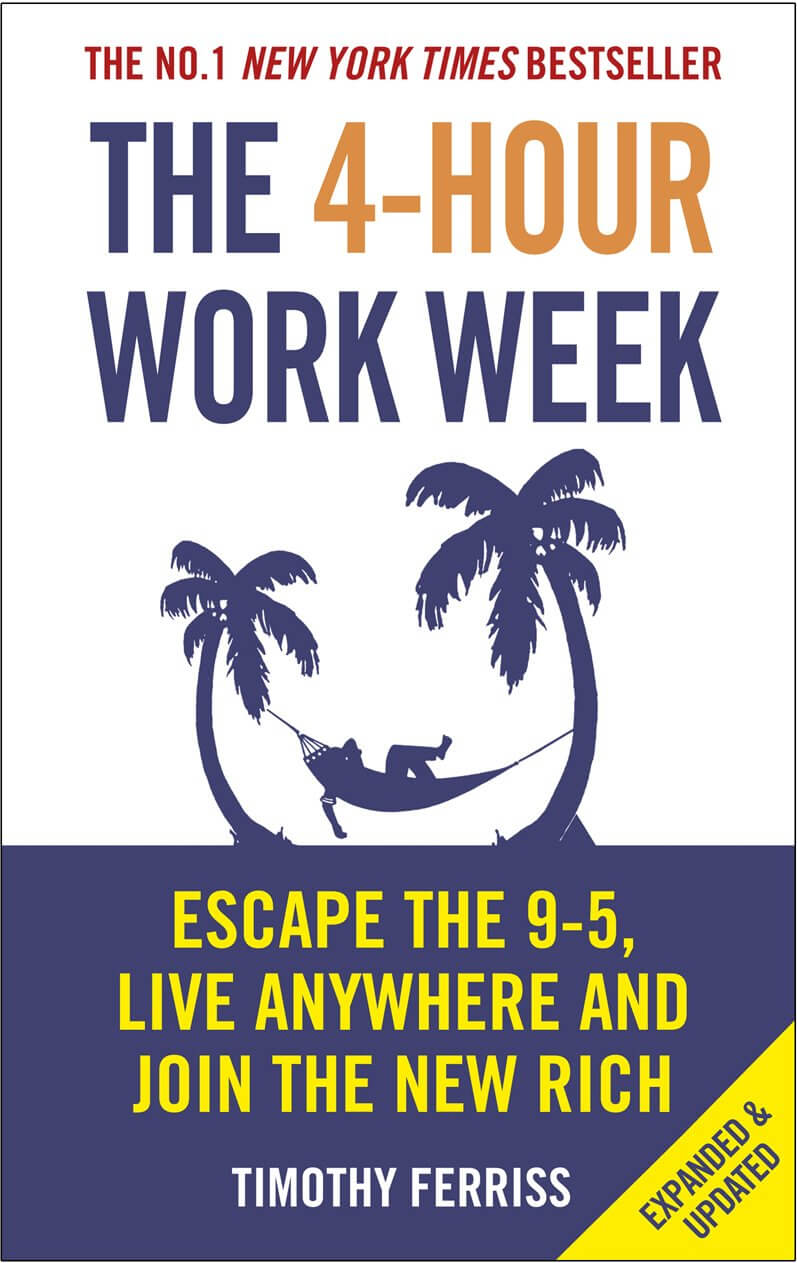

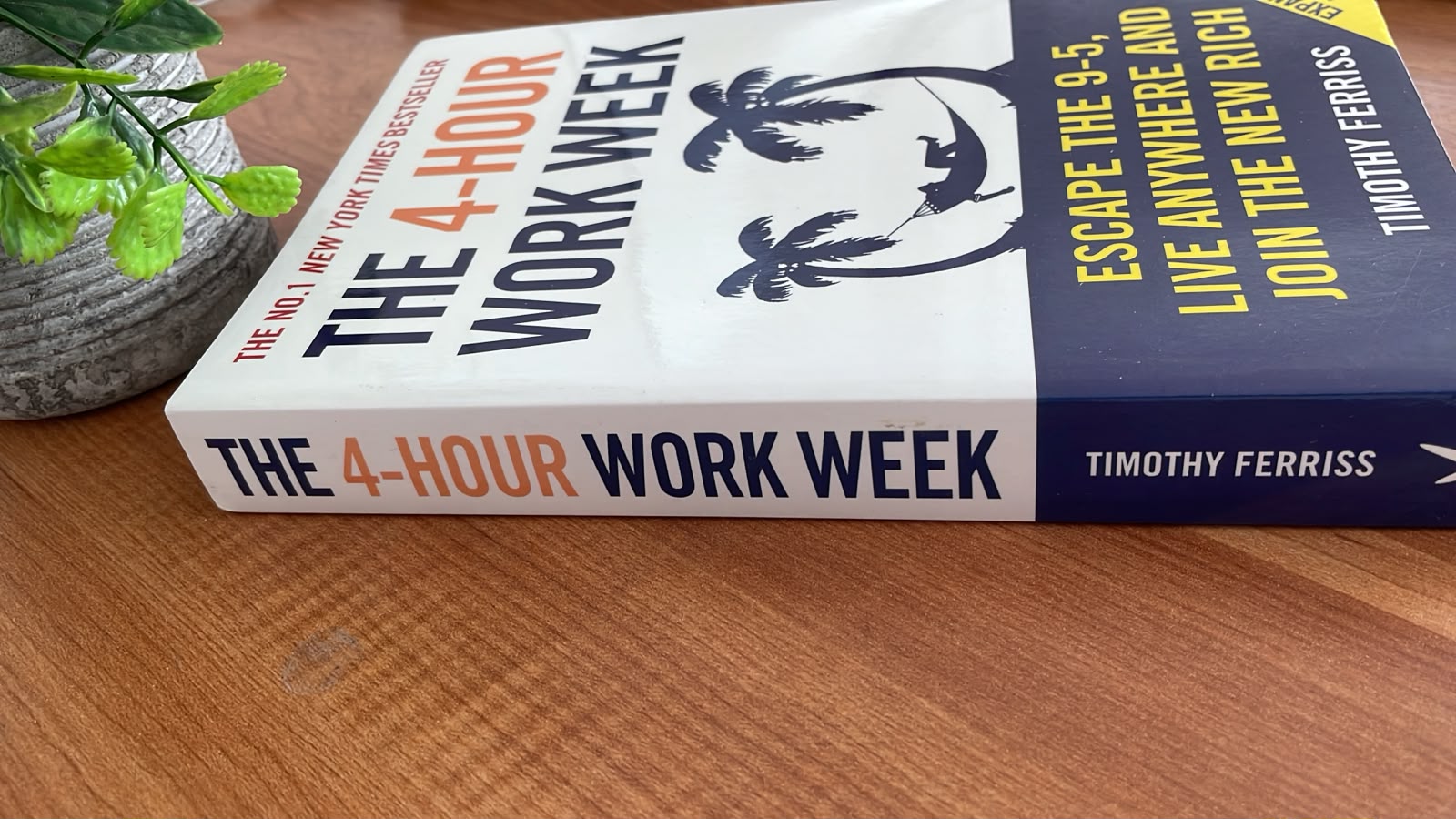





The 4-Hour Work Week by Timothy Ferriss


රු2,000.00
3 X Rs. 666.67 or 8% Cashback with


or 3 X රු666.67 with


or up to 4 X රු500.00 with


4 Hour Work Week by Timothy Ferriss is a bestselling business and productivity book that challenges the traditional idea of spending decades working long hours before finally enjoying freedom in retirement.
Ferriss introduces the concept of lifestyle design, encouraging readers to rethink how they use time, money and technology.
The book explores eliminating low-value work, automating repetitive processes, outsourcing appropriate tasks, creating more flexible income and using what Ferriss calls mini-retirements throughout life rather than postponing meaningful experiences until old age.
The framework is commonly summarised as DEAL: Definition, Elimination, Automation and Liberation.
Product details:
- Full title: The 4-Hour Work Week
- Author: Timothy Ferriss
- Publisher: Ebury Publishing
- Imprint: Vermilion
- Format: Paperback
- Pages: 416
- Language: English
- ISBN-13: 9780091929114
- ISBN-10: 0091929113
- Publication date: 6 January 2011
- Dimensions: 21.5 × 13.4 × 3.0 cm
- Weight: 409 g
- Categories: Business, Entrepreneurship, Productivity and Personal Development
- Key themes: Lifestyle design, automation, outsourcing, productivity, entrepreneurship and freedom
4 in stock
The 4-Hour Work Week by Timothy Ferriss
4 Hour Work Week by Timothy Ferriss is a bestselling business and productivity book that challenges conventional ideas about work, retirement and success.
Instead of assuming that people must spend decades working long hours before eventually enjoying their lives, Ferriss asks readers to think differently about time, income and personal freedom.
The book introduces the idea of lifestyle design and provides a framework for eliminating unnecessary work, automating tasks and creating greater flexibility.
4 Hour Work Week
4 Hour Work Week is not simply about working exactly four hours every week.
The broader idea is to become more deliberate about how work is structured.
Ferriss argues that many people confuse being busy with being productive.
A person can spend ten hours at a desk without producing ten hours of meaningful results.
The book therefore asks readers to focus on effectiveness rather than activity.
Rethink the Traditional Career Path
A common traditional career model looks like this:
Work hard for several decades.
Save money.
Retire.
Then finally spend more time travelling, relaxing or pursuing personal interests.
Ferriss challenges this idea.
He argues that people should look for ways to experience more freedom throughout their lives instead of postponing everything until retirement.
This leads to one of the book’s best-known concepts: the mini-retirement.
Rather than taking one long retirement at the end of life, readers are encouraged to consider periods of travel, exploration or reduced work throughout different stages of life.
The DEAL Framework
The main structure behind 4 Hour Work Week can be understood through four stages:
- Definition
- Elimination
- Automation
- Liberation
Together, these form the acronym DEAL.
Each stage addresses a different part of building a more flexible approach to work and life.
Definition
The first stage involves defining what you actually want.
Ferriss challenges readers to question assumptions about success.
For one person, success may mean a larger business.
For another, it may mean more time with family.
Someone else may want the freedom to travel while working remotely.
The important point is to identify the lifestyle behind the financial goal.
People often say they want more money.
What they may actually want is what they believe the money will allow them to do.
That might include:
- Travelling
- Having more free time
- Leaving an unwanted job
- Supporting family
- Building a business
- Learning new skills
- Living in another country
Clarifying the desired lifestyle can make goals more meaningful.
Elimination
The second stage focuses on eliminating unnecessary work.
Ferriss draws heavily on the idea that a relatively small number of activities often produce a large percentage of results.
This is commonly associated with the Pareto Principle, or 80/20 rule.
In business, a small percentage of customers may produce a large share of revenue.
A small number of products may account for most sales.
A few activities may create most meaningful progress.
Readers are encouraged to identify those high-value activities.
Everything else should be questioned.
Stop Measuring Productivity by Hours
One important lesson in 4 Hour Work Week is that working longer does not automatically mean working better.
Someone who completes an important task in two hours may be more productive than someone who spends eight hours moving between emails, meetings and minor requests.
Ferriss encourages readers to focus on output.
Useful questions include:
- Which activity creates the greatest result?
- What work can be removed?
- Which meetings are unnecessary?
- Which customers consume too much time?
- What can be simplified?
- What should I stop doing?
Removing low-value activity can create room for important work.
Reduce Unnecessary Interruptions
Constant interruptions make concentration difficult.
Email, messages, calls and notifications can fragment the day.
4 Hour Work Week encourages readers to reduce unnecessary communication and process information more intentionally.
Instead of checking email continuously, someone might process it during defined periods.
This principle is especially relevant in modern digital workplaces where notifications can arrive throughout the entire day.
The goal is not to ignore important communication.
It is to prevent communication from controlling every minute.
Automation
The third part of the framework is automation.
Ferriss explores ways to build systems that reduce the amount of direct involvement required from the owner.
In business, this may involve:
- Automated online payments
- Standard operating procedures
- Customer-service systems
- Outsourcing
- Digital marketing
- Fulfilment partners
- Software tools
- Delegation
The objective is to avoid designing a business where every decision depends on one person.
A business that cannot operate without the owner may eventually become another demanding job.
Outsource Appropriate Tasks
Outsourcing is one of the book’s most famous topics.
Ferriss discusses using virtual assistants and external service providers for appropriate tasks.
This concept has become much more familiar since the book was first released.
Today, companies routinely use remote teams, freelancers and specialised service providers.
The strategic lesson is straightforward.
You do not need to personally perform every task.
Activities that another qualified person can complete efficiently may be delegated.
The owner can then focus on work that genuinely requires their attention.
Know What Not to Outsource
Delegation still requires judgement.
Some activities should remain closely controlled.
Important strategic decisions, sensitive information and tasks requiring specialised accountability may not be suitable for casual outsourcing.
Effective delegation needs:
- Clear instructions
- Appropriate access
- Defined expectations
- Quality checks
- Accountability
- Good communication
Automation should create efficiency without eliminating necessary oversight.
Build Systems Instead of Depending on Memory
Systems make repeated work more predictable.
A good process documents how something should happen.
For example, a business may create procedures for:
- Processing orders
- Handling returns
- Answering common questions
- Managing inventory
- Following up with customers
- Publishing products
- Preparing reports
Once the process is clear, it becomes easier to delegate and improve.
This is one of the most practical business lessons in 4 Hour Work Week.
Liberation
The final stage focuses on mobility and freedom.
Ferriss explores how people can structure work so that location becomes less important.
Remote working technologies were less common when the original book appeared in 2007.
Today, many of the concepts are much more familiar.
Cloud software, video meetings, digital payments and online collaboration make location-independent work possible for many professions.
However, the principle is not simply about working from a beach.
The deeper idea is reducing unnecessary dependence on a particular place or schedule.
Lifestyle Design
Lifestyle design is central to the book.
Instead of accepting a standard model automatically, readers are encouraged to decide what combination of work, income, time and freedom they actually want.
A useful exercise is to ask:
- Where would I like to live?
- How much income do I realistically need?
- How much free time matters to me?
- Which experiences am I postponing?
- What parts of my work can be simplified?
- Which responsibilities can be delegated?
- What would an ideal week look like?
These questions help turn lifestyle design into something specific.
Mini-Retirements
The idea of mini-retirements challenges the assumption that retirement should happen only once.
A person may choose to take longer periods away from normal routines at different stages of life.
This could involve travel, learning, family time or another meaningful project.
Of course, not everyone has the financial or professional flexibility to do this immediately.
The principle can still encourage readers to reconsider whether every major life experience must be delayed until traditional retirement age.
Fear-Setting
Ferriss is also known for discussing the value of examining fear directly.
People sometimes avoid an important decision because they imagine the worst possible outcome without analysing it carefully.
A useful exercise is to define:
- What could go wrong?
- How likely is it?
- How could I prevent it?
- How could I repair the situation?
- What is the cost of doing nothing?
This can help distinguish genuine risk from vague anxiety.
Test Small Before Making Large Changes
The book’s philosophy is generally experimental.
Instead of changing everything immediately, readers can test ideas.
For example, someone interested in remote work might begin by negotiating one remote day.
A business owner considering outsourcing could delegate one small recurring task.
Someone developing a side business could first test whether customers are willing to pay.
Small experiments provide information.
Entrepreneurship and Income
4 Hour Work Week also explores entrepreneurship.
Ferriss discusses creating businesses that can generate income without demanding constant daily attention from the owner.
This does not mean that building such a business requires no work.
The important idea is designing processes intentionally.
Readers are encouraged to think about scalable products, automation and systems rather than relying entirely on selling their own time.
Focus on Results
A recurring principle throughout the book is that results matter more than visible busyness.
An employee who solves an important problem quickly may create more value than someone who appears busy for twelve hours.
A business owner may discover that one marketing channel produces most sales.
A freelancer may find that a small number of clients generate most profit.
Once these patterns become visible, priorities can change.
Who Should Read This Book?
4 Hour Work Week may appeal to:
- Entrepreneurs
- Business owners
- Freelancers
- Remote workers
- Productivity enthusiasts
- Professionals
- Digital entrepreneurs
- Side-hustle builders
- Travellers
- Readers interested in lifestyle design
It may be particularly useful for readers who feel constantly busy but want to examine whether their current work structure is actually producing the life they want.
About Timothy Ferriss
Timothy Ferriss is an entrepreneur, investor, author and podcast host.
His books include The 4-Hour Workweek, The 4-Hour Body, The 4-Hour Chef, Tools of Titans and Tribe of Mentors.
Penguin notes that The 4-Hour Workweek spent years on the New York Times bestseller list and that Ferriss is known for his work on rapid learning, entrepreneurship and experimentation.
Product Details
Product title: The 4-Hour Work Week
Subtitle: Escape the 9-5, Live Anywhere and Join the New Rich
Author: Timothy Ferriss
Publisher: Ebury Publishing
Imprint: Vermilion
Format: Paperback
Language: English
Page count: 416 pages
ISBN-13: 9780091929114
ISBN-10: 0091929113
Publication date: 6 January 2011
Dimensions: 215 × 30 × 134 mm
Weight: 409 grams
Categories: Business, Entrepreneurship, Productivity and Personal Development
Key themes: Lifestyle design, elimination, automation, outsourcing, entrepreneurship and mobility
Why Choose 4 Hour Work Week?
4 Hour Work Week remains one of the most influential modern books about rethinking work and lifestyle.
Timothy Ferriss challenges readers to question traditional assumptions about productivity, retirement and success.
The DEAL framework provides a memorable way to think about defining goals, eliminating low-value tasks, automating systems and increasing flexibility.
Some specific tools and examples reflect the era in which the book was written, but its broader questions about time, work, freedom and intentional living remain relevant.
For entrepreneurs, professionals and readers interested in productivity and lifestyle design, 4 Hour Work Week is a valuable addition to a business and personal-development bookshelf.
Explore our complete business and productivity books collection to discover more titles about entrepreneurship, time management, habits and building efficient systems.
.

View the official publication details for
The 4-Hour Work Week by Timothy Ferriss
.
| Author | Tim Ferriss |
|---|---|
| Language | English |
| Type | Paperback Printed Book |
| ISBN/ISSN | 978-0091929114, 9780091929114 |
| Pages | 416 |
Be the first to review “The 4-Hour Work Week by Timothy Ferriss”
Related products
Non-Fiction & Knowledge
රු2,450.00
3 X Rs. 816.67 or 8% Cashback with
or 3 X රු816.67 with
or up to 4 X රු612.50 with
-24%

Out of stock
Non-Fiction & Knowledge
Original price was: රු2,500.00.රු1,900.00Current price is: රු1,900.00.
3 X Rs. 633.33 or 8% Cashback with
or 3 X රු633.33 with
or up to 4 X රු475.00 with

Out of stock
Non-Fiction & Knowledge
රු1,500.00
3 X Rs. 500.00 or 8% Cashback with
or 3 X රු500.00 with
or up to 4 X රු375.00 with
-24%

Non-Fiction & Knowledge
Original price was: රු2,300.00.රු1,750.00Current price is: රු1,750.00.
3 X Rs. 583.33 or 8% Cashback with
or 3 X රු583.33 with
or up to 4 X රු437.50 with
-17%
Out of stock
Non-Fiction & Knowledge
Original price was: රු2,900.00.රු2,400.00Current price is: රු2,400.00.
3 X Rs. 800.00 or 8% Cashback with
or 3 X රු800.00 with
or up to 4 X රු600.00 with
-23%

Non-Fiction & Knowledge
Original price was: රු2,200.00.රු1,700.00Current price is: රු1,700.00.
3 X Rs. 566.67 or 8% Cashback with
or 3 X රු566.67 with
or up to 4 X රු425.00 with
Out of stock
Self-Help & Psychology
රු2,200.00
3 X Rs. 733.33 or 8% Cashback with
or 3 X රු733.33 with
or up to 4 X රු550.00 with

Non-Fiction & Knowledge
රු1,700.00
3 X Rs. 566.67 or 8% Cashback with
or 3 X රු566.67 with
or up to 4 X රු425.00 with
Reviews
There are no reviews yet.