
No products in the cart.
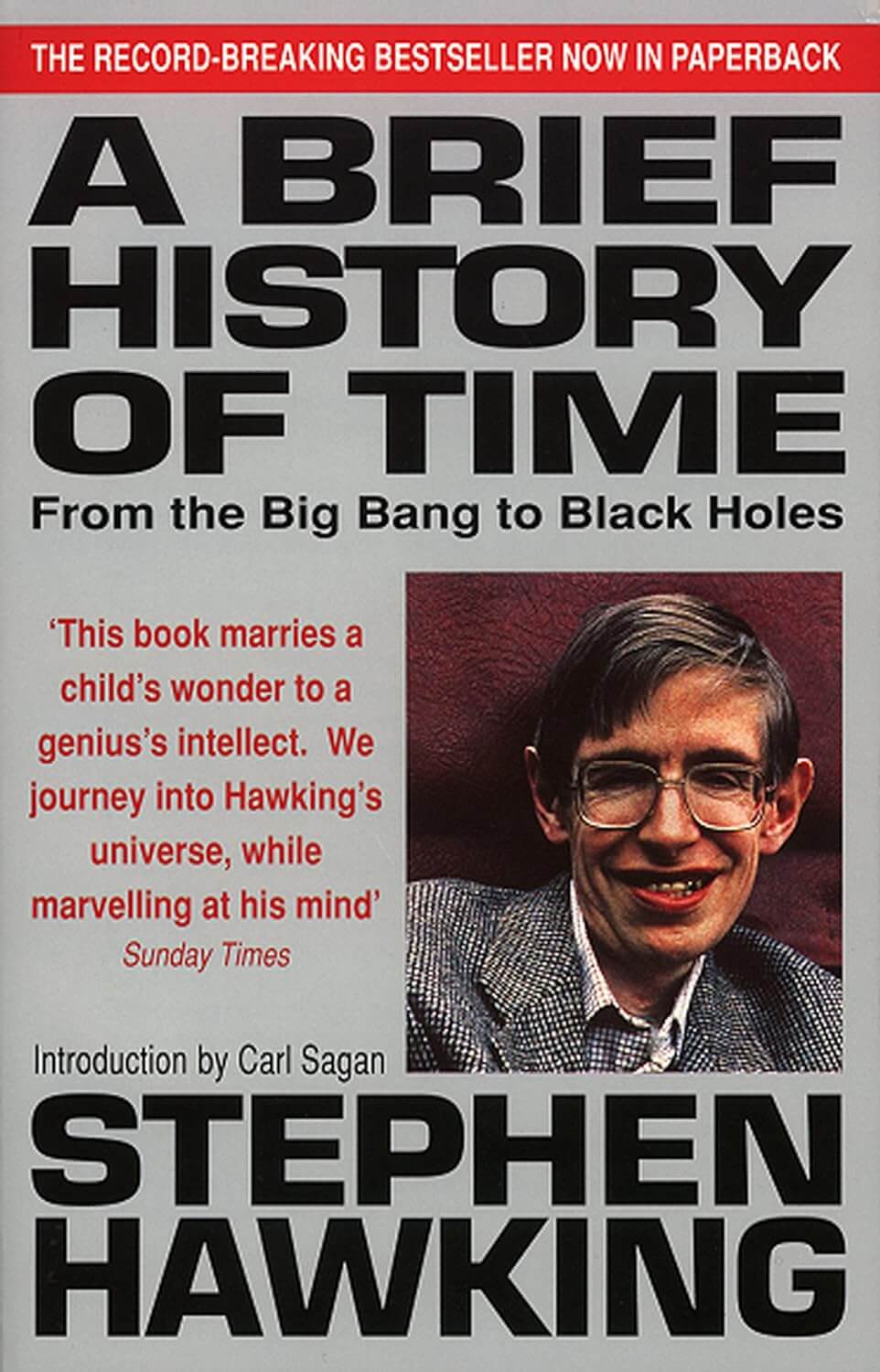
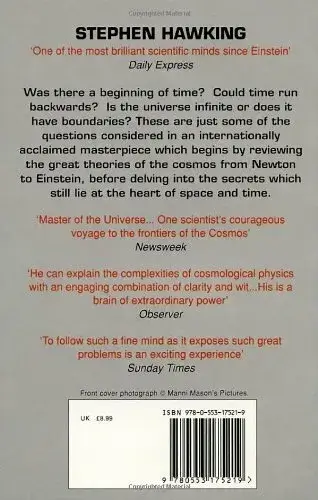
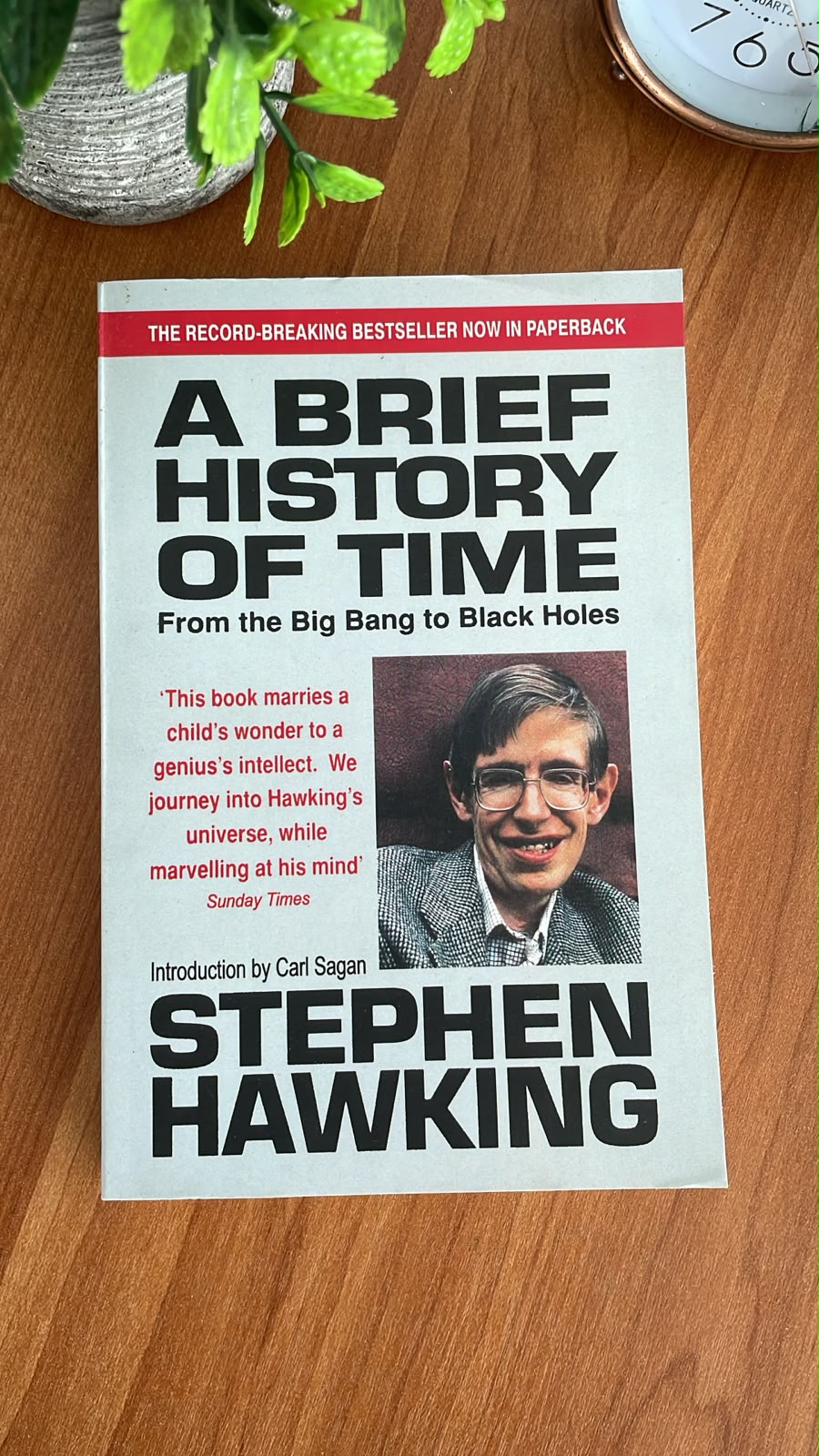
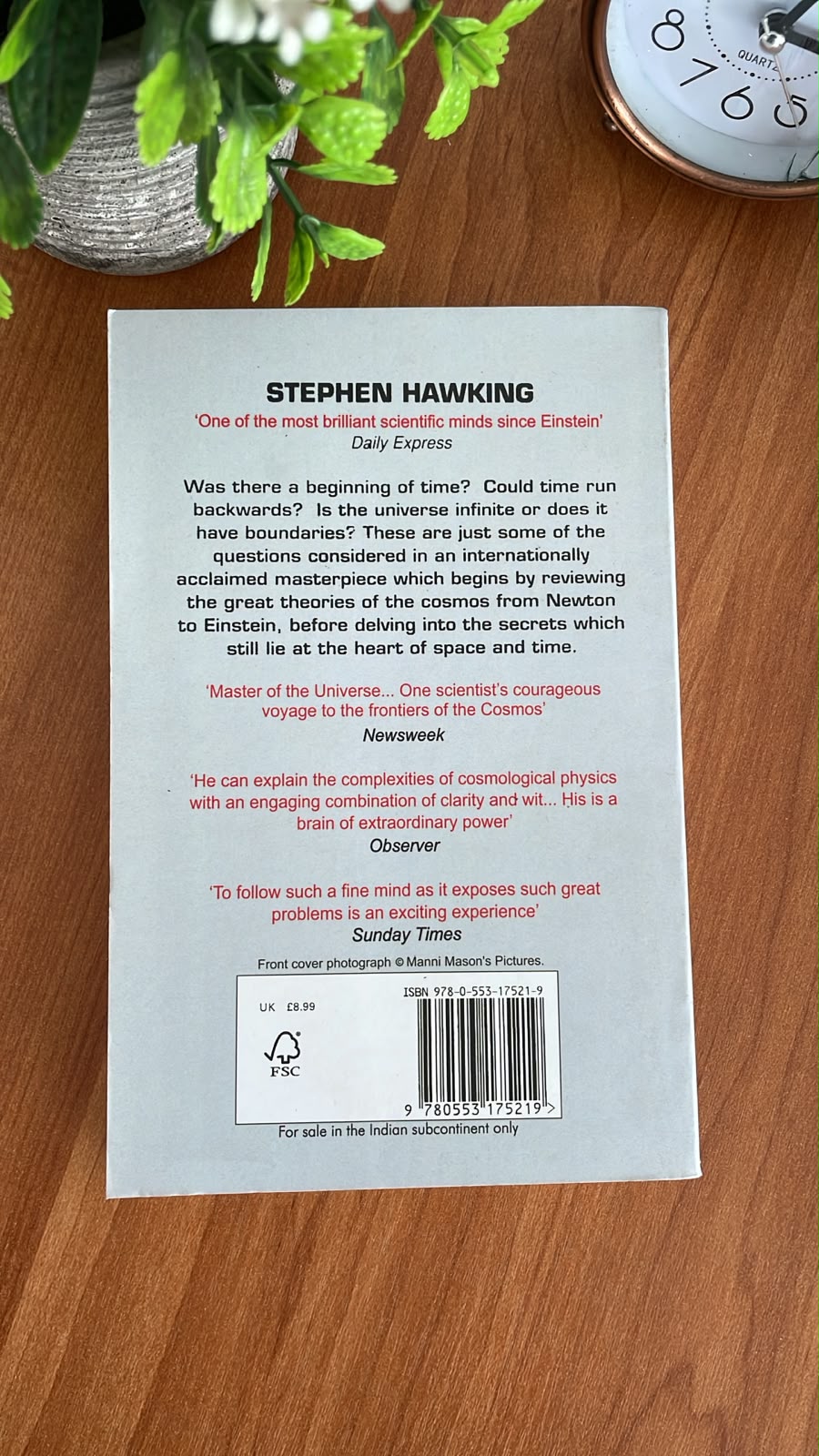
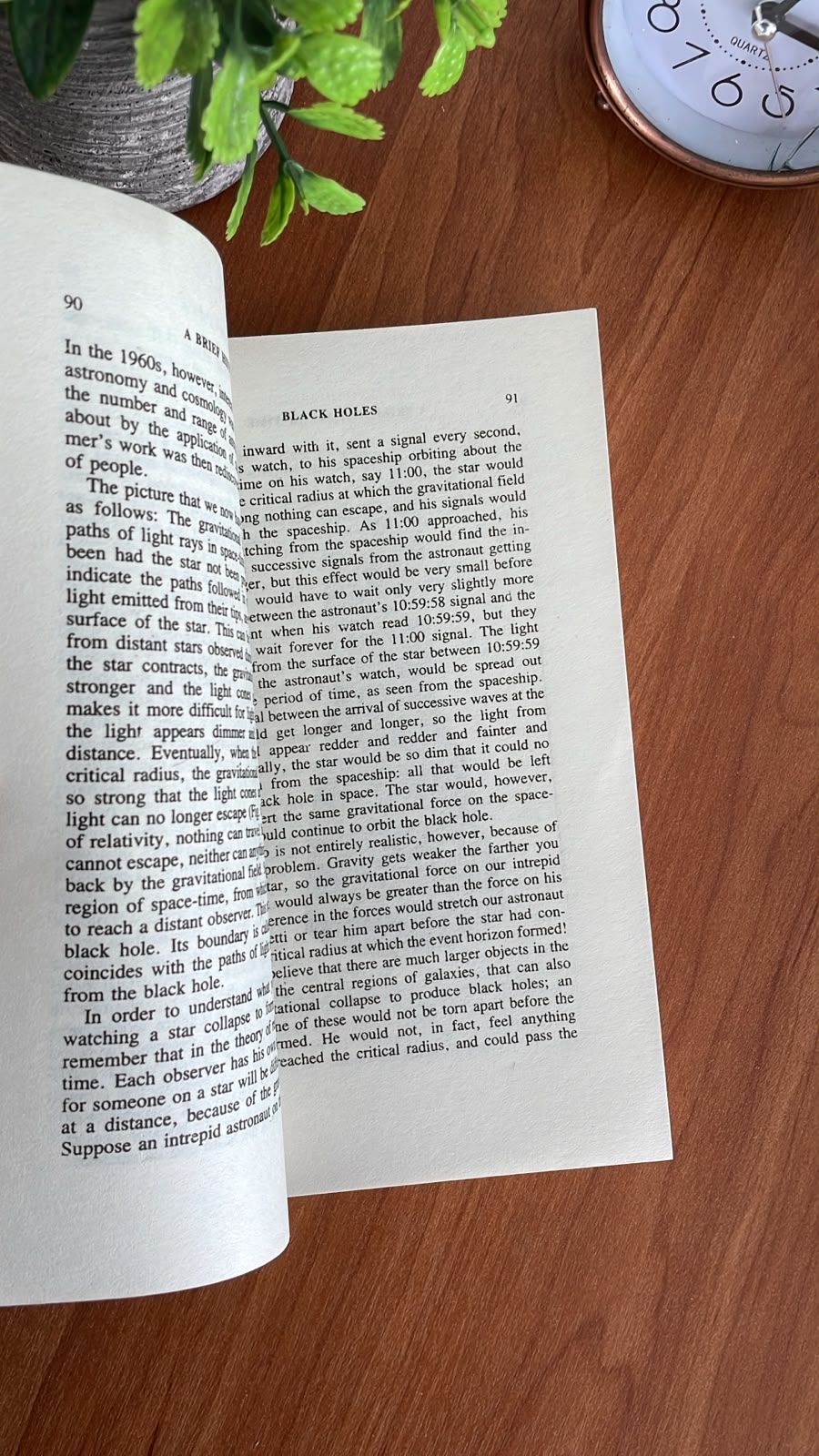
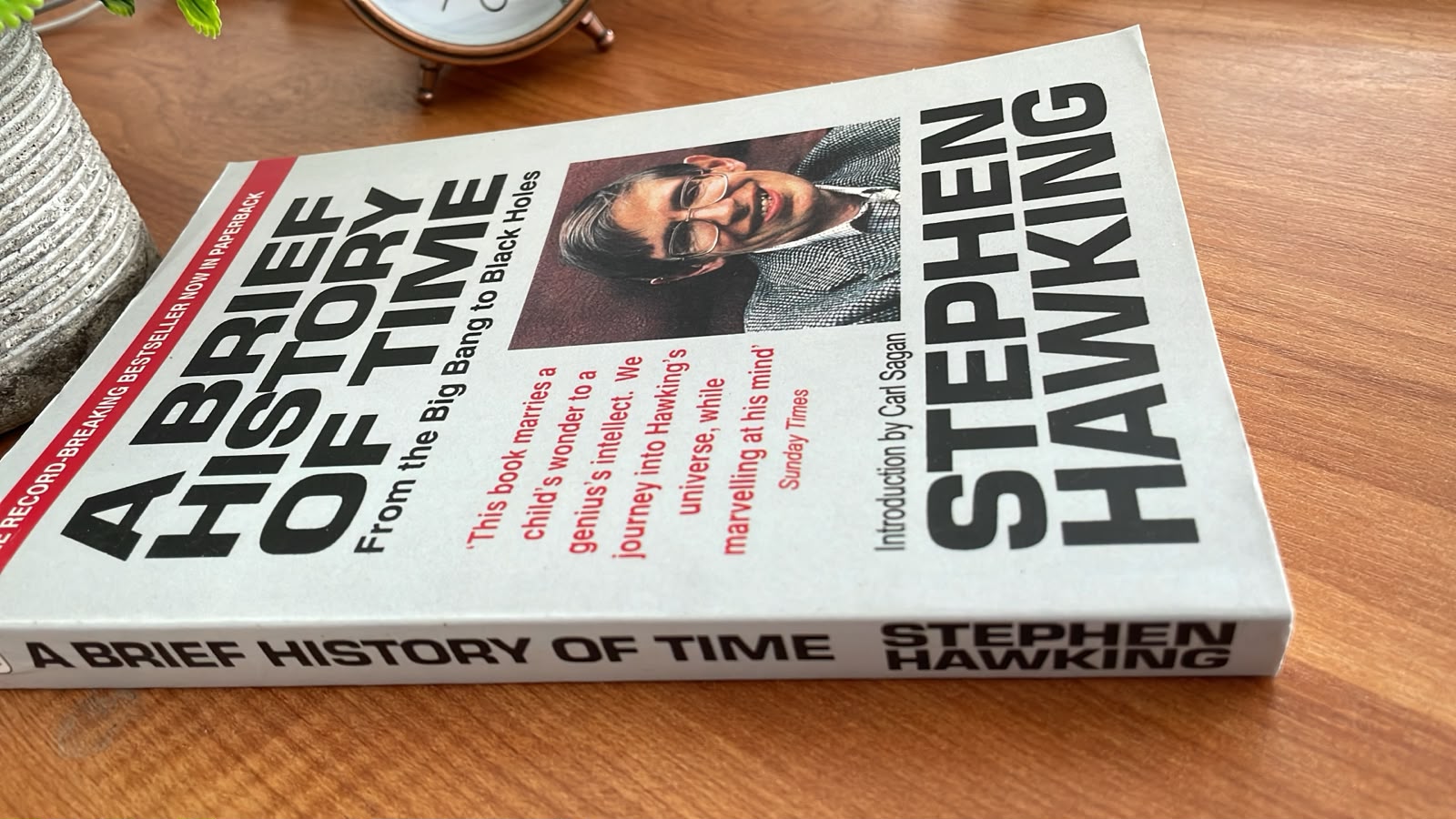




A Brief History of Time by Stephen Hawking


රු1,500.00
3 X Rs. 500.00 or 8% Cashback with


or 3 X රු500.00 with


or up to 4 X රු375.00 with


A Brief History of Time by Stephen Hawking is a landmark popular science book that explores some of humanity’s biggest questions about the universe.
Hawking takes readers from early ideas about the cosmos to modern theories involving relativity, quantum mechanics, black holes and the Big Bang.
Written for general readers, the book asks fascinating questions about whether time had a beginning, whether the universe has boundaries and how the fundamental laws of physics may fit together.
It also examines black holes, the arrow of time, the expansion of the universe and the search for a unified understanding of nature.
This edition includes updated material reflecting later developments in cosmology and Hawking’s thinking.
Product details:
- Title: A Brief History of Time
- Subtitle: From Big Bang to Black Holes
- Author: Stephen Hawking
- Publisher: Bantam
- Format: Paperback
- Language: English
- Pages: 272
- ISBN-13: 9780857501004
- ISBN-10: 0857501003
- Publication date: 18 August 2011
- Dimensions: 19.8 × 12.8 × 1.9 cm
- Weight: 230 g
- Categories: Popular Science, Physics, Astronomy and Cosmology
- Key themes: Big Bang, black holes, space, time, relativity, quantum mechanics and the universe
Out of stock
Email when stock available
A Brief History of Time by Stephen Hawking


A Brief History of Time by Stephen Hawking is one of the most famous popular science books ever written about the universe.
It takes some of the biggest ideas in modern physics and explains why scientists continue searching for answers about space, time, matter and the origin of everything around us.
A Brief History of Time
A Brief History of Time begins with questions that have fascinated people for centuries.
Where did the universe come from?
Did time have a beginning?
Will the universe continue forever?
Could time ever run backwards?
And can the laws of nature eventually be combined into one complete theory?
Stephen Hawking explores these questions through the development of modern cosmology.
Understanding Our Picture of the Universe
Human ideas about the universe have changed dramatically throughout history.
Ancient models often placed Earth at the centre of everything.
Later discoveries gradually transformed that picture.
Astronomy showed that Earth is one planet orbiting one star.
Our Sun became one star among billions within a galaxy.
The universe then became far larger and stranger than earlier generations could have imagined.
From Aristotle to Modern Cosmology
Hawking introduces readers to some of the major changes in scientific thinking.
Early ideas from Aristotle and Ptolemy influenced humanity’s understanding of the heavens for centuries.
Later thinkers challenged those models.
Copernicus proposed a Sun-centred picture of the solar system.
Galileo’s observations strengthened the case for a changing scientific understanding of the heavens.
Newton then transformed physics through his laws of motion and gravity.
These discoveries laid important foundations for modern cosmology.
Newton and Gravity
Isaac Newton showed that the same fundamental principles could describe objects falling on Earth and planets moving through space.
Gravity became a universal force.
This was a revolutionary idea.
It suggested that the heavens and Earth followed the same physical laws.
Yet Newton’s framework was not the final explanation.
New discoveries would eventually reveal situations where classical physics was incomplete.
Einstein Changes Space and Time
Albert Einstein transformed our understanding of space and time.
His theories of relativity showed that measurements of time and distance depend on motion and gravity.
Space and time could no longer be treated as completely separate and fixed.
Instead, they became connected through spacetime.
This changed the way physicists understood the universe.
General Relativity
Einstein’s general theory of relativity describes gravity in terms of curved spacetime.
Mass and energy influence the geometry around them.
Objects then move through this curved spacetime.
This framework became extremely important for understanding stars, galaxies and the universe itself.
It also helped scientists understand the possibility of black holes.
What Is a Black Hole?
Black holes are among the most fascinating subjects in A Brief History of Time.
A black hole is a region where gravity becomes so strong that ordinary matter and light cannot easily escape once they pass a critical boundary.
That boundary is known as the event horizon.
Black holes challenged scientists to think about what happens when gravity becomes extremely powerful.
They also became central to Stephen Hawking’s own scientific work.
Hawking Radiation
Stephen Hawking made an important theoretical contribution to black-hole physics.
He showed that quantum effects imply that black holes should not remain completely black forever.
Instead, they can emit thermal radiation.
This phenomenon became known as Hawking radiation.
It created an extraordinary connection between gravity, quantum theory and thermodynamics.
Black Holes Can Change
A classical picture might suggest that a black hole simply continues absorbing matter indefinitely.
Hawking’s work introduced a more complicated possibility.
If black holes emit radiation, they can gradually lose energy.
Over enormous periods of time, this process may cause them to shrink.
The idea changed scientific discussions about the ultimate fate of black holes.
The Big Bang
Another major subject in A Brief History of Time is the origin of the universe.
Modern cosmology describes the observable universe as having developed from an extremely hot and dense early state.
As the universe expanded, it cooled.
Matter eventually formed.
Stars and galaxies appeared much later.
The Big Bang model provides the framework for understanding this cosmic history.
An Expanding Universe
One of the great discoveries of modern astronomy was that the universe is expanding.
Galaxies on very large scales are moving apart as space itself expands.
This observation dramatically changed cosmology.
A changing universe suggested that the cosmos had been different in the distant past.
Scientists could therefore attempt to trace cosmic history backwards.
Looking Back in Time
Astronomy has an unusual feature.
When we look into space, we also look into the past.
Light takes time to travel.
The light reaching Earth from the Sun is already several minutes old.
Light from distant stars may have travelled for hundreds or thousands of years.
Light from extremely distant galaxies can take billions of years to reach us.
Astronomers can therefore observe the universe at earlier stages of its history.
What Happened at the Beginning?
The earliest moments of the universe remain among the most difficult problems in physics.
General relativity describes gravity extremely well on large scales.
Quantum mechanics describes nature extremely well on very small scales.
Yet extreme conditions may require both theories simultaneously.
Finding a successful theory of quantum gravity remains one of physics’ great challenges.
Quantum Mechanics
Quantum mechanics describes nature at extremely small scales.
Its predictions can appear strange compared with everyday experience.
Particles can behave in ways that challenge ordinary intuition.
Probability becomes fundamental.
This creates a very different picture from the predictable mechanical universe imagined in classical physics.
The Uncertainty Principle
One important idea from quantum physics is the uncertainty principle.
Certain pairs of physical properties cannot both be known with unlimited precision at the same time.
This is not simply a limitation of poor measuring equipment.
It is connected with the structure of quantum physics itself.
These ideas become important when scientists investigate the earliest universe and black holes.
Relativity and Quantum Theory
Two of modern physics’ greatest achievements are general relativity and quantum mechanics.
Each works exceptionally well within its own domain.
The difficulty appears when scientists try to describe circumstances where both must apply.
Black holes and the early universe are examples.
A complete understanding may require a deeper theory that successfully includes both.
The Search for a Unified Theory
A Brief History of Time discusses the possibility of a unified theory.
Such a theory would connect the different laws and forces of physics within a single consistent framework.
This goal has fascinated physicists for generations.
Einstein spent many years pursuing unification.
Modern physicists continue exploring related questions.
The Fundamental Forces
Nature is described through fundamental interactions.
Gravity is the force most familiar on astronomical scales.
Electromagnetism governs interactions involving electrically charged particles.
The strong and weak nuclear interactions operate mainly within the atomic and subatomic world.
Understanding how these forces relate is an important part of fundamental physics.
The Arrow of Time
Why does time seem to move in only one direction?
We remember yesterday but not tomorrow.
A broken cup may scatter across the floor.
We do not normally see broken pieces spontaneously assemble themselves into a cup.
A Brief History of Time examines this directionality.
The subject connects cosmology with thermodynamics and entropy.
Entropy and Time
Entropy is closely related to the tendency of physical systems to move toward more probable states.
This idea helps physicists describe why many processes appear irreversible.
It also creates a connection between everyday experiences of time and the larger history of the universe.
The arrow of time therefore becomes both a physical and philosophical question.
Could Time Run Backwards?
The possibility of reversed time naturally captures the imagination.
Physics makes the subject more complicated than science fiction often suggests.
Some equations can work similarly whether time is considered forward or backward.
Yet our observed universe has clear directional features.
Understanding why remains a fascinating problem.
Does the Universe Have an Edge?
People often imagine the universe as expanding into empty space.
Modern cosmology can be more subtle.
An expanding universe does not necessarily need an ordinary physical edge.
Space itself can have geometry.
This means questions such as “What is outside the universe?” may not have the simple answer that everyday intuition suggests.
Is the Universe Infinite?
Whether the universe as a whole is finite or infinite is another deep question.
We can only observe a limited region.
Light from beyond a certain distance has not had enough time to reach us.
This creates an observable universe.
The entire universe may extend much farther beyond what can currently be seen.
Space Is Not Empty
Empty space in modern physics is not necessarily absolute nothingness.
Quantum theories describe fields that exist throughout space.
Fluctuations can occur even in what appears to be a vacuum.
These ideas become important when discussing black holes and the early universe.
They demonstrate how different modern physics can be from everyday intuition.
Why the Book Is Accessible
A Brief History of Time was written for general readers.
Hawking avoids turning the book into a conventional mathematics textbook.
Instead, he uses explanations, examples and conceptual reasoning.
The reader can therefore explore major ideas in cosmology without needing advanced mathematical training.
Some concepts remain challenging.
That challenge is part of the book’s appeal.
Science Changes Through Better Explanations
Scientific understanding develops as evidence improves.
A theory may explain observations extremely well for a long period.
New evidence can then reveal where it needs modification.
Newtonian physics remains extremely useful.
Relativity provides a deeper description under conditions where Newton’s framework becomes insufficient.
Science therefore develops through increasingly powerful models of nature.
Questions Matter as Much as Answers
One strength of A Brief History of Time is its willingness to explore unanswered questions.
Science is not simply a collection of facts.
It is also a process of identifying what remains unexplained.
Why does the universe have the laws it has?
Why did it begin in its particular state?
Can all fundamental forces be unified?
These questions continue to inspire scientific research.
Understanding Our Place in the Cosmos
Cosmology places everyday life within an extraordinary scale.
Earth is one planet around one star.
The Sun belongs to the Milky Way.
The Milky Way is one galaxy among an enormous number of galaxies.
Thinking on this scale can change the way readers view ordinary human experience.
It shows both how small our physical position is and how remarkable our ability to investigate the universe can be.
Science and Philosophy
Many questions in cosmology also have philosophical dimensions.
What does it mean for time to begin?
Why do physical laws exist?
Can a universe arise without an ordinary boundary in time?
Scientific theories do not automatically settle every philosophical question.
However, they can change the assumptions behind those questions.
Updated Scientific Ideas
This edition includes updates connected with later developments in cosmology.
These include discussion related to dark energy, the information paradox, eternal inflation, observations of the microwave background and gravitational waves.
The additions help connect Hawking’s classic discussion with scientific developments that occurred after the book’s original publication.
Dark Energy
Observations indicate that the expansion of the universe is accelerating.
The term dark energy is used for the unknown component associated with this accelerated expansion.
Its fundamental nature remains uncertain.
This makes dark energy one of the major mysteries of contemporary cosmology.
The Information Paradox
Black holes create another major puzzle.
If information about matter falls into a black hole, what ultimately happens to that information?
Quantum theory strongly constrains how information should behave.
Hawking radiation therefore created a deep theoretical problem.
This became known as the black-hole information paradox.
Cosmic Microwave Background
The universe contains faint microwave radiation arriving from all directions.
This cosmic microwave background is a remnant of the early universe.
Its detailed structure provides scientists with important evidence about cosmic history.
Measurements of this radiation have become central to modern cosmology.
Gravitational Waves
Einstein’s theory predicted gravitational waves.
These are disturbances in spacetime produced by accelerating massive objects.
Their direct detection opened a new way of studying the universe.
Scientists can now investigate cosmic events not only through light but through gravitational signals.
Why A Brief History of Time Became Important
The book brought difficult ideas from theoretical physics to a huge general audience.
It encouraged readers who might never open a university physics textbook to think seriously about cosmology.
Its success also demonstrated the public’s appetite for ambitious scientific questions.
The book does not make every idea simple.
Instead, it invites readers to engage with ideas that are genuinely difficult.
About Stephen Hawking
Stephen Hawking was a theoretical physicist and cosmologist whose research focused on gravity, black holes and the universe.
He held the position of Lucasian Professor of Mathematics at the University of Cambridge for thirty years.
His scientific work helped transform modern thinking about black holes.
His writing also introduced millions of general readers to cosmology.
Other Books by Stephen Hawking
Readers interested in A Brief History of Time may also explore Hawking’s other books.
These include:
- A Briefer History of Time
- The Universe in a Nutshell
- The Grand Design
- Black Holes and Baby Universes
- Black Holes: The BBC Reith Lectures
- My Brief History
Each approaches questions about science and the universe from a different perspective.
Who Should Read This Book?
A Brief History of Time may appeal to:
- Popular science readers
- Physics enthusiasts
- Astronomy enthusiasts
- Students
- Stephen Hawking fans
- Readers interested in black holes
- Readers curious about the Big Bang
- People interested in space and time
- Cosmology beginners
- Readers interested in the fundamental laws of nature
No advanced physics qualification is required to begin reading.
Curiosity is much more important.
What Readers Can Learn
The book introduces readers to many major concepts in modern physics.
These include:
- The history of cosmology
- Space and time
- General relativity
- Quantum mechanics
- Black holes
- Hawking radiation
- The Big Bang
- The expanding universe
- The arrow of time
- Unified theories
- The origin and possible fate of the universe
These topics provide an excellent starting point for further reading.
Product Details
Product title: A Brief History of Time
Subtitle: From Big Bang to Black Holes
Author: Stephen Hawking
Publisher: Bantam
Format: Paperback
Language: English
Page count: 272 pages
ISBN-13: 9780857501004
ISBN-10: 0857501003
Publication date: 18 August 2011
Dimensions: 198 × 128 × 19 mm
Weight: 230 grams
Categories: Popular Science, Physics, Astronomy and Cosmology
Key themes: Big Bang, black holes, relativity, quantum mechanics, space, time and the universe
Why Choose A Brief History of Time?
A Brief History of Time gives general readers an opportunity to explore some of the deepest questions in modern science.
Stephen Hawking moves from the history of our understanding of the universe to relativity, quantum mechanics, black holes and cosmology.
The book asks enormous questions without requiring readers to begin with advanced mathematics.
It encourages curiosity about where the universe came from, how its laws work and what its future may hold.
For readers interested in science, astronomy, physics and the mysteries of the cosmos, A Brief History of Time is an essential addition to a nonfiction bookshelf.
Explore our complete science, physics and astronomy books collection to discover more fascinating titles about space, cosmology and the natural world.
View the official publication details for
A Brief History of Time by Stephen Hawking
.
| Author | Stephen Hawking |
|---|---|
| Language | English |
| Type | Paperback Printed Book |
| ISBN/ISSN | 0553175211, 978-0553175219 |
| Pages | 240 |
Be the first to review “A Brief History of Time by Stephen Hawking”
Related products
-13%

Out of stock
Non-Fiction & Knowledge
Original price was: රු3,850.00.රු3,350.00Current price is: රු3,350.00.
3 X Rs. 1,116.67 or 8% Cashback with
or 3 X රු1,116.67 with
or up to 4 X රු837.50 with
Non-Fiction & Knowledge
රු2,450.00
3 X Rs. 816.67 or 8% Cashback with
or 3 X රු816.67 with
or up to 4 X රු612.50 with
-24%

Out of stock
Non-Fiction & Knowledge
Original price was: රු2,500.00.රු1,900.00Current price is: රු1,900.00.
3 X Rs. 633.33 or 8% Cashback with
or 3 X රු633.33 with
or up to 4 X රු475.00 with
-26%
Non-Fiction & Knowledge
The 7 Habits of Highly Effective People by Stephen R. Covey – Blue Cover
Original price was: රු2,300.00.රු1,700.00Current price is: රු1,700.00.
3 X Rs. 566.67 or 8% Cashback with
or 3 X රු566.67 with
or up to 4 X රු425.00 with

Out of stock
Self-Help & Psychology
රු1,900.00
3 X Rs. 633.33 or 8% Cashback with
or 3 X රු633.33 with
or up to 4 X රු475.00 with

Non-Fiction & Knowledge
රු1,550.00
3 X Rs. 516.67 or 8% Cashback with
or 3 X රු516.67 with
or up to 4 X රු387.50 with
-14%

Out of stock
Self-Help & Psychology
Original price was: රු2,900.00.රු2,500.00Current price is: රු2,500.00.
3 X Rs. 833.33 or 8% Cashback with
or 3 X රු833.33 with
or up to 4 X රු625.00 with

රු2,000.00
3 X Rs. 666.67 or 8% Cashback with
or 3 X රු666.67 with
or up to 4 X රු500.00 with
Reviews
There are no reviews yet.