
No products in the cart.
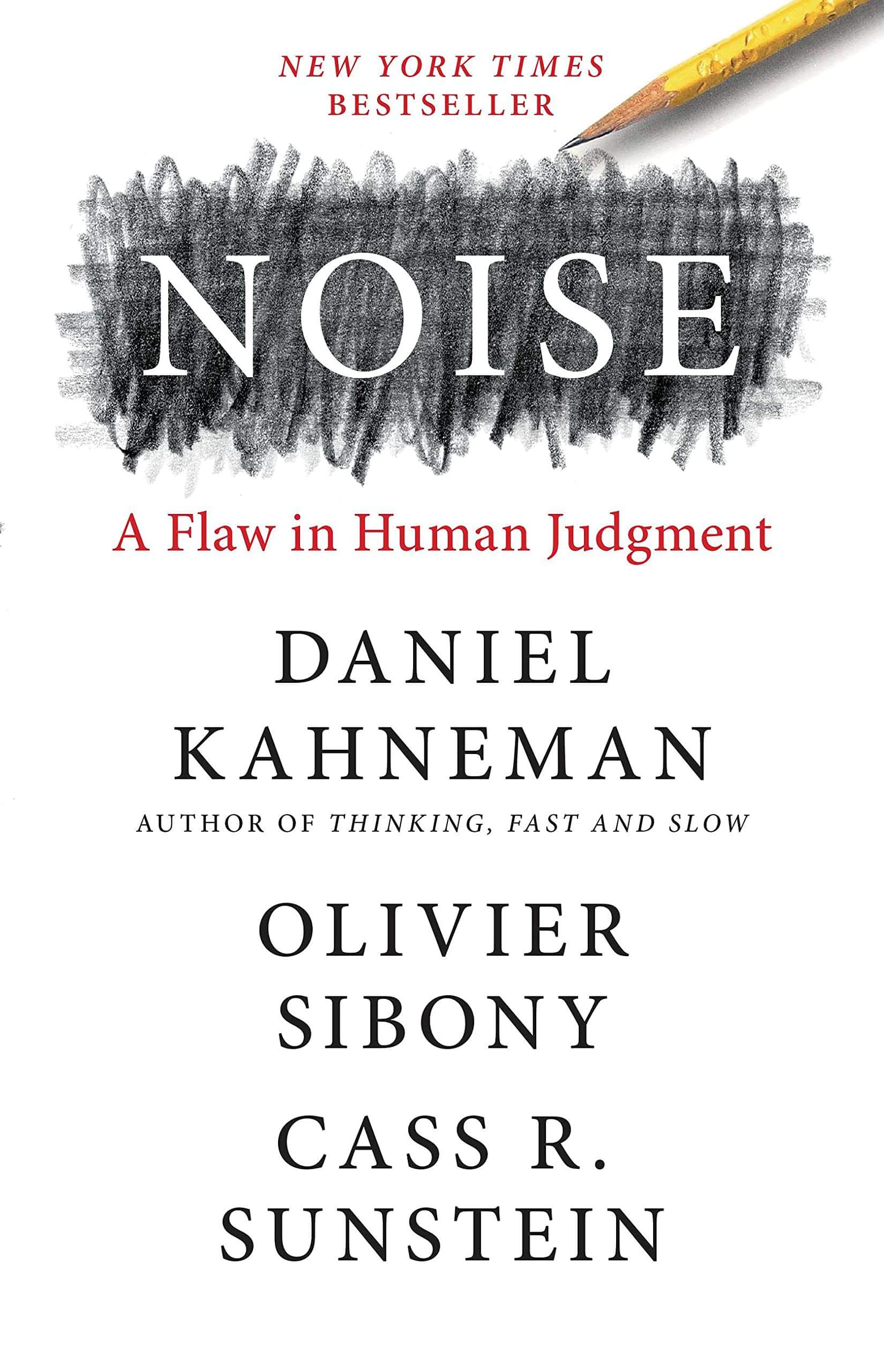


Noise A Flaw in Human Judgment by Daniel Kahneman, Olivier Sibony and Cass R. Sunstein is a fascinating exploration of a hidden problem affecting decisions in medicine, law, business, hiring, forecasting, education and everyday professional life: unwanted variability in judgments that should be similar.
Imagine two doctors examining comparable patients and reaching very different diagnoses.
Two judges reviewing similar cases but giving dramatically different sentences.
Two hiring managers interviewing equally qualified candidates and making opposite decisions.
Or even the same person reaching a different conclusion simply because the decision happens on another day.
Most people immediately recognize another problem in judgment:
Bias.
But the authors argue that bias is only part of the story.
There is another major source of error.
Noise.
Bias pushes judgments systematically in a particular direction.
Noise makes judgments scatter unpredictably.
Both reduce decision quality.
Yet organizations often investigate bias while barely noticing noise.
Noise A Flaw in Human Judgment explains why this inconsistency occurs, how it can be measured and what organizations can do to reduce it without eliminating useful human judgment altogether.
The authors examine fields including medicine, criminal justice, insurance, economic forecasting, personnel selection, performance evaluation and business strategy, showing that wherever people exercise judgment, significant variation can appear. Hachette describes noise as variability in judgments that should ideally be identical and notes its effects across these professional fields.
Noise A Flaw in Human Judgment – Book Overview
Noise A Flaw in Human Judgment asks readers to think about decision-making in a new way.
Suppose a target represents the correct answer.
If decisions consistently miss the target in the same direction, there is bias.
If decisions are scattered widely around the target, there is noise.
An organization can suffer from:
Bias.
Noise.
Or both.
The important insight is that average accuracy can hide enormous inconsistency between individual decisions.
What Is Noise?
Noise is unwanted variability.
If several qualified professionals examine essentially the same case, we expect their judgments to be reasonably similar.
When they are wildly different, the system is noisy.
For example:
One doctor recommends treatment.
Another does not.
One employee receives an excellent performance rating.
Another manager would rate the same employee much lower.
One insurance underwriter quotes one premium.
Another gives a substantially different figure.
These differences may occur even when everyone involved is competent and acting honestly.
That is what makes noise difficult to notice.
Noise Is Different From Bias
This distinction is central to Noise A Flaw in Human Judgment.
Imagine archers firing at a target.
With bias, the arrows cluster together but consistently miss the center in one direction.
With noise, the arrows are spread widely.
Bias is systematic.
Noise is variable.
If every manager consistently undervalues a particular group, that suggests bias.
If managers evaluate identical situations very differently from one another, that suggests noise.
Real systems can contain both at the same time.
Why Noise Is Easy to Ignore
Bias is often easier to notice because it creates a pattern.
Noise can hide inside individual decisions.
If you see only one doctor making one diagnosis, you cannot immediately know whether another doctor would decide differently.
If you see only one manager conducting one interview, you do not know how much the outcome depended on that particular manager.
Noise becomes visible when judgments are compared.
The Lottery of Judgment
This creates an uncomfortable idea.
Sometimes the outcome of an important decision may depend partly on who happens to make it.
Which judge.
Which doctor.
Which interviewer.
Which claims adjuster.
Which manager.
If substantially similar cases receive different outcomes simply because different professionals handle them, the system begins to resemble a lottery.
System Noise
The authors use the idea of system noise to describe unwanted variability within systems where judgments should be reasonably consistent.
Organizations may believe their professionals are applying the same standards.
Actual results may reveal enormous differences.
A noise audit can help expose this.
Noise Audits
One practical idea in Noise A Flaw in Human Judgment is the noise audit.
Give multiple professionals the same cases.
Ask each person to make an independent judgment.
Then compare the results.
Organizations are often surprised by the variation.
Before measurement, everyone may believe:
“We generally agree.”
The data may show otherwise.
Level Noise
One source of variation is level noise.
Some judges are generally harsher.
Some managers generally give higher performance ratings.
Some doctors may be more intervention-oriented.
Some forecasters are consistently more optimistic.
These differences create variation even before considering the details of individual cases.
Pattern Noise
People also respond differently to specific characteristics.
Two managers might have similar average ratings but disagree strongly about what makes an employee excellent.
One values creativity.
Another values reliability.
One emphasizes communication.
Another focuses on measurable results.
Their overall average may look similar while individual judgments vary enormously.
This is part of what the authors describe as pattern noise.
Occasion Noise
Even the same person may make different judgments at different times.
Mood.
Fatigue.
Recent experiences.
Stress.
Sequence.
Context.
can affect judgment.
The decision made today may not perfectly match the decision the same person would make next week.
This is known as occasion noise.
Your Mind as a Measuring Instrument
One memorable idea in the book is to think of human judgment like a measuring instrument.
If a scale gives you:
70 kg today,
75 kg tomorrow,
67 kg the next day,
when your weight has not materially changed,
you would not trust that scale.
Yet organizations sometimes accept similar inconsistency from human judgment without measuring it.
Professional Judgment
This does not mean professionals are useless.
Human judgment can be extremely valuable when situations require:
Experience.
Context.
Interpretation.
Expertise.
Flexibility.
But expertise does not make a person perfectly consistent.
That is why good systems support professional judgment with structured processes.
Medicine
Medicine provides powerful examples.
Different doctors can sometimes make different:
Diagnoses.
Treatment recommendations.
Risk estimates.
The consequences may be significant.
Reducing noise does not mean automatically replacing doctors with rigid algorithms.
It can mean improving diagnostic standards, structured assessment and consultation.
Law
Legal judgment is another major area examined in Noise A Flaw in Human Judgment.
Society generally expects comparable cases to receive reasonably comparable treatment.
Large unexplained variation raises fairness concerns.
If someone’s punishment depends heavily on which judge receives the case, consistency becomes a justice issue.
Hiring
Hiring is highly vulnerable to noise.
Different interviewers may respond differently to the same candidate.
One interviewer loves confidence.
Another sees arrogance.
One values formal qualifications.
Another prioritizes experience.
One develops a positive first impression that shapes the rest of the interview.
This can make hiring less consistent than organizations realize.
Structured Interviews
A useful way to reduce hiring noise is to make the evaluation more structured.
Ask candidates comparable questions.
Define criteria before the interview.
Score dimensions separately.
Collect independent judgments.
Combine the information afterward.
This does not make hiring perfect.
It makes the decision process more disciplined.
Performance Reviews
Performance evaluation is another noisy area.
An employee’s rating may depend on:
Manager expectations.
Team culture.
Recent events.
Personal standards.
How generously the manager usually scores.
Two equally capable employees can therefore receive very different evaluations.
Recency Effects
Managers may overweight what happened recently.
An excellent project completed last week may dominate the review.
A mistake that occurred yesterday may overshadow months of strong performance.
Structured evidence can reduce this problem.
Insurance
Insurance underwriting is one of the book’s striking organizational examples.
Companies may assume trained professionals will give reasonably similar assessments.
Noise audits can reveal surprising variation.
The problem is expensive because inconsistent judgments influence pricing and risk.
Forecasting
Forecasting is inherently uncertain.
Economic forecasts.
Business forecasts.
Demand forecasts.
Risk forecasts.
No method can remove all uncertainty.
But noise adds unnecessary error on top of unavoidable uncertainty.
Structured forecasting procedures can improve consistency.
Strategy
Senior executives make decisions with major consequences.
Acquisitions.
Investments.
Market entry.
Product launches.
Budgets.
Because strategic decisions are rare and complex, organizations may find it difficult to learn from them.
A bad outcome might result from:
Bad luck.
Bad information.
Bias.
Noise.
Or poor reasoning.
Separating these factors is difficult.
Decision Quality Versus Outcome Quality
This is an important lesson.
A good decision can produce a bad outcome.
A bad decision can occasionally produce a good outcome.
Suppose you make a reckless investment and get lucky.
The profit does not prove the decision process was good.
Likewise, a carefully evaluated investment can fail because conditions change unexpectedly.
Evaluate the process, not only the outcome.
Judgment and Prediction
The book distinguishes different types of judgment.
Sometimes people are predicting:
Will this employee succeed?
Will this company default?
How long will this project take?
Sometimes they are evaluating:
How serious is this offense?
How good was this performance?
How much should this insurance policy cost?
Understanding the kind of judgment helps determine how it should be improved.
Decision Hygiene
One of the book’s most useful concepts is decision hygiene.
Personal hygiene reduces the risk of problems even when we do not know exactly which infection might occur.
Decision hygiene works similarly.
It creates procedures that reduce error without requiring us to predict exactly which bias or noise will appear.
Independent Judgments
One powerful decision-hygiene principle is to obtain judgments independently before group discussion.
Why?
Because groups influence one another.
The first person to speak may anchor everyone else’s thinking.
A senior manager’s opinion may silence disagreement.
A confident speaker may influence people more than the evidence deserves.
Independent assessments preserve information that might otherwise disappear.
How Groups Can Amplify Noise
Groups do not automatically produce better judgment.
A meeting can introduce:
Social pressure.
Status effects.
Anchoring.
Groupthink.
Information cascades.
One person makes an early statement.
Others adjust toward it.
Soon the group appears to agree.
But the agreement may have been created by the meeting itself.
Aggregate Independent Estimates
Independent judgments can sometimes be combined to improve accuracy.
Different people may make different errors.
When those errors are partly independent, averaging estimates can cancel some of them out.
This is related to the well-known idea of the wisdom of crowds.
But the crowd is most useful when judgments are genuinely independent.
Sequence Information Carefully
Another principle is to avoid receiving all information at once when some evidence can create premature impressions.
For example, an interviewer who first hears a glowing recommendation may interpret every later answer positively.
A structured process can evaluate important dimensions separately before forming an overall impression.
Break the Problem Into Components
Instead of asking:
“Is this candidate good?”
evaluate separate dimensions:
Technical ability.
Experience.
Communication.
Problem-solving.
Leadership.
Then combine the judgments.
Breaking a complex judgment into smaller assessments can reduce uncontrolled intuition.
Mediating Assessments
The authors discuss structured approaches in which decision-makers evaluate relevant dimensions independently before reaching a final holistic conclusion.
This is particularly useful in complex business decisions.
It prevents an early overall impression from contaminating every later judgment.
Intuition
Noise A Flaw in Human Judgment does not simply argue that intuition is always bad.
Experienced professionals can develop valuable intuition in predictable environments where they receive reliable feedback.
But intuition becomes less trustworthy when:
The environment is highly uncertain.
Feedback is weak.
Cases are rare.
Professionals cannot easily learn whether prior judgments were correct.
Under those conditions, confidence can exceed actual accuracy.
Confidence Is Not Accuracy
People often assume that confident decision-makers are more accurate.
Not necessarily.
Confidence reflects how certain someone feels.
Accuracy reflects whether the judgment is correct.
Those are different things.
A person can be:
Confident and correct.
Confident and wrong.
Uncertain and correct.
Uncertain and wrong.
Algorithms
The book also examines the potential advantages of simple rules and algorithms.
Algorithms can be less noisy because the same inputs produce the same output.
A formula does not wake up in a bad mood.
It does not become impatient after lunch.
It does not judge one candidate more harshly because the previous interview went badly.
Algorithms Are Not Automatically Fair
Consistency does not mean perfection.
An algorithm can systematically reproduce:
Poor assumptions.
Biased data.
Incorrect objectives.
If an algorithm makes the same unfair mistake every time, it may have low noise but high bias.
Therefore reducing noise is only one part of improving judgment.
Rules Versus Standards
There is often tension between rigid rules and flexible standards.
Rules improve consistency.
Standards allow discretion.
For example:
A precise speed limit is a rule.
“Drive at a safe speed” is a standard.
Standards can respond better to context.
But they also create more room for noisy judgments.
The ideal balance depends on the decision.
Fairness and Consistency
Consistency is closely connected to fairness.
People reasonably expect similar cases to be treated similarly.
If two employees produce the same performance but receive very different ratings because of different managers, the system may feel unfair.
If two comparable defendants receive dramatically different sentences because of different judges, the issue becomes even more serious.
Noise Versus Individualization
There is an important caution.
Not every difference is undesirable.
Different cases may genuinely deserve different decisions.
Reducing noise does not mean forcing every situation into the same answer.
The goal is to reduce unjustified variation.
Good judgment still responds to relevant differences.
Measurement
Organizations cannot reduce a problem they refuse to measure.
Noise audits therefore matter because they transform a vague suspicion into evidence.
Without measurement, leaders may believe:
“Our people are experienced.”
“Our process works.”
“We generally agree.”
Measurement may reveal something very different.
Organizational Blindness
Why do companies underestimate noise?
Because professionals usually see their own decisions one at a time.
A manager reviews one employee.
A doctor sees one patient.
A judge handles one case.
They rarely observe all the alternative judgments other professionals might have made.
Noise is therefore a property of the system, not something easily visible from one individual decision.
Decision-Making in Business
Business leaders can apply the ideas in Noise A Flaw in Human Judgment to:
Recruitment.
Promotions.
Supplier selection.
Pricing.
Credit approval.
Sales forecasting.
Investment decisions.
Customer complaints.
Strategic planning.
The book encourages organizations to ask:
Would another competent employee make the same decision?
If not, why not?
Customer Service
Suppose one customer service employee gives a refund.
Another refuses an almost identical case.
A third gives store credit.
Customers experience the company as inconsistent.
Clear guidelines can reduce unnecessary variation while preserving enough flexibility for unusual cases.
Sales and Pricing
Noise can also appear in pricing.
Two employees may quote different prices for similar customers without a justified reason.
This may reduce:
Profitability.
Customer trust.
Fairness.
Structured pricing policies can help.
Procurement
Procurement teams make repeated judgments about:
Supplier quality.
Price.
Reliability.
Risk.
Delivery performance.
If different staff members apply completely different standards, supplier decisions become noisy.
A structured scoring model can make the process more consistent.
Software and Product Development
Even software teams experience noisy judgment.
How serious is this bug?
Which feature should receive priority?
How long will development take?
Which candidate is the strongest developer?
Which design is better?
Using shared criteria does not eliminate judgment.
It makes reasoning easier to compare.
Education
Teachers can also produce noisy evaluations.
Essay grading is a classic example.
Two teachers may assign different grades to the same work.
Rubrics and calibration exercises can improve consistency.
But overly rigid rubrics can also miss genuine quality.
Again, the challenge is balance.
Noise and Bias Can Coexist
A decision system may be both noisy and biased.
For example, interviewers could systematically disadvantage one group and disagree heavily among themselves.
Fixing only bias would not remove all the error.
Fixing only noise would not guarantee fairness.
Both need attention.
Reducing Noise Is Not About Eliminating Humans
One misunderstanding would be:
Humans are inconsistent, therefore computers should make every decision.
That is too simple.
Human judgment is often essential when values, context and unusual circumstances matter.
The better goal is:
Use structure where structure improves judgment.
Use humans where human judgment adds value.
And create systems that support rather than undermine good reasoning.
Organizational Culture
Even the best framework fails if an organization rewards:
Speed over accuracy.
Confidence over evidence.
Hierarchy over honest disagreement.
Leaders need to create environments where people can say:
“I disagree.”
“I am uncertain.”
“We need more information.”
Confidence should not become a substitute for analysis.
Uncertainty
Decision-makers should become more comfortable expressing uncertainty.
Instead of:
“This will definitely work.”
say:
“We estimate a 70% probability.”
Probabilistic thinking makes uncertainty visible.
It also helps organizations learn from predictions over time.
Calibration
A well-calibrated forecaster who says “70% likely” should be correct about 70% of the time across many comparable forecasts.
This is more useful than vague confidence.
Calibration can improve through feedback and measurement.
Learning From Decisions
Organizations should record:
What decision was made?
What information was available?
What assumptions were used?
What probability was assigned?
Then revisit the decision later.
Without records, hindsight can distort memory.
People often remember themselves as having predicted the outcome more accurately than they actually did.
Hindsight Bias
After something happens, it can feel obvious.
“The company was clearly going to fail.”
“The candidate was obviously excellent.”
“The market decline was predictable.”
But was it actually obvious beforehand?
Recording predictions protects against rewriting history.
Noise and Thinking Fast and Slow
Readers familiar with Daniel Kahneman’s Thinking, Fast and Slow will recognize the broader interest in human judgment.
However, Noise A Flaw in Human Judgment is not simply a sequel.
Thinking, Fast and Slow focuses heavily on cognitive biases and systems of thinking.
Noise concentrates on unwanted variability between judgments and how decision systems can be improved.
Noise and Nudge
Cass Sunstein is also known as co-author of Nudge with Richard Thaler.
Nudge explores how choice environments influence behavior.
Noise A Flaw in Human Judgment focuses instead on inconsistency and error in judgment.
The books complement one another but can be read independently.
Do You Need to Read Thinking Fast and Slow First?
No.
Noise A Flaw in Human Judgment is completely understandable as a standalone nonfiction book.
Readers may benefit from familiarity with behavioral science, but previous Kahneman books are not required.
Is Noise a Psychology Book?
Yes, but it also strongly overlaps with:
Business.
Management.
Economics.
Law.
Public policy.
Decision science.
Organizational behavior.
For your bookstore, a strong primary category would be Non-Fiction > Psychology & Philosophy, with a secondary business/management category if your WooCommerce structure allows it.
Is It a Self-Help Book?
Not primarily.
Although individuals can apply many ideas, the book focuses strongly on professional and organizational judgment.
Readers looking for a light motivational self-help book may find it more analytical.
Is It Difficult to Read?
The book is research-driven and conceptually substantial.
It is more demanding than a simple productivity book.
However, the authors use practical examples from:
Medicine.
Law.
Recruitment.
Forecasting.
Business.
These examples make abstract ideas easier to understand.
The Three Authors
Daniel Kahneman was a psychologist and Nobel laureate in Economic Sciences, widely known for his work on judgment and decision-making and for Thinking, Fast and Slow.
Olivier Sibony specializes in strategy and decision-making and has taught at HEC Paris and been associated with Oxford’s Saïd Business School.
Cass R. Sunstein is a legal scholar and public-policy expert known for extensive work on behavioral science, regulation and decision-making, including Nudge. Hachette lists all three as the authors of Noise.
Official Hardcover Edition Details
For the Little, Brown Spark hardcover currently represented in your Order 40 sheet:
Title: Noise: A Flaw in Human Judgment
Authors: Daniel Kahneman, Olivier Sibony, Cass R. Sunstein
Publisher: Little, Brown Spark
Publication Date: May 18, 2021
ISBN-13: 9780316451406
Pages: 464
Format: Hardcover
Your Order 40 file also records 9780316451406 for the title.
Because another internal sheet uses ISBN 9780316451383, check the barcode on the physical copy before updating the live product.
Important Themes
Noise A Flaw in Human Judgment explores:
- Decision-making
- Human judgment
- Noise
- Bias
- Decision error
- Behavioral science
- Psychology
- Management
- Hiring
- Performance reviews
- Medicine
- Law
- Forecasting
- Professional judgment
- Algorithms
- Decision hygiene
- Group decision-making
- Fairness
- Consistency
- Organizational improvement
7 Powerful Lessons From Noise A Flaw in Human Judgment
- Bias is only one type of decision error. Organizations also need to look for noise—the unwanted differences between judgments that should be similar.
- You cannot see system noise by examining only one decision. Compare multiple professionals judging the same cases if you want to understand how inconsistent the system really is.
- Independent judgments are often more valuable than immediate group discussion. Gathering individual assessments first can prevent authority, anchoring and group influence from destroying useful differences in information.
- Break complex judgments into separate components. Evaluating relevant dimensions individually before forming an overall impression can reduce the influence of premature intuition.
- Consistency can improve fairness. Similar people and cases should not receive radically different treatment merely because a different doctor, manager, interviewer or judge happened to evaluate them.
- Algorithms and rules can reduce noise, but they do not automatically remove bias. A perfectly consistent decision can still be systematically wrong, so both consistency and fairness must be examined.
- Better decisions require better processes, not simply smarter people. Even experienced professionals are susceptible to noise. Structured decision hygiene can improve judgment across an entire organization.
Why Read Noise A Flaw in Human Judgment?
Noise A Flaw in Human Judgment is an excellent choice for readers interested in psychology, behavioral economics, leadership, decision-making, management, hiring, strategy and improving organizational processes.
It is especially valuable for anyone who makes repeated judgments about other people or uncertain situations.
Managers deciding promotions.
Recruiters interviewing candidates.
Business owners evaluating suppliers.
Doctors making diagnoses.
Analysts making forecasts.
Teachers grading work.
Executives making strategic decisions.
The central question is powerful:
If another qualified person saw exactly the same information, would they reach roughly the same conclusion?
If the answer is frequently no, the problem may not be the individual.
The decision system itself may be noisy.
Who Should Read This Book?
Noise A Flaw in Human Judgment may especially appeal to:
- Business leaders
- Managers
- HR professionals
- Recruiters
- Entrepreneurs
- Psychologists
- Law and public-policy readers
- Doctors and healthcare professionals
- Data analysts
- Economists
- Consultants
- Strategy professionals
- Students of behavioral science
- Readers of Thinking, Fast and Slow
- Readers of Nudge
- Anyone responsible for making important judgments
Noise A Flaw in Human Judgment – Better Decisions Need Better Systems
Noise A Flaw in Human Judgment reveals a problem that can remain invisible even inside highly professional organizations.
Everyone may be intelligent.
Everyone may be experienced.
Everyone may be trying to do the right thing.
And the system can still produce inconsistent decisions.
One doctor says yes.
Another says no.
One interviewer thinks the candidate is excellent.
Another thinks the same candidate is weak.
One manager gives a high rating.
Another would give a low one.
When those differences reflect relevant facts, they may be justified.
When they result from who happened to make the decision, what mood they were in or which information they noticed first, the system contains noise.
That changes how we should think about improving decisions.
The solution is not simply:
Hire smarter people.
Tell managers to be less biased.
Ask professionals to try harder.
Human judgment benefits from good process design.
Measure variation.
Define criteria.
Collect judgments independently.
Separate assessments.
Use evidence.
Create guidelines.
Introduce algorithms where appropriate.
Review outcomes.
Keep mechanisms for correction.
The goal is not perfect uniformity.
Judgment exists because real cases differ.
The goal is to ensure that meaningful differences in outcomes come from meaningful differences in the cases—not from arbitrary variation in the people making the decisions.
That is why Noise A Flaw in Human Judgment is particularly useful for organizations.
Better decisions are not created only inside individual minds.
They are created by better systems.
For readers who enjoyed Thinking, Fast and Slow, behavioral psychology, management science or books about how organizations can make more rational and fair decisions, Noise A Flaw in Human Judgment offers an important framework for recognizing a source of error that often hides in plain sight.
Learn more about Noise: A Flaw in Human Judgment by Daniel Kahneman, Olivier Sibony, and Cass R. Sunstein on the official Hachette Book Group website.
Explore more psychology and decision-making books at Bargain Books.
| Author | and Olivier Sibony, Cass R. Sunstein, Daniel Kahneman |
|---|---|
| Language | English |
| Type | Paperback Printed Book (Second Quality Copy) |
Be the first to review “Noise by Cass R. Sunstein, Daniel Kahneman, and Olivier Sibony”
Related products
Non-Fiction & Knowledge
රු2,450.00
3 X Rs. 816.67 or 8% Cashback with


or 3 X රු816.67 with


or up to 4 X රු612.50 with

-26%
Non-Fiction & Knowledge
The 7 Habits of Highly Effective People by Stephen R. Covey – Blue Cover
Original price was: රු2,300.00.රු1,700.00Current price is: රු1,700.00.
3 X Rs. 566.67 or 8% Cashback with
or 3 X රු566.67 with
or up to 4 X රු425.00 with
-24%
Non-Fiction & Knowledge
Original price was: රු2,300.00.රු1,750.00Current price is: රු1,750.00.
3 X Rs. 583.33 or 8% Cashback with
or 3 X රු583.33 with
or up to 4 X රු437.50 with

Non-Fiction & Knowledge
රු1,950.00
3 X Rs. 650.00 or 8% Cashback with
or 3 X රු650.00 with
or up to 4 X රු487.50 with
රු2,000.00
3 X Rs. 666.67 or 8% Cashback with
or 3 X රු666.67 with
or up to 4 X රු500.00 with
-13%
Out of stock
Non-Fiction & Knowledge
Original price was: රු3,900.00.රු3,400.00Current price is: රු3,400.00.
3 X Rs. 1,133.33 or 8% Cashback with
or 3 X රු1,133.33 with
or up to 4 X රු850.00 with
Out of stock
Self-Help & Psychology
රු1,900.00
3 X Rs. 633.33 or 8% Cashback with
or 3 X රු633.33 with
or up to 4 X රු475.00 with
-33%

Self-Help & Psychology
Original price was: රු2,300.00.රු1,550.00Current price is: රු1,550.00.
3 X Rs. 516.67 or 8% Cashback with
or 3 X රු516.67 with
or up to 4 X රු387.50 with
Reviews
There are no reviews yet.