No products in the cart.
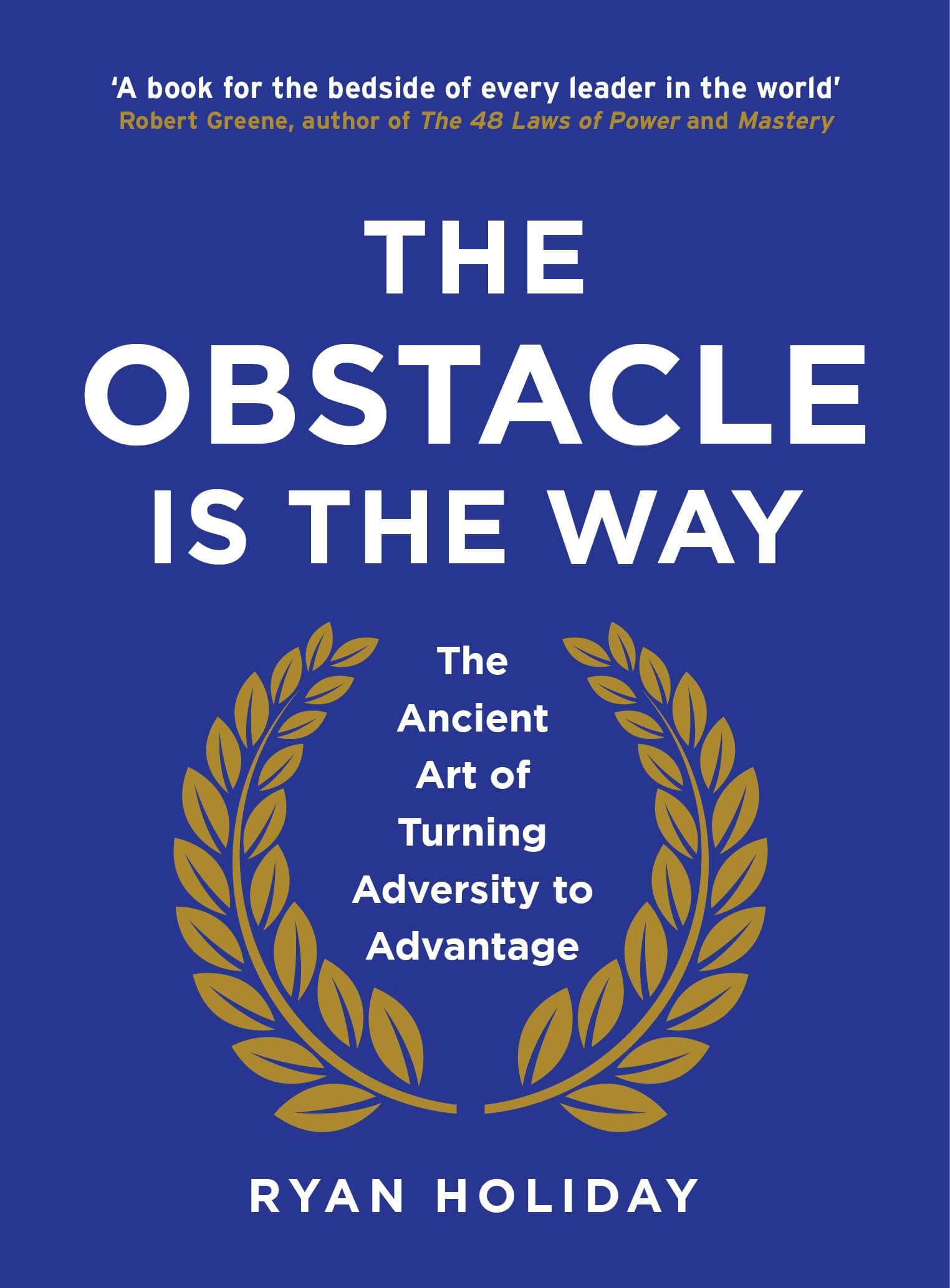
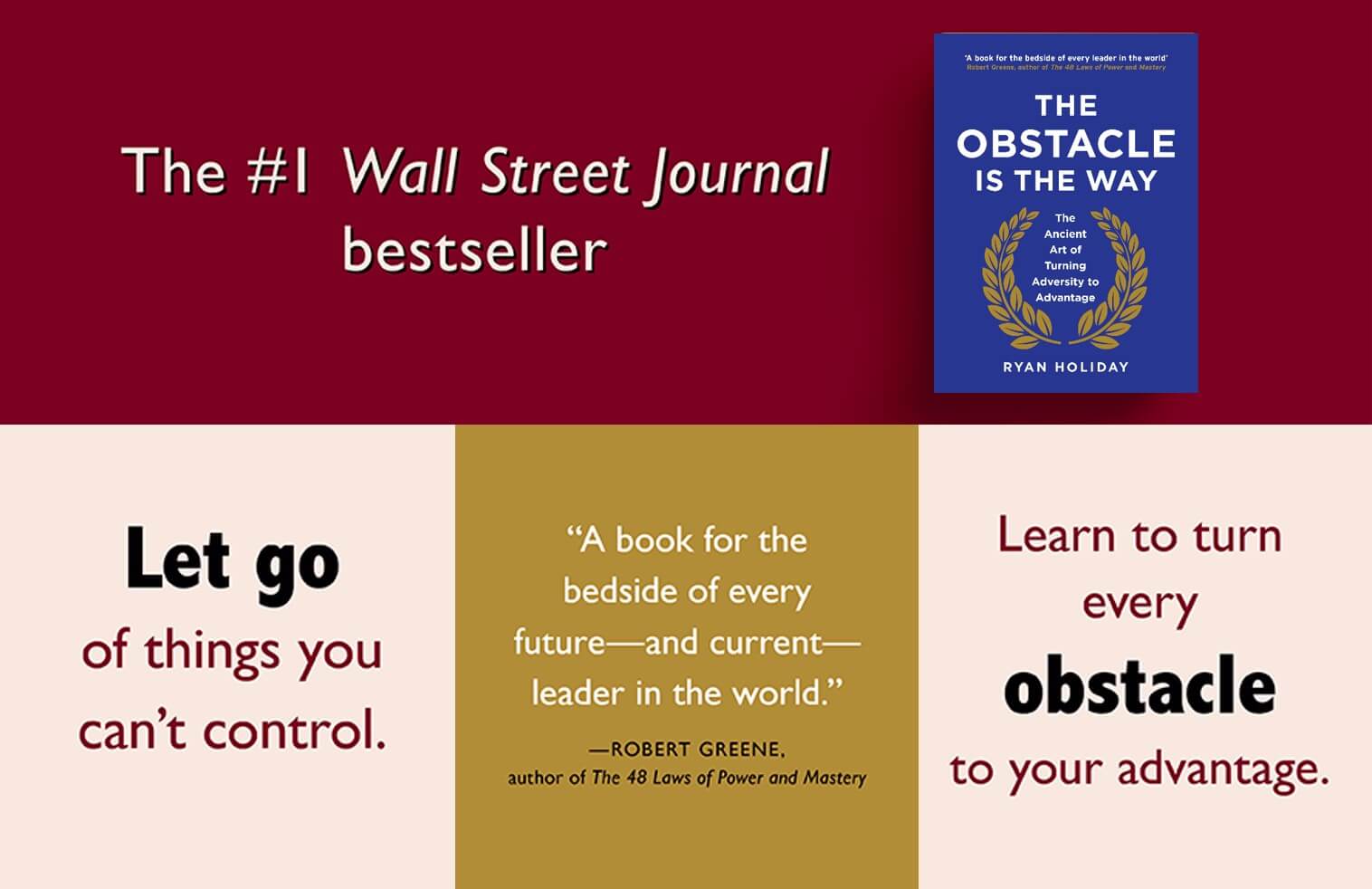
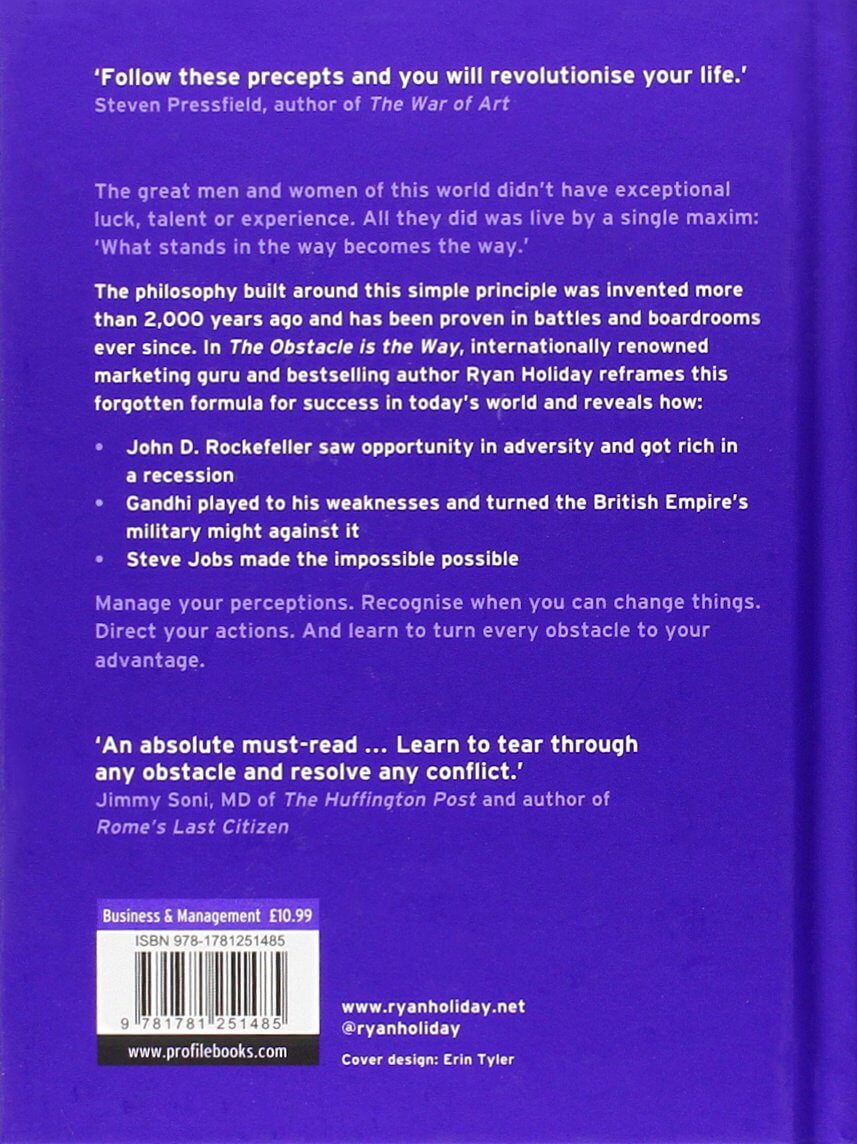
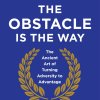



The Obstacle Is the Way by Ryan Holiday is a practical and motivating guide to transforming adversity into advantage by applying timeless principles from ancient Stoic philosophy to the challenges of modern life.
Everyone encounters obstacles.
A failed project.
A rejected application.
Financial pressure.
Competition.
A difficult customer.
A career setback.
An unexpected crisis.
A mistake.
A goal that suddenly seems impossible.
Our first reaction is often frustration.
Why is this happening?
Why now?
Why me?
Ryan Holiday suggests a more useful question:
What can I do with this?
Drawing inspiration from Stoic thinkers such as Marcus Aurelius, Epictetus and Seneca, together with examples from leaders, entrepreneurs, athletes, military figures and historical personalities, Holiday explains that obstacles do not always have to stop progress.
Sometimes they can become part of the progress itself.
The central philosophy behind The Obstacle Is the Way by Ryan Holiday can be understood through three disciplines:
Perception – How we interpret what happens.
Action – What we choose to do about it.
Will – How we endure what we cannot immediately change.
The book does not promise that every difficulty is secretly wonderful.
It offers something more practical:
A way of responding when difficulty is already here.
The Obstacle Is the Way by Ryan Holiday – Book Overview
The Obstacle Is the Way by Ryan Holiday takes an ancient Stoic idea and applies it to modern problems.
The phrase behind the title is associated with Marcus Aurelius:
The thing blocking the path can itself become part of the path.
Imagine a business loses its biggest customer.
That is clearly a problem.
But it may force the company to:
Diversify revenue.
Improve service.
Find better customers.
Build stronger systems.
Reduce dependency.
The obstacle remains real.
But the response can create an advantage that would never have existed otherwise.
This is the basic mindset Holiday develops throughout the book.
The Three Disciplines
The book is structured around three broad Stoic disciplines:
Perception.
Action.
Will.
These stages provide a simple framework for dealing with adversity.
First, see clearly.
Then act intelligently.
Finally, endure what cannot yet be changed.
Perception
Perception is the way we interpret events.
Two people can experience the same setback and respond completely differently.
One thinks:
Everything is ruined.
The other thinks:
This is difficult. What options remain?
The external event may be identical.
The internal interpretation changes what happens next.
Events and Judgments
Stoic philosophy distinguishes between what happens and what we think about what happens.
Suppose someone criticizes your work.
The event:
A person criticized your work.
Your interpretation might be:
“I am terrible.”
“They hate me.”
“My career is over.”
Or:
“Some of this feedback may be useful.”
The first interpretation creates emotional paralysis.
The second creates room for improvement.
Control What You Can
One of the most useful Stoic principles in The Obstacle Is the Way by Ryan Holiday is distinguishing between what you control and what you do not.
You cannot fully control:
Other people’s opinions.
Economic conditions.
Weather.
Competition.
Past mistakes.
Unexpected events.
But you can often influence:
Preparation.
Effort.
Your response.
Communication.
Decision-making.
The next action.
Energy spent fighting what cannot be controlled is energy unavailable for what can.
Objectivity
When a problem appears, emotion can make it look larger than it is.
Fear says:
Everything is impossible.
Anger says:
Someone must pay.
Ego says:
This should not be happening to me.
Objectivity asks:
What actually happened?
What facts do I know?
What options remain?
That shift can dramatically improve decision-making.
Panic Makes Problems Larger
A difficult situation already contains enough difficulty.
We do not need to add unnecessary emotional chaos.
This does not mean becoming emotionless.
It means preventing temporary emotion from controlling every decision.
The Story You Tell Yourself
People often suffer twice.
First from the problem.
Then from the story created around the problem.
For example:
“I failed an exam.”
becomes:
“I always fail.”
“I am not intelligent.”
“I will never graduate.”
The original event is one failed examination.
The rest is interpretation.
The Obstacle Is the Way by Ryan Holiday encourages separating the two.
Action
Clear perception is useful only if it eventually produces action.
Stoicism is not passive acceptance.
Holiday repeatedly emphasizes:
Do something.
Try.
Move.
Test.
Adjust.
Learn.
Then act again.
Begin Before Conditions Are Perfect
Many people wait for:
More confidence.
More money.
More information.
More time.
The perfect opportunity.
Sometimes preparation is necessary.
But perfection can become an excuse for avoiding action.
Progress often begins before we feel completely ready.
Take the Next Step
Large problems can become psychologically overwhelming.
Instead of asking:
How do I solve everything?
ask:
What is the next useful action?
A student might study one chapter.
A job seeker might improve one CV.
An entrepreneur might call one customer.
A writer might finish one page.
Small action reduces helplessness.
Persistence
One unsuccessful attempt does not prove the goal is impossible.
It may simply prove that one method did not work.
This distinction is critical.
Goal:
Fixed.
Method:
Flexible.
Persistence becomes much more effective when combined with adaptation.
Try Another Route
If the door is locked, do not spend your entire life kicking the same door.
Look for:
Another entrance.
Another approach.
Another partner.
Another market.
Another method.
The obstacle may force creativity.
Problems Can Create Opportunities
This is one of the central arguments in The Obstacle Is the Way by Ryan Holiday.
Competition may force improvement.
Limited resources may force simplicity.
Rejection may force skill development.
Failure may reveal weak assumptions.
A crisis may expose systems that should have been fixed earlier.
The obstacle creates pressure.
Pressure can create change.
Process
Holiday encourages focusing on the process rather than becoming obsessed with distant outcomes.
You cannot directly control:
Winning.
Getting promoted.
Being accepted.
Becoming famous.
You can control many of the actions that make those outcomes more likely.
This creates a healthier focus.
Do the Work in Front of You
When people become obsessed with the final result, ordinary work can feel meaningless.
But almost every major achievement is built from repetitive tasks.
Practice.
Research.
Emails.
Training.
Revision.
Customer conversations.
The glamorous result depends on unglamorous work.
Excellence in Small Things
Stoicism emphasizes doing the current responsibility well.
You may not control the whole system.
But you can improve your part.
Small improvements compound.
Failure as Feedback
Failure contains information.
Instead of asking only:
Why did I fail?
ask:
What specifically failed?
Was it:
The timing?
The strategy?
The preparation?
The communication?
The product?
The pricing?
The execution?
Specific questions lead to specific improvements.
Do Not Waste Failure
Failure becomes especially painful when we learn nothing from it.
A mistake can be expensive.
If it produces better judgment later, at least part of the cost becomes useful.
The Discipline of Will
Some obstacles cannot be quickly solved.
Illness.
Loss.
Economic conditions.
Another person’s choices.
A delayed opportunity.
In these situations, action has limits.
That is where will becomes important.
Will means developing the ability to endure reality without being psychologically destroyed by it.
Acceptance Is Not Approval
Stoic acceptance is frequently misunderstood.
Accepting something does not mean:
I like this.
This is fair.
This should have happened.
It means:
This has happened. Now what?
Reality does not change because we refuse to acknowledge it.
Acceptance allows energy to move toward response.
Amor Fati
A famous Stoic-related concept is amor fati—love of fate.
This does not require celebrating tragedy.
The practical interpretation is:
Do not spend your entire life wishing reality had been different.
Work with the reality you actually have.
Ask what can still be built from it.
Prepare for Difficulty
Stoics did not assume life would always be comfortable.
They expected:
Change.
Loss.
Competition.
Criticism.
Failure.
Mortality.
Preparing mentally for difficulty can reduce shock when problems eventually arrive.
The Reserve Clause
A useful Stoic attitude toward goals is:
“I will do everything reasonable to achieve this, fate permitting.”
You work seriously.
But you do not assume you control every outcome.
This allows ambition without psychological dependence on results.
Ryan Holiday and Stoicism
Ryan Holiday has become one of the best-known contemporary writers popularizing Stoic philosophy.
His books include The Daily Stoic, Ego Is the Enemy, Stillness Is the Key and his Stoic Virtues series. Penguin Random House notes that his books have appeared in more than forty languages.
The Obstacle Is the Way was one of the books that helped introduce Holiday’s modern interpretation of Stoicism to a broad audience.
Marcus Aurelius
Marcus Aurelius was a Roman emperor and Stoic philosopher whose private reflections were later collected as Meditations.
His writings repeatedly return to themes such as:
Self-control.
Responsibility.
Impermanence.
Adversity.
Duty.
The relationship between action and obstacles.
Holiday uses these ideas as a foundation for the book’s central philosophy.
Epictetus
Epictetus emphasized the distinction between things within our control and things outside our control.
This remains one of the most practical ideas in Stoicism.
If something is outside your control, endless anxiety does not increase your influence over it.
Focus instead on your own judgment and actions.
Seneca
Seneca wrote extensively about:
Adversity.
Wealth.
Death.
Time.
Fear.
Anger.
His writings repeatedly suggest that philosophical preparation can help people face difficult circumstances more intelligently.
Stoicism Is Not About Suppressing Emotion
This is worth clarifying.
Stoicism is sometimes misunderstood as:
Never feel anything.
Never cry.
Become emotionally cold.
That is not a particularly accurate or useful interpretation.
The goal is closer to:
Do not allow uncontrolled emotion to destroy judgment.
Feelings can exist.
You still decide how to respond.
The Obstacle Versus the Ego
Ego makes obstacles harder.
Ego says:
I deserve better.
I cannot be wrong.
I should already be successful.
People should recognize me.
When reality disagrees, ego experiences humiliation.
A more practical mindset asks:
What does the situation require?
Humility
Humility creates flexibility.
If you can admit:
I was wrong.
I need help.
My plan failed.
Someone else knows more.
you gain new options.
If ego prevents those admissions, the obstacle becomes harder.
Discipline
Motivation is temporary.
Discipline is more dependable.
You will not always feel inspired to:
Train.
Study.
Work.
Save.
Write.
Improve.
The ability to act without waiting for motivation gives people a significant advantage.
Consistency
One dramatic effort rarely changes a life.
Consistent actions do.
Read regularly.
Exercise regularly.
Practice regularly.
Follow up regularly.
Review regularly.
Progress often looks unimpressive until enough time passes.
Entrepreneurs and Business Owners
The Obstacle Is the Way by Ryan Holiday is particularly relevant to entrepreneurs.
Business guarantees uncertainty.
Customers change.
Competitors appear.
Suppliers fail.
Marketing campaigns underperform.
Technology changes.
A founder cannot eliminate uncertainty.
The founder must become better at responding to it.
A Business Example
Imagine a bookstore advertises one title heavily.
The campaign produces many messages but few purchases.
A reactive response might be:
Facebook ads do not work.
A more useful response asks:
Was the audience wrong?
Was the price wrong?
Was the creative weak?
Was the landing page slow?
Were customers asking questions that the advertisement failed to answer?
The obstacle becomes data.
Software Development
The same philosophy applies to software.
A feature breaks.
A deployment fails.
Users misunderstand a workflow.
Instead of simply becoming frustrated, developers can ask:
Why did this fail?
What test was missing?
What monitoring was missing?
What assumption was wrong?
A bug can reveal a weakness in the system that would otherwise remain hidden.
Students
Students can use the book’s framework during exams.
A bad mark does not automatically mean:
I cannot learn this.
Instead:
Where did I lose marks?
Was it understanding?
Memory?
Time management?
Exam technique?
Then work on the actual obstacle.
Career Development
A rejected job application can be painful.
But it can also create a review process.
Is the CV strong?
Does the portfolio demonstrate enough?
Are applications targeted?
Are interview skills weak?
Again, rejection becomes information.
Athletes
Athletes understand obstacles naturally.
Injury.
Loss.
Competition.
Poor performance.
The training process requires continuous response to difficulty.
This is one reason the book has become popular among coaches and high-performance environments; its official publisher describes it as relevant to students, athletes, parents and leaders alike.
Leadership
Leaders often face problems they did not create.
That does not remove responsibility for responding.
A strong leader asks:
What does the team need now?
What is the priority?
What can be controlled?
Who needs information?
What decision must happen next?
Leadership becomes particularly visible when plans fail.
Calm Under Pressure
Teams observe leaders during crises.
If the leader panics, fear spreads.
If the leader communicates clearly, people can focus.
Calm does not mean pretending the situation is easy.
It means remaining useful.
Creativity Under Constraint
Unlimited resources do not always produce creativity.
Constraints can force better thinking.
Limited budget?
Simplify.
Limited time?
Prioritize.
Limited staff?
Automate.
The obstacle can remove unnecessary options.
Turning Weakness Into Strength
A small company cannot outspend a huge competitor.
But it may move faster.
A new employee lacks experience.
But they may question assumptions experienced people no longer notice.
A small bookstore cannot stock every title.
But it can curate more carefully.
The point is not pretending weaknesses are strengths.
It is finding what becomes possible because the situation is different.
Do Not Pretend Every Obstacle Is Good
A useful reading of The Obstacle Is the Way by Ryan Holiday should avoid an overly simplistic conclusion.
Some events are genuinely terrible.
Loss is loss.
Illness is illness.
Injustice is injustice.
Stoicism does not require claiming every painful event happened for a wonderful reason.
The practical question is:
Given that this is happening, how can I respond with the best judgment available?
Not Every Problem Can Be Solved Alone
Stoicism should also not be used as an excuse to avoid help.
Some obstacles require:
Doctors.
Therapists.
Lawyers.
Financial advisers.
Teachers.
Team members.
Family support.
Asking for qualified help can itself be rational action.
Systems Matter Too
Personal mindset matters.
But not every obstacle is caused by mindset.
People may face:
Poverty.
Discrimination.
Illness.
Economic crises.
Institutional barriers.
A philosophy of personal responsibility should not become an excuse to pretend structural problems do not exist.
You control your response.
You do not necessarily control the entire environment.
Progress, Not Positivity
The book is not primarily about thinking positively.
It is about thinking usefully.
A positive thinker may say:
Everything will be fine.
A Stoic approach may say:
Things may not be fine. What should I do anyway?
That is much more practical.
Action Beats Rumination
Thinking is useful until it becomes endless repetition.
At some point, ask:
What decision follows from this thought?
If there is no action, the thinking may have become rumination.
The Present Moment
You cannot act yesterday.
You cannot directly act next year.
You act now.
This keeps Stoicism grounded in immediate responsibility.
Difficult People as Obstacles
Not every obstacle is an event.
Sometimes the obstacle is another person.
A difficult boss.
Customer.
Coworker.
Competitor.
You may not control them.
But you can often control:
Your communication.
Boundaries.
Preparation.
Documentation.
Whether you react emotionally.
Criticism
Criticism can hurt.
Ask two questions:
Is it true?
Is it useful?
If yes, learn.
If no, let it go.
Either way, endless anger rarely improves the situation.
Rejection
Rejection creates clarity.
A proposal was rejected.
A customer said no.
A publisher declined.
A job application failed.
Now information exists that did not exist before.
The next attempt can improve.
Patience
Some obstacles cannot be forced.
Progress may require time.
Learning a language.
Building reputation.
Growing a company.
Recovering physically.
Patience does not mean inactivity.
It means continuing useful action while accepting the timeline may not be fully controllable.
Perspective
A problem that feels enormous today may look very different in five years.
Perspective does not erase immediate pain.
It prevents the present moment from pretending it represents the entire future.
Memento Mori
Stoicism frequently reflects on mortality.
Remembering that life is finite can clarify priorities.
Some arguments suddenly look less important.
Some delayed goals look more urgent.
Time becomes more valuable.
What Really Matters?
Obstacles often expose priorities.
When circumstances become difficult, people discover what they actually care about.
Reputation?
Family?
Money?
Health?
Freedom?
Purpose?
Adversity can remove illusions.
Character
Holiday’s Stoic framework ultimately focuses on character.
You may not control whether you win.
You can influence whether you act with:
Courage.
Discipline.
Patience.
Honesty.
Persistence.
The result matters.
But so does who you become while pursuing it.
Is The Obstacle Is the Way a Self-Help Book?
Yes, though it is strongly rooted in Stoic philosophy, historical examples and practical psychology.
It fits naturally under Self-Help & Personal Development, while also overlapping with Philosophy, Business, Leadership and Motivation.
Is It a Philosophy Book?
Yes, in an accessible modern sense.
It does not function like an academic history of Stoicism.
Instead, Holiday takes Stoic principles and translates them into practical lessons for modern problems.
Do You Need to Know Stoicism First?
No.
The Obstacle Is the Way by Ryan Holiday is often used as an introduction to Stoic thinking.
Readers can begin here without reading Marcus Aurelius, Seneca or Epictetus first.
Those interested in deeper study can explore the classical works afterward.
Is It Part of a Series?
The book is commonly grouped with two other Ryan Holiday books as a practical Stoicism trilogy:
The Obstacle Is the Way
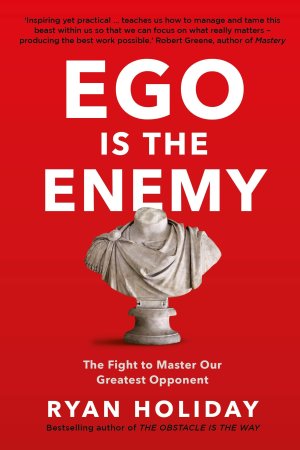
Ego Is the Enemy
Stillness Is the Key
They share related themes but each can be read independently.
There is no strict requirement to read them in order.
Should You Read Ego Is the Enemy Next?
It is a natural choice.
The Obstacle Is the Way by Ryan Holiday focuses on responding to external difficulty.
Ego Is the Enemy focuses heavily on the internal obstacle of ego.
Stillness Is the Key emphasizes clarity and inner steadiness.
Together, they complement one another well.
Original and 10th Anniversary Editions
The original version of The Obstacle Is the Way was published in 2014.
In 2024, Holiday released an expanded 10th-anniversary edition with a new introduction and additional content and examples. Penguin Random House lists the expanded Portfolio hardcover at 224 pages, ISBN 9780593719916; Profile Books also publishes a UK 10th-anniversary edition.
Because there are multiple editions, check the ISBN and page count printed on the physical copy you are selling before entering WooCommerce attributes.
Important Themes
The Obstacle Is the Way by Ryan Holiday explores Stoicism, resilience, perception, discipline, persistence, adversity, failure, courage, acceptance, leadership, self-control, problem-solving, responsibility, adaptability, entrepreneurship, patience, humility, action and personal growth.
7 Powerful Lessons From The Obstacle Is the Way by Ryan Holiday
- Separate the obstacle from your judgment about it. Problems become harder when fear, anger and ego add unnecessary interpretations. Begin by identifying what actually happened.
- Focus your energy on what you can influence. You cannot control every outcome, but you can usually control part of your preparation, effort, communication and next action.
- Take action instead of waiting for perfect conditions. Progress often begins with one practical step, followed by another, rather than a complete solution appearing immediately.
- Use failure as information. A failed attempt tells you something about the strategy, preparation or assumptions. Learn from it before trying again.
- Stay committed to the goal while remaining flexible about the method. Persistence does not mean repeating a failed strategy forever. Adaptability makes persistence intelligent.
- Accept what cannot currently be changed. Acceptance is not approval or surrender. It is recognizing reality clearly enough to stop wasting energy fighting facts.
- Look for the opportunity hidden inside the constraint. The obstacle may force you to become more disciplined, creative, prepared or capable than you would have become on an easier path.
Why Read The Obstacle Is the Way by Ryan Holiday?
The Obstacle Is the Way by Ryan Holiday is an excellent choice for readers interested in Stoicism, motivation, resilience, entrepreneurship, business, leadership, mental strength, discipline and overcoming setbacks.
It is particularly useful for people who are dealing with a difficult period and do not want vague encouragement.
The message is not:
“Everything will magically work out.”
It is:
See clearly.
Work with what you control.
Act.
Adapt.
Persist.
Accept what cannot immediately be changed.
Then continue.
That practical framework is one reason the book has remained popular since its original publication and received an expanded anniversary edition a decade later.
Who Should Read This Book?
The Obstacle Is the Way by Ryan Holiday may especially appeal to entrepreneurs, students, managers, athletes, software developers, business owners, professionals experiencing career setbacks, readers interested in Stoicism, people building self-discipline and anyone who wants a more practical way to respond to adversity.
It can also be useful for readers who normally dislike motivational books because Holiday grounds much of his argument in historical examples and philosophical principles rather than relying only on positive slogans.
The Obstacle Is the Way by Ryan Holiday – Turn Adversity Into Action
The Obstacle Is the Way by Ryan Holiday begins with a reality nobody can permanently escape.
Something will go wrong.
The plan will change.
Someone will say no.
A competitor will appear.
A mistake will happen.
An opportunity will disappear.
A difficult person will make life harder.
The obstacle itself may not be optional.
Your response is where possibility begins.
You can spend enormous energy wishing the obstacle had never appeared.
Or you can study it.
What is this problem actually made of?
What part can I control?
What does it reveal?
What skill does it demand?
What alternative route exists?
Sometimes the obstacle disappears.
Sometimes it does not.
Sometimes you overcome it.
Sometimes you learn to carry it.
But in each case, your ability to respond can improve.
That is the central message of the book.
The way forward is not always around the obstacle.
Sometimes the obstacle teaches you how to move forward.
Failure teaches preparation.
Competition teaches improvement.
Constraint teaches creativity.
Delay teaches patience.
Uncertainty teaches adaptability.
Difficulty reveals character.
None of this means adversity is pleasant.
It means adversity does not get the final word automatically.
You still have a role.
Perception.
Action.
Will.
See clearly.
Do what can be done.
Endure what cannot yet be changed.
Then take the next step.
For readers interested in resilience, Stoicism, business, leadership and practical personal development, The Obstacle Is the Way by Ryan Holiday offers a concise and powerful framework for facing difficult circumstances without allowing those circumstances to define what happens next.
Learn more about The Obstacle Is the Way by Ryan Holiday on the official Penguin Random House website.
Explore more personal development and philosophy books at Bargain Books.
| Author | Ryan Holiday |
|---|---|
| Language | English |
| Type | Paperback Printed Book (Second Quality Copy) |
Be the first to review “Obstacle Is the Way by Ryan Holiday”
Related products
-28%
Self-Help & Psychology
Original price was: රු1,800.00.රු1,300.00Current price is: රු1,300.00.
3 X Rs. 433.33 or 8% Cashback with


or 3 X රු433.33 with


or up to 4 X රු325.00 with

-24%
Out of stock
Non-Fiction & Knowledge
Original price was: රු2,100.00.රු1,600.00Current price is: රු1,600.00.
3 X Rs. 533.33 or 8% Cashback with
or 3 X රු533.33 with
or up to 4 X රු400.00 with

Non-Fiction & Knowledge
රු1,950.00
3 X Rs. 650.00 or 8% Cashback with
or 3 X රු650.00 with
or up to 4 X රු487.50 with
Out of stock
Non-Fiction & Knowledge
රු1,500.00
3 X Rs. 500.00 or 8% Cashback with
or 3 X රු500.00 with
or up to 4 X රු375.00 with
-14%
Out of stock
Self-Help & Psychology
Original price was: රු2,900.00.රු2,500.00Current price is: රු2,500.00.
3 X Rs. 833.33 or 8% Cashback with
or 3 X රු833.33 with
or up to 4 X රු625.00 with
Out of stock
Non-Fiction & Knowledge
රු1,600.00
3 X Rs. 533.33 or 8% Cashback with
or 3 X රු533.33 with
or up to 4 X රු400.00 with
-34%
Non-Fiction & Knowledge
Original price was: රු2,250.00.රු1,490.00Current price is: රු1,490.00.
3 X Rs. 496.67 or 8% Cashback with
or 3 X රු496.67 with
or up to 4 X රු372.50 with
රු2,000.00
3 X Rs. 666.67 or 8% Cashback with
or 3 X රු666.67 with
or up to 4 X රු500.00 with
Reviews
There are no reviews yet.