
No products in the cart.
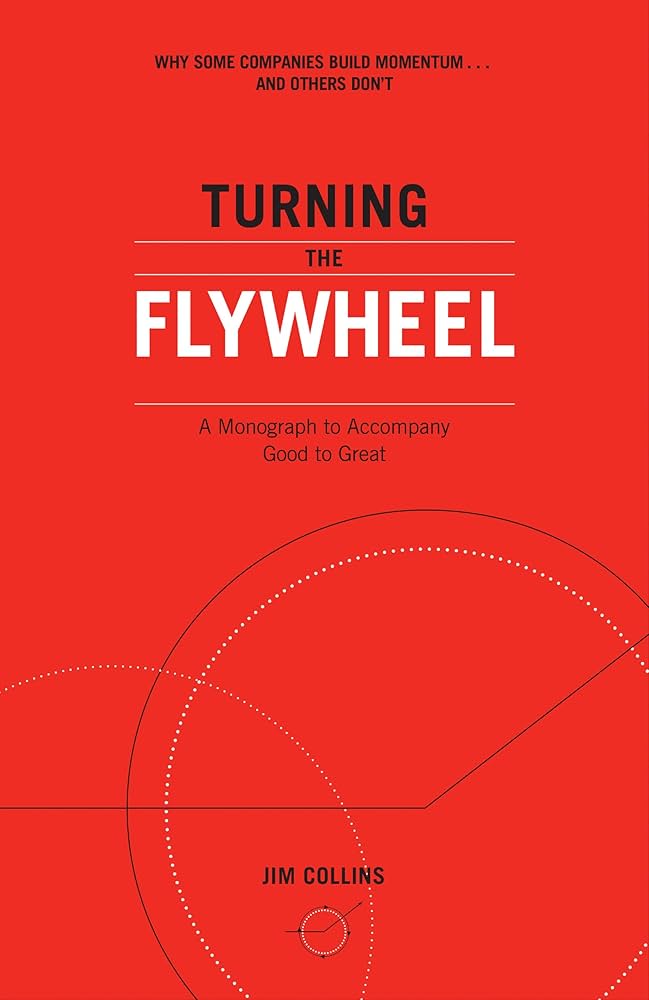









Turning the Flywheel by Jim Collins
Turning the Flywheel by Jim Collins is a practical business guide about creating lasting momentum through a series of connected, disciplined actions.
The idea is simple.
Great organizations rarely become successful because of one dramatic breakthrough.
Instead, they make the right moves repeatedly.
Each successful action strengthens the next one.
Over time, the organization begins to build momentum.
Jim Collins compares this process to pushing a giant, heavy flywheel.
At first, movement is slow.
But consistent effort eventually makes the wheel turn faster and faster.
About Turning the Flywheel
Turning the Flywheel expands on one of the most influential ideas from Jim Collins’s bestselling book Good to Great.
Collins originally used the flywheel metaphor to explain why great companies rarely transform overnight.
There is usually no single magical strategy.
No one perfect product.
No one brilliant leader.
No single lucky break.
Instead, success comes from consistent actions that reinforce one another.
In this short monograph, Collins goes further.
He asks businesses and organizations to identify their own specific flywheel.
The goal is to understand exactly how momentum is created.
What Is the Flywheel Effect?
Imagine a huge metal wheel.
It is extremely heavy.
You push it once.
Almost nothing happens.
You push again.
It moves slightly.
You keep pushing in the same direction.
Eventually, the wheel completes one full turn.
Then another.
Then another.
With each turn, momentum increases.
Soon, the wheel begins rotating much faster.
The same principle applies to organizations.
According to Collins, major business success often comes from many disciplined actions reinforcing each other over time.
The flywheel concept first appeared in Good to Great. Collins later developed it further in Turning the Flywheel.
7 Powerful Lessons from Turning the Flywheel
1. Success Is Usually Built Gradually
One of the strongest lessons in Turning the Flywheel is that dramatic results often come from undramatic actions.
Organizations may look like they suddenly became successful.
But the real story is usually different.
Years of small improvements may have happened first.
Better products.
Better customer experiences.
Better systems.
Better people.
Better decisions.
Eventually, those improvements reinforce one another.
2. Identify the Drivers of Momentum
Every organization needs to understand what causes its flywheel to turn.
For one company, better products may attract more customers.
More customers may create more revenue.
More revenue may allow better investment.
That investment may improve the product again.
The cycle continues.
The exact components will differ between organizations.
The important thing is understanding how they connect.
3. Sequence Matters
The order of the flywheel matters.
A good flywheel is not simply a random list of business activities.
Each step should logically create or strengthen the next step.
That sequence is what creates momentum.
If one part does not connect properly, the cycle becomes weaker.
Leaders therefore need to understand cause and effect.
4. Consistency Beats Constant Reinvention
Companies sometimes abandon good strategies too quickly.
A new executive arrives.
A new trend appears.
A competitor launches something interesting.
Suddenly, everyone wants a completely new strategy.
Turning the Flywheel argues that strong momentum often comes from disciplined consistency.
That does not mean refusing to change.
It means understanding what already works before replacing it.
5. Your Flywheel Must Be Unique
Amazon has a famous flywheel.
But Collins warns against simply copying another organization.
A retailer will have a different flywheel from a hospital.
A school will have a different flywheel from a technology company.
A nonprofit will have different drivers from a manufacturer.
Your organization must identify its own logic.
Collins notes that the flywheel concept has been applied across startups, nonprofits, healthcare, professional sports, schools, and many other sectors.
6. Momentum Can Become Self-Reinforcing
The strongest flywheels create a reinforcing cycle.
One success makes the next success easier.
That success strengthens the next step.
Eventually, the system develops momentum of its own.
This is different from constantly forcing growth through short-term promotions or isolated initiatives.
A strong flywheel becomes part of how the organization operates.
7. Keep Renewing the Flywheel
A successful flywheel is not something leaders design once and then forget.
Markets change.
Customers change.
Technology changes.
Competitors change.
The organization must continue testing and improving the components.
The fundamental logic may stay consistent while individual activities evolve.
The Amazon Example
Amazon plays an important role in Turning the Flywheel.
Collins explains how the company deliberately clarified the drivers in its business model.
One improvement could lead to another.
A better customer experience could attract more traffic.
More traffic could attract more sellers.
More sellers could increase selection.
Greater scale could improve economics.
Those improvements could then strengthen the customer experience again.
The important lesson is not to copy Amazon directly.
The lesson is to identify a similarly logical reinforcing cycle in your own organization.
Collins uses Amazon as an archetype of a highly effective flywheel.
From Good to Great to Turning the Flywheel
The original flywheel idea appeared in Good to Great.
There, Collins used the metaphor to explain organizational transformation.
Companies often appear to reach a breakthrough suddenly.
But closer analysis shows that the breakthrough usually resulted from years of disciplined effort.
Turning the Flywheel focuses specifically on making the concept practical.
Instead of only understanding the metaphor, readers are encouraged to map their own flywheel.
How to Build Your Flywheel
A useful starting question is:
How does our flywheel turn?
Then ask:
What creates value?
What attracts customers?
What strengthens customer loyalty?
What improves economics?
What creates resources for reinvestment?
What makes the organization better at its core activity?
The goal is to identify a cycle where each component naturally strengthens the next.
Avoid Random Growth
Growth can become dangerous if it is not connected to a strong underlying system.
A company may launch many products.
Enter many markets.
Hire rapidly.
Spend heavily on advertising.
But activity is not the same as momentum.
A strong flywheel creates growth because the core system becomes stronger.
Random initiatives can create complexity without creating lasting advantage.
Discipline Matters
Consistency is essential.
The first few pushes of a flywheel may produce little visible progress.
That can be frustrating.
Leaders may want to change direction.
But if the underlying logic is sound, disciplined repetition matters.
Eventually, accumulated effort creates momentum.
This is one of the central ideas behind Collins’s broader research on great companies.
Cause and Effect
A useful flywheel should be based on clear cause-and-effect relationships.
Do not simply write:
Marketing.
Sales.
Customers.
Profit.
Growth.
That does not explain why one step creates the next.
A better flywheel explains the mechanism.
For example:
Better customer experience leads to stronger retention.
Stronger retention creates more recurring revenue.
More recurring revenue funds product improvement.
Better products improve the customer experience.
Now there is a reinforcing loop.
The Flywheel and Strategy
A flywheel is not exactly the same as strategy.
Strategy tells an organization where it will compete and how it intends to succeed.
The flywheel helps explain how repeated actions create momentum within that strategy.
The two should support each other.
A business with a weak strategy cannot solve every problem by simply drawing a flywheel.
Small Organizations Can Use It Too
The flywheel concept is not limited to giant companies.
Collins discusses its relevance to small businesses and other organizations.
A local business could create a simple flywheel.
Excellent service creates repeat customers.
Repeat customers create referrals.
Referrals lower customer-acquisition costs.
Lower acquisition costs free resources for improving service.
The scale may be smaller.
The principle is the same.
Nonprofits and Schools
Collins also emphasizes that the flywheel is not purely a commercial idea.
Nonprofits can use it.
Schools can use it.
Healthcare organizations can use it.
The key question remains the same:
What sequence of actions creates increasing momentum toward the mission?
Collins specifically cites examples from healthcare, nonprofits, arts organizations, and even a rural elementary school.
Avoid the Doom Loop
The opposite of a flywheel is what Collins has called a doom loop.
Organizations enter a doom loop when they repeatedly change direction.
New strategy.
New leader.
New initiative.
New restructuring.
Nothing has enough time to build momentum.
The constant changes can make the organization weaker.
A disciplined flywheel provides a more coherent path.
Leadership and the Flywheel
Leaders play an important role in identifying and protecting the flywheel.
They need to understand which activities truly drive momentum.
They also need the discipline to avoid distractions.
This can be difficult.
Leaders are constantly exposed to new ideas.
Not every new idea deserves attention.
A strong leader asks whether the idea strengthens the flywheel or pulls the organization away from it.
Innovation Still Matters
Consistency does not mean stagnation.
Organizations still need innovation.
New technology may create opportunities.
Customer needs may change.
Competitors may introduce better approaches.
Innovation can strengthen the flywheel.
The important question is whether a new idea improves the underlying system.
Measuring the Flywheel
A flywheel becomes more useful when its components can be measured.
What indicates that customer experience is improving?
What demonstrates stronger retention?
What shows better economics?
What proves that reinvestment is creating better products?
Metrics help leaders test whether the flywheel actually works.
Without evidence, the model can become nothing more than an attractive diagram.
Who Should Read This Book?
Turning the Flywheel is ideal for entrepreneurs, managers, executives, business owners, startup founders, consultants, and team leaders.
It is especially useful for readers who have already read Good to Great.
However, the core idea can still be understood without reading Collins’s earlier work.
The book is short and highly focused.
That makes it useful for leadership teams who want a practical framework they can discuss together.
About Jim Collins
Jim Collins is a researcher, author, and advisor known for studying why some organizations outperform others over long periods.
His books include Good to Great, Built to Last, Great by Choice, How the Mighty Fall, and Beyond Entrepreneurship 2.0.
His work focuses on leadership, organizational performance, discipline, strategy, and long-term greatness.
Readers can learn more through the official Jim Collins page for Turning the Flywheel.
Product Details
Title: Turning the Flywheel
Subtitle: A Monograph to Accompany Good to Great
Author: Jim Collins
Genre: Business / Management / Strategy / Leadership
Language: English
Original Publication: January 2019
Publisher: HarperBusiness
ISBN-13: 9780062933799
Format: Hardcover / Monograph
The first edition’s copyright and bibliographic page confirms ISBN 978-0-06-293379-9 and identifies it as the first edition published in 2019.
Different international editions and formats may use different ISBNs and specifications.
Always check the barcode on your physical copy before entering final WooCommerce product details.
Explore More Business Books
Turning the Flywheel teaches a simple but powerful principle.
Strong organizations do not depend on one miracle moment.
They understand which activities create momentum.
They connect those activities into a logical cycle.
Then they execute consistently.
One turn strengthens the next.
Over time, momentum becomes much harder to stop.
Readers looking for more strategy and management books can explore Business, Finance & Economics Books at Bargain Books.
For entrepreneurs and leaders who want to understand how lasting business momentum is built, Turning the Flywheel offers a short and practical framework that can be applied across many types of organizations.
Be the first to review “Turning the Flywheel by Jim Collins”
Related products

Strategy & Analysis
රු2,100.00
3 X Rs. 700.00 or 8% Cashback with


or 3 X රු700.00 with


or up to 4 X රු525.00 with


Out of stock
Analysis & Strategy
රු1,900.00
3 X Rs. 633.33 or 8% Cashback with
or 3 X රු633.33 with
or up to 4 X රු475.00 with

Out of stock
Analysis & Strategy
රු1,650.00
3 X Rs. 550.00 or 8% Cashback with
or 3 X රු550.00 with
or up to 4 X රු412.50 with
-13%

Analysis & Strategy
Original price was: රු3,850.00.රු3,350.00Current price is: රු3,350.00.
3 X Rs. 1,116.67 or 8% Cashback with
or 3 X රු1,116.67 with
or up to 4 X රු837.50 with
-44%
Out of stock
Analysis & Strategy
Original price was: රු2,750.00.රු1,550.00Current price is: රු1,550.00.
3 X Rs. 516.67 or 8% Cashback with
or 3 X රු516.67 with
or up to 4 X රු387.50 with

Out of stock
Analysis & Strategy
රු1,800.00
3 X Rs. 600.00 or 8% Cashback with
or 3 X රු600.00 with
or up to 4 X රු450.00 with

Analysis & Strategy
රු2,100.00
3 X Rs. 700.00 or 8% Cashback with
or 3 X රු700.00 with
or up to 4 X රු525.00 with
-14%

Out of stock
Analysis & Strategy
Original price was: රු3,700.00.රු3,200.00Current price is: රු3,200.00.
3 X Rs. 1,066.67 or 8% Cashback with
or 3 X රු1,066.67 with
or up to 4 X රු800.00 with
Reviews
There are no reviews yet.