
No products in the cart.

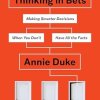

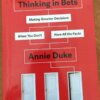


Thinking in Bets by Annie Duke
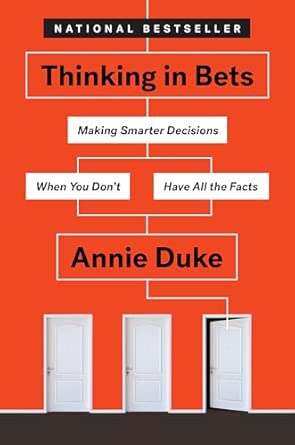
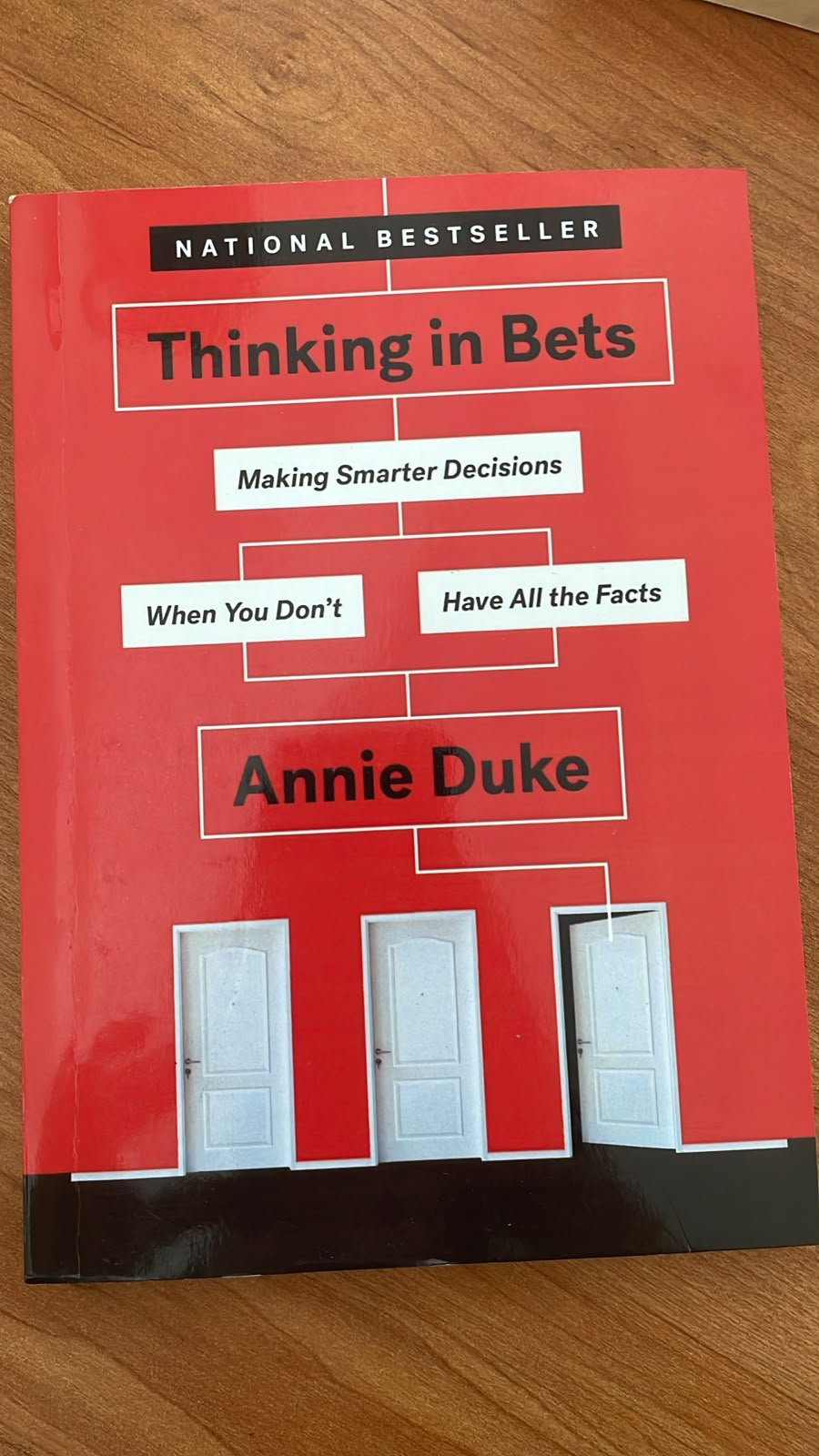
Thinking in Bets by Annie Duke is a practical guide to making better decisions when outcomes are uncertain and complete information is unavailable.
Most important decisions contain some element of uncertainty.
You can make a strong decision and still get a bad result.
You can also make a poor decision and get lucky.
Annie Duke argues that learning to separate the quality of a decision from its outcome is one of the most valuable skills anyone can develop.
About Thinking in Bets
Thinking in Bets draws heavily on Annie Duke’s experience as a professional poker player.
Poker is a useful model for decision-making because players never have all the information.
They know their own cards.
They observe other players.
They estimate probabilities.
But uncertainty always remains.
Life works in a similar way.
Business decisions, investments, career choices, relationships, and everyday choices all involve incomplete information.
The book shows readers how to think more clearly in these situations.
7 Powerful Lessons from Thinking in Bets
1. A Good Decision Can Have a Bad Outcome
One of the most important ideas in Thinking in Bets is that outcomes do not always reveal whether a decision was good.
Imagine making a decision that has a 90% chance of success.
If you happen to land in the 10% failure outcome, that does not automatically mean your reasoning was poor.
Likewise, a reckless decision can occasionally produce a great result through luck.
Judging decisions only by results can therefore be misleading.
2. Learn to Think in Probabilities
People often want certainty.
They say something will happen or will not happen.
Duke encourages readers to think in probabilities instead.
How confident are you?
Is something 60% likely?
80%?
95%?
Thinking this way encourages more realistic judgment.
It also makes it easier to update your beliefs when new information appears.
3. Luck and Skill Are Different
A strong decision-making process cannot eliminate luck.
This matters in business.
It matters in sports.
It matters in investing.
It also matters in everyday life.
The goal is not to guarantee the outcome.
The goal is to improve the odds.
4. Saying “I’m Not Sure” Is Useful
Many people feel pressure to appear certain.
But pretending to know more than you actually know can lead to poor decisions.
Thinking in Bets encourages intellectual humility.
Saying “I’m not sure” is not weakness.
It creates space to ask better questions.
It also makes it easier to consider alternatives.
5. Question Your Own Beliefs
People naturally look for information that confirms what they already believe.
This is often called confirmation bias.
Duke encourages readers to actively search for evidence that could prove them wrong.
A strong decision-maker does not only ask, “Why am I right?”
They also ask, “What would make me change my mind?”
6. Get Feedback from the Right People
Decision-making improves when people challenge each other honestly.
Duke recommends creating groups where members are willing to question assumptions.
The goal is not agreement.
The goal is better reasoning.
A useful group should reward truth-seeking rather than simply supporting whatever someone already believes.
7. Evaluate the Process, Not Only the Result
Thinking in Bets emphasizes process.
Ask what information was available when the decision was made.
Ask what assumptions were used.
Ask whether the probabilities were reasonable.
Then evaluate the decision.
This produces better learning than simply celebrating wins and blaming losses.
What Does “Thinking in Bets” Mean?
Thinking in bets means recognizing that decisions are made under uncertainty.
You are rarely choosing between a guaranteed success and a guaranteed failure.
You are choosing between different possibilities.
Each possibility has some probability.
The goal is to select the option with the strongest expected outcome based on the information currently available.
That mindset can reduce emotional decision-making.
Resulting: A Common Decision-Making Mistake
One of the important concepts in the book is “resulting.”
This means judging the quality of a decision based only on what happened afterward.
For example, imagine someone takes an unnecessary risk and gets lucky.
They may conclude the decision was smart.
But the reasoning may still have been poor.
The opposite can also happen.
A carefully considered choice may produce a disappointing result.
That does not automatically make it a bad decision.
Poker as a Model for Life
Poker plays a major role in Thinking in Bets.
Players constantly make decisions without knowing every card.
They estimate what opponents may have.
They consider probabilities.
They also have to manage emotion.
This makes poker a useful laboratory for decision-making.
A player who judges every choice only by whether they won the hand will learn badly.
A player who evaluates the reasoning behind the choice can improve over time.
Decision Quality Versus Outcome Quality
Decision quality and outcome quality are connected, but they are not identical.
Good decisions improve the likelihood of good outcomes.
They do not guarantee them.
This distinction is especially important in leadership and entrepreneurship.
A manager may choose the best available strategy and still face unexpected market conditions.
The correct lesson may not be to abandon the process.
It may be to recognize that uncertainty was part of the situation.
The Importance of Uncertainty
Many poor decisions come from overconfidence.
People assume they know more than they do.
Uncertainty encourages caution.
It also encourages curiosity.
When you accept that your information may be incomplete, you become more willing to search for additional evidence.
This can improve decision quality.
Belief Updating
A strong thinker should be willing to update beliefs.
New information should change confidence.
This is easier when beliefs are treated as probabilities rather than fixed truths.
If you believe something with 70% confidence, new evidence can move that estimate.
That flexibility is useful in business, investing, strategy, and daily life.
Confirmation Bias
Confirmation bias makes people prefer evidence that supports their existing beliefs.
This is dangerous.
A business owner may focus only on positive customer comments.
An investor may ignore evidence that challenges a favorite stock.
A manager may dismiss criticism of a strategy.
Thinking in Bets encourages readers to actively look for opposing evidence.
That can expose weak assumptions earlier.
Decision Groups
Annie Duke also discusses the value of working with people who challenge your thinking.
A good decision group should not simply agree with you.
Members should ask difficult questions.
They should demand evidence.
They should be willing to point out inconsistencies.
This creates a more disciplined approach to reasoning.
Separating Identity from Beliefs
People sometimes treat beliefs as part of identity.
If someone challenges the belief, it can feel like a personal attack.
That makes rational discussion difficult.
Duke encourages readers to separate ideas from identity.
A belief can change without changing your worth as a person.
This makes learning easier.
The Role of Emotion
Decisions are not purely logical.
Emotion plays a major role.
Fear can make people avoid good opportunities.
Excitement can make them ignore risk.
Regret can distort future choices.
A probability-based approach can help create distance from these emotional reactions.
The goal is not to remove emotion completely.
It is to prevent emotion from controlling every decision.
Business and Leadership Applications
Thinking in Bets is especially useful for business leaders.
Managers regularly make decisions without complete information.
Should the company launch a product?
Should it hire someone?
Should it enter a new market?
No answer is guaranteed.
Leaders can improve these choices by identifying assumptions, estimating probabilities, and reviewing decisions afterward.
Investing and Risk
The ideas also apply to investing.
Markets are uncertain.
Even strong analysis can be wrong.
Investors who confuse a profitable outcome with good reasoning can become overconfident.
Those who evaluate process can learn more effectively.
The book’s emphasis on uncertainty and probabilities is especially relevant in financial decision-making.
Learning from Mistakes
Mistakes become more useful when they are analyzed honestly.
Ask what information was missing.
Ask whether the probability estimate was unrealistic.
Ask whether emotion affected the choice.
Then adjust the process.
This creates learning.
Simply saying “I lost, so the decision was bad” provides much less insight.
Who Should Read This Book?
Thinking in Bets is ideal for entrepreneurs, investors, managers, students, analysts, and anyone who regularly makes decisions under uncertainty.
It may particularly appeal to readers interested in psychology, behavioral economics, risk, and critical thinking.
Poker knowledge is not required.
The poker examples are used to explain broader decision-making principles.
About Annie Duke
Annie Duke is an author, speaker, and decision strategist.
Before moving into decision education and consulting, she spent many years as a professional poker player.
Her background also includes graduate-level study in cognitive psychology.
Her books include Thinking in Bets, How to Decide, and Quit.
Readers can learn more on the official Annie Duke page for Thinking in Bets.
Product Details
Title: Thinking in Bets
Subtitle: Making Smarter Decisions When You Don’t Have All the Facts
Author: Annie Duke
Genre: Decision-Making / Psychology / Business / Behavioral Science
Language: English
Publisher: Portfolio
Original Publication: February 6, 2018
Paperback Publication: May 7, 2019
Paperback ISBN-13: 9780735216372
Pages: 288
Paperback Dimensions: Approximately 5.5 × 8.25 inches
Always check the ISBN, format, and page count printed on your physical copy before entering final WooCommerce specifications.
Explore More Business and Psychology Books
Thinking in Bets teaches readers to become more comfortable with uncertainty.
It encourages you to distinguish luck from skill.
It asks you to challenge your own beliefs.
It promotes probability-based thinking.
And it emphasizes learning from the decision process rather than judging everything by the final result.
Readers interested in decision-making, leadership, business, and behavioral science can explore more Business, Finance & Economics Books at Bargain Books.
Readers interested in psychology and personal development can also explore Self-Help & Psychology Books at Bargain Books.
For anyone who wants to make smarter decisions when certainty is impossible, Thinking in Bets offers a practical and highly useful framework.
Be the first to review “Thinking in Bets by DUKE ANNIE”
Related products
Strategy & Analysis
රු2,100.00
3 X Rs. 700.00 or 8% Cashback with


or 3 X රු700.00 with


or up to 4 X රු525.00 with

-26%
Out of stock
Analysis & Strategy
Original price was: රු1,900.00.රු1,400.00Current price is: රු1,400.00.
3 X Rs. 466.67 or 8% Cashback with
or 3 X රු466.67 with
or up to 4 X රු350.00 with
-14%
Out of stock
Analysis & Strategy
Original price was: රු3,700.00.රු3,200.00Current price is: රු3,200.00.
3 X Rs. 1,066.67 or 8% Cashback with
or 3 X රු1,066.67 with
or up to 4 X රු800.00 with
Out of stock
Analysis & Strategy
රු1,800.00
3 X Rs. 600.00 or 8% Cashback with
or 3 X රු600.00 with
or up to 4 X රු450.00 with
Science & Nature
රු2,900.00
3 X Rs. 966.67 or 8% Cashback with
or 3 X රු966.67 with
or up to 4 X රු725.00 with
-12%
Out of stock
Analysis & Strategy
Original price was: රු1,700.00.රු1,500.00Current price is: රු1,500.00.
3 X Rs. 500.00 or 8% Cashback with
or 3 X රු500.00 with
or up to 4 X රු375.00 with
-19%
Out of stock
Analysis & Strategy
Original price was: රු2,600.00.රු2,100.00Current price is: රු2,100.00.
3 X Rs. 700.00 or 8% Cashback with
or 3 X රු700.00 with
or up to 4 X රු525.00 with
-13%
Analysis & Strategy
Original price was: රු3,850.00.රු3,350.00Current price is: රු3,350.00.
3 X Rs. 1,116.67 or 8% Cashback with
or 3 X රු1,116.67 with
or up to 4 X රු837.50 with
Reviews
There are no reviews yet.