
No products in the cart.
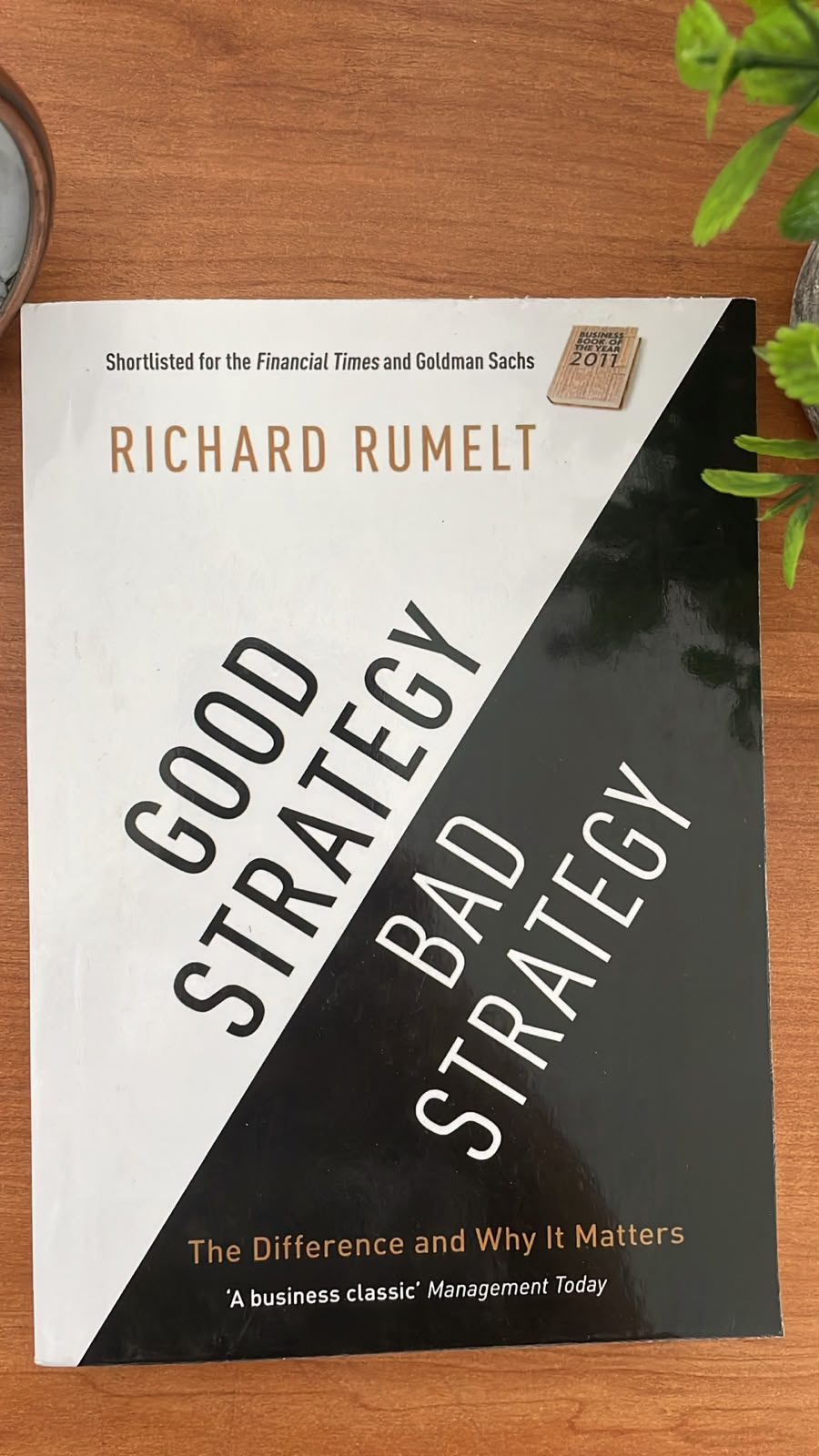
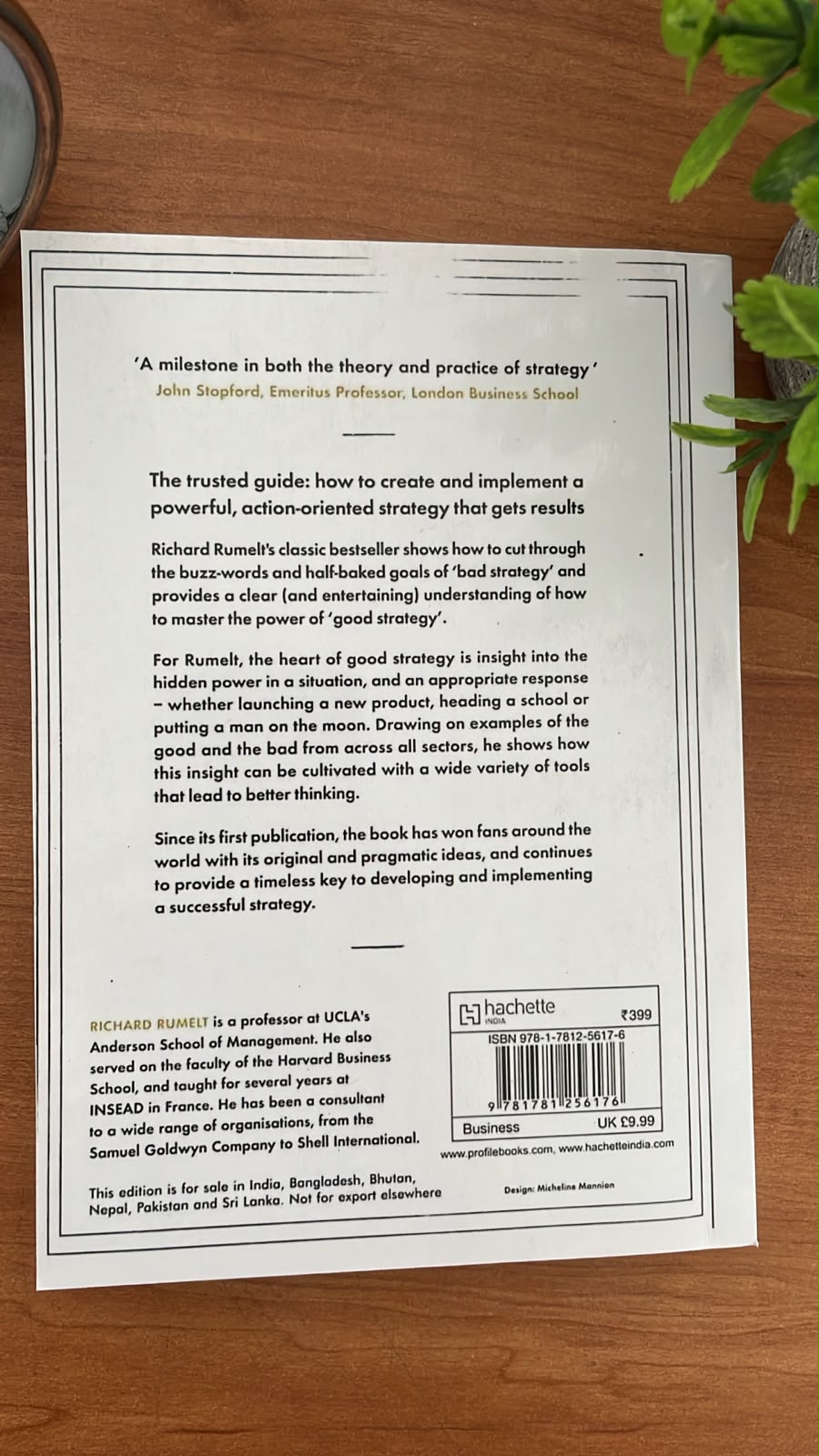

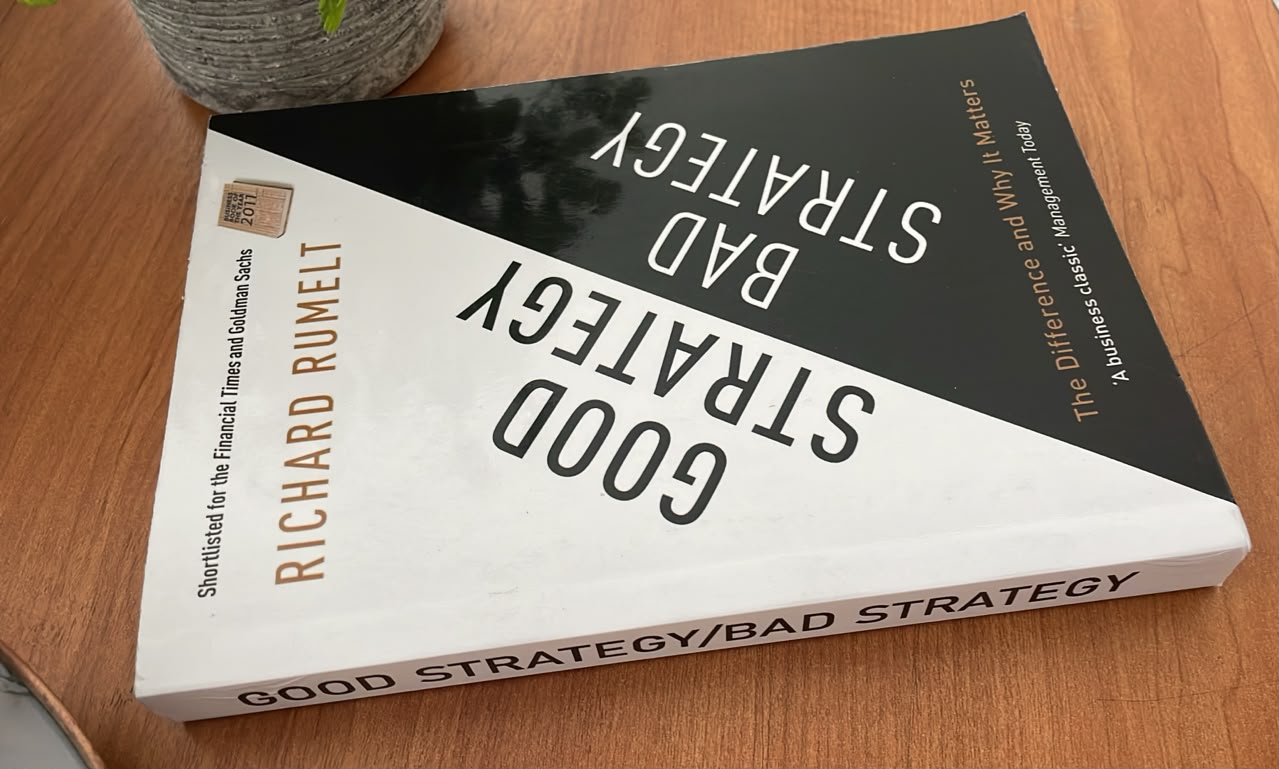



Good Startegy And Bad Startegy by Richard Rumelt


රු1,950.00
3 X Rs. 650.00 or 8% Cashback with


or 3 X රු650.00 with


or up to 4 X රු487.50 with


Good Strategy/Bad Strategy by Richard Rumelt is a highly influential business book that explains what real strategy looks like and why many organizations fail to create it. The book breaks down the difference between effective strategy and vague, ineffective planning.
Through real-world examples and clear explanations, it shows how successful strategies are built on identifying key problems, focusing resources, and taking decisive actions. It is widely considered a must-read for leaders, managers, and entrepreneurs.
Out of stock
Email when stock available
Good Strategy Bad Strategy by Richard Rumelt
Good Strategy Bad Strategy by Richard Rumelt is an influential business book that explains what real strategy looks like, why so many organizations confuse goals with strategy, and how leaders can create clear plans for overcoming their most important challenges.
Many companies say they have a strategy when what they actually have is a collection of ambitious goals, motivational statements, financial targets or vague promises about growth.
Richard Rumelt argues that this is not enough.
A real strategy begins by understanding the central problem facing an organization. Leaders must then decide where to focus their resources and create coordinated actions capable of addressing that challenge.
Rather than filling strategy documents with complicated language, Good Strategy Bad Strategy encourages leaders to think clearly, identify the most important obstacles and concentrate their efforts where they can make the greatest difference.
Why Read Good Strategy Bad Strategy?
One of the biggest strengths of Good Strategy Bad Strategy is its practical definition of strategy.
Strategy is often treated as something mysterious that belongs only to senior executives or large corporations.
Rumelt takes a different approach.
He explains that good strategy is essentially a coherent response to an important challenge.
The first step is understanding what is actually preventing progress.
The next step is deciding how to deal with that obstacle.
Finally, the organization needs coordinated actions that turn the strategic idea into reality.
The publisher describes good strategy as a specific and coherent approach to overcoming obstacles and applying power where it can have the greatest effect.
This makes the book useful not only for corporate executives but also for entrepreneurs, managers, business owners and anyone responsible for making important decisions.
What Is Bad Strategy?
A major part of the book focuses on identifying bad strategy.
Bad strategy often looks impressive.
It may contain inspirational language, ambitious financial goals or complicated business terminology.
But underneath those words, there may be no real explanation of the problem or how the organization intends to solve it.
Rumelt criticizes the tendency to confuse motivational slogans, buzzwords and financial objectives with genuine strategy.
For example, a company might announce:
“We will become the market leader by delivering world-class customer service and achieving extraordinary growth.”
That sounds positive.
But it does not explain what challenge the company currently faces.
It does not identify where the company should focus.
And it does not describe what actions employees should take.
A good strategy needs more than ambition.
It needs choices.
Start With the Real Problem
An important lesson in Good Strategy Bad Strategy is that leaders should diagnose the situation before creating solutions.
Imagine that sales are declining.
A weak strategy might simply say:
“Increase sales by 25% next year.”
But increasing sales is a goal, not a strategy.
A stronger approach would first investigate why sales are falling.
Perhaps customers believe the product is too expensive.
Maybe competitors provide faster delivery.
Perhaps the company is targeting the wrong market.
Or the sales team may be focusing on products with low demand.
Until the real problem is understood, creating an effective strategy is difficult.
This principle can be applied to businesses of almost any size.
Focus Your Resources
Organizations usually have limited resources.
There is only so much money, time, talent and management attention available.
Good strategy therefore requires focus.
Trying to solve every problem simultaneously can prevent the organization from making meaningful progress anywhere.
Rumelt explains that effective strategy concentrates effort where it can produce the greatest impact.
This may require leaders to make uncomfortable choices.
Some projects may need to stop.
Some opportunities may need to be ignored.
Resources may need to move from one department to another.
Strategy therefore involves deciding not only what the organization will do, but also what it will not do.
For entrepreneurs and small-business owners, this lesson can be particularly valuable.
Limited resources make focus essential.
Strategy Is Not the Same as Goals
Companies naturally need goals.
Revenue targets, sales targets, customer-growth targets and expansion plans can all be useful.
But Good Strategy Bad Strategy makes an important distinction between goals and strategy.
A goal describes the result you want.
Strategy explains how you intend to overcome the obstacles standing between you and that result.
For example:
Goal: Increase online sales by 30%.
That alone is not a strategy.
A strategy might identify that customers abandon the website because checkout is too complicated.
The company could then focus on simplifying checkout, improving mobile usability and offering more convenient payment methods.
Now the organization has identified a challenge and created coordinated actions to address it.
That is much closer to genuine strategic thinking.
Create Coordinated Action
Another important lesson from Good Strategy Bad Strategy is that different actions should support the same overall direction.
Imagine a company that wants to compete by providing the fastest delivery in its market.
Its actions might include:
- Improving inventory availability
- Choosing faster courier partners
- Optimizing warehouse processes
- Improving order-processing software
- Placing inventory closer to customers
- Monitoring delivery performance
Each action supports the same strategic objective.
This creates coordination.
A weak strategy, in contrast, might contain dozens of unrelated projects competing for attention and resources.
Good strategy creates alignment between decisions.
Use Your Strengths Wisely
Successful strategy also involves identifying sources of advantage.
A smaller company may not have the budget of a large competitor.
But it might have stronger customer relationships, greater flexibility or specialized knowledge.
Instead of competing everywhere, the company can focus on situations where its strengths matter most.
Rumelt discusses multiple sources of strategic power and uses examples from business, government, nonprofit organizations and military history to illustrate how focused advantages can be used effectively.
The key lesson is that strategy is not simply about working harder.
It is about applying effort intelligently.
Good Strategy Requires Difficult Choices
One reason bad strategy is common is that good strategy can be uncomfortable.
Choosing one priority means other priorities may receive fewer resources.
Focusing on one customer group may mean ignoring another.
Closing an unsuccessful product line may disappoint people who worked on it.
Leaders often try to avoid these difficult decisions by creating strategies that promise everything to everyone.
But when every objective becomes a priority, nothing is truly prioritized.
Good Strategy Bad Strategy encourages leaders to make clear choices.
The purpose of strategy is not to make every stakeholder happy.
It is to create a realistic way of overcoming the organization’s most important challenges.
Learn From Real-World Examples
Another strength of the book is its use of practical examples.
Rumelt draws examples from major companies and organizations, including Apple, General Motors, Walmart, Nvidia, Cisco and others, as well as examples from military affairs, education and government.
These cases demonstrate that strategic thinking is not limited to one industry.
Whether someone is managing a technology company, retail business, nonprofit organization or government institution, many of the underlying challenges are similar.
Leaders need to understand reality.
They need to identify leverage.
They need to focus limited resources.
And they need to turn ideas into coordinated action.
Strategy for Entrepreneurs
Entrepreneurs can benefit particularly from the lessons in Good Strategy Bad Strategy.
Small businesses rarely have unlimited budgets.
They cannot copy every competitor.
They cannot pursue every marketing opportunity.
And they cannot build every possible product.
A strong strategy helps entrepreneurs determine what matters most.
For example, a small retailer may decide that competing purely on price against larger competitors is impossible.
Instead, it might focus on specialized products, knowledgeable service and faster local delivery.
That choice helps guide decisions about inventory, marketing, staffing and technology.
The strategy provides direction.
Strategy and Leadership
Developing and implementing strategy is one of the central responsibilities of leadership.
Leaders need to see beyond daily operational problems and understand the broader challenges facing their organizations.
However, strategy should not become an annual presentation that employees forget after a meeting.
A useful strategy should influence everyday decisions.
Employees should understand:
What problem are we trying to solve?
What are our priorities?
Where should we focus?
What should we stop doing?
When those questions have clear answers, strategy becomes something the organization can actually use.
Who Should Read Good Strategy Bad Strategy?
This book is an excellent choice for readers interested in:
- Business strategy
- Entrepreneurship
- Leadership
- Management
- Strategic thinking
- Competitive advantage
- Business growth
- Decision making
- Organizational leadership
- Problem solving
- Business planning
- Company management
- Start-up strategy
It is especially useful for business owners, entrepreneurs, executives, managers, consultants and business students.
Readers who enjoyed books such as Good to Great, Blue Ocean Strategy or Zero to One may also find Rumelt’s approach to strategy valuable.
Is Good Strategy Bad Strategy Worth Reading?
If you want to understand the difference between setting goals and creating an actual strategy, Good Strategy Bad Strategy is an excellent book to read.
Richard Rumelt avoids treating strategy as motivational business language.
Instead, he encourages readers to identify difficult problems, understand what is really happening and create focused actions that address the most important challenge.
The book’s lessons can be applied to large organizations, small businesses, start-ups and even personal projects.
Its central message is straightforward: strategy requires clarity, focus and action.
A long list of goals is not enough.
A company needs to know what problem matters most and how it intends to overcome it.
Buy Good Strategy Bad Strategy in Sri Lanka
If you are searching for Good Strategy Bad Strategy in Sri Lanka, Richard Rumelt’s bestselling strategy book is a valuable addition to any business or management collection.
Published in 2011, the book has become a widely recognized work on strategic thinking and remains relevant for leaders who want to move beyond vague mission statements and unrealistic targets.
Whether you are starting a business, managing a team, developing a company strategy or studying management, Good Strategy Bad Strategy provides a practical framework for identifying problems, focusing resources and turning strategic thinking into coordinated action.
For anyone who wants to make better business decisions and understand what strategy actually means, this is a highly valuable read.
Learn more about Good Strategy Bad Strategy by Richard Rumelt on the official Profile Books website.
Explore more business and strategy books at Bargain Books.
Be the first to review “Good Startegy And Bad Startegy by Richard Rumelt”
Related products
Science & Nature
රු2,900.00
3 X Rs. 966.67 or 8% Cashback with
or 3 X රු966.67 with
or up to 4 X රු725.00 with
-19%
Out of stock
Analysis & Strategy
Original price was: රු2,600.00.රු2,100.00Current price is: රු2,100.00.
3 X Rs. 700.00 or 8% Cashback with
or 3 X රු700.00 with
or up to 4 X රු525.00 with
Strategy & Analysis
රු2,100.00
3 X Rs. 700.00 or 8% Cashback with
or 3 X රු700.00 with
or up to 4 X රු525.00 with
-13%
Analysis & Strategy
Original price was: රු3,850.00.රු3,350.00Current price is: රු3,350.00.
3 X Rs. 1,116.67 or 8% Cashback with
or 3 X රු1,116.67 with
or up to 4 X රු837.50 with
Analysis & Strategy
රු2,100.00
3 X Rs. 700.00 or 8% Cashback with
or 3 X රු700.00 with
or up to 4 X රු525.00 with
-26%

Out of stock
Analysis & Strategy
Original price was: රු1,900.00.රු1,400.00Current price is: රු1,400.00.
3 X Rs. 466.67 or 8% Cashback with
or 3 X රු466.67 with
or up to 4 X රු350.00 with
-14%
Out of stock
Analysis & Strategy
Original price was: රු3,700.00.රු3,200.00Current price is: රු3,200.00.
3 X Rs. 1,066.67 or 8% Cashback with
or 3 X රු1,066.67 with
or up to 4 X රු800.00 with
Strategy & Analysis
රු1,250.00
3 X Rs. 416.67 or 8% Cashback with
or 3 X රු416.67 with
or up to 4 X රු312.50 with
Reviews
There are no reviews yet.