No products in the cart.
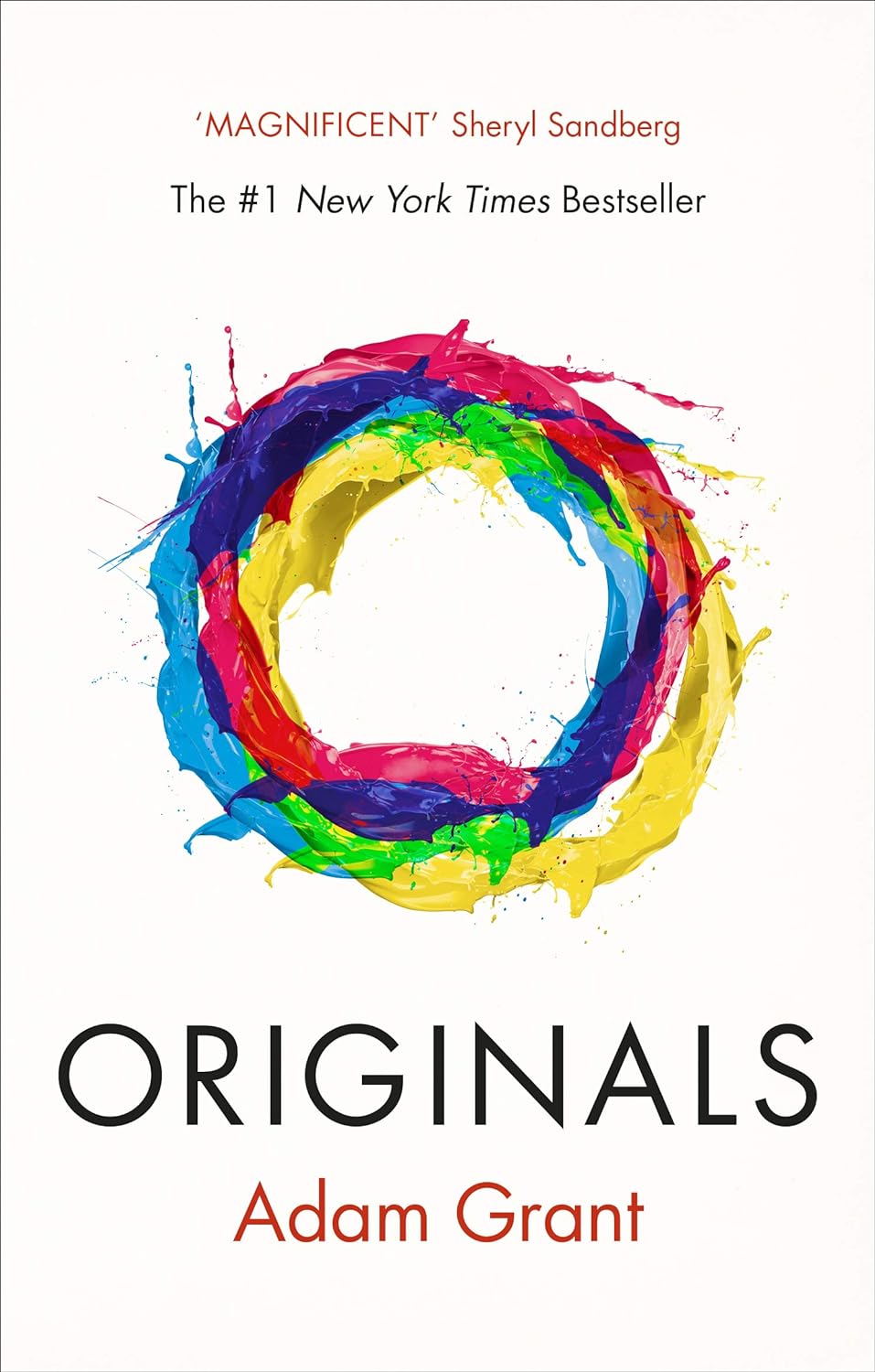
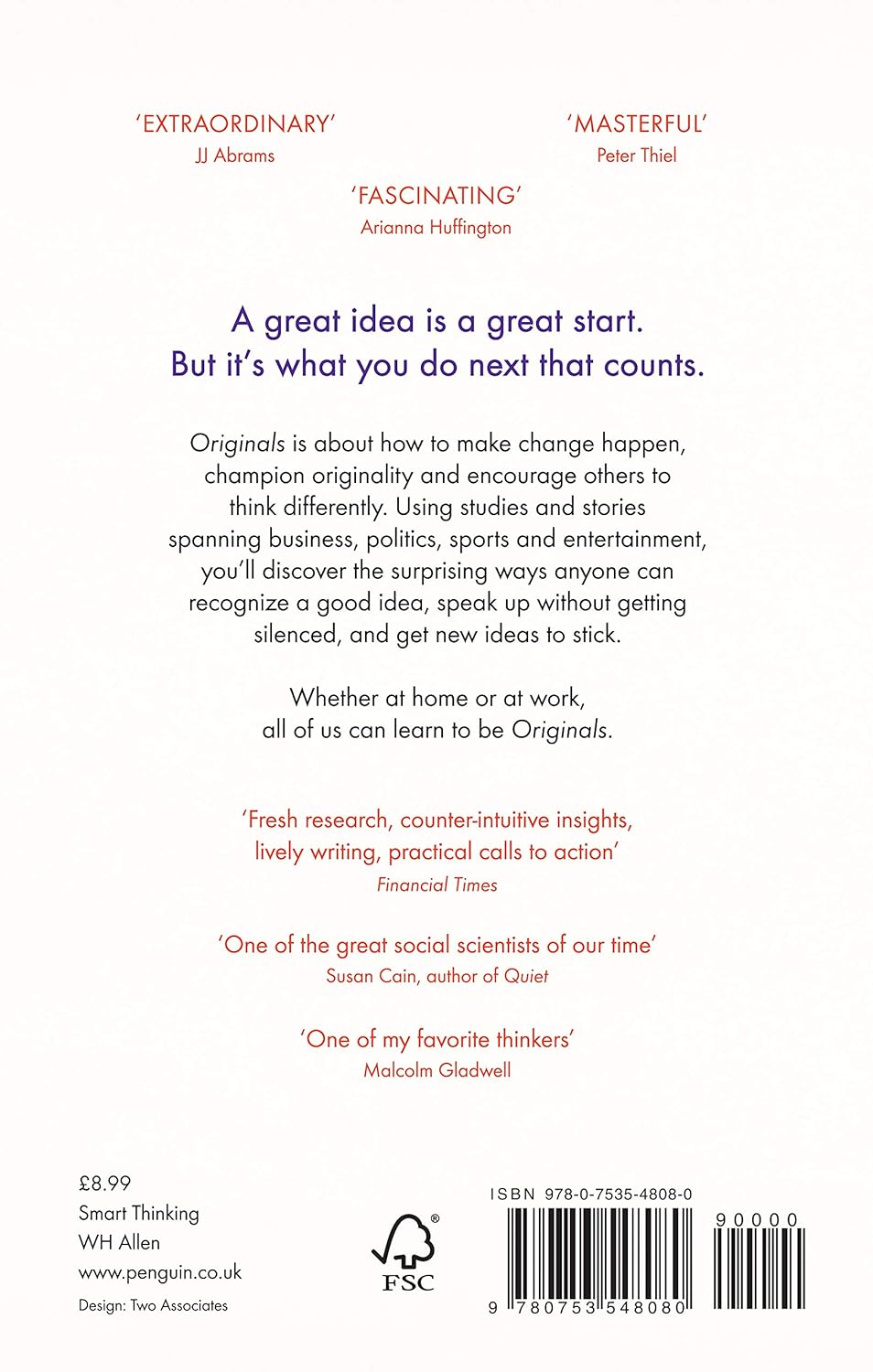


Originals by Adam Grant
රු1,900.00
3 X Rs. 633.33 or 8% Cashback with


or 3 X රු633.33 with


or up to 4 X රු475.00 with


“Originals” by Adam Grant explores how individuals can champion new ideas and originality, challenging the status quo in the process. The book delves into the minds of creative thinkers, offering insights and strategies for fostering innovation and making a difference in various fields.
Out of stock
Email when stock available
Originals by Adam Grant is a fascinating business and psychology book about how ordinary people can develop original ideas, challenge outdated assumptions and create meaningful change without becoming reckless rebels.
Many people imagine an “original” as someone completely different from everyone else.
A fearless entrepreneur.
A genius inventor.
A person who ignores every rule.
Someone naturally overflowing with brilliant ideas.
Adam Grant challenges that picture.
Original thinkers can feel afraid.
They can doubt themselves.
They can procrastinate.
They can keep stable jobs while developing new ideas.
They can make bad predictions.
And they can generate many terrible ideas before discovering one excellent idea.
What separates successful originals is not the absence of fear or failure.
It is how they manage those problems.
Drawing on research from organizational psychology and stories from business, politics, entertainment and social movements, Originals by Adam Grant explores how people recognize promising ideas, persuade others to support them, challenge authority without destroying their careers, build coalitions and create environments where useful dissent can survive.
The book also examines how parents and teachers can encourage originality in children and how leaders can prevent organizations from becoming trapped by groupthink.
For entrepreneurs, managers, students, marketers, creators and professionals who want to think differently without taking unnecessary risks, Originals offers a practical and often surprising look at what innovation actually requires.
Originals by Adam Grant – Book Overview
Originals by Adam Grant begins with a question that matters in almost every industry:
Why do some people successfully challenge the status quo while others remain silent?
Having a creative idea is only the beginning.
You also need to decide:
Is this idea actually good?
When should I share it?
Who should hear it first?
How much risk should I take?
What happens if people reject it?
How do I persuade others?
How do I prevent an organization from killing unconventional ideas too early?
Grant studies originality as a process rather than a personality trait.
That makes the book especially useful.
You do not need to be born an artistic genius.
You can improve the way you generate, evaluate and promote ideas.
What Does It Mean to Be Original?
Originality does not necessarily mean inventing something that has never existed in any form.
Often it means questioning an assumption everyone else accepts.
Why do we do it this way?
Could customers want something different?
Does this rule still make sense?
Is there a better process?
Should this product even exist?
Original thinkers notice that the current system is only one possible system.
That realization creates space for change.
The Status Quo Is Not Automatically Correct
People frequently inherit routines.
A company has always used the same process.
A school has always taught the same way.
An industry has always sold products through the same channel.
Over time, people stop asking why.
The routine becomes normal.
Normal begins feeling inevitable.
Originals by Adam Grant encourages readers to treat existing practices as choices rather than natural laws.
Some traditions are excellent.
Others survive mainly because nobody has challenged them.
Question the Default
One of the most useful habits of original thinking is questioning defaults.
Why is this the standard option?
Who designed it?
When?
Under what conditions?
Do those conditions still exist?
A process created ten years ago may have made perfect sense then.
Technology, customers or competition may have changed since.
Originality begins when someone notices the mismatch.
Creativity Is Not Enough
Creative ideas alone do not guarantee impact.
Someone may have brilliant concepts and never act on them.
Another person may have a good idea but present it badly.
Someone else may challenge authority so aggressively that nobody wants to listen.
Therefore originality involves more than idea generation.
It also involves:
Judgment.
Timing.
Communication.
Coalition-building.
Risk management.
Persistence.
Generate More Ideas
One of the strongest lessons in Originals by Adam Grant is that highly creative people often produce a large quantity of work.
Not everything is excellent.
That is important.
We often look at successful creators and see only their famous achievements.
We do not see all the:
Unused ideas.
Failed experiments.
Weak drafts.
Rejected concepts.
The more ideas you create, the more chances you have of finding something unusually strong.
Quantity Can Support Quality
Suppose you need one excellent campaign idea.
Trying to produce exactly one idea puts enormous pressure on that first attempt.
Instead, generate:
Ten.
Twenty.
Fifty possibilities.
Most may be ordinary.
That is fine.
The goal of brainstorming is not for every idea to survive.
The goal is to increase the pool from which stronger ideas can emerge.
Your First Idea May Not Be Your Best
People often become emotionally attached to the first solution they create.
That can be dangerous.
The first idea feels special because it is ours.
But ownership does not prove quality.
Strong original thinkers learn to separate:
“I created this”
from
“This is the best option.”
That distinction is essential in design, business and product development.
Idea Selection Is Difficult
Generating ideas can sometimes be easier than identifying which one will succeed.
Creators may be too emotionally close to their work.
Managers may rely on outdated assumptions.
Customers may not know what they want until they see it.
This means evaluating originality requires multiple perspectives.
Seek Feedback
Useful feedback can reveal weaknesses the creator cannot see.
But not every opinion is equally valuable.
The best feedback often comes from people who:
Understand the field.
Understand the audience.
Have enough independence to disagree.
Will explain why something works or fails.
Blindly following every comment destroys originality.
Ignoring all criticism can destroy it too.
Originals Are Not Always Extreme Risk-Takers
One of the myths challenged in Originals by Adam Grant is that innovators must bet everything on one idea.
Popular stories often make entrepreneurship sound like:
Quit immediately.
Risk all your money.
Ignore everyone.
Believe completely.
Grant presents a more complicated picture.
Some successful innovators reduce risk in one part of life while experimenting aggressively in another.
Balance the Risk Portfolio
Imagine someone wants to start a company.
There are many possible strategies.
Quit today and invest everything.
Or:
Keep employment temporarily.
Test demand.
Build a prototype.
Find initial customers.
Learn.
Then make a larger commitment.
The second option may look less dramatic.
It can still produce an original business.
Risk management is not cowardice.
Originality Does Not Require Recklessness
This distinction is especially useful for entrepreneurs.
You can believe strongly in an idea while still asking:
What evidence do I have?
What is the downside?
How can I test cheaply?
What would make me change my mind?
What assumptions are most dangerous?
Courage and caution can coexist.
Fear Is Normal
Original thinkers may fear:
Rejection.
Embarrassment.
Financial loss.
Criticism.
Authority.
Failure.
The goal is not to remove every fear before acting.
That may never happen.
The goal is to decide whether the idea matters enough to act intelligently despite discomfort.
Strategic Procrastination
One of the more surprising ideas discussed in Originals by Adam Grant is that procrastination is not always harmful.
Starting early but delaying final commitment can sometimes give ideas time to develop.
Your mind continues making connections.
Alternative possibilities appear.
The first solution has less chance of becoming permanent too early.
This does not mean leaving everything until the final minute.
The useful version is closer to:
Start.
Explore.
Pause.
Return.
Refine.
Incubation
Creative work often improves when the brain has time away from the problem.
Writers experience this.
Programmers experience it.
Designers experience it.
You may struggle with a problem for hours.
Walk away.
Then suddenly see the solution later.
Incubation gives unconscious processing time to continue.
Timing Matters
Having the right idea at the wrong moment can still produce failure.
Markets may not be ready.
Technology may be immature.
Customers may not understand the need.
Organizations may lack resources.
Originality therefore involves not only:
What?
but also:
When?
First-Mover Advantage Is Not Guaranteed
Business culture often celebrates being first.
But first movers also face disadvantages.
They educate the market.
Make early mistakes.
Discover technical problems.
Spend money developing infrastructure.
Later entrants can learn from those failures.
Being first can help.
Being better at the right time may help more.
Speaking Up
Organizations need people who challenge bad decisions.
But speaking up can be risky.
An employee may worry about appearing:
Difficult.
Negative.
Disloyal.
Uncooperative.
Originals by Adam Grant explores how people can make dissent more effective.
Build Credibility
The same criticism can receive very different reactions depending on who says it.
Someone who has consistently contributed useful work may have more freedom to challenge established practices.
Credibility creates influence.
That means one strategy for changing a system is becoming valuable enough that people take your disagreement seriously.
Challenge Ideas, Not People
There is a difference between:
“This process creates three unnecessary delays.”
and:
“The people who designed this process are incompetent.”
The first invites analysis.
The second invites defense.
Original thinkers need communication skills because a good idea presented badly can be rejected for avoidable reasons.
Show the Weaknesses in Your Own Idea
An unusual persuasion strategy discussed in the book is acknowledging disadvantages instead of pretending your proposal is perfect. The publisher highlights an example involving an entrepreneur who presented reasons not to invest in a startup.
Why might this work?
It signals honesty.
It reduces the audience’s need to search for hidden weaknesses.
And it gives the speaker an opportunity to frame the risks realistically.
Confidence Without Pretending
A strong proposal can sound like:
“This is why I think the idea has potential. Here are the three biggest risks. Here is how we plan to test them.”
That is often more credible than:
“This idea cannot fail.”
Anyone experienced in business knows that every idea can fail.
Familiarity Helps New Ideas
Completely unfamiliar ideas can make people uncomfortable.
Sometimes repetition helps.
An idea that sounds strange the first time may become more understandable after people encounter it repeatedly.
This does not mean repeating a bad idea turns it into a good one.
It means familiarity affects how humans evaluate novelty.
Build Coalitions
Large changes rarely happen because one individual gives one perfect speech.
Originals often need allies.
Colleagues.
Managers.
Customers.
Communities.
Investors.
Partners.
Movements become stronger when different people have reasons to support the same change.
Allies Do Not Need to Agree on Everything
Two groups may disagree strongly on many subjects but support the same specific objective.
A successful coalition can sometimes form around a shared goal rather than complete ideological agreement.
That requires pragmatism.
Groupthink
One of the biggest organizational dangers discussed in Originals by Adam Grant is groupthink.
Groupthink occurs when maintaining agreement becomes more important than evaluating reality honestly.
A team begins rewarding:
Agreement.
Loyalty.
Harmony.
while discouraging:
Questions.
Criticism.
Contradictory evidence.
Eventually everyone appears to agree.
That does not mean the decision is good.
Teams Need Dissent
A healthy organization needs people willing to say:
I disagree.
What evidence supports this?
What if our assumption is wrong?
What is the strongest argument against this plan?
What could cause failure?
Dissent can feel uncomfortable.
But discomfort is sometimes a sign that important thinking is happening.
Psychological Safety
Employees need enough safety to raise concerns without automatically expecting punishment or humiliation.
If people believe disagreement destroys careers, they will eventually stop giving honest feedback.
Management then receives increasingly distorted information.
The organization becomes more confident while becoming less informed.
Leaders Need to Hear Bad News
A dangerous leader says:
“Tell me I’m right.”
A stronger leader asks:
“What am I missing?”
This matters in:
Business.
Government.
Technology.
Healthcare.
Almost every complex organization.
People at the top often have the greatest authority but less direct contact with everyday problems.
They need channels through which uncomfortable information can travel upward.
Devil’s Advocate Versus Genuine Dissent
Simply assigning someone to pretend to disagree may not always produce the same effect as having someone who genuinely holds another viewpoint.
Real disagreement forces people to defend assumptions more seriously.
Organizations should therefore avoid creating cultures where everyone thinks alike.
Diversity of Thought
People with different:
Experiences.
Disciplines.
Backgrounds.
Personalities.
may notice different problems.
A software engineer sees one risk.
A customer-support employee sees another.
A finance professional sees another.
A customer sees another.
Originality becomes stronger when these perspectives can interact.
Culture Fit Can Become Dangerous
Companies often hire for “culture fit.”
That sounds sensible.
Teams need cooperation.
But if culture fit means:
Hire people who think exactly like us,
the organization may slowly eliminate useful disagreement.
A better question can be:
What perspective does this person add?
Hire for Contribution, Not Cloning
An organization should not become a collection of identical personalities.
Strong teams often contain complementary strengths.
Someone analytical.
Someone creative.
Someone skeptical.
Someone relationship-oriented.
Different thinking styles can improve decision quality when managed well.
Nurturing Originality in Children
Originals by Adam Grant also examines how parents and teachers can encourage independent thinking.
Children need rules.
But explaining the reason behind rules can help them develop moral reasoning rather than simple obedience.
The goal is not producing children who reject every instruction.
It is helping them think about principles.
Values Versus Rules
“Don’t do that because I said so” teaches obedience.
“Don’t do that because it harms another person” teaches a principle.
Principles can be applied to unfamiliar situations.
This supports independent judgment.
Creativity in Education
Students can become excessively focused on finding:
The correct answer.
The expected answer.
The answer the teacher wants.
That works for questions with one objective solution.
It is less useful for problems requiring innovation.
Education should also create opportunities to:
Question.
Design.
Experiment.
Argue respectfully.
Create.
Role Models Matter
Young people can benefit from hearing stories about people who challenged harmful norms and improved their communities.
But it is useful to show not only their success.
Also show:
Uncertainty.
Mistakes.
Rejection.
Work.
Otherwise children may conclude that originality belongs only to extraordinary heroes.
Originals Still Feel Doubt
Confidence is often created retrospectively.
We see someone’s success and assume:
They always knew.
Often they did not.
People can believe an idea deserves a chance while still worrying that they might be wrong.
This is a much more realistic model of courage.
Motivation Matters
Originality becomes easier to sustain when the goal feels meaningful.
A person fighting only for ego may abandon the effort after rejection.
Someone who believes a problem genuinely needs solving may continue longer.
Purpose can therefore support persistence.
Anger Can Motivate Change
Negative emotions are not always destructive.
Frustration and anger can sometimes signal that something is wrong.
The important question is what happens next.
Anger can become:
Complaint.
Aggression.
Or constructive action.
Originals learn to channel dissatisfaction into attempts to improve the situation.
Managing Anxiety
Fear about an upcoming challenge can be interpreted as evidence that you will fail.
Or as evidence that your body is preparing for something important.
How people interpret emotional arousal can influence performance.
Instead of demanding:
“I must calm down completely,”
someone might think:
“I am energized because this matters.”
Persistence Needs Judgment
Persistence is useful.
Blind persistence is not.
An original thinker must sometimes abandon an idea.
The challenge is identifying whether:
The idea is weak.
The execution is weak.
The timing is wrong.
The audience is wrong.
Or the idea simply needs more development.
Knowing when to continue and when to change direction is part of creative judgment.
Failure Is Part of Originality
If every idea succeeds, you may not be experimenting very much.
Innovation naturally produces failures because it explores uncertainty.
A healthy organization therefore distinguishes between:
Negligent failure
and
intelligent experimentation that did not work.
Punishing every failed experiment can destroy creativity.
Test Ideas Cheaply
Instead of debating endlessly, create evidence.
Prototype.
Pilot.
Survey.
Interview.
Run a small campaign.
Release a minimum version.
Experimentation allows reality to participate in the decision.
Originality in Entrepreneurship
Entrepreneurs can apply Originals by Adam Grant by asking:
What assumption in my industry deserves questioning?
What problem are customers tolerating because every company treats it as normal?
Can we test an alternative cheaply?
How can we reduce downside while learning?
Who are the early supporters?
Innovation does not require inventing something technologically revolutionary.
A different business model can also be original.
Originality in Marketing
Marketers need originality because audiences eventually stop noticing repeated approaches.
But originality without relevance becomes noise.
A creative campaign must still connect with:
The customer.
The product.
The brand.
The goal.
Different merely for the sake of being different is not automatically effective.
Originality in Software and Technology
Software teams regularly face assumptions such as:
We have always used this architecture.
Customers want this feature.
This process needs six approvals.
This workflow cannot be automated.
An original engineer asks for evidence.
But good engineering also requires understanding why the existing system was created before replacing it.
Innovation and Legacy Systems
Something that looks inefficient may exist because of a constraint you have not discovered yet.
Therefore the correct sequence is often:
Question.
Investigate.
Understand.
Then redesign.
That prevents originality from becoming careless disruption.
Originality in Leadership
Leaders do not need to generate every idea themselves.
A powerful leader can instead build a system where other people’s ideas survive.
That requires:
Listening.
Rewarding thoughtful dissent.
Allowing experimentation.
Giving credit.
Learning from failure.
The leader’s job becomes creating conditions for originality.
Don’t Punish the Messenger
If an employee identifies a genuine problem, punishing them teaches everyone else to hide problems.
Short-term comfort creates long-term ignorance.
Healthy organizations separate:
Bad news
from
the person reporting bad news.
Originals and Career Growth
Professionals sometimes believe they must choose between:
Obedience
and
rebellion.
There is a large middle ground.
You can become highly reliable while also proposing better approaches.
You can challenge a process respectfully.
You can test an alternative before demanding complete change.
You can build allies.
Originality can be strategic.
Is Originals a Self-Help Book?
Partly.
It contains lessons readers can apply personally.
But it is better described as a combination of:
Business.
Organizational psychology.
Creativity.
Leadership.
Innovation.
Personal development.
It draws heavily on research and case studies rather than presenting only motivational advice.
Is Originals About Entrepreneurship?
Entrepreneurship is one major area, but the book is broader.
Grant examines originality in workplaces, creative fields, social change, families and education.
You do not need to own a business to benefit from it.
Is Originals a Sequel to Think Again?
No.
Originals was published before Think Again and works completely independently.
There is no required reading order among Adam Grant’s main nonfiction books.
You can begin directly with Originals by Adam Grant.
How Does Originals Compare With Think Again?
The books overlap in their interest in flexible thinking but emphasize different problems.
Originals focuses more on generating and championing unconventional ideas and challenging the status quo.
Think Again focuses more directly on reconsidering beliefs, updating opinions and developing the habit of rethinking.
Your BookLounge catalogue also carries Think Again by Adam Grant, so the two could be useful cross-sells on the website.
Adam Grant
Adam Grant is an organizational psychologist at the Wharton School and the author of books including Give and Take, Originals, Think Again and Hidden Potential. Penguin Random House describes his work as examining motivation, success, change and organizational behavior.
Foreword by Sheryl Sandberg
The standard edition of Originals includes a foreword by Sheryl Sandberg.
For your normal WooCommerce author field, I recommend:
Adam Grant
If you have a contributor field, you can separately note:
Foreword by Sheryl Sandberg.
Edition Details
There are several editions, so use the ISBN printed on your exact physical copy.
The U.S. Penguin Books paperback is:
ISBN: 9780143128854
Pages: 336
Publication: February 7, 2017.
The UK WH Allen paperback is:
ISBN: 9780753556993
Pages: 336
Publication: February 9, 2017.
For your Sri Lankan website stock, check the physical barcode before entering the ISBN because either regional edition may appear through international suppliers.
Important Themes
Originals by Adam Grant explores originality, creativity, innovation, entrepreneurship, risk management, procrastination, idea generation, idea selection, persuasion, leadership, dissent, groupthink, workplace culture, speaking up, coalition-building, fear, timing, experimentation, parenting and challenging the status quo.
7 Powerful Lessons From Originals by Adam Grant
- Generate more ideas instead of expecting your first idea to be brilliant. Original creators often produce large quantities of work, and much of it is ordinary. More attempts create more opportunities for exceptional ideas to emerge.
- Originality does not require reckless risk-taking. You can reduce risk in one area while experimenting boldly in another. Smart innovators protect themselves from unnecessary downside.
- Question defaults instead of assuming existing systems are inevitable. Many processes survive because people stopped asking why they exist, not because they remain optimal.
- Give ideas time to develop. Starting early while delaying final commitment can sometimes improve creativity by allowing alternative possibilities to emerge.
- Build allies before trying to overturn the system. Good ideas rarely spread through individual brilliance alone. Influence, credibility and coalitions help unconventional ideas survive resistance.
- Healthy organizations need genuine disagreement. Leaders who surround themselves only with people who agree risk creating groupthink and losing access to critical information.
- Fear and doubt do not disqualify you from being original. Successful originals are not necessarily fearless. They learn to act, experiment and speak up even while uncertainty remains.
Why Read Originals by Adam Grant?
Originals by Adam Grant is an excellent choice for readers interested in creativity, innovation, business, entrepreneurship, leadership, psychology, workplace culture and personal development.
It is especially useful if you have ever thought:
I have an idea, but I am afraid people will reject it.
I want to start something different, but I cannot afford to risk everything.
My workplace keeps using an outdated process.
My team agrees too quickly.
I struggle to know whether my creative ideas are actually good.
I want employees to speak up more.
I want to become more innovative without becoming reckless.
Grant’s central message is encouraging because originality is presented as something more practical than genius.
You can learn to:
Generate more alternatives.
Test assumptions.
Build support.
Manage risk.
Speak more effectively.
Listen to dissent.
And create environments where useful ideas have a better chance of surviving.
Who Should Read This Book?
Originals by Adam Grant may especially appeal to entrepreneurs, managers, business owners, software developers, marketers, designers, students, teachers, creators, team leaders, innovators and professionals who want to challenge established ways of working without making unnecessary risks.
It is also useful for leaders who do not necessarily want to become more personally creative but want their teams to become better at generating and sharing ideas.
Originals by Adam Grant – You Do Not Need to Be Fearless to Change Something
Originals by Adam Grant challenges the romantic story we often tell about innovation.
We imagine the original thinker standing alone.
Completely confident.
Certain everyone else is wrong.
Risking everything.
Then changing the world.
Reality is usually messier.
Original thinkers doubt themselves.
Some keep their day jobs.
Some procrastinate.
Some make terrible predictions.
Some produce dozens of weak ideas before finding the strong one.
Some need allies before they can challenge authority.
Some fail.
Then learn.
Then try differently.
This is what makes the book useful.
Originality becomes achievable.
You do not need to wake up tomorrow and become a fearless revolutionary.
You can begin with something smaller.
Notice a problem everyone accepts.
Ask why.
Generate several alternatives.
Research them.
Ask for feedback.
Test one.
Learn.
Improve it.
Build credibility.
Find people who see the same opportunity.
Then speak.
Originality is not simply thinking differently.
It is turning useful different thinking into action.
And that requires much more than creativity.
It requires judgment.
Timing.
Courage.
Relationships.
Persistence.
And enough humility to admit when your original idea was actually wrong.
For readers who want to create better ideas, improve organizations, challenge groupthink or simply become more confident questioning the status quo, Originals by Adam Grant offers a practical and research-driven guide to becoming more original without needing to risk everything.
Learn more about Originals by Adam Grant on the official Adam Grant website.
Explore more business and personal development books at Bargain Books.
| Author | Adam Grant |
|---|---|
| Type | Paperback Brand new Printed (Indian Locally published) |
| ISBN/ISSN | 0753548089 |
| Language | English |
| Pages | 336 |
Be the first to review “Originals by Adam Grant”
Related products
Damaged & Imperfect Books
රු550.00
3 X Rs. 183.33 or 8% Cashback with
or 3 X රු183.33 with
or up to 4 X රු137.50 with
Damaged & Imperfect Books
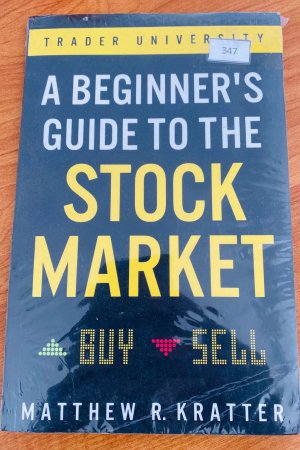
Beginner’s Guide To The Stock Market by Matthew R Kratter (347)
රු1,500.00
3 X Rs. 500.00 or 8% Cashback with
or 3 X රු500.00 with
or up to 4 X රු375.00 with
Analysis & Strategy
රු2,250.00
3 X Rs. 750.00 or 8% Cashback with
or 3 X රු750.00 with
or up to 4 X රු562.50 with
-39%

Out of stock
Analysis & Strategy
Original price was: රු2,800.00.රු1,700.00Current price is: රු1,700.00.
3 X Rs. 566.67 or 8% Cashback with
or 3 X රු566.67 with
or up to 4 X රු425.00 with
Out of stock
Analysis & Strategy
රු1,650.00
3 X Rs. 550.00 or 8% Cashback with
or 3 X රු550.00 with
or up to 4 X රු412.50 with
-44%
Out of stock
Analysis & Strategy
Original price was: රු2,750.00.රු1,550.00Current price is: රු1,550.00.
3 X Rs. 516.67 or 8% Cashback with
or 3 X රු516.67 with
or up to 4 X රු387.50 with

Out of stock
රු3,900.00
3 X Rs. 1,300.00 or 8% Cashback with
or 3 X රු1,300.00 with
or up to 4 X රු975.00 with
-15%

Out of stock
Analysis & Strategy
Beginner’s Guide To The Stock Market by Matthew R Kratter (Hardcover)
Original price was: රු3,300.00.රු2,800.00Current price is: රු2,800.00.
3 X Rs. 933.33 or 8% Cashback with
or 3 X රු933.33 with
or up to 4 X රු700.00 with
Reviews
There are no reviews yet.