No products in the cart.
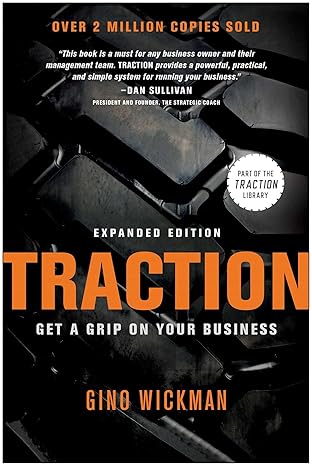
Traction by Gino Wickman


රු1,950.00
3 X Rs. 650.00 or 8% Cashback with


or 3 X රු650.00 with

or up to 4 X රු487.50 with


• Practical business guide based on the Entrepreneurial Operating System (EOS)
• Helps entrepreneurs build clarity, accountability, and growth
• Ideal for business owners, leaders, and startups
Out of stock
Email when stock available
Traction by Gino Wickman
Traction by Gino Wickman is a practical business guide for entrepreneurs and leadership teams who want more clarity, accountability, discipline, and control inside their companies.
The book introduces the Entrepreneurial Operating System, commonly known as EOS.
EOS is built around a simple idea.
Strong businesses become healthier when they consistently strengthen six key areas: Vision, People, Data, Issues, Process, and Traction.
Rather than focusing on theory, the book provides tools that leaders can use directly in their organizations.
About Traction by Gino Wickman
Many entrepreneurs begin businesses with energy and ambition.
As companies grow, things become more complicated.
Employees may not understand priorities.
Meetings may become ineffective.
Problems can remain unresolved.
Owners may feel that the business is controlling them rather than the other way around.
Traction by Gino Wickman was written to address these problems.
The book provides a structured operating system for running entrepreneurial organizations more consistently.
What Is EOS?
EOS stands for Entrepreneurial Operating System.
It is a set of practical tools designed to help leadership teams clarify what they want, organize their people, measure performance, solve problems, document important processes, and execute priorities.
Gino Wickman developed EOS after working with entrepreneurial businesses.
He later introduced the system publicly through Traction.
EOS Worldwide describes the system as focusing on six key components of a business.
6 Powerful Components in Traction by Gino Wickman
1. Vision
A company needs a clear direction.
Leaders may know what they want.
The problem is that employees may not understand the same vision.
The Vision Component helps leadership teams clarify where the organization is going and how it plans to get there.
When everyone understands the same priorities, decision-making becomes easier.
A clear vision can also reduce confusion between departments.
2. People
A strong strategy still requires the right people.
The People Component focuses on putting suitable individuals into suitable roles.
This involves more than technical ability.
Employees should also fit the organization’s core values.
The goal is to create a team where people understand their responsibilities and can perform them effectively.
3. Data
Businesses generate large amounts of information.
But more information does not automatically create better decisions.
The Data Component encourages leaders to identify a small number of important weekly numbers.
These metrics create a clearer picture of performance.
Instead of relying only on feelings or assumptions, managers can use measurable information.
4. Issues
Every company has problems.
The real difference is how quickly those problems are identified and solved.
Traction by Gino Wickman encourages leadership teams to bring important issues into the open.
EOS uses a structured approach to identify, discuss, and solve problems.
The aim is to solve the root issue rather than repeatedly treating symptoms.
5. Process
Successful businesses often depend on repeatable processes.
Sales may follow one process.
Customer service may follow another.
Finance, purchasing, recruitment, and operations can also require standardized procedures.
The Process Component helps businesses identify and document the most important ways work gets done.
Consistency can make scaling easier.
6. Traction
Vision explains where the company wants to go.
Traction is about execution.
EOS encourages businesses to turn larger goals into shorter-term priorities.
These priorities are known as Rocks.
The official EOS framework typically recommends three to seven important priorities for each 90-day period.
The purpose is to create focus and accountability.
The Vision/Traction Organizer
One of the best-known EOS tools is the Vision/Traction Organizer.
It helps leadership teams summarize important parts of their business strategy.
This can include core values.
It can include long-term goals.
It can also include shorter-term targets.
The advantage is simplicity.
Instead of having a business plan that few employees read, teams can work from a clearer operating framework.
Rocks and the 90-Day World
Long-term goals can feel distant.
EOS addresses this by breaking progress into 90-day periods.
Important quarterly priorities are called Rocks.
Each Rock should have clear ownership.
At the end of the quarter, teams can evaluate whether the priority was completed.
EOS Worldwide identifies Rocks as one of the main tools used to strengthen the Traction Component.
Accountability
Accountability is one of the strongest themes in Traction by Gino Wickman.
A business becomes difficult to manage when responsibilities are unclear.
Employees may assume someone else owns a task.
Managers may avoid difficult conversations.
Projects can remain unfinished.
EOS encourages organizations to define who is responsible for what.
Clear ownership makes performance easier to evaluate.
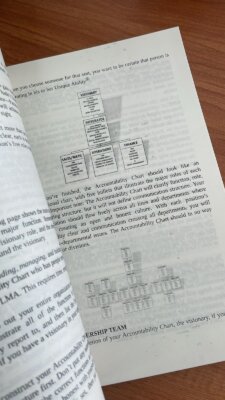
The Accountability Chart
The EOS Accountability Chart is different from a traditional organization chart.
Instead of focusing only on hierarchy, it focuses on roles and responsibilities.
The goal is to identify the major functions inside the business.
Then leaders assign accountability for those functions.
This can help reduce duplicated work and uncertainty.
Weekly Scorecards
Financial reports often look backward.
EOS adds weekly scorecards to help leaders see important trends sooner.
A scorecard contains a small number of measurable indicators.
Each number has an owner.
Each number also has a target.
If something moves outside the expected range, leaders can investigate quickly.
This helps convert vague concerns into measurable problems.
Level 10 Meetings
Meetings can consume enormous amounts of time.
They can also produce very little action.
EOS uses a structured weekly meeting format known as the Level 10 Meeting.
The format is designed to maintain a consistent agenda.
Teams review important numbers.
They review priorities.
They identify issues.
They then spend time solving the most important problems.
EOS Worldwide lists the Level 10 Meeting as one of the foundational tools used by leadership teams.
IDS: Identify, Discuss, Solve
EOS uses a problem-solving approach commonly called IDS.
First, identify the real issue.
Second, discuss it.
Third, solve it.
The order matters.
Teams sometimes spend too much time discussing symptoms.
Identifying the real problem can make the conversation much more productive.
The objective is not to talk about problems indefinitely.
It is to reach a clear decision and action.
Process and Consistency
A growing business cannot depend entirely on individual memory.
Important processes need consistency.
Customers should receive a similar standard of service.
Employees should understand how major tasks are handled.
New team members should not have to reinvent basic procedures.
Documenting core processes can reduce this dependence on individuals.
It can also make training easier.
Discipline and Execution
Ideas are rarely the biggest problem in business.
Execution is often harder.
A company may have a strong strategy but fail to follow through.
Traction by Gino Wickman emphasizes disciplined execution.
Priorities should be clear.
Meetings should produce action.
Responsibilities should have owners.
Progress should be measured.
These habits help turn strategy into consistent results.
Solving Issues Instead of Avoiding Them
Leadership teams sometimes avoid uncomfortable topics.
The result is that the same problems appear repeatedly.
EOS encourages leaders to create an Issues List.
Problems can then be addressed systematically.
The objective is transparency.
If an issue threatens performance, the team should be able to discuss it openly.
Healthy organizations solve important issues instead of hiding them.
Creating a Healthier Leadership Team
EOS is not only about operational systems.
Team health also matters.
Leaders need trust.
They need the ability to disagree honestly.
They need to make decisions and then move forward together.
Without a healthy leadership team, even good tools may fail.
The EOS model therefore combines execution with stronger working relationships.
Who Should Read This Book?
Traction by Gino Wickman is ideal for entrepreneurs, founders, business owners, managers, department heads, and leadership teams.
It can be especially useful for growing small and medium-sized businesses.
Companies experiencing unclear responsibilities may benefit from the framework.
Businesses struggling with meetings, accountability, priorities, or unresolved issues may also find practical ideas.
The book is particularly relevant for organizations that want a complete operating framework rather than isolated productivity tips.
About Gino Wickman
Gino Wickman is an entrepreneur, author, and creator of the Entrepreneurial Operating System.
EOS Worldwide states that Wickman developed the system in the early 2000s and introduced it publicly in Traction in 2007.
He later co-founded EOS Worldwide with Don Tinney.
His other books include Rocket Fuel, Get a Grip, Entrepreneurial Leap, and The EOS Life.
Readers can learn more through the official EOS Worldwide website.
Product Details
Title: Traction
Subtitle: Get a Grip on Your Business
Author: Gino Wickman
Genre: Business / Entrepreneurship / Management / Leadership
Language: English
Core Framework: Entrepreneurial Operating System (EOS)
Original Publication: 2007
Main Concepts: Vision, People, Data, Issues, Process, Traction
Different editions of the book have been released over time.
ISBN, publisher, page count, dimensions, and cover design can therefore vary.
Always check the ISBN and specifications printed on your physical copy before entering the final WooCommerce product information.
Explore More Business Books
Traction by Gino Wickman gives entrepreneurs a structured way to run a growing company.
It helps leaders clarify vision.
It encourages them to build stronger teams.
It introduces measurable scorecards.
It provides a method for solving problems.
It encourages standardized processes.
And it creates discipline through quarterly priorities and weekly meetings.
The central message is that a good business needs both vision and execution.
Readers interested in entrepreneurship, management, leadership, and business systems can explore more Business, Finance & Economics Books at Bargain Books.
For entrepreneurs who feel overwhelmed by constant problems or unclear priorities, Traction by Gino Wickman offers a practical framework for bringing more structure, accountability, and focus into the business.

Be the first to review “Traction by Gino Wickman”
Related products
Non-Fiction & Knowledge
රු2,250.00
3 X Rs. 750.00 or 8% Cashback with
or 3 X රු750.00 with
or up to 4 X රු562.50 with
Out of stock
Non-Fiction & Knowledge
රු1,500.00
3 X Rs. 500.00 or 8% Cashback with
or 3 X රු500.00 with
or up to 4 X රු375.00 with
Non-Fiction & Knowledge
රු2,450.00
3 X Rs. 816.67 or 8% Cashback with
or 3 X රු816.67 with
or up to 4 X රු612.50 with
-19%

Out of stock
Biography
Original price was: රු2,400.00.රු1,950.00Current price is: රු1,950.00.
3 X Rs. 650.00 or 8% Cashback with
or 3 X රු650.00 with
or up to 4 X රු487.50 with
රු2,000.00
3 X Rs. 666.67 or 8% Cashback with
or 3 X රු666.67 with
or up to 4 X රු500.00 with
-26%
Non-Fiction & Knowledge
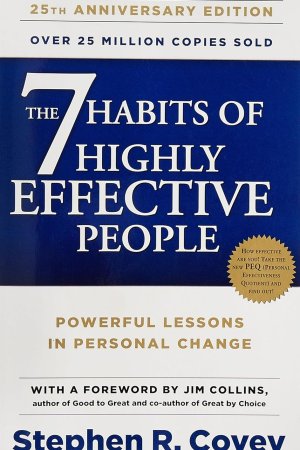
The 7 Habits of Highly Effective People by Stephen R. Covey – Blue Cover
Original price was: රු2,300.00.රු1,700.00Current price is: රු1,700.00.
3 X Rs. 566.67 or 8% Cashback with
or 3 X රු566.67 with
or up to 4 X රු425.00 with
-24%
Out of stock
Non-Fiction & Knowledge
Original price was: රු2,100.00.රු1,600.00Current price is: රු1,600.00.
3 X Rs. 533.33 or 8% Cashback with
or 3 X රු533.33 with
or up to 4 X රු400.00 with
Non-Fiction & Knowledge
රු1,550.00
3 X Rs. 516.67 or 8% Cashback with
or 3 X රු516.67 with
or up to 4 X රු387.50 with
Reviews
There are no reviews yet.