
No products in the cart.
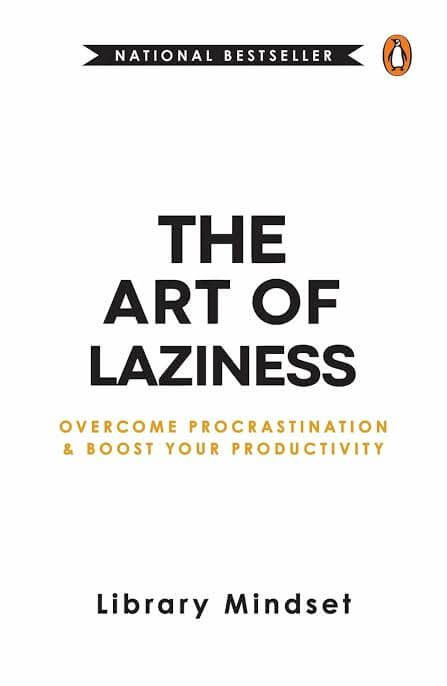
The Art of Laziness: Overcome Procrastination & Improve Your Productivity by Library Mindset

රු1,500.00
3 X Rs. 500.00 or 8% Cashback with


or 3 X රු500.00 with


or up to 4 X රු375.00 with


The Art of Laziness by Library Mindset is an easy-to-read self-development guide about overcoming procrastination, improving focus and becoming more productive.
It offers practical ideas for building better habits, reducing distractions and taking action toward important goals.
Format: Paperback
Pages: 120 recommended for the current printing
Publisher: Penguin Business / Penguin Random House India
ISBN: 9780143469124
5 in stock
The Art of Laziness by Library Mindset
The Art of Laziness: Overcome Procrastination & Improve Your Productivity by Library Mindset is a short, accessible personal-development book about overcoming procrastination, building better habits and making more effective use of your time.
The book starts from a simple problem:
Many people know what they want to do, yet struggle to begin.
They may want to:
- Study
- Exercise
- Build a business
- Read more
- Learn a skill
- Improve their career
- Complete an important project
But instead, they delay.
The book explores ways to move from intention toward action.
Penguin Random House India presents the book as a guide for readers who feel unmotivated and want practical help with overcoming laziness, stopping procrastination and improving productivity.
Overcoming Procrastination
Procrastination is one of the book’s main topics.
People often delay difficult or uncomfortable tasks even when they know those tasks are important.
The book encourages readers to identify this pattern and interrupt it.
Instead of waiting to feel perfectly motivated, the emphasis is on beginning.
A small action can often create momentum.
This idea is especially relevant for readers who repeatedly say:
- “I’ll start tomorrow.”
- “I’ll do it when I feel motivated.”
- “I need more time.”
- “I’m not ready yet.”
The book pushes readers to question whether waiting is actually helping.
Productivity
Another central theme is productivity.
The book does not present productivity simply as working more hours.
Instead, it encourages readers to use their time more deliberately.
That means deciding:
- What matters most
- What should be done first
- What can be removed
- Which distractions are wasting time
- Which habits are preventing progress
The goal is to get meaningful work done rather than simply remain busy.
Motivation
Motivation can be unreliable.
Some days people naturally feel energetic.
Other days they do not.
The Art of Laziness encourages readers not to build their entire life around waiting for motivation.
Instead, progress can come from:
- Routines
- Small actions
- Clear priorities
- Consistency
- Better environmental choices
This makes the book suitable for readers who often begin enthusiastically but struggle to continue.
The Two-Day Rule
One practical idea associated with the book is the Two-Day Rule.
The concept is simple:
Missing one day does not need to become missing several days.
If you skip a habit once, return to it quickly.
For example:
If you normally exercise every day and miss Tuesday, try not to miss Wednesday as well.
This can prevent a temporary interruption from becoming a complete collapse of the habit.
Parkinson’s Law
The book also refers to Parkinson’s Law, the idea that work tends to expand to fill the time available for it.
If you give yourself an entire day to complete a small task, the task may consume the entire day.
Giving yourself a clearer and more reasonable deadline can sometimes improve focus.
The lesson is not to create unrealistic pressure.
It is to avoid giving simple tasks unlimited time.
Distractions
Modern life offers constant distraction.
Examples include:
- Social media
- Short videos
- Notifications
- Messaging apps
- YouTube
- Entertainment
- Constant phone checking
These activities can quietly consume large amounts of time.
The book encourages readers to recognise which distractions repeatedly interrupt meaningful work.
Focus
Improving productivity requires improving focus.
Trying to complete several demanding tasks simultaneously often reduces the quality of attention given to each one.
The book encourages readers to focus on what matters most and reduce unnecessary switching between activities.
This can be especially relevant to:
- Students
- Office workers
- Entrepreneurs
- Freelancers
- Creators
Comfort Zones
Another idea is that growth often requires discomfort.
It can feel easier to remain with familiar routines than to attempt something uncertain.
But meaningful goals often involve:
- Learning
- Failure
- Rejection
- Practice
- Risk
- Temporary discomfort
The book encourages readers to recognise when comfort has become an excuse for avoiding progress.
Clear Goals
Vague goals are difficult to act on.
For example:
“I want to become successful.”
is unclear.
A more specific goal might be:
“I will study this subject for 30 minutes each evening.”
Clear actions make it easier to begin.
The book encourages readers to move from general wishes toward specific behaviours.
Building Better Habits
Habits reduce the need to repeatedly decide what to do.
A useful behaviour performed often enough can become easier over time.
The book discusses ways to develop routines that support:
- Study
- Work
- Exercise
- Reading
- Personal projects
The focus is on creating consistency rather than relying entirely on willpower.
Time Is Limited
One of the book’s recurring motivational ideas is that life is finite.
The original description points out that even someone who lives around eighty years experiences only a limited number of summers.
The point is not to create fear.
It is to remind readers that continually postponing meaningful goals has a cost.
Library Mindset
Library Mindset began as an online book-focused community.
Penguin’s catalogue describes Library Mindset as a book community that began in 2020 and had grown to millions of followers across social platforms by the time this edition was published.
The writing style reflects that social-media background:
- Short ideas
- Practical lessons
- Memorable examples
- Easy-to-read sections
This makes the book approachable for readers who may not normally read long productivity books.
Who May Enjoy This Book?
The Art of Laziness may appeal to readers interested in:
- Productivity
- Motivation
- Procrastination
- Habit building
- Time management
- Focus
- Self-discipline
- Personal development
- Self-improvement
It may especially suit beginners who want a short and straightforward introduction rather than a highly academic productivity book.
Important Evidence Note
This is a popular self-help and motivational book, not a clinical psychology or neuroscience textbook.
Its advice should be treated as general personal-development guidance.
Persistent lack of motivation can sometimes be connected to circumstances such as burnout, sleep problems, stress or health conditions, so the idea of “laziness” should not automatically be used to explain every difficulty with productivity.
For readers looking to buy The Art of Laziness by Library Mindset in Sri Lanka, ISBN 9780143469124 is the Penguin Business paperback edition used for this listing.
Be the first to review “The Art of Laziness: Overcome Procrastination & Improve Your Productivity by Library Mindset”
Related products
-24%

Out of stock
Non-Fiction & Knowledge
Original price was: රු2,500.00.රු1,900.00Current price is: රු1,900.00.
3 X Rs. 633.33 or 8% Cashback with
or 3 X රු633.33 with
or up to 4 X රු475.00 with
Non-Fiction & Knowledge
රු1,650.00
3 X Rs. 550.00 or 8% Cashback with
or 3 X රු550.00 with
or up to 4 X රු412.50 with

Non-Fiction & Knowledge
රු1,700.00
3 X Rs. 566.67 or 8% Cashback with
or 3 X රු566.67 with
or up to 4 X රු425.00 with
-11%

Non-Fiction & Knowledge
Original price was: රු2,200.00.රු1,950.00Current price is: රු1,950.00.
3 X Rs. 650.00 or 8% Cashback with
or 3 X රු650.00 with
or up to 4 X රු487.50 with
-24%
Out of stock
Non-Fiction & Knowledge
Original price was: රු2,100.00.රු1,600.00Current price is: රු1,600.00.
3 X Rs. 533.33 or 8% Cashback with
or 3 X රු533.33 with
or up to 4 X රු400.00 with

Non-Fiction & Knowledge
රු1,550.00
3 X Rs. 516.67 or 8% Cashback with
or 3 X රු516.67 with
or up to 4 X රු387.50 with

Non-Fiction & Knowledge
රු1,950.00
3 X Rs. 650.00 or 8% Cashback with
or 3 X රු650.00 with
or up to 4 X රු487.50 with
Non-Fiction & Knowledge
රු1,750.00
3 X Rs. 583.33 or 8% Cashback with
or 3 X රු583.33 with
or up to 4 X රු437.50 with
Reviews
There are no reviews yet.