
No products in the cart.
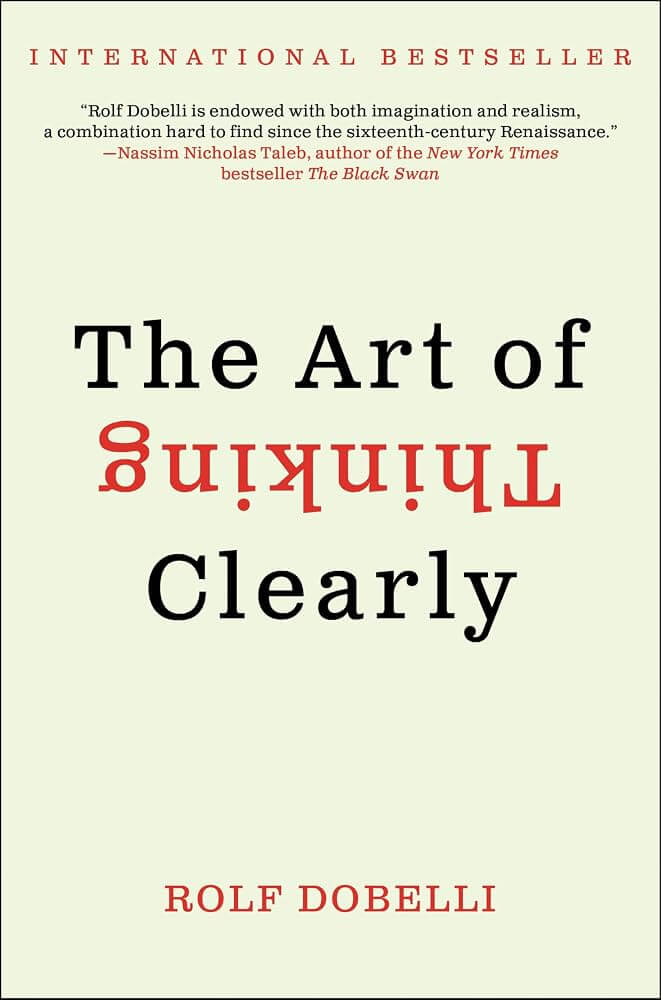
The Art of Thinking Clearly: Better Thinking, Better Decisions by Rolf Dobelli

රු1,650.00
3 X Rs. 550.00 or 8% Cashback with


or 3 X රු550.00 with


or up to 4 X රු412.50 with


The Art of Thinking Clearly by Rolf Dobelli explores 99 common cognitive errors that can distort our judgment and decision-making.
Through short, easy-to-read chapters, Dobelli examines biases such as survivorship bias, sunk costs, social proof and overconfidence to help readers make clearer choices.
Format: Paperback
Pages: 336
Publisher: Sceptre / Hodder & Stoughton
ISBN: 9781444759563
5 in stock
The Art of Thinking Clearly by Rolf Dobelli
The Art of Thinking Clearly by Rolf Dobelli is an accessible guide to the common thinking errors that can influence our decisions without us noticing.
Rather than presenting one long argument, Dobelli divides the book into 99 short chapters, each examining a particular cognitive error, bias or decision-making trap.
These include patterns such as:
- Survivorship bias
- Sunk cost fallacy
- Confirmation bias
- Social proof
- Overconfidence
- Loss aversion
- Availability bias
- Anchoring
- Framing
- Authority bias
The book’s central idea is simple:
Better decisions can often come not from becoming dramatically smarter, but from learning to recognize the predictable ways our thinking can go wrong.
Current publisher-linked descriptions present the book as a practical guide to spotting common cognitive errors and improving choices in work, money and everyday life.
Cognitive Biases
Human beings do not evaluate every situation perfectly rationally.
Our brains use shortcuts.
These shortcuts can be useful because they allow us to make decisions quickly.
But they can also create predictable mistakes.
Dobelli examines these patterns in short, memorable chapters.
The book aims to help readers recognize them before they influence an important decision.
Survivorship Bias
One of the best-known concepts discussed in the book is survivorship bias.
People often focus on successful examples because those are the examples they can see.
But unsuccessful cases may be invisible.
For example, if we study only successful entrepreneurs, we may conclude that certain habits guarantee success.
What we may overlook are the many people who followed similar strategies and failed.
The lesson is to consider the unseen failures as well as the visible successes.
Sunk Cost Fallacy
The sunk cost fallacy happens when people continue with something simply because they have already invested:
- Time
- Money
- Effort
- Emotion
A person may continue a failing project because they have already spent a large amount on it.
But past costs cannot be recovered.
Dobelli encourages readers to focus instead on whether continuing makes sense from the present moment forward.
Confirmation Bias
Confirmation bias describes our tendency to notice information that supports what we already believe.
People may:
- Seek supportive evidence
- Ignore contradictory information
- Interpret ambiguity in their favour
This can affect decisions in:
- Business
- Investing
- Relationships
- Careers
- Everyday arguments
Recognizing confirmation bias can encourage people to deliberately look for evidence that challenges their own assumptions.
Social Proof
People often copy what others are doing.
Sometimes this is sensible.
If many people are running out of a building, following them may be a good idea.
But social proof can also lead people into poor decisions simply because something is popular.
This can affect:
- Trends
- Investing
- Consumer behaviour
- Social media
- Group decisions
Dobelli encourages readers to distinguish between useful collective information and blind imitation.
Overconfidence
People often overestimate:
- Their knowledge
- Their predictions
- Their abilities
- Their control over outcomes
This can create problems when making decisions involving uncertainty.
A person may be confident without actually having enough evidence.
The book repeatedly encourages humility about what we know.
Loss Aversion
Losses often feel more painful than equivalent gains feel pleasurable.
This psychological tendency is commonly called loss aversion.
It can affect decisions involving:
- Money
- Investments
- Negotiation
- Relationships
- Career choices
Someone may avoid a sensible opportunity because they fear losing what they already have.
Availability Bias
People often judge likelihood based on how easily an example comes to mind.
If dramatic events receive heavy media attention, they may feel more common than they really are.
This can distort:
- Risk perception
- Financial decisions
- Everyday fears
Dobelli encourages readers to separate memorable stories from actual probabilities.
Anchoring
Anchoring happens when an initial number or piece of information influences later judgments.
For example, the first price someone sees can shape whether a later price feels cheap or expensive.
Anchors can appear in:
- Negotiations
- Retail pricing
- Salary discussions
- Forecasts
- Business decisions
Even arbitrary numbers can sometimes influence judgment.
Framing
The way information is presented can influence how people interpret it.
A statement such as:
“90% survival rate”
can feel very different from:
“10% mortality rate”
even though they describe the same outcome.
Dobelli uses examples like this to show how presentation can shape perception.
Authority Bias
People often give extra weight to statements made by:
- Experts
- Leaders
- Famous people
- Professionals
- Institutions
Authority can be useful.
Experts often know more than non-experts.
But Dobelli warns against assuming that authority automatically guarantees correctness.
Action Bias
People often feel pressure to do something when faced with uncertainty.
Action can feel more responsible than waiting.
But sometimes the best decision is to do nothing until better information becomes available.
This is particularly relevant to:
- Investing
- Management
- Crisis decisions
The urge to act can create unnecessary mistakes.
Outcome Bias
A good outcome does not always mean the original decision was good.
A bad decision can occasionally produce a lucky result.
Likewise, a sensible decision can sometimes lead to a poor outcome.
Dobelli encourages readers to judge decisions partly by the quality of the reasoning used at the time, not only by the result afterward.
Short, Accessible Chapters
One of the main strengths of The Art of Thinking Clearly is its structure.
The book consists of 99 short chapters, each focused on one thinking error.
That makes it easy to read:
- One chapter at a time
- During a commute
- Between other books
- As a reference book
Readers can also return to specific chapters whenever they encounter a similar decision-making problem.
Psychology Without Heavy Academic Language
The book draws on ideas associated with:
- Cognitive psychology
- Behavioural economics
- Decision science
But it is written for general readers.
It does not require a background in psychology.
Dobelli explains concepts through everyday examples rather than academic formulas.
Practical Decision-Making
The book may be especially useful for people making decisions involving:
- Careers
- Investing
- Business
- Relationships
- Negotiation
- Management
- Personal finance
Its main value is not memorizing every bias.
The goal is to become more aware of situations where judgment may be distorted.
Important Evidence Note
The Art of Thinking Clearly is a popular psychology and decision-making book.
Many of the biases it discusses are established concepts in psychology and behavioural economics.
However, the book presents them in a simplified, practical format rather than as a comprehensive academic review.
Readers should therefore treat it as an accessible introduction to clearer thinking, not as a substitute for a psychology textbook or professional advice.
Translation
The English edition is translated by Nicky Griffin.
The original German title is:
Die Kunst des klaren Denkens
The English edition’s copyright material confirms that it is a translation of Dobelli’s original German work.
Who May Enjoy This Book?
The Art of Thinking Clearly may appeal to readers interested in:
- Psychology
- Decision-making
- Behavioural economics
- Critical thinking
- Personal development
- Business
- Investing
- Human behaviour
- Cognitive biases
It may especially appeal to readers who enjoyed:
- Thinking, Fast and Slow
- Predictably Irrational
- The Psychology of Money
- Nudge
- Thinking in Bets
About Rolf Dobelli
Rolf Dobelli is a Swiss author and entrepreneur known for writing about decision-making, clear thinking and modern intellectual life.
His books include:
- The Art of Thinking Clearly
- The Art of the Good Life
- Stop Reading the News
Current bookseller profiles also identify him as the founder of Zurich.Minds and a co-founder of getAbstract.
For readers looking to buy The Art of Thinking Clearly by Rolf Dobelli in Sri Lanka, ISBN 9781444759563 is the Sceptre paperback edition used for this listing.
Be the first to review “The Art of Thinking Clearly: Better Thinking, Better Decisions by Rolf Dobelli”
Related products

Non-Fiction & Knowledge
රු1,950.00
3 X Rs. 650.00 or 8% Cashback with
or 3 X රු650.00 with
or up to 4 X රු487.50 with
Non-Fiction & Knowledge
රු1,650.00
3 X Rs. 550.00 or 8% Cashback with
or 3 X රු550.00 with
or up to 4 X රු412.50 with
-34%
Non-Fiction & Knowledge
Original price was: රු2,250.00.රු1,490.00Current price is: රු1,490.00.
3 X Rs. 496.67 or 8% Cashback with
or 3 X රු496.67 with
or up to 4 X රු372.50 with
-24%
Out of stock
Non-Fiction & Knowledge
Original price was: රු2,500.00.රු1,900.00Current price is: රු1,900.00.
3 X Rs. 633.33 or 8% Cashback with
or 3 X රු633.33 with
or up to 4 X රු475.00 with
-33%
Non-Fiction & Knowledge
Original price was: රු2,850.00.රු1,900.00Current price is: රු1,900.00.
3 X Rs. 633.33 or 8% Cashback with
or 3 X රු633.33 with
or up to 4 X රු475.00 with
රු2,100.00
3 X Rs. 700.00 or 8% Cashback with
or 3 X රු700.00 with
or up to 4 X රු525.00 with
Non-Fiction & Knowledge
රු1,700.00
3 X Rs. 566.67 or 8% Cashback with
or 3 X රු566.67 with
or up to 4 X රු425.00 with
Non-Fiction & Knowledge
රු1,550.00
3 X Rs. 516.67 or 8% Cashback with
or 3 X රු516.67 with
or up to 4 X රු387.50 with
Reviews
There are no reviews yet.