
No products in the cart.
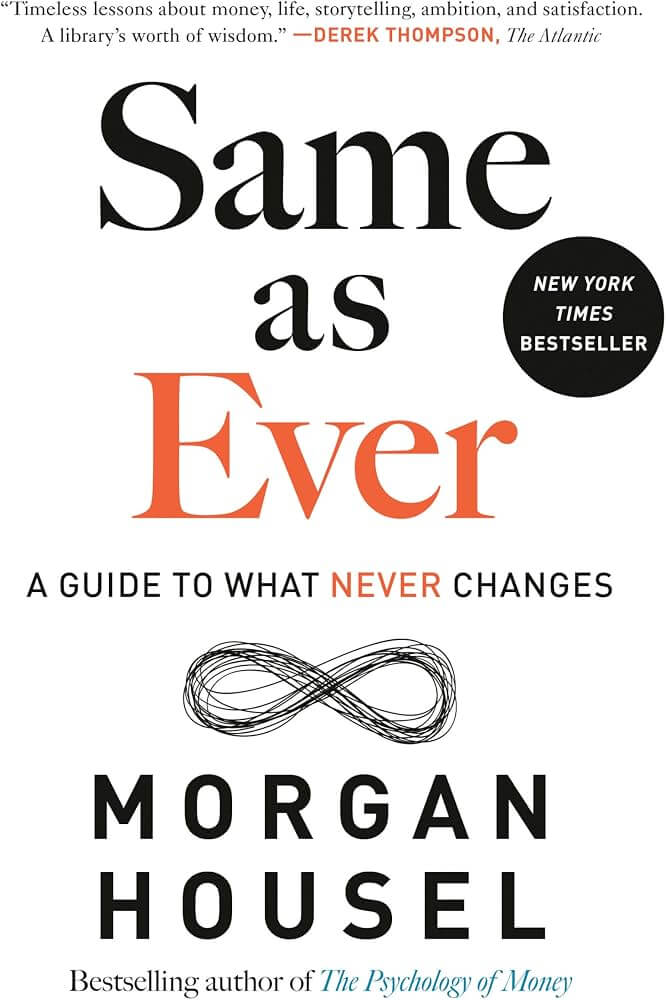
Same as Ever: A Guide to What Never Changes by Morgan Housel


රු2,100.00
3 X Rs. 700.00 or 8% Cashback with


or 3 X රු700.00 with


or up to 4 X රු525.00 with


Same as Ever: A Guide to What Never Changes by Morgan Housel explores timeless patterns in human behaviour, risk, money, opportunity and decision-making.
Through memorable stories and practical lessons, Housel explains why understanding what remains constant may be more useful than trying to perfectly predict the future.
Format: Hardcover
Pages: 240
Publisher: Portfolio / Penguin Random House
ISBN: 9780593332702
2100 in stock
Same as Ever by Morgan Housel
Same as Ever: A Guide to What Never Changes by Morgan Housel is a thought-provoking book about one simple but powerful idea:
Instead of always asking what will change in the future, it may be more useful to ask:
What will stay the same?
Morgan Housel is best known for The Psychology of Money, and in Same as Ever he turns his attention toward the recurring patterns of human behaviour, risk, uncertainty, ambition, wealth, fear and opportunity.
Penguin Random House describes the book as a collection of stories and examples designed to help readers understand the things that remain consistently true even when the world around us changes.
Why Focus on What Never Changes?
Predicting the future is difficult.
Investors try to predict markets.
Businesses try to predict consumer behaviour.
People try to predict careers, technology, relationships and economic conditions.
But the events that matter most are often unexpected.
Housel suggests a different approach.
Instead of trying to perfectly predict what comes next, readers can study the things that have remained surprisingly stable over long periods of time.
These include:
- Human fear
- Greed
- Envy
- Ambition
- Risk
- Incentives
- Expectations
- Storytelling
- Patience
- Uncertainty
The environment changes.
Human behaviour often does not.
Timeless Human Behaviour
A major theme of the book is that technology changes faster than psychology.
People now use smartphones, social media, online banking and artificial intelligence.
But many of the emotional forces behind decisions are extremely old.
People still:
- Fear losing what they have
- Compare themselves with others
- Chase status
- Overestimate what they can predict
- Underestimate rare events
- Become overconfident after success
- Panic during uncertainty
Understanding those patterns can be more useful than trying to predict every future headline.
Risk
Risk is one of the most important topics in Same as Ever.
Housel emphasises that the biggest risks are often the ones people do not see coming.
That creates a paradox.
If a danger is obvious and widely understood, people may already have prepared for it.
The risks that cause the most disruption are often unexpected.
This is why Housel encourages readers to build room for error.
Rather than designing a plan that only works if everything goes correctly, it can be wiser to prepare for:
- Delays
- Mistakes
- Market downturns
- Unexpected expenses
- Business problems
- Personal setbacks
A strong plan should be able to survive surprise.
Expectations
Another important theme is the relationship between reality and expectations.
People do not always judge life based on what they have.
They often judge it based on what they expected to have.
A person can become wealthier and still feel disappointed if expectations rise even faster.
This idea applies to:
- Money
- Careers
- Lifestyle
- Relationships
- Business
- Investment returns
Housel argues that managing expectations can be just as important as improving circumstances.
The Role of Stories
Humans understand the world through stories.
Numbers matter.
Data matters.
But stories often have greater emotional power.
This affects:
- Investing
- Politics
- Business
- Marketing
- Social trends
- Personal beliefs
A compelling story can influence behaviour even when evidence is incomplete.
That makes storytelling extremely powerful.
It can help people understand difficult ideas, but it can also create overconfidence or herd behaviour.
Money and Wealth
Like The Psychology of Money, this book contains several lessons connected to wealth.
Housel repeatedly returns to ideas such as:
- Patience
- Long-term thinking
- Compounding
- Saving
- Avoiding ruin
- Controlling expectations
He argues that financial success often depends less on perfect forecasting and more on surviving long enough for good decisions to compound.
That makes endurance an important competitive advantage.
Compounding
Compounding works best when something is allowed to continue for a long time.
This can apply to:
- Money
- Knowledge
- Reputation
- Relationships
- Skills
- Businesses
The difficulty is that people often interrupt compounding because they become impatient.
A strategy that looks boring in the short term may become extremely powerful over decades.
Patience
Patience appears repeatedly throughout the book.
Many meaningful results take longer than people expect.
Housel highlights the difference between:
- Short-term excitement
- Long-term effectiveness
The best decision is not always the one that creates the fastest result.
Sometimes the greatest advantage is simply being able to continue longer than others.
Success and Luck
The book also explores the relationship between effort and luck.
Success can involve:
- Skill
- Preparation
- Timing
- Persistence
- Opportunity
- Randomness
This matters because people often study successful individuals and assume every outcome was intentionally created.
Housel encourages readers to remain aware of uncertainty.
Good decisions do not always produce good outcomes.
Bad decisions do not always produce immediate failure.
Over time, however, decision quality still matters.
Opportunity
Uncertainty creates danger, but it also creates opportunity.
Periods of disruption may create:
- New businesses
- New technologies
- New careers
- New investment opportunities
- New markets
Housel does not suggest that people should blindly take risks.
Instead, the broader lesson is to remain flexible enough to respond when opportunities appear.
Incentives
People often respond strongly to incentives.
A system may be designed with good intentions, but if incentives encourage the wrong behaviour, the result can be very different from what was intended.
Understanding incentives can help explain behaviour in:
- Companies
- Markets
- Governments
- Organizations
- Personal finance
This is one of the recurring ideas Housel uses to show how human behaviour remains consistent across different periods.
Short Stories and Examples
One reason Same as Ever is accessible is its structure.
Housel uses short stories, historical examples and compact lessons rather than building one long technical argument.
The Harriman House description of the international edition notes that the book is built around 24 short stories about the ways life, behaviour and business continue to repeat familiar patterns.
That makes the book suitable for readers who enjoy learning through examples.
Practical Rather Than Predictive
The book is not a forecast of exactly what will happen next.
Its purpose is almost the opposite.
Housel argues that forecasting is unreliable.
Instead, he focuses on principles that may remain useful across many possible futures.
These include:
- Avoiding ruin
- Being patient
- Managing expectations
- Understanding incentives
- Leaving room for error
- Thinking long term
- Respecting uncertainty
Who May Enjoy This Book?
Same as Ever may appeal to readers interested in:
- Personal finance
- Investing
- Psychology
- Risk
- Decision-making
- Business
- Economics
- Human behaviour
- Long-term thinking
- Self-development
It may especially appeal to readers who enjoyed:
- The Psychology of Money
- The Intelligent Investor
- Thinking, Fast and Slow
- The Black Swan
- The Almanack of Naval Ravikant
- Atomic Habits
About Morgan Housel
Morgan Housel is a writer and partner at The Collaborative Fund.
Penguin Random House notes that he has won the Society of American Business Editors and Writers’ Best in Business Award twice, has won the New York Times Sidney Award, and has been a finalist for the Gerald Loeb Award.
His books include:
- The Psychology of Money
- Same as Ever
- The Art of Spending Money
For readers searching for Same as Ever by Morgan Housel in Sri Lanka, ISBN 9780593332702 is the Portfolio hardcover edition used for this listing.
Be the first to review “Same as Ever: A Guide to What Never Changes by Morgan Housel”
Related products
Self-Help & Psychology
රු1,200.00
3 X Rs. 400.00 or 8% Cashback with
or 3 X රු400.00 with
or up to 4 X රු300.00 with
Non-Fiction & Knowledge
රු2,250.00
3 X Rs. 750.00 or 8% Cashback with
or 3 X රු750.00 with
or up to 4 X රු562.50 with

Non-Fiction & Knowledge
රු1,950.00
3 X Rs. 650.00 or 8% Cashback with
or 3 X රු650.00 with
or up to 4 X රු487.50 with
Self-Help & Psychology
රු1,350.00
3 X Rs. 450.00 or 8% Cashback with
or 3 X රු450.00 with
or up to 4 X රු337.50 with
-24%
Non-Fiction & Knowledge
Original price was: රු2,300.00.රු1,750.00Current price is: රු1,750.00.
3 X Rs. 583.33 or 8% Cashback with
or 3 X රු583.33 with
or up to 4 X රු437.50 with
Out of stock
Autobiography
රු2,750.00
3 X Rs. 916.67 or 8% Cashback with
or 3 X රු916.67 with
or up to 4 X රු687.50 with
Non-Fiction & Knowledge
රු1,650.00
3 X Rs. 550.00 or 8% Cashback with
or 3 X රු550.00 with
or up to 4 X රු412.50 with

Self-Help & Psychology
රු1,500.00
3 X Rs. 500.00 or 8% Cashback with
or 3 X රු500.00 with
or up to 4 X රු375.00 with
Reviews
There are no reviews yet.