
No products in the cart.
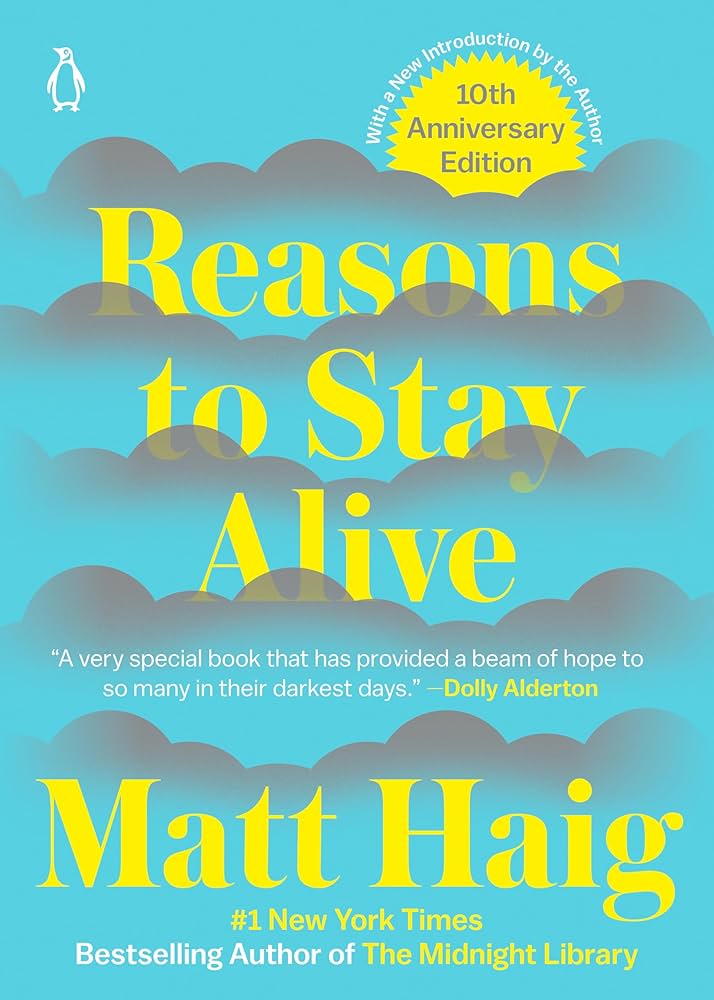
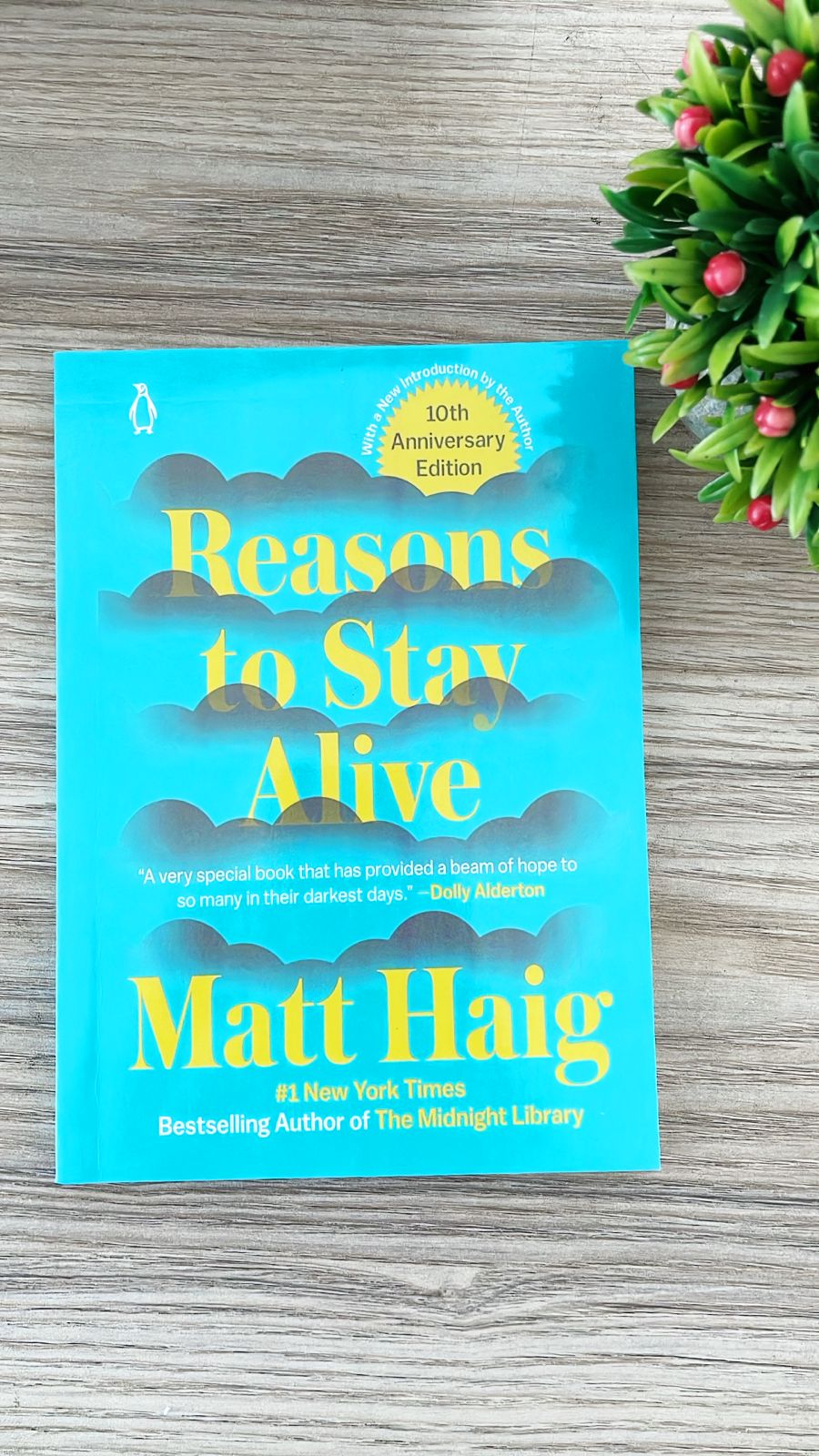











Reasons to Stay Alive by Matt Haig is a deeply personal, compassionate and ultimately hopeful memoir about depression, anxiety, recovery and rediscovering the value of being alive when life feels unbearably difficult.
At the age of twenty-four, Matt Haig experienced a severe mental-health crisis.
His world seemed to collapse.
Ordinary tasks became overwhelming.
His thoughts frightened him.
His anxiety became intense.
And he struggled to imagine a future in which he might feel differently.
Yet time passed.
His condition changed.
Slowly, imperfectly and without one magical solution, Haig began to recover.
Reasons to Stay Alive by Matt Haig grew from that experience.
Rather than presenting depression as a problem with a simple cure, Haig writes about what it felt like from the inside and the things that gradually helped him reconnect with life.
Love.
Family.
Books.
Walking.
Writing.
Time.
Conversation.
Perspective.
Small moments.
Hope.
He writes not as a doctor giving clinical instructions, but as someone describing what he personally lived through and what he learned from surviving it.
The result is a book that can feel less like a traditional self-help manual and more like hearing from someone who has been through an extremely dark period and wants to tell you:
Things can change, even when your mind is telling you they never will.
Reasons to Stay Alive by Matt Haig – Book Overview
Reasons to Stay Alive by Matt Haig sits somewhere between memoir, reflection and personal-development writing.
It is autobiographical because Haig describes his own experiences.
It is reflective because he considers what those experiences taught him about life.
And it can feel supportive because many of the lessons are written in short, accessible sections that readers can return to during difficult periods.
The book is not built around one long chronological narrative.
Instead, Haig combines:
Memories.
Lists.
Observations.
Short reflections.
Personal stories.
Thoughts about depression and anxiety.
Ideas about what makes life meaningful.
This structure makes the book easy to read in smaller sections.
Matt Haig’s Mental-Health Crisis
Haig has written openly about becoming severely depressed while in his twenties.
The experience affected both his mind and body.
Depression was not simply feeling sad.
Anxiety was not simply worrying too much.
His symptoms changed the way he experienced:
Time.
Space.
His body.
Other people.
The future.
Everyday decisions.
That distinction is important because people who have never experienced severe depression may underestimate how physically and mentally consuming it can become.
Depression Is More Than Sadness
One of the valuable aspects of Reasons to Stay Alive by Matt Haig is its attempt to describe depression from inside the experience.
Sadness usually has a recognizable emotional quality.
Depression can involve:
Numbness.
Fear.
Exhaustion.
Hopelessness.
Disconnection.
Physical symptoms.
Loss of interest.
Difficulty imagining change.
Different people experience depression differently, and Haig repeatedly writes from his own perspective rather than claiming that everyone will experience exactly what he did.
Anxiety
Anxiety is also central to the memoir.
Haig describes intense fear and panic alongside depression.
This creates a difficult combination.
Depression may say:
Nothing will improve.
Anxiety may simultaneously make everything feel urgent and threatening.
Living between those states can become exhausting.
The Mind Can Make Temporary Pain Feel Permanent
One of the most powerful ideas in Reasons to Stay Alive by Matt Haig is that a distressed mind may interpret the present as permanent.
When someone feels terrible today, the brain may say:
You will always feel like this.
Nothing will change.
This is your life now.
Haig’s own recovery challenges that assumption.
Feelings can be extremely real without being accurate predictions of the future.
Time
Time becomes one of the book’s most important themes.
Recovery does not always happen dramatically.
Sometimes change becomes visible only when looking backward.
A person may still be struggling today but realize:
I handled something this month that I could not handle six months ago.
That is progress.
Recovery Is Not Always Linear
Mental-health recovery rarely follows a perfectly straight path.
Better day.
Better day.
Better day.
Finished.
Real recovery may look more like:
Improvement.
Setback.
Good week.
Bad morning.
Progress.
Fear.
More progress.
That does not necessarily mean recovery has failed.
Small Improvements Matter
When life feels overwhelming, a huge goal such as:
“Become completely happy”
may be unrealistic.
A smaller goal can be:
Get through today.
Take a shower.
Go outside.
Eat something.
Answer one message.
Read two pages.
Small actions can matter precisely because they are possible.
Love
Love plays an important role in Reasons to Stay Alive by Matt Haig.
During Haig’s darkest period, the presence of people who cared for him mattered enormously.
That does not mean love magically cures mental illness.
It means human connection can provide:
Support.
Patience.
Companionship.
Reasons to continue.
Someone does not always need to know exactly what to say.
Sometimes staying present matters.
Family
Family relationships also appear throughout Haig’s story.
Mental illness affects more than the person experiencing symptoms.
Partners.
Parents.
Friends.
Other family members.
may also feel:
Fear.
Confusion.
Helplessness.
Learning how to support someone can be difficult when there is no simple solution.
You Do Not Need Perfect Words
People sometimes avoid someone who is struggling because they fear saying the wrong thing.
Support does not always require a brilliant speech.
It may look like:
Listening.
Checking in.
Helping with practical things.
Taking someone’s distress seriously.
Encouraging appropriate professional help.
Remaining compassionate.
Books
Reading becomes another important source of connection.
Books can help people recognize that other minds have experienced:
Fear.
Grief.
Loneliness.
Uncertainty.
Survival.
A reader who feels isolated may discover language for something they could not explain themselves.
Words Can Create Perspective
One reason Reasons to Stay Alive by Matt Haig resonates with readers is that Haig tries to give language to experiences that can feel almost impossible to describe.
Naming an experience does not automatically solve it.
But language can make it feel less mysterious.
Writing
Writing became part of Haig’s way of processing experience.
Writing can help some people:
Organize thoughts.
Observe emotions.
Separate thoughts from facts.
Record progress.
Express things that are difficult to say aloud.
This does not mean writing is a treatment for everyone, but it can be a useful tool for reflection.
Walking
Haig also writes about the value of movement and walking.
A walk may not solve the problem causing distress.
But movement can change:
Environment.
Attention.
Routine.
Physical state.
Sometimes leaving one room is enough to slightly change the emotional landscape of a difficult moment.
Nature
Nature can provide perspective.
Sky.
Trees.
Weather.
Animals.
Seasons.
Natural rhythms continue regardless of the thoughts filling our minds.
For some people, being outside creates enough distance from internal distress to make the day more manageable.
Exercise and Mental Health
Physical activity can support wellbeing for many people.
But Reasons to Stay Alive by Matt Haig should not be reduced to advice such as:
“Just exercise and depression will disappear.”
Mental-health conditions vary enormously.
Exercise can be one helpful component alongside medical care, therapy, social support, sleep, medication when appropriate, and other interventions.
The Internet
Modern life gives people unprecedented access to information and connection.
It also creates comparison.
You may compare:
Your ordinary day
with
Someone else’s carefully selected highlight.
That can distort reality.
Everyone else appears:
Successful.
Happy.
Confident.
Social.
Productive.
Your own struggles remain fully visible to you while theirs remain hidden.
Comparison
Comparison can make a difficult emotional state worse.
You may think:
Everyone else is handling life better than me.
But you cannot see another person’s inner world.
Their appearance is not proof of emotional ease.
Social Pressure
Society often creates pressure to:
Achieve more.
Earn more.
Look better.
Be happier.
Travel more.
Work harder.
Become more interesting.
But constant self-optimization can make ordinary life feel like failure.
Haig’s reflections often point toward appreciating life rather than continually trying to turn yourself into a different person.
Being Alive Is Not a Productivity Competition
A person’s value is not equal to:
Salary.
Grades.
Job title.
Follower count.
Body shape.
Productivity.
People may intellectually understand this while emotionally continuing to judge themselves by those measures.
Reasons to Stay Alive by Matt Haig repeatedly moves attention toward simpler experiences of being human.
Ordinary Things
Some of life’s reasons to continue are not dramatic.
Coffee.
Conversation.
Music.
A book.
Sunlight.
Walking.
Laughter.
A future trip.
A person you love.
Something you have not experienced yet.
The value of these things can be difficult to perceive during severe depression.
But inability to feel their value now does not mean that value is permanently gone.
Future Experiences
One of the strongest reasons for hope is that the future contains things we cannot yet predict.
People we have not met.
Books we have not read.
Places we have not visited.
Jokes we have not heard.
Meals we have not tasted.
Versions of ourselves we have not yet become.
Despair often makes the future feel closed.
Reality remains open.
The Present Is Not the Whole Story
A terrible chapter is still a chapter.
It is not automatically the ending.
That may sound simple.
But during crisis, remembering that distinction can become enormously difficult.
Hope
Hope in Reasons to Stay Alive by Matt Haig is not presented as constant optimism.
Hope can be much smaller.
Hope can simply mean:
Maybe this feeling is not permanent.
Maybe tomorrow will be different.
Maybe someone can help.
Maybe I should stay long enough to find out.
You Do Not Have to Feel Hope to Continue
This is an important distinction.
Someone may feel completely hopeless and still take a helpful action.
You can:
Call someone.
Attend an appointment.
Eat.
Rest.
Stay near people.
Seek urgent support.
Action does not always need to wait for motivation.
Mental Illness and Identity
A person may begin to think:
I am depression.
I am anxiety.
But an illness is not the total identity of a human being.
You can experience depression without depression containing everything about you.
Thoughts Are Not Always Facts
A distressed mind can generate extremely convincing thoughts.
“I am useless.”
“Everyone would be better without me.”
“Nothing will ever change.”
The emotional intensity of a thought does not prove its truth.
Learning to create even a little distance between:
“I am thinking this”
and
“This is objectively true”
can be important.
Self-Compassion
Many people speak to themselves in ways they would never speak to another person.
One mistake becomes:
I ruin everything.
One bad day becomes:
I will never improve.
Self-compassion means recognizing difficulty without adding unnecessary self-attack.
You Are Allowed to Struggle
Struggle is not a moral failure.
Needing help is not evidence of weakness.
People seek treatment for physical illness without expecting shame.
Mental health deserves the same seriousness.
Medication and Treatment
Haig writes from his personal experience, and readers should avoid treating any one person’s recovery path as universal.
Different people may benefit from different combinations of:
Psychotherapy.
Medication.
Lifestyle changes.
Social support.
Medical treatment.
Specialist mental-health care.
What worked for one writer is not automatically the correct treatment for another person.
This Book Is Not a Replacement for Professional Care
This is important.
Reasons to Stay Alive by Matt Haig can offer:
Recognition.
Comfort.
Perspective.
Hope.
Language.
But it is a memoir, not a clinical treatment program.
Readers experiencing serious depression, panic, suicidal thoughts or another mental-health crisis should seek appropriate professional or emergency support rather than relying on a book alone.
Panic
Panic can make ordinary physical sensations feel terrifying.
Heart racing.
Breathing changing.
Dizziness.
Fear.
A person may interpret these sensations as evidence of immediate catastrophe.
Understanding panic does not always make it disappear instantly, but knowledge can reduce some of the mystery surrounding the experience.
The Body and Mind Are Connected
Mental states affect the body.
Physical states affect the mind.
Sleep deprivation can affect mood.
Stress affects the body.
Movement may influence emotional state.
Illness can affect mental wellbeing.
Separating “mental” and “physical” health too sharply can therefore be misleading.
Sleep
Sleep problems can worsen emotional distress.
At the same time, depression and anxiety can make sleep difficult.
This creates a frustrating cycle.
Protecting sleep where possible can therefore become part of broader wellbeing.
Alcohol and Other Coping Strategies
People in distress may reach for substances to escape uncomfortable thoughts or feelings.
Temporary relief can sometimes create larger long-term problems.
Healthy support systems and professional guidance are safer ways to address persistent psychological distress.
Being Honest
One of the barriers around mental health is the pressure to pretend.
“I’m fine.”
Sometimes saying:
“I am not doing well.”
is an important first step.
Honesty gives other people an opportunity to respond.
Stigma
Mental illness has historically been surrounded by shame.
People may worry that depression makes them:
Weak.
Ungrateful.
Difficult.
Unsuccessful.
None of those conclusions necessarily follows.
Mental-health conditions affect people across all backgrounds.
Success Does Not Immunize Anyone
Money.
Career success.
Intelligence.
Relationships.
Public recognition.
None guarantees protection from mental illness.
This matters because people sometimes blame themselves:
“My life looks good. Why do I feel terrible?”
Mental-health problems do not always follow a simple external explanation.
Gratitude Without Guilt
Gratitude can be useful.
But telling someone with depression:
“You should be grateful”
can become harmful if it implies they chose their symptoms.
A person can know they have good things in life and still be clinically depressed.
Both can be true.
Acceptance
Recovery may involve accepting that difficult feelings sometimes exist without immediately fighting every one of them.
This does not mean surrender.
It means reducing the secondary struggle:
I should not feel this.
Why am I feeling this?
I am failing because I feel this.
Sometimes the feeling becomes easier to carry when it is not treated as another personal failure.
Change
A central message in Reasons to Stay Alive by Matt Haig is that human beings change.
Bodies change.
Circumstances change.
Relationships change.
Thought patterns change.
Emotional states change.
No feeling can guarantee its own permanence.
Perspective
Pain compresses perspective.
A bad moment can become:
My entire life.
Perspective widens the frame.
There was a before.
There can be an after.
Bad Days Are Still Days
A bad day does not erase progress.
A difficult week does not prove that recovery was imaginary.
Human wellbeing naturally fluctuates.
Judging the whole journey by the worst hour creates an unfair picture.
The Importance of Connection
Isolation can intensify distress.
Connection may come through:
Friends.
Family.
Support groups.
Therapists.
Doctors.
Communities.
Even a brief honest conversation may reduce the feeling of carrying everything alone.
Asking for Help
Asking for help can feel difficult because it creates vulnerability.
But help-seeking is often an act of courage.
It means saying:
I want things to improve enough that I am willing to involve someone else.
Help Can Be Practical
Support is not always emotional conversation.
Sometimes help means:
Driving someone to an appointment.
Cooking a meal.
Helping with paperwork.
Sitting nearby.
Taking care of practical problems can free some mental energy during a crisis.
Reasons Can Be Small
The title Reasons to Stay Alive may sound as though every reason must be profound.
It does not.
A reason can be:
Tomorrow’s breakfast.
A pet.
A sibling.
A film you want to see.
A book you have not finished.
A person who loves you.
A future version of yourself.
Small reasons still count.
Meaning Can Return
During depression, activities that once mattered may feel empty.
This can be frightening.
A person may think:
If I cannot enjoy this now, I will never enjoy anything again.
But the ability to experience pleasure and meaning can return as symptoms improve.
Memory Is Biased by Mood
When people feel terrible, memory can become selective.
The mind may recall failures easily and good experiences poorly.
It may seem as though life has always been bad.
Mood can influence how the past is interpreted.
Reading During Difficult Times
One reason readers connect strongly with Reasons to Stay Alive by Matt Haig is that its short sections make it easier to approach when concentration is limited.
Someone who struggles to focus on a long chapter may still manage a few pages.
Accessible Writing
Haig’s style is direct, conversational and reflective.
He does not bury personal experience under heavy academic terminology.
That makes the book approachable for readers who may not normally choose psychology or mental-health nonfiction.
Is Reasons to Stay Alive a Self-Help Book?
Partly, but memoir is the better primary description.
Haig shares personal lessons and reflections that readers may find useful, but the book is rooted in his own lived experience rather than offering a formal therapeutic program.
Is Reasons to Stay Alive Based on a True Story?
Yes.
Reasons to Stay Alive by Matt Haig is nonfiction and draws directly from Haig’s own experiences with depression, anxiety and recovery. Canongate describes it as the true story of the crisis he experienced at age twenty-four and how he gradually learned to live again.
Is It Connected to The Midnight Library?
No.
The Midnight Library is a fictional novel by Matt Haig.
Reasons to Stay Alive is nonfiction and autobiographical.
The two books explore some overlapping themes such as despair, possibility and the value of life, but they are separate works and can be read independently.
Do You Need to Read Any Matt Haig Book First?
No.
Reasons to Stay Alive by Matt Haig is completely standalone.
Readers can begin here without reading The Midnight Library, The Humans, The Comfort Book or any other Haig title.
The Comfort Book
Readers who appreciate Haig’s reflective nonfiction may also enjoy The Comfort Book, which contains short reflections on hope, survival and getting through difficult days. Canongate describes it as a collection of consolations and suggestions for making bad days better.
Notes on a Nervous Planet
Another related nonfiction title is Notes on a Nervous Planet, in which Haig examines anxiety within modern life and an overstimulating world.
These books share concerns, but each can be read independently.
Matt Haig
Matt Haig is a British author whose work includes fiction, nonfiction and children’s books.
His nonfiction includes Reasons to Stay Alive and The Comfort Book, while his novels include The Humans, How to Stop Time, The Life Impossible and the internationally bestselling The Midnight Library. Canongate describes Reasons to Stay Alive as his award-winning memoir of mental illness.
Publication and Edition Note
Reasons to Stay Alive was first published by Canongate on 5 March 2015. The original hardback ISBN is 9781782115083 and is listed at 272 pages. Canongate now also offers a 10th anniversary edition, published in February 2025, revised and updated with a new introduction and listed at 288 pages.
Because several editions exist, check the ISBN, format and page count printed on the exact physical copy you are selling before entering those fields in WooCommerce.
Content Considerations
Reasons to Stay Alive by Matt Haig deals directly with serious mental-health subjects, including severe depression, anxiety, panic attacks, suicidal thoughts, hopelessness, psychological distress and recovery.
The overall message is hopeful, but some passages may be emotionally intense for readers currently experiencing similar struggles.
It is also important to market the book responsibly: it can be supportive and validating, but it should not be presented as a replacement for professional mental-health treatment or crisis care.
Important Themes
Reasons to Stay Alive by Matt Haig explores depression, anxiety, panic, hope, recovery, love, family, mental health, self-compassion, time, books, walking, connection, fear, identity, gratitude, perspective, ordinary joys, survival and the possibility of change.
7 Powerful Lessons From Reasons to Stay Alive by Matt Haig
1. Your current feeling is not necessarily your permanent future. Depression can make the present feel endless, but emotional states and circumstances can change over time.
2. Recovery can happen slowly and unevenly. Improvement does not need to be dramatic, and a bad day does not automatically erase months of progress.
3. Small reasons to continue still matter. Meaning does not need to arrive as one enormous life purpose. Food, music, books, people, pets, sunlight and future experiences can all matter.
4. Connection can make difficult periods more survivable. Family, friends and professional support cannot magically remove illness, but not carrying everything alone can make an important difference.
5. Thoughts are powerful without always being factual. A distressed mind can produce convincing predictions about worthlessness or hopelessness that do not accurately describe reality or the future.
6. Ordinary life deserves more appreciation than we often give it. Much of what makes life meaningful exists in simple experiences rather than constant achievement or excitement.
7. Asking for help is compatible with strength. Books can provide comfort and perspective, but serious mental-health problems deserve appropriate professional care, just as serious physical-health problems do.
Why Read Reasons to Stay Alive by Matt Haig?
Reasons to Stay Alive by Matt Haig is an excellent choice for readers interested in mental health, memoir, depression and anxiety recovery, emotional wellbeing, hope, self-compassion and reflective nonfiction.
It may also help readers who want to understand what severe depression can feel like from another person’s perspective.
That makes it relevant not only to people who have experienced depression themselves but also to:
Partners.
Friends.
Family members.
Teachers.
Colleagues.
Anyone trying to understand someone they care about.
The book’s strength is not that it provides one universal solution.
It does not.
Its strength is that it gives language to despair while refusing to treat despair as the final truth.
Who Should Read This Book?
Reasons to Stay Alive by Matt Haig may especially appeal to readers who enjoy personal memoirs, reflective nonfiction, mental-health writing and books about hope after difficult periods.
It can also suit readers who enjoyed the emotional themes in The Midnight Library and want to read Haig’s real-life nonfiction.
Because of its discussion of depression and suicidal thinking, readers should consider their own emotional state before reading if those subjects are particularly difficult for them.
Reasons to Stay Alive by Matt Haig – The Future Is Larger Than the Present Moment
Reasons to Stay Alive by Matt Haig is ultimately a book about perspective.
Depression can shrink the world.
A whole future can become one painful moment.
The mind says:
This is forever.
You are trapped.
Nothing will change.
Haig’s life became evidence that those predictions were not the whole truth.
He did not suddenly wake up perfectly healed.
He continued.
Slowly.
Days passed.
Some things helped.
Some did not.
He learned more about himself.
He wrote.
Walked.
Read.
Loved.
Talked.
Lived.
Eventually the life he once could not imagine became the life he was actually living.
That is why the book’s hope feels different from simple motivational positivity.
It does not say:
Everything is easy.
It says:
Everything can change.
Sometimes a person does not need to know exactly how the next ten years will unfold.
They only need enough possibility to reach the next day.
Then the next.
And perhaps one day they look back and realize that the future they could not imagine has already begun.
For readers seeking a compassionate, candid and hopeful memoir about depression, anxiety and rebuilding a relationship with life, Reasons to Stay Alive by Matt Haig is a powerful reminder that the darkest moment is not automatically the final one.
Learn more about Reasons to Stay Alive by Matt Haig on the official Canongate Books website.
Explore more memoir and personal development books at Bargain Books.
Be the first to review “Reasons To Stay Alive by Matt Haig”
Related products
-26%

Out of stock
Non-Fiction & Knowledge
Original price was: රු2,000.00.රු1,490.00Current price is: රු1,490.00.
3 X Rs. 496.67 or 8% Cashback with


or 3 X රු496.67 with


or up to 4 X රු372.50 with


Non-Fiction & Knowledge
රු1,800.00
3 X Rs. 600.00 or 8% Cashback with
or 3 X රු600.00 with
or up to 4 X රු450.00 with
-24%

Out of stock
Non-Fiction & Knowledge
Original price was: රු2,500.00.රු1,900.00Current price is: රු1,900.00.
3 X Rs. 633.33 or 8% Cashback with
or 3 X රු633.33 with
or up to 4 X රු475.00 with
Non-Fiction & Knowledge
රු1,550.00
3 X Rs. 516.67 or 8% Cashback with
or 3 X රු516.67 with
or up to 4 X රු387.50 with
-14%

Out of stock
Non-Fiction & Knowledge
Original price was: රු3,500.00.රු3,000.00Current price is: රු3,000.00.
3 X Rs. 1,000.00 or 8% Cashback with
or 3 X රු1,000.00 with
or up to 4 X රු750.00 with
-24%

Out of stock
Non-Fiction & Knowledge
Original price was: රු2,100.00.රු1,600.00Current price is: රු1,600.00.
3 X Rs. 533.33 or 8% Cashback with
or 3 X රු533.33 with
or up to 4 X රු400.00 with
-26%
Non-Fiction & Knowledge
The 7 Habits of Highly Effective People by Stephen R. Covey – Blue Cover
Original price was: රු2,300.00.රු1,700.00Current price is: රු1,700.00.
3 X Rs. 566.67 or 8% Cashback with
or 3 X රු566.67 with
or up to 4 X රු425.00 with
-24%

Non-Fiction & Knowledge
Original price was: රු2,300.00.රු1,750.00Current price is: රු1,750.00.
3 X Rs. 583.33 or 8% Cashback with
or 3 X රු583.33 with
or up to 4 X රු437.50 with
Reviews
There are no reviews yet.