
No products in the cart.
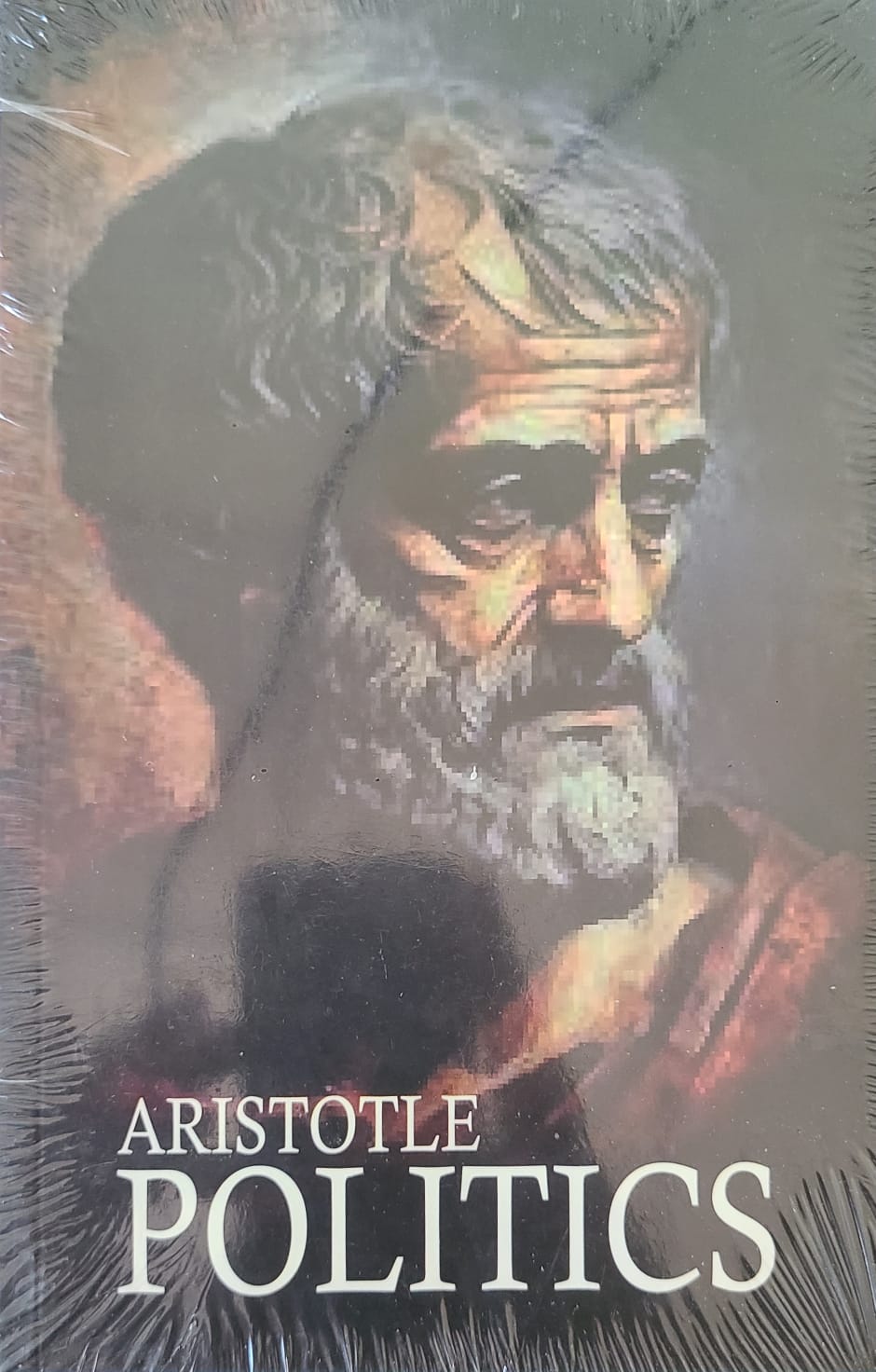
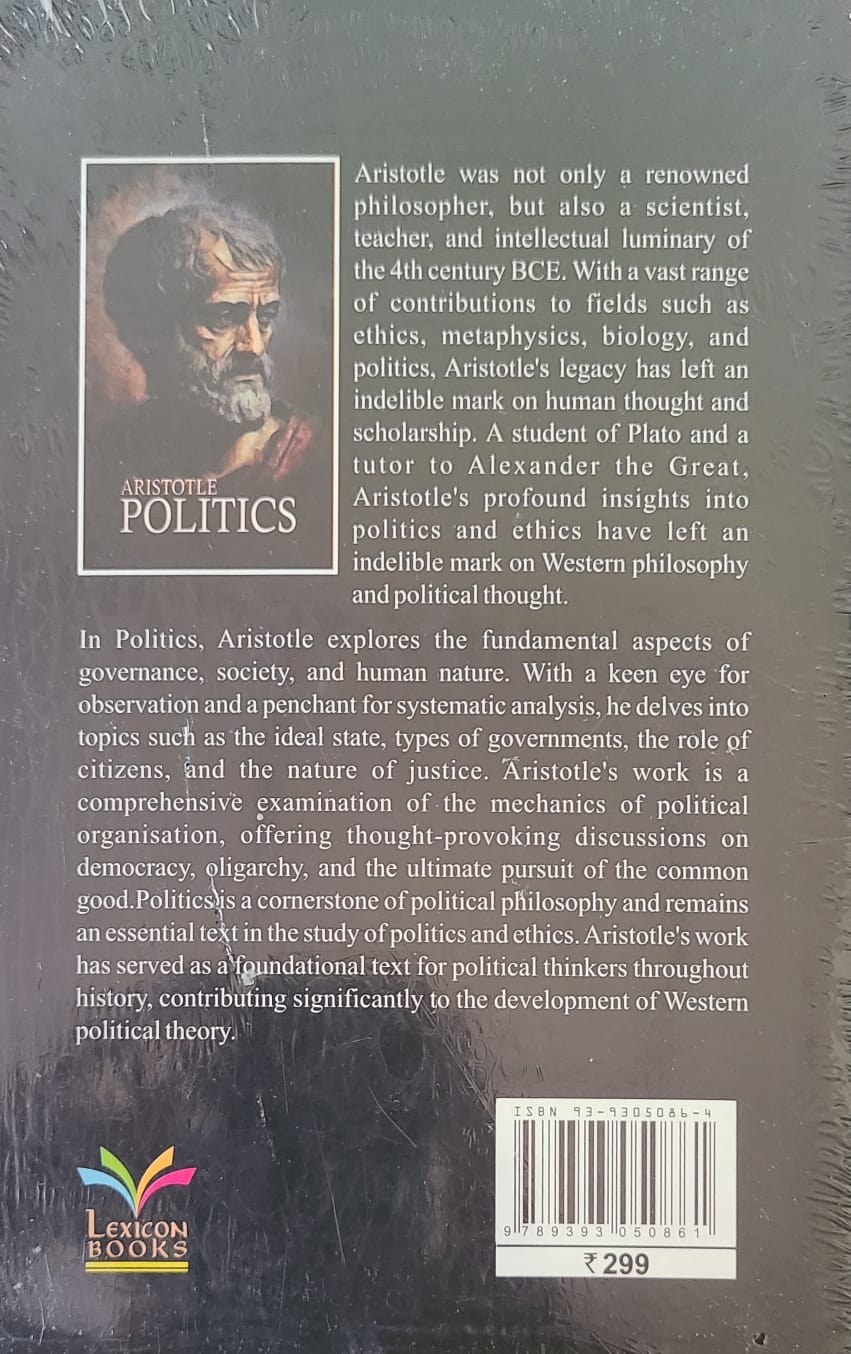

Politics by Aristotle


රු1,450.00
3 X Rs. 483.33 or 8% Cashback with


or 3 X රු483.33 with


or up to 4 X රු362.50 with


Politics by Aristotle is a foundational classic of political philosophy exploring government, citizenship, constitutions, democracy, oligarchy, monarchy, justice, law and political stability. Through comparisons of different forms of government, Aristotle asks who should rule, what political power is for, why governments become corrupt and how societies can pursue the common good. Essential reading for students of politics, philosophy, law and history, it remains one of the most influential works on government and civic life ever written.
Out of stock
Email when stock available
Politics by Aristotle is one of the foundational works of political philosophy, examining government, citizenship, justice, constitutions, political power and the question of how a society should be organized to help human beings live well.
Written more than two thousand years ago, Aristotle’s political thought begins with a surprisingly modern concern:
What makes a political system good?
Is democracy always best?
Can rule by a small group ever be justified?
Why do governments collapse?
What causes revolution?
Who should count as a citizen?
Should wealth determine political power?
What responsibilities do citizens have toward their community?
And what is government ultimately supposed to achieve?
Rather than discussing politics only in the abstract, Aristotle compares different systems of government and examines their strengths, weaknesses and tendencies toward corruption.
He considers:
Democracy.
Oligarchy.
Monarchy.
Aristocracy.
Tyranny.
Constitutional government.
Citizenship.
Law.
Education.
Property.
Political stability.
Revolution.
The common good.
Politics by Aristotle is therefore much more than an ancient historical document. It introduces questions that remain central to debates about government and society today.
Politics by Aristotle – Book Overview
Politics by Aristotle asks how human beings should organize themselves into political communities.
Aristotle believed that politics was closely connected with ethics.
Government was not merely about:
Collecting taxes.
Controlling territory.
Maintaining armies.
For Aristotle, political life was connected with a much larger question:
What kind of life allows human beings to flourish?
That makes Politics both a political and philosophical work.
Aristotle
Aristotle was born in 384 BCE in Stagira in ancient Macedonia.
He studied at Plato’s Academy in Athens for many years, later taught Alexander the Great, and eventually founded his own school, the Lyceum.
His surviving works cover an extraordinary range of subjects including:
Ethics.
Politics.
Logic.
Biology.
Metaphysics.
Rhetoric.
Poetry.
Psychology.
Natural philosophy.
His influence on Western and Islamic intellectual traditions has been enormous.
Politics and Ethics
Aristotle’s Politics is closely connected with his Nicomachean Ethics.
The Ethics asks:
What is a good human life?
Politics asks:
What kind of community helps make such a life possible?
This is important because Aristotle does not treat individuals as completely separate from society.
Human beings live:
In families.
In communities.
Under laws.
Inside institutions.
Political arrangements therefore influence what kinds of lives people are able to lead.
The Political Community
Aristotle sees political communities as developing from smaller social units.
Households.
Villages.
Then the polis, or city-state.
The polis is not simply a location on a map.
It is an organized political community.
For Aristotle, political association exists not merely so people can survive, but so they can pursue a good life together.
Humans as Political Beings
One of Aristotle’s most famous ideas is that human beings are naturally suited to political life.
Humans communicate.
Make moral judgments.
Create laws.
Debate justice.
Form communities.
Unlike an isolated individual, a citizen participates in institutions larger than themselves.
This makes political participation part of Aristotle’s understanding of human social life.
What Is a Citizen?
One of the central questions in Politics by Aristotle is:
Who counts as a citizen?
For Aristotle, citizenship involves more than simply living somewhere.
A citizen participates in political life.
That may involve:
Deliberation.
Public office.
Judgment.
Decision-making.
This makes citizenship an active role rather than merely a legal label.
Citizenship and Participation
Modern citizenship is very different from citizenship in an ancient Greek city-state.
Today, many democracies define citizenship through legal nationality.
Aristotle’s discussion is much narrower and reflects the social inequalities of his historical context.
Nevertheless, his emphasis on political participation raises an enduring question:
Is citizenship only a status?
Or does it also involve responsibility?
Different Forms of Government
A major part of Politics by Aristotle involves classifying political systems.
Aristotle distinguishes between governments according to:
Who rules.
And whose interests they serve.
This produces several major categories.
Monarchy
Monarchy means rule by one person.
In Aristotle’s ideal classification, a good monarchy would govern for the common good.
But rule by one person can deteriorate into:
Tyranny.
Tyranny
Tyranny is one of the corrupt forms of government.
A tyrant governs primarily for personal benefit rather than for the good of the political community.
The central problem is not merely that one person rules.
The deeper problem is:
Who benefits from that rule?
Aristocracy
Aristocracy, in Aristotle’s technical sense, means rule by a relatively small group considered excellent or virtuous.
Ideally, they govern for the common good.
But aristocracy can deteriorate into oligarchy.
Oligarchy
Oligarchy means rule by a wealthy minority.
Aristotle is especially interested in the tension between:
Rich.
Poor.
Because economic inequality can become political inequality.
This makes his discussion surprisingly relevant to later debates about wealth and political influence.
Democracy
Aristotle analyzes democracy in considerable detail.
Ancient Greek democracy was very different from modern representative democracy.
Nevertheless, many fundamental questions remain familiar:
Who participates?
How are offices distributed?
How much power should majorities have?
How can law constrain political decisions?
How should economic classes share authority?
Aristotle Was Not Simply Pro- or Anti-Democracy
It would be misleading to reduce Aristotle’s position to:
“Democracy good”
or
“Democracy bad.”
He studies multiple forms of democracy and examines how political arrangements function under different social conditions.
His method is comparative.
He wants to understand which systems are:
Stable.
Just.
Practical.
Or vulnerable to corruption.
Polity
One of Aristotle’s important political concepts is sometimes translated as polity, constitutional government, or simply a mixed constitution.
This system attempts to balance political forces rather than giving complete control to one economic class.
The idea is significant because Aristotle often prefers practical balance to ideological purity.
The Middle Class
Aristotle gives considerable importance to a strong middle element within society.
Why?
Because extreme inequality can create conflict.
If politics becomes a permanent struggle between:
Very rich
and
very poor,
political stability may weaken.
A substantial middle group may reduce that conflict.
This remains one of the most discussed observations in Politics.
Economic Inequality
Aristotle understands that wealth affects politics.
People with more property may demand greater influence.
Those with less wealth may demand political equality.
Conflict develops when groups define justice differently.
This leads to one of the book’s major insights:
Political instability often comes from disagreements about what counts as fairness.
Justice
Different political groups may understand justice differently.
One group says:
“We contribute more wealth, so we deserve more power.”
Another says:
“We are equally free citizens, so we deserve equal political power.”
Both arguments begin from a principle that contains some truth.
Conflict emerges when one principle is treated as the entire definition of justice.
The Common Good
A central question throughout Politics by Aristotle is whether rulers govern for:
The community
or
themselves.
This distinction helps Aristotle separate good and corrupt forms of government.
Political power becomes dangerous when public authority becomes simply a tool for private gain.
Law
Aristotle repeatedly considers the importance of law.
Should political decisions depend primarily on:
A ruler?
A group?
Or established laws?
The problem with personal rule is obvious.
Individuals can become:
Angry.
Biased.
Self-interested.
Inconsistent.
Law can create greater stability.
Rule of Law
The idea that government should operate through law rather than personal impulse became central to later political thought.
But laws themselves can still be unjust.
So the deeper challenge is not merely:
Have laws.
It is:
Create laws that support justice and the common good.
Constitutions
For Aristotle, a constitution means much more than one written document.
It refers to the organization of political authority.
Who rules?
How are offices distributed?
Who participates?
What is the purpose of the state?
A constitution therefore reveals the character of a political system.
Comparing Constitutions
Aristotle’s political investigation drew on study of many Greek constitutions.
Penguin describes The Politics as drawing upon examination of more than 150 city constitutions in Aristotle’s attempt to understand which forms of government work best in theory and practice.
This comparative approach is one reason Aristotle is often regarded as an early systematic political scientist.
Ideal Government Versus Practical Government
One of the strengths of Politics by Aristotle is that Aristotle distinguishes between:
The best government imaginable
and
the best government realistically possible under particular conditions.
This is a useful political distinction.
A system may look perfect in theory.
But if it cannot function under real circumstances, it may not be useful.
Political Realism
Aristotle therefore asks practical questions.
What works with this population?
Under these economic conditions?
With these customs?
Political theory must eventually confront actual human behavior.
Revolution
Aristotle also studies why political systems experience revolution or constitutional change.
Possible causes include:
Inequality.
Perceived injustice.
Competition for office.
Economic conflict.
Fear.
Ambition.
Abuse of power.
Different groups may rebel not simply because they are objectively poor or oppressed, but because they believe they are being treated unfairly relative to others.
Perceived Injustice
This is an especially important insight.
Politics depends not only on material conditions.
It also depends on perceptions.
People compare.
Who has power?
Who receives rewards?
Who is excluded?
Who receives respect?
A political system can become unstable when significant groups believe the arrangement is fundamentally unfair.
Preventing Political Collapse
Aristotle is interested not only in how revolutions begin but also how constitutions can remain stable.
Good political systems need:
Balance.
Respect for law.
Moderation.
Institutions.
Education.
A reasonably sustainable distribution of power.
Moderation
Aristotle frequently favors moderation.
Extreme concentration of:
Wealth.
Poverty.
Power.
Ambition.
can destabilize communities.
This reflects a broader feature of Aristotle’s philosophy, where balance often plays an important role.
Education
Education is politically important because governments depend on citizens capable of living under their constitutions.
A political system cannot survive indefinitely if its citizens are educated in values completely opposed to that system.
Aristotle therefore connects education with citizenship.
Education and Civic Character
Political institutions are influenced by the character of the people inside them.
Rules matter.
But culture matters too.
Citizens need habits and knowledge that allow institutions to function.
This remains relevant in modern debates about:
Civic education.
Political literacy.
Media literacy.
Public responsibility.
Property
Aristotle discusses property and economic organization.
He considers arguments for common ownership and private property, including positions associated with Plato.
Aristotle generally sees advantages in private ownership while also emphasizing responsible use and concern for the community.
Aristotle and Plato
Aristotle studied under Plato, but he did not simply repeat Plato’s political philosophy.
Plato’s Republic imagines a highly structured ideal state.
Aristotle is often more empirical.
He examines actual constitutions and asks how real political systems work.
This makes reading The Republic and Politics together especially interesting.
Politics Versus The Republic
Plato often begins from an ideal philosophical structure.
Aristotle frequently begins from observation and comparison.
Both ask:
What is justice?
Who should rule?
What makes a good society?
But their methods and answers differ significantly.
Politics and Nicomachean Ethics
Readers interested in Aristotle can also pair Politics with Nicomachean Ethics.
The Ethics explores:
Virtue.
Happiness.
Character.
Practical wisdom.
The Politics expands those questions from individuals to communities.
Political Philosophy
Politics by Aristotle belongs to the foundational tradition of political philosophy.
Political philosophy asks questions such as:
What makes government legitimate?
What is justice?
What does citizenship require?
Should political power be equal?
What are the limits of government?
Which institutions best promote human flourishing?
These questions still shape political debate.
Is Politics by Aristotle Still Relevant?
Yes, although it must be read historically and critically.
The political institutions Aristotle studied were ancient Greek city-states, not modern nation-states.
He did not know:
Modern representative democracy.
Universal suffrage.
Constitutional rights as understood today.
Modern political parties.
Mass media.
Digital technology.
Globalized economies.
Nevertheless, the deeper questions about power, inequality, law, citizenship and political stability remain recognizable.
Historical Limitations
Modern readers should also be aware that Aristotle’s political thought reflects serious inequalities of his era.
His discussions include assumptions about:
Slavery.
Women.
Citizenship.
Social hierarchy.
These positions conflict sharply with modern commitments to universal equality and human rights.
A serious reading should not ignore or excuse these limitations.
Aristotle and Slavery
One of the most controversial sections concerns Aristotle’s attempt to defend a concept of “natural slavery.”
This argument is rejected by modern ethics and political thought.
It is important to study historically because it demonstrates how even influential thinkers can construct philosophical arguments around deeply unjust social institutions.
Women and Citizenship
Women in the ancient Greek political systems Aristotle analyzes generally lacked the political participation granted to male citizens.
This means his concept of citizenship was far narrower than modern democratic citizenship.
Readers should keep that historical limitation in mind.
Reading Classics Critically
A classic does not need to be correct about everything to remain worth reading.
Important books can be valuable because they:
Created influential concepts.
Asked enduring questions.
Shaped later thinkers.
Reveal historical assumptions.
Give readers arguments to examine critically.
That is the best way to approach Politics by Aristotle.
Influence
Politics influenced centuries of thought about:
Government.
Constitutional design.
Citizenship.
Law.
Political stability.
Thomas Aquinas, Machiavelli and many later thinkers engaged with ideas connected to Aristotle’s political philosophy. Penguin specifically notes its major influence on subsequent political thinkers.
Aristotle and Political Science
Aristotle is sometimes described as an early founder of political science because of his systematic comparison of political institutions.
Instead of asking only:
What should government ideally be?
he also asks:
How do governments actually behave?
That combination of normative and empirical analysis became central to later political study.
Is Politics Difficult to Read?
Yes, parts can be challenging.
Readers should expect:
Ancient terminology.
Complex classifications.
Historical examples.
Philosophical arguments.
Repeated distinctions between different constitutional forms.
A good introduction and notes can help significantly.
The Penguin Classics edition in your current order includes introductions, glossaries and a bibliography designed to support readers.
How to Read Politics More Easily
A beginner does not need to understand every sentence on the first reading.
A useful method is to focus on major questions:
What is the purpose of government?
Who is a citizen?
Who should rule?
What causes governments to become corrupt?
What causes revolution?
How does inequality affect politics?
What helps create stability?
Then return to difficult sections later.
Is Politics a History Book?
Not primarily.
It contains historical discussion and examples, but it is fundamentally a work of:
Political philosophy and political theory.
For your store, it fits well under Politics & Society, with Philosophy also being a relevant secondary classification.
Your BargainBooks approved hierarchy includes Non-Fiction & Knowledge > Politics & Society and a separate Philosophy category.
Is Politics a Book About Modern Party Politics?
No.
Readers should not expect discussion of modern political parties or current elections.
The book examines fundamental structures of political organization:
Citizenship.
Constitutions.
Government types.
Law.
Justice.
Political stability.
Is Politics a Left-Wing or Right-Wing Book?
Neither label fits well.
Modern “left” and “right” political categories developed thousands of years after Aristotle.
Trying to place him neatly inside today’s partisan spectrum can distort the text.
It is better to study his arguments directly.
Who Should Read Politics?
Politics by Aristotle is especially useful for:
Political science students.
Philosophy students.
Law students.
History students.
Public policy students.
Readers interested in democracy.
Readers studying classical civilization.
People interested in political theory.
Anyone wanting to understand the intellectual roots of debates about government.
Edition Details
Your current order file identifies:
Title: Politics
Author: Aristotle
ISBN: 9780140444216
The official Penguin Classics edition with that ISBN is:
Title: The Politics
Author: Aristotle
Translator: T. A. Sinclair
Revision: Trevor J. Saunders
Publisher: Penguin Classics
ISBN-13: 9780140444216
Pages: 512
However, your older inventory also contains 9789389931266, which Penguin Random House identifies as a Fingerprint paperback edition, published in 2020 with 304 pages.
Check the physical barcode before entering the ISBN and page count.
Important Themes
Politics by Aristotle explores:
- Government
- Political philosophy
- Democracy
- Oligarchy
- Monarchy
- Aristocracy
- Tyranny
- Citizenship
- Constitutions
- Justice
- Law
- Political power
- Economic inequality
- Revolution
- Political stability
- Education
- Civic responsibility
- Property
- Ethics
- The common good
7 Powerful Lessons From Politics by Aristotle
- Government should be judged partly by whom it serves. Aristotle distinguishes between governments working for the common good and those used primarily for rulers’ private interests.
- Political systems can decay when power becomes concentrated around narrow interests. Monarchy can become tyranny, while rule by an elite can become oligarchy when rulers prioritize themselves.
- Economic inequality can become political instability. Extreme division between rich and poor may create competing definitions of justice and increase social conflict.
- A strong middle element can support political stability. Aristotle argues that communities dominated by extreme wealth and extreme poverty may be less stable than those with a substantial middle group.
- Good institutions need citizens capable of sustaining them. Laws alone are not enough. Education, civic habits and political culture influence whether a constitution survives.
- Practical politics requires understanding circumstances. The theoretically perfect system may not be the best system available for every society. Political judgment requires attention to real conditions.
- Political power should remain open to criticism and examination. Aristotle’s comparative method reminds readers that no political structure should be accepted simply because it already exists.
Why Read Politics by Aristotle?
Politics by Aristotle remains essential reading because many debates that appear modern are actually ancient.
Who should govern?
What makes power legitimate?
How much inequality can a society tolerate?
Should wealth provide greater political influence?
How should laws restrain leaders?
What duties come with citizenship?
Why do political systems collapse?
How can governments remain stable without becoming oppressive?
The specific societies Aristotle studied are long gone.
The questions are not.
Readers do not need to accept all of Aristotle’s answers.
In fact, some of his claims—particularly concerning slavery, gender and social hierarchy—should be challenged directly.
But engaging critically with influential arguments is part of studying political philosophy.
The book teaches readers not merely what to think, but what questions must be asked when analyzing political institutions.
Politics by Aristotle – What Makes a Good Government?
Politics by Aristotle begins from a fundamental assumption:
Politics matters because the organization of society affects how people live.
A government can create order.
But order alone is not enough.
A tyranny can create order.
A government can create wealth.
But wealth alone is not enough.
An oligarchy may produce enormous wealth for a small group.
A political system must therefore be judged by deeper standards.
Justice.
Participation.
Stability.
Law.
The common good.
Aristotle’s genius lies partly in refusing to treat government as a simple choice between labels.
Democracy is not one single thing.
Oligarchy is not one single thing.
Political systems contain variations.
Their success depends on:
Institutions.
Economic structure.
Citizens.
Culture.
Law.
Distribution of power.
This makes Politics useful even thousands of years later.
Modern readers live in societies Aristotle could never have imagined.
Nation-states with millions of citizens.
Universal elections.
Digital communication.
Human-rights law.
Global markets.
Artificial intelligence.
Yet we still confront the same fundamental problem:
How should power be organized so that people can live together without political authority becoming a tool for domination?
Aristotle does not give modern society a ready-made answer.
He gives something more enduring:
A framework for asking better questions.
For students of politics, philosophy, history, law and government, Politics by Aristotle remains one of the foundational texts for understanding how political thinkers have wrestled with power, citizenship, justice and the design of society for more than two millennia.
Learn more about The Politics by Aristotle on the official Penguin Random House website.
Explore more philosophy and political science books at Bargain Books.
| Author | Aristotle |
|---|---|
| Type | Paperback Brand new Printed (Indian Locally published) |
| ISBN/ISSN | 9391464548 |
| Language | English |
| Pages | 276 |
Be the first to review “Politics by Aristotle”
Related products

Out of stock
Non-Fiction & Knowledge
රු1,900.00
3 X Rs. 633.33 or 8% Cashback with
or 3 X රු633.33 with
or up to 4 X රු475.00 with
Out of stock
Non-Fiction & Knowledge
රු1,600.00
3 X Rs. 533.33 or 8% Cashback with
or 3 X රු533.33 with
or up to 4 X රු400.00 with
-7%

Out of stock
Original price was: රු4,500.00.රු4,200.00Current price is: රු4,200.00.
3 X Rs. 1,400.00 or 8% Cashback with
or 3 X රු1,400.00 with
or up to 4 X රු1,050.00 with
-13%
Out of stock
Non-Fiction & Knowledge
Original price was: රු3,900.00.රු3,400.00Current price is: රු3,400.00.
3 X Rs. 1,133.33 or 8% Cashback with
or 3 X රු1,133.33 with
or up to 4 X රු850.00 with
-24%

Out of stock
Non-Fiction & Knowledge
Original price was: රු2,500.00.රු1,900.00Current price is: රු1,900.00.
3 X Rs. 633.33 or 8% Cashback with
or 3 X රු633.33 with
or up to 4 X රු475.00 with
-33%
Non-Fiction & Knowledge
Original price was: රු2,850.00.රු1,900.00Current price is: රු1,900.00.
3 X Rs. 633.33 or 8% Cashback with
or 3 X රු633.33 with
or up to 4 X රු475.00 with
Non-Fiction & Knowledge
රු2,250.00
3 X Rs. 750.00 or 8% Cashback with
or 3 X රු750.00 with
or up to 4 X රු562.50 with
Non-Fiction & Knowledge
රු2,450.00
3 X Rs. 816.67 or 8% Cashback with
or 3 X රු816.67 with
or up to 4 X රු612.50 with
Reviews
There are no reviews yet.