
No products in the cart.
-9%

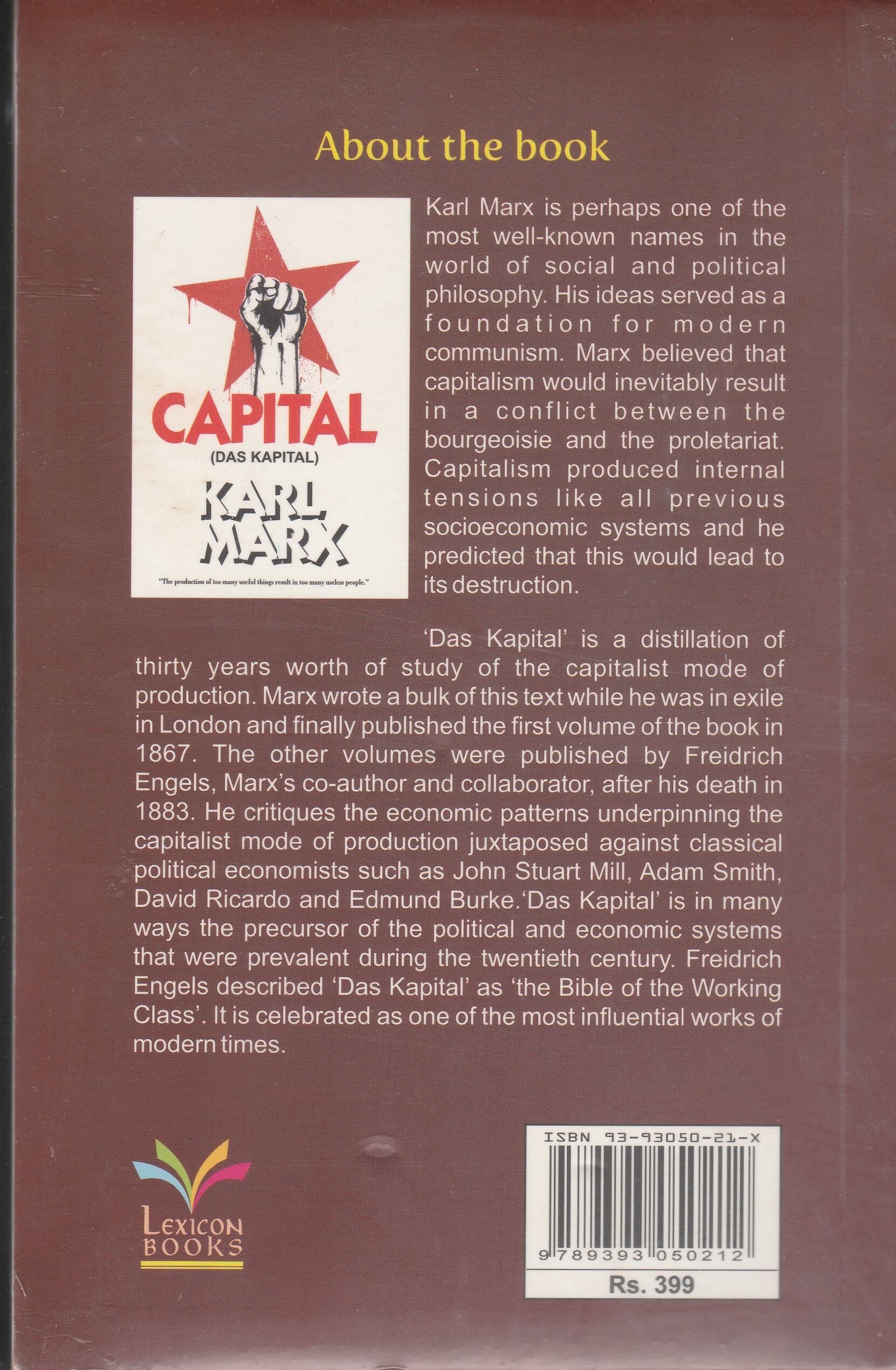


Das Kapital by Karl Marx


Original price was: රු5,450.00.රු4,950.00Current price is: රු4,950.00.
3 X Rs. 1,650.00 or 8% Cashback with


or 3 X රු1,650.00 with


or up to 4 X රු1,237.50 with


“Dive into the cornerstone of political economy with ‘Das Kapital’ by Karl Marx. This seminal work explores the dynamics of capitalism, offering a critical analysis of economic systems. A must-read for those seeking to understand the roots of modern economic thought.”
Out of stock
Email when stock available
Das Kapital by Karl Marx is one of the most influential works in the history of economics, political thought and social theory.
Originally published in the nineteenth century, the book examines how capitalist economies operate and how wealth, labour and production are connected.
Das Kapital explores commodities, wages, profit, capital accumulation and the relationship between workers and owners.
It is an important book for readers interested in economics, politics, philosophy, sociology and economic history.
Why Read Das Kapital?
Das Kapital attempts to explain the mechanisms behind capitalist production.
Karl Marx examines how goods acquire value and how labour contributes to the production of wealth.
He also considers how profits are generated within economic systems.
The book challenges readers to think critically about work, ownership and the distribution of wealth.
Understanding Capitalism
Capitalism is the central subject of Das Kapital.
Marx examines an economy in which businesses and individuals own productive assets and use them to create goods for exchange.
He studies how money can be transformed into capital.
Capital can then be invested to generate additional value.
This cycle becomes an important part of Marx’s explanation of economic growth and inequality.
Commodities and Value
A major section of Das Kapital focuses on commodities.
A commodity is something produced for exchange.
Marx examines why certain goods have value and how that value appears in markets.
He distinguishes between the usefulness of an item and its value in exchange.
These ideas form the foundation for many of the arguments developed later in the book.
Labour and Production
Labour plays a central role throughout Das Kapital.
Workers provide time, knowledge and physical or mental effort to produce goods and services.
Marx investigates the relationship between the value created through labour and the wages workers receive.
This leads to one of the most debated ideas associated with his economic analysis.
The book asks readers to consider who benefits most from the value created through production.
Surplus Value
Surplus value is one of the best-known concepts in Das Kapital.
Marx argues that workers can create more economic value during production than they receive through wages.
The difference contributes to profit and capital accumulation.
This concept becomes central to his criticism of capitalist economic relationships.
Readers interested in economic theory may find this section particularly important.
Capital Accumulation
Businesses often reinvest profits.
This can allow them to expand production, purchase new equipment or hire more workers.
Das Kapital examines how this process contributes to the accumulation of capital.
Marx also considers what happens when wealth and productive resources become increasingly concentrated.
These ideas remain important in discussions about inequality and economic power.
Workers and Capital Owners
Another major theme in Das Kapital is the relationship between labour and capital.
Workers generally earn wages by selling their labour.
Owners control factories, equipment, land or other productive resources.
Marx explores how these different positions create conflicting economic interests.
This analysis became highly influential in later political and economic debates.
Money and Exchange
Money is more than a simple payment tool in Das Kapital.
Marx examines how money functions within systems of exchange.
Goods are produced.
They are sold.
Money can then be reinvested.
Understanding this process helps explain how ordinary commercial activity can develop into larger systems of capital accumulation.
Economic Inequality
Das Kapital also examines inequality.
Marx questions why some groups accumulate enormous wealth while others remain dependent on wages.
He links inequality to ownership and control over productive resources.
This makes the book relevant to readers interested in debates about wealth distribution and economic power.
Industrial Society
The book was written during a period of enormous industrial change.
Factories were expanding.
Cities were growing.
New forms of employment were transforming everyday life.
Das Kapital examines how industrial production changed relationships between workers, employers and markets.
This historical context helps explain why the book became so influential.
Economics and Social Theory
Das Kapital is not simply an economics textbook.
It also contains important ideas about society and power.
Marx connects economic systems with social relationships.
Who owns resources can influence who holds economic power.
Who controls production can also influence political and social structures.
This broader perspective has made the book important across multiple academic fields.
A Challenging but Influential Classic
Das Kapital can be demanding.
Marx uses detailed arguments and complex economic concepts.
Readers may need time to understand certain sections.
However, the difficulty is also part of the book’s intellectual importance.
Many ideas introduced in the work influenced later economists, historians, sociologists and political thinkers.
7 Powerful Ideas From Das Kapital
- Commodities Have Different Forms of Value – Goods can have both practical usefulness and exchange value.
- Labour Creates Economic Value – Human work plays a central role in production.
- Surplus Value Drives Profit – Marx examines the difference between value produced and wages paid.
- Capital Can Accumulate – Profits can be reinvested to produce additional wealth.
- Ownership Creates Economic Power – Control over productive resources influences social relationships.
- Capitalism Contains Internal Tensions – Competing interests can exist between workers and owners.
- Economics Shapes Society – Economic structures can influence politics, culture and social organisation.
What You Can Learn From Das Kapital
Readers can explore:
- Capitalism
- Economic theory
- Labour and wages
- Commodities
- Value and exchange
- Surplus value
- Capital accumulation
- Industrial society
- Economic inequality
- Class relationships
- Political economy
- Social theory
- History of economics
- Karl Marx’s philosophy
- Economic power
Who Should Read Das Kapital?
Das Kapital is suitable for readers interested in economics and political philosophy.
Students of sociology may also find the book valuable.
Readers interested in economic history can explore one of the nineteenth century’s most influential critiques of capitalism.
It can also appeal to anyone who wants to understand the origins of Marxist economic theory.
The book is best approached as a major historical and theoretical work rather than a simple introduction to personal finance or modern investing.
A Powerful Classic of Economic Thought
Das Kapital remains one of the most widely discussed works in economic and political history.
Karl Marx examines capitalism through labour, commodities, profit, ownership and the accumulation of wealth.
Whether readers agree or disagree with his conclusions, the ideas presented in the book have influenced political movements, economic debates and academic thought around the world.
For readers interested in economics, philosophy, history and society, Das Kapital is an important classic worth exploring. https://yourwebsite.com/das-kapital/
| Author | Karl Marx |
|---|---|
| Type | Paperback Printed Book |
| ISBN/ISSN | 8175994142, 978-8175994140 |
| Language | English |
Be the first to review “Das Kapital by Karl Marx”
Related products
-13%

Out of stock
Non-Fiction & Knowledge
Original price was: රු3,900.00.රු3,400.00Current price is: රු3,400.00.
3 X Rs. 1,133.33 or 8% Cashback with
or 3 X රු1,133.33 with
or up to 4 X රු850.00 with
-26%

Non-Fiction & Knowledge
The 7 Habits of Highly Effective People by Stephen R. Covey – Blue Cover
Original price was: රු2,300.00.රු1,700.00Current price is: රු1,700.00.
3 X Rs. 566.67 or 8% Cashback with
or 3 X රු566.67 with
or up to 4 X රු425.00 with

Non-Fiction & Knowledge
රු1,700.00
3 X Rs. 566.67 or 8% Cashback with
or 3 X රු566.67 with
or up to 4 X රු425.00 with
-33%

Non-Fiction & Knowledge
Original price was: රු2,850.00.රු1,900.00Current price is: රු1,900.00.
3 X Rs. 633.33 or 8% Cashback with
or 3 X රු633.33 with
or up to 4 X රු475.00 with

Out of stock
Autobiography
රු2,750.00
3 X Rs. 916.67 or 8% Cashback with
or 3 X රු916.67 with
or up to 4 X රු687.50 with

රු2,000.00
3 X Rs. 666.67 or 8% Cashback with
or 3 X රු666.67 with
or up to 4 X රු500.00 with
-17%

Out of stock
Non-Fiction & Knowledge
Original price was: රු2,900.00.රු2,400.00Current price is: රු2,400.00.
3 X Rs. 800.00 or 8% Cashback with
or 3 X රු800.00 with
or up to 4 X රු600.00 with
-24%

Out of stock
Non-Fiction & Knowledge
Original price was: රු2,500.00.රු1,900.00Current price is: රු1,900.00.
3 X Rs. 633.33 or 8% Cashback with
or 3 X රු633.33 with
or up to 4 X රු475.00 with
Reviews
There are no reviews yet.