
No products in the cart.
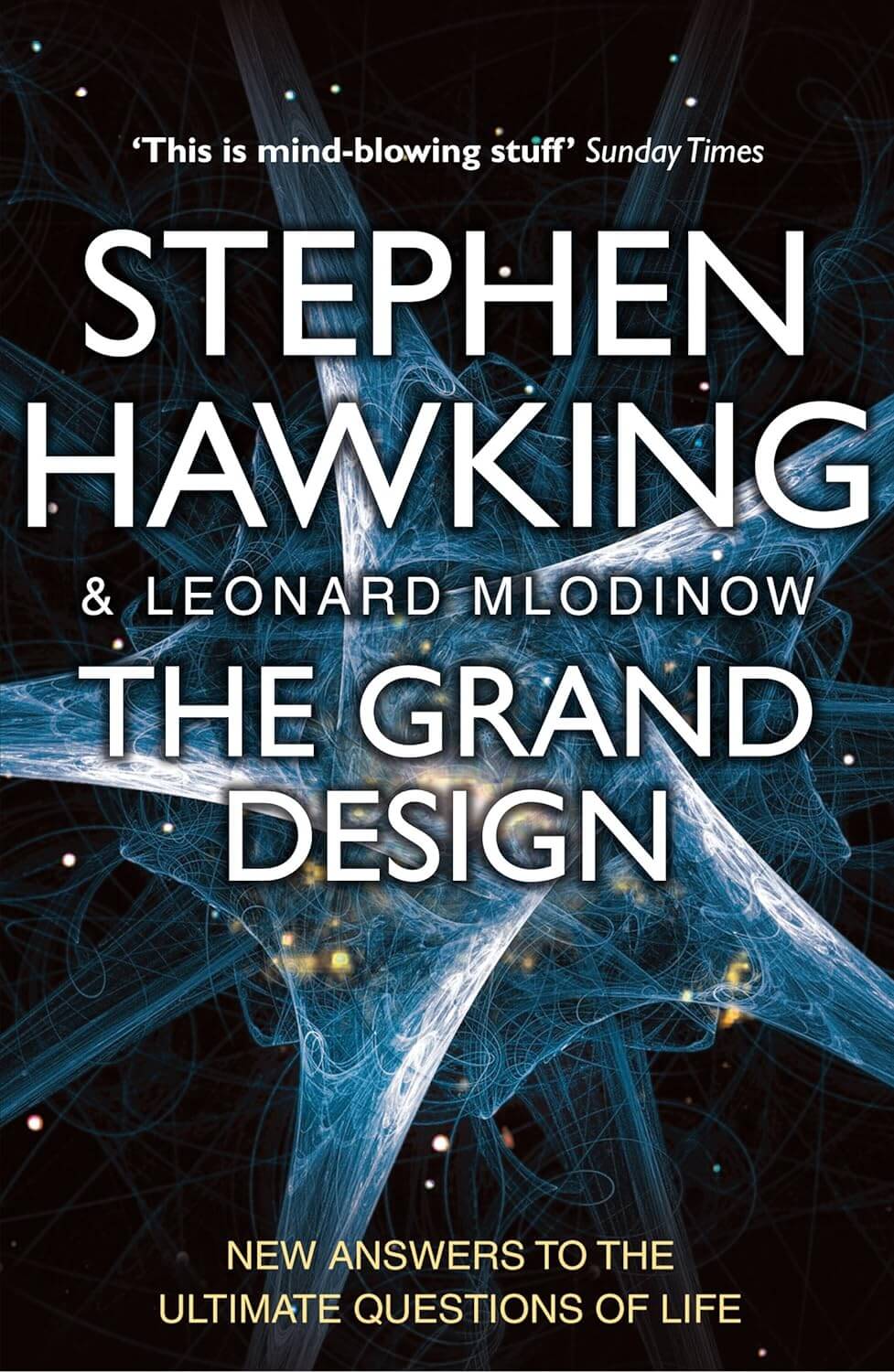
The Grand Design by Stephen Hawking


රු1,900.00
3 X Rs. 633.33 or 8% Cashback with


or 3 X රු633.33 with


or up to 4 X රු475.00 with


A succinct, startling and lavishly illustrated guide to discoveries that are altering our understanding and threatening some of our most cherished belief systems, The Grand Design is a book that will inform – and provoke – like no other.
Out of stock
Email when stock available
The Grand Design by Stephen Hawking and Leonard Mlodinow
The Grand Design by Stephen Hawking and Leonard Mlodinow is a fascinating popular-science book that explores some of humanity’s biggest questions about the universe, reality and our existence.
Why does the universe exist?
How did it begin?
Why are the laws of nature the way they are?
Is our universe unique, or could there be many universes?
And can science eventually develop a single framework capable of explaining the fundamental laws governing everything around us?
Stephen Hawking and physicist Leonard Mlodinow explore these questions using ideas from modern physics and cosmology while presenting complicated scientific concepts in language designed for general readers.
The result is a thought-provoking journey through the history of scientific understanding and some of the most ambitious theories in modern physics.
Why Read The Grand Design?
One of the biggest attractions of The Grand Design is its willingness to tackle questions that humans have been asking for thousands of years.
People have always wondered where the universe came from and why it exists.
In earlier periods, philosophers and religious thinkers provided different explanations for these questions.
Modern science approaches them through observation, mathematics and physical theories.
Hawking and Mlodinow take readers through this changing understanding of reality and explain how scientific ideas have developed over time.
Rather than focusing only on one branch of physics, the book brings together cosmology, quantum mechanics and theories about the fundamental forces of nature.
Understanding the Universe
The universe is incredibly large and complex.
Stars, galaxies, planets and matter all behave according to physical laws.
Scientists have spent centuries attempting to understand those laws.
The Grand Design explains how our picture of the universe has changed as scientific knowledge has improved.
Ideas that once seemed obvious have sometimes been replaced by entirely different explanations.
For example, humanity once believed Earth occupied a special position at the centre of the cosmos.
Modern astronomy revealed a much larger universe containing enormous numbers of galaxies.
Physics later introduced even more surprising ideas about space, time, matter and energy.
The book helps readers appreciate how dramatically our understanding of reality has changed.
Quantum Physics and Reality
One of the most important subjects in The Grand Design is quantum physics.
Quantum theory describes the behaviour of nature at extremely small scales.
At this level, reality does not always behave according to the everyday rules we expect.
Particles can behave in ways that seem strange from our ordinary experience.
Probability becomes extremely important.
And traditional ideas about objects having one simple, predictable history become much more complicated.
Hawking and Mlodinow use these concepts to explore larger questions about the universe itself.
This can be challenging material, but the authors aim to make the central ideas understandable without requiring readers to have advanced mathematical knowledge.
What Is the Multiverse?
Another fascinating idea explored in The Grand Design is the possibility of a multiverse.
The multiverse concept suggests that our universe may not be the only universe.
Instead, there could potentially be many universes with different conditions or even different physical laws.
This idea creates some enormous philosophical and scientific questions.
Why does our universe appear suitable for stars, planets and life?
Are the physical constants of our universe special?
Or are we simply living in one universe among many where conditions happen to allow observers like us to exist?
The book examines how modern cosmological theories can lead scientists toward these possibilities.
For readers who enjoy thinking about enormous questions concerning existence, this is one of the most interesting parts of the book.
What Is M-Theory?
The Grand Design also discusses M-theory, an ambitious framework connected to string theory.
Physicists have long searched for a theory capable of bringing together the different laws that describe the universe.
Einstein famously spent years searching for a unified theory.
Modern physics has made enormous progress, but combining all fundamental forces into one complete framework remains one of science’s biggest challenges.
Hawking and Mlodinow discuss M-theory as a possible candidate for a deeper framework capable of connecting different physical descriptions.
For general readers, this section provides an introduction to one of the most ambitious goals in theoretical physics: finding a more complete explanation for how the universe works.
The Nature of Reality
Reality seems straightforward in everyday life.
We observe objects around us and assume that what we see represents the world exactly as it exists.
But modern physics complicates this assumption.
The Grand Design discusses an idea called model-dependent realism.
In simple terms, humans understand reality through models.
A scientific model can help us predict what will happen and explain observations, even if the underlying reality is difficult to imagine directly.
Different models may sometimes describe the same situation in different ways.
This encourages readers to think carefully about what scientists mean when they say a theory describes reality.
It also connects physics with deeper philosophical questions about knowledge and perception.
Science and the Origin of the Universe
Perhaps the most discussed part of The Grand Design concerns the origin of the universe.
Hawking and Mlodinow examine whether the known laws of physics can provide an explanation for how a universe could arise without requiring an external physical cause.
This discussion has generated significant debate because questions about the beginning of the universe are connected not only with physics but also with philosophy and religion.
The authors approach the subject from a scientific perspective.
Readers do not necessarily need to agree with every conclusion to find the discussion valuable.
The book encourages people to think critically about how scientific explanations work and where science may be able to answer questions once considered purely philosophical.
A Book for General Readers
You do not need to be a physicist to read The Grand Design.
The book was written for a general audience and avoids requiring readers to work through complicated mathematical equations.
Instead, it focuses on explaining the concepts and ideas behind modern theories.
This makes it a good choice for readers who are interested in science but may not have formal training in physics.
Some concepts can still require careful reading.
Quantum mechanics, cosmology and unified theories are naturally complicated subjects.
However, Hawking and Mlodinow provide an accessible introduction to ideas that might otherwise require much more technical study.
From A Brief History of Time to The Grand Design
Stephen Hawking became internationally famous for explaining complex scientific questions to general readers.
His earlier book A Brief History of Time introduced millions of readers to cosmology, black holes, space and time.
The Grand Design continues that tradition while focusing on more recent theoretical ideas and some of the biggest unanswered questions about the universe.
Readers who enjoyed A Brief History of Time, The Universe in a Nutshell or other accessible science books may find The Grand Design particularly interesting.
It can also serve as an introduction for readers who are discovering Hawking’s work for the first time.
Who Should Read The Grand Design?
This book is an excellent choice for readers interested in:
- Physics
- Cosmology
- Astronomy
- Quantum mechanics
- The origin of the universe
- The multiverse
- M-theory and string theory
- Space and time
- Philosophy of science
- Fundamental laws of nature
- Stephen Hawking books
- Popular science
- Big questions about existence
It is particularly suitable for curious readers who enjoy learning about scientific ideas without reading a university-level physics textbook.
Is The Grand Design Worth Reading?
If you have ever wondered why the universe exists or how modern physics attempts to explain reality, The Grand Design offers plenty to think about.
The book does not simply provide a collection of scientific facts.
Instead, it explores the larger implications of those discoveries.
Modern physics has changed our understanding of space, time and matter.
Quantum theory has challenged traditional ideas about reality.
Cosmology has expanded our understanding of the scale and history of the universe.
And theories such as M-theory attempt to connect these discoveries into a deeper explanation.
That makes the book particularly appealing to readers who enjoy science that also raises philosophical questions.
Buy The Grand Design in Sri Lanka
If you are searching for The Grand Design in Sri Lanka, this bestselling popular-science book is an excellent addition to any science, physics or astronomy collection.
Join Stephen Hawking and Leonard Mlodinow as they explore some of the deepest questions about reality, the laws of nature and the origin of the universe.
From quantum physics and the multiverse to M-theory and the search for a unified understanding of nature, The Grand Design introduces readers to some of the most fascinating ideas in modern theoretical physics.
Whether you are already a fan of Stephen Hawking or simply curious about how the universe works, this book offers an accessible and thought-provoking journey into the science behind some of humanity’s greatest questions.
Learn more about The Grand Design by Stephen Hawking and Leonard Mlodinow on the official Penguin Random House website.
Explore more science and educational books at Bargain Books.
| Author | Stephen Hawking |
|---|---|
| Type | Paperback Printed Book |
| ISBN/ISSN | 978-0553819229, 9780553819229 |
| Language | English |
| Pages | 256 |
Be the first to review “The Grand Design by Stephen Hawking”
Related products
-26%

Non-Fiction & Knowledge
The 7 Habits of Highly Effective People by Stephen R. Covey – Blue Cover
Original price was: රු2,300.00.රු1,700.00Current price is: රු1,700.00.
3 X Rs. 566.67 or 8% Cashback with
or 3 X රු566.67 with
or up to 4 X රු425.00 with
-7%

Out of stock
Original price was: රු4,500.00.රු4,200.00Current price is: රු4,200.00.
3 X Rs. 1,400.00 or 8% Cashback with
or 3 X රු1,400.00 with
or up to 4 X රු1,050.00 with
-17%

Fiction & Literature
Blue Ocean Strategy (Paperback) by W. Chan Kim & Renée Mauborgne
Original price was: රු1,800.00.රු1,500.00Current price is: රු1,500.00.
3 X Rs. 500.00 or 8% Cashback with
or 3 X රු500.00 with
or up to 4 X රු375.00 with
-24%
Out of stock
Non-Fiction & Knowledge
Original price was: රු2,100.00.රු1,600.00Current price is: රු1,600.00.
3 X Rs. 533.33 or 8% Cashback with
or 3 X රු533.33 with
or up to 4 X රු400.00 with

Non-Fiction & Knowledge
රු2,450.00
3 X Rs. 816.67 or 8% Cashback with
or 3 X රු816.67 with
or up to 4 X රු612.50 with
-24%

Out of stock
Non-Fiction & Knowledge
Original price was: රු2,500.00.රු1,900.00Current price is: රු1,900.00.
3 X Rs. 633.33 or 8% Cashback with
or 3 X රු633.33 with
or up to 4 X රු475.00 with
Out of stock
Damaged & Imperfect Books
රු950.00
3 X Rs. 316.67 or 8% Cashback with
or 3 X රු316.67 with
or up to 4 X රු237.50 with

රු2,000.00
3 X Rs. 666.67 or 8% Cashback with
or 3 X රු666.67 with
or up to 4 X රු500.00 with
Reviews
There are no reviews yet.