
No products in the cart.
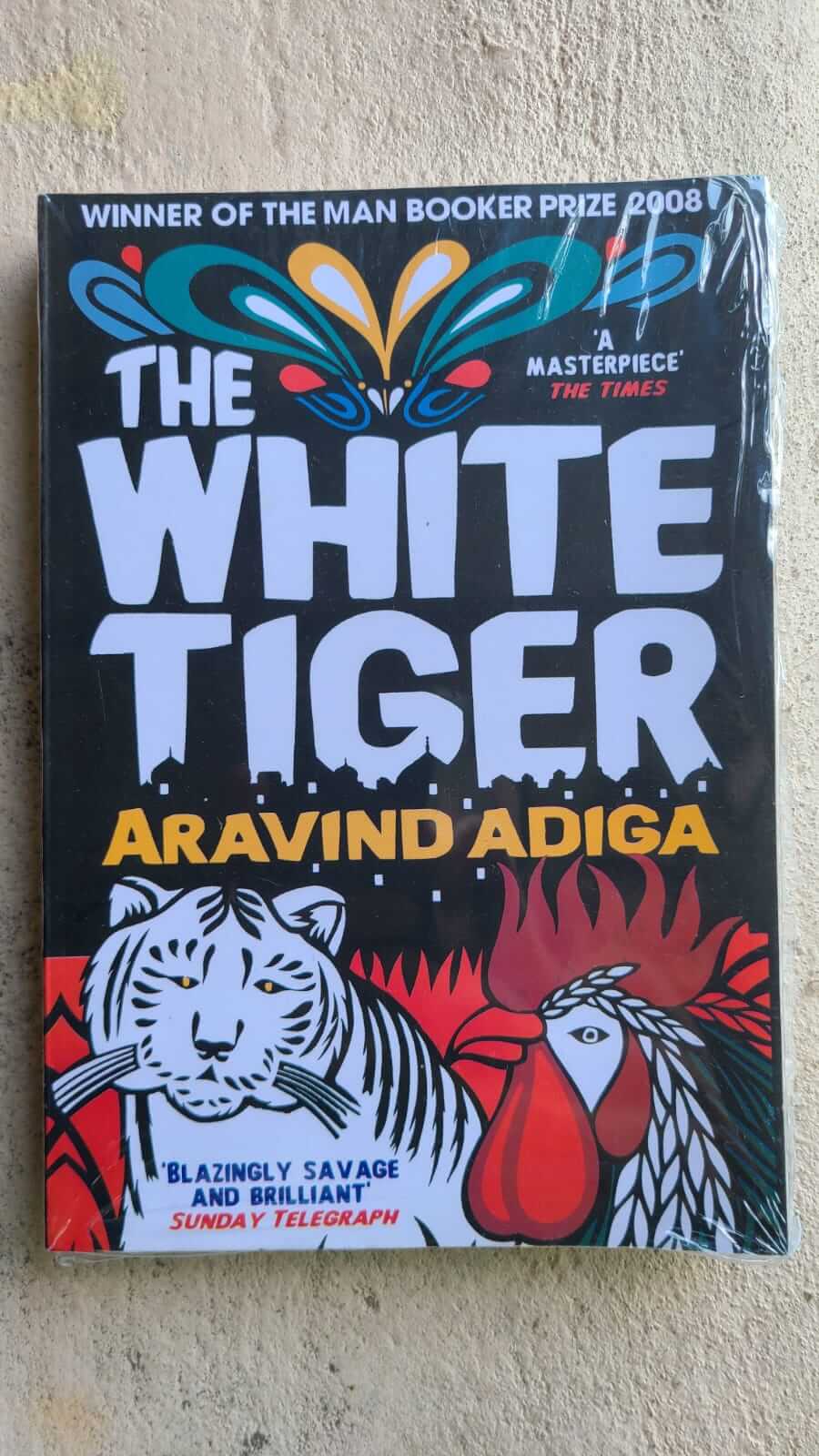
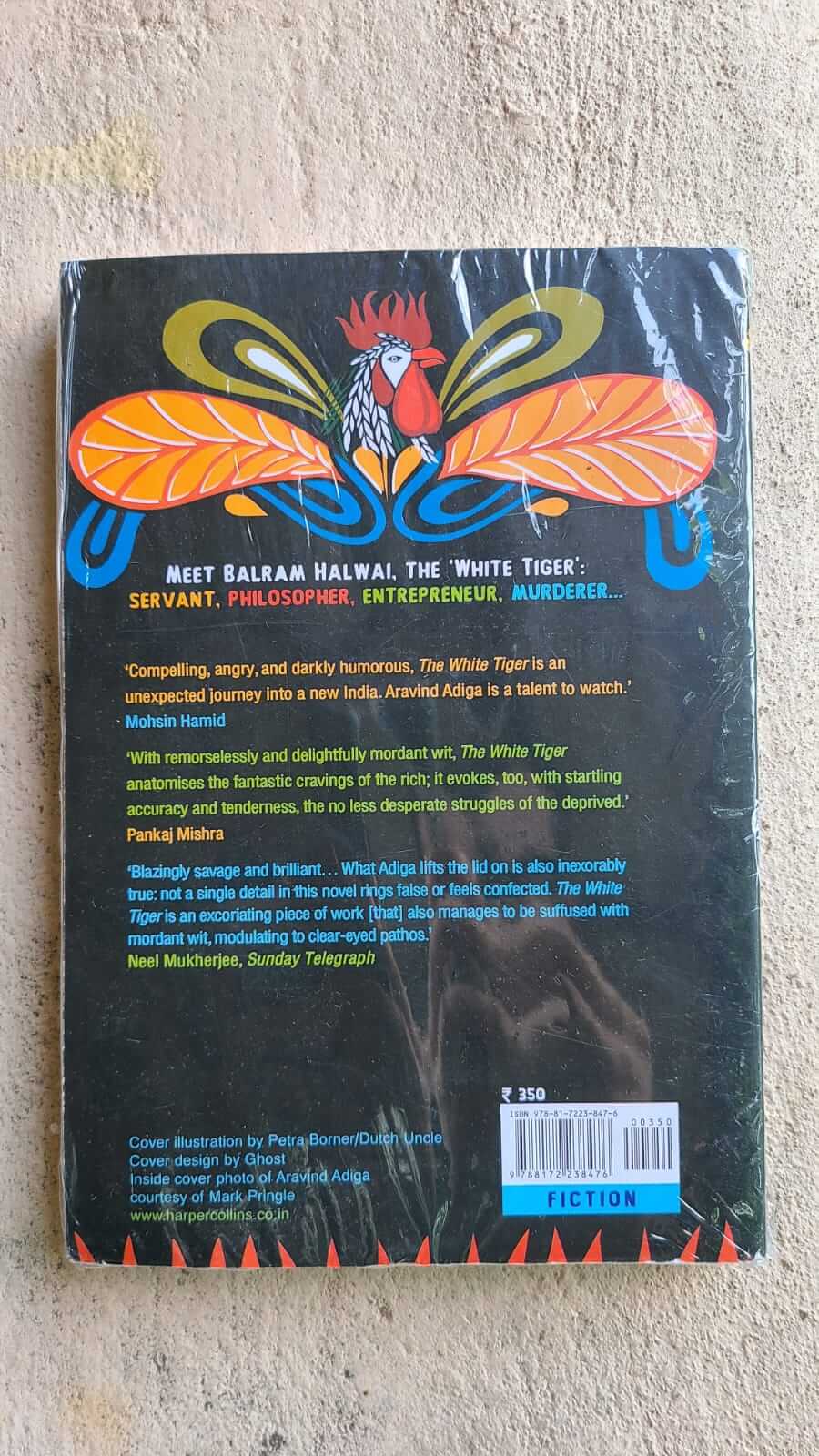

The White Tiger by Aravind Adiga
The White Tiger by Aravind Adiga is a darkly funny and provocative novel about ambition, poverty, inequality, corruption, power, and one man’s determination to escape the life chosen for him.
The story follows Balram Halwai.
He is born into poverty in rural India.
But Balram refuses to accept that poverty must define his entire life.
About The White Tiger
The White Tiger is told largely through a series of letters written by Balram.
He addresses the Premier of China.
Through these letters, he tells the story of how he rose from poverty to become an entrepreneur.
But his journey is far from ordinary.
It involves servitude.
Deception.
Crime.
And murder.
Meet Balram Halwai
Balram is the central character and narrator.
He is intelligent.
Observant.
Ambitious.
And deeply frustrated by the social system around him.
He grows up in a poor village.
His family has little power.
Education is limited.
Opportunity is even more limited.
But Balram believes he is different.
He sees himself as a rare “white tiger.”
7 Powerful Reasons to Read The White Tiger
1. Balram Is an Unforgettable Narrator
Balram is not a traditional hero.
He can be charming.
Funny.
Angry.
Cruel.
And morally disturbing.
His voice makes The White Tiger compelling.
Readers may disagree with his actions while still wanting to understand him.
2. The Novel Explores Class Inequality
Class is one of the biggest themes in the book.
Balram constantly sees the difference between rich and poor.
The wealthy have choices.
The poor often do not.
This inequality shapes almost every major decision he makes.
3. It Examines Ambition
Balram wants more.
He wants money.
Freedom.
Status.
Control over his own life.
His ambition drives the entire story.
But the novel also asks what a person may be willing to sacrifice in order to escape poverty.
4. The Dark Humor Is Memorable
The book deals with serious subjects.
But it is also sharply funny.
Balram observes people with sarcasm and wit.
His commentary makes the novel entertaining even when the themes become uncomfortable.
5. Corruption Is Everywhere
Corruption appears throughout The White Tiger.
Politics.
Business.
Employment.
Police.
Social relationships.
Balram sees a system in which power often protects the powerful.
This shapes his belief that following the rules may never allow him to escape.
6. The Story Is Fast-Paced
Despite its social and political themes, the novel moves quickly.
Balram’s voice keeps the story energetic.
Each stage of his life pushes him closer to a major turning point.
The result feels part social satire and part crime story.
7. It Raises Difficult Moral Questions
The book does not give readers easy answers.
Can poverty excuse terrible choices?
Can someone escape exploitation without becoming exploitative?
Does success justify the methods used to obtain it?
These questions make the novel memorable long after it ends.
Balram’s Childhood
Balram grows up in a poor village near the River Ganges.
His family expects him to contribute financially.
Education becomes difficult.
He eventually leaves school.
His early life shows how poverty can limit opportunity before a person even reaches adulthood.
Becoming a Driver
Balram learns to drive.
This gives him access to a different world.
He becomes a chauffeur for a wealthy family.
For the first time, he sees luxury closely.
Large homes.
Expensive cars.
Shopping malls.
Money.
The contrast between his employers’ lives and his own becomes impossible to ignore.
Delhi
Delhi becomes an important setting.
Balram sees two versions of the city.
One belongs to the wealthy.
The other belongs to servants, drivers, and workers.
These worlds exist beside each other.
But the distance between them remains enormous.
The Rooster Coop
One of the novel’s most important ideas is what Balram calls the “Rooster Coop.”
He uses it to describe the way poor workers remain trapped.
They know they are exploited.
They know escape might be possible.
But fear keeps them obedient.
Family responsibility also plays a role.
Balram begins believing that escaping the Coop requires an extreme act.
Servitude
Balram’s role as a driver teaches him how power operates.
He is close enough to the wealthy to observe them.
But he is never treated as an equal.
His employers depend on him.
Yet they can dismiss him easily.
This contradiction fuels his anger.
Ambition and Morality
Balram wants freedom.
But freedom comes at a cost.
The novel deliberately makes his choices uncomfortable.
Readers are asked to understand his circumstances without automatically approving his actions.
That moral tension is one of the strongest parts of the book.
Entrepreneurship
Balram eventually reinvents himself as a businessman.
This transformation is central to his idea of success.
He believes he has escaped the world of servants.
But the novel leaves readers with another question.
Has he really escaped the system?
Or has he simply moved to the other side of it?
Modern India
The White Tiger presents contrasting images of India.
Rural poverty.
Urban wealth.
Technology.
Outsourcing.
Political corruption.
Luxury shopping malls.
Traditional social structures.
These contradictions create the world Balram is trying to navigate.
Social Satire
The novel uses satire to criticize systems of power.
Balram often exaggerates.
He mocks politicians.
Business owners.
Employers.
And even himself.
That humor makes the social criticism sharper.
The Booker Prize
The White Tiger won the 2008 Man Booker Prize.
The award helped establish Aravind Adiga internationally.
The novel has since become one of his best-known works.
Film Adaptation
The novel was later adapted into a film.
The adaptation introduced Balram’s story to an even wider audience.
Readers who have seen the film may still find the book worthwhile because Balram’s narrative voice is especially important on the page.
Who Should Read This Book?
The White Tiger is ideal for readers who enjoy literary fiction, social satire, crime fiction, contemporary Indian literature, and morally complex narrators.
It may also appeal to readers interested in class, inequality, ambition, globalization, and entrepreneurship.
Readers who prefer morally straightforward protagonists may find Balram challenging.
That is part of the point.
About Aravind Adiga
Aravind Adiga is an Indian author and journalist.
His books include The White Tiger, Selection Day, Amnesty, Last Man in Tower, and Between the Assassinations.
Simon & Schuster notes that The White Tiger won the Man Booker Prize and identifies Adiga as the author of several novels and short stories.
Readers can learn more through the official Simon & Schuster page for The White Tiger.
Product Details
Title: The White Tiger
Author: Aravind Adiga
Genre: Literary Fiction / Social Satire / Contemporary Fiction
Language: English
Original Publication: 2008
Award: 2008 Man Booker Prize Winner
Common Atlantic Books Paperback Edition
Publisher: Atlantic Books
ISBN-13: 9781848878082
Format: Paperback
Publication Date: March 1, 2012
Atlantic Books confirms this paperback edition and ISBN.
Free Press Trade Paperback Edition
Publisher: Free Press
ISBN-13: 9781416562603
Format: Trade Paperback
Pages: 304
Publication Date: October 14, 2008
Simon & Schuster confirms these specifications for the Free Press trade paperback.
Important Edition Note
Different editions of The White Tiger use different covers, ISBNs, dimensions, and page counts.
Always check the barcode printed on your physical copy before entering final WooCommerce specifications.
Explore More Fiction Books
The White Tiger tells the story of a man determined to escape poverty.
But his escape raises uncomfortable questions.
What does freedom cost?
How does inequality shape morality?
And can someone beat an unfair system without becoming part of it?
Readers can explore more Fiction & Literature Books at Bargain Books.
For readers who enjoy sharp social commentary, dark humor, morally complicated characters, and powerful literary fiction, The White Tiger is an unforgettable novel.
| Author | Aravind Adiga |
|---|---|
| Language | English |
| Type | Paperback Printed Book (Second Quality Copy) |
Be the first to review “White tiger by Aravind Adiga”
Related products
-19%
Out of stock
Non-Fiction & Knowledge
Original price was: රු2,650.00.රු2,150.00Current price is: රු2,150.00.
3 X Rs. 716.67 or 8% Cashback with


or 3 X රු716.67 with


or up to 4 X රු537.50 with


Out of stock
Non-Fiction & Knowledge
රු1,500.00
3 X Rs. 500.00 or 8% Cashback with
or 3 X රු500.00 with
or up to 4 X රු375.00 with
Out of stock
Autobiography
රු2,750.00
3 X Rs. 916.67 or 8% Cashback with
or 3 X රු916.67 with
or up to 4 X රු687.50 with
Non-Fiction & Knowledge
රු2,250.00
3 X Rs. 750.00 or 8% Cashback with
or 3 X රු750.00 with
or up to 4 X රු562.50 with
-24%

Out of stock
Non-Fiction & Knowledge
Original price was: රු2,500.00.රු1,900.00Current price is: රු1,900.00.
3 X Rs. 633.33 or 8% Cashback with
or 3 X රු633.33 with
or up to 4 X රු475.00 with
-14%
Out of stock
Self-Help & Psychology
Original price was: රු2,900.00.රු2,500.00Current price is: රු2,500.00.
3 X Rs. 833.33 or 8% Cashback with
or 3 X රු833.33 with
or up to 4 X රු625.00 with
-13%

Out of stock
Non-Fiction & Knowledge
Original price was: රු3,900.00.රු3,400.00Current price is: රු3,400.00.
3 X Rs. 1,133.33 or 8% Cashback with
or 3 X රු1,133.33 with
or up to 4 X රු850.00 with
Out of stock
Non-Fiction & Knowledge
රු1,800.00
3 X Rs. 600.00 or 8% Cashback with
or 3 X රු600.00 with
or up to 4 X රු450.00 with
Reviews
There are no reviews yet.