
No products in the cart.
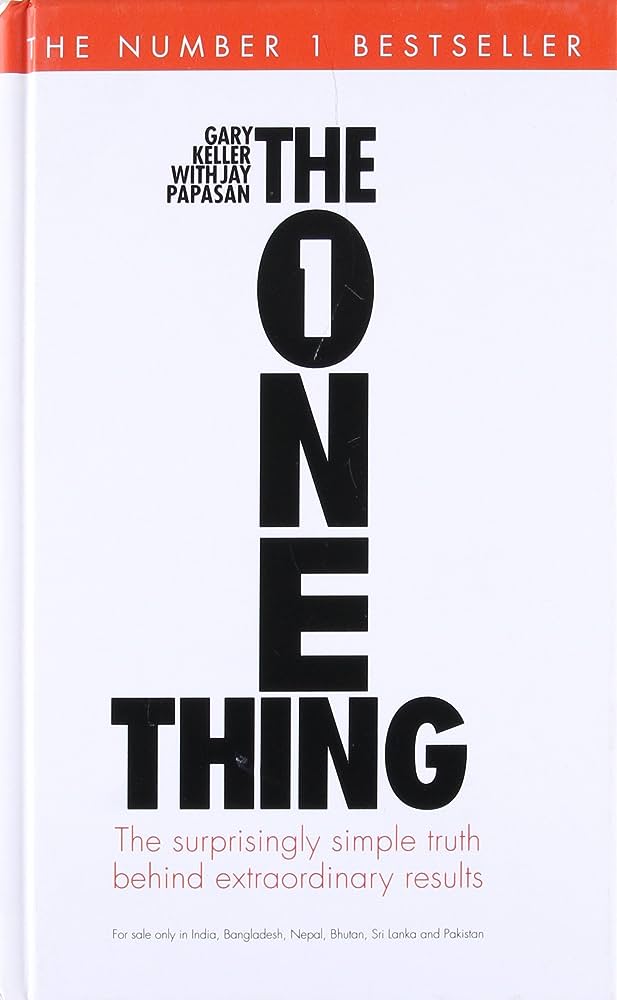
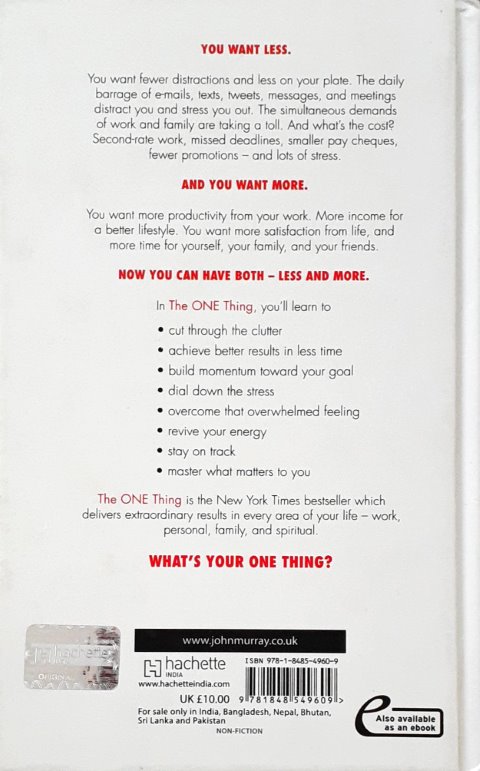
The One Thing (Hard Cover) by Gary Keller and Jay Papasan

රු1,950.00
3 X Rs. 650.00 or 8% Cashback with


or 3 X රු650.00 with


or up to 4 X රු487.50 with


Unlock extraordinary results with “One Thing” by Gary Keller. This hardcover edition reveals the power of focus, offering actionable strategies to simplify your efforts and achieve exceptional outcomes. Order now to streamline your path to success.
Out of stock
Email when stock available
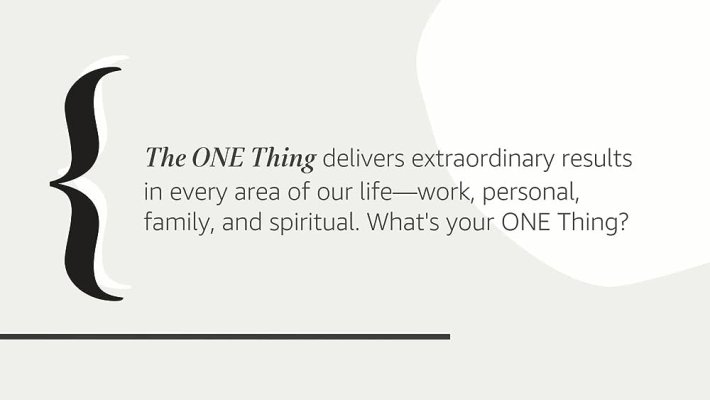
The One Thing Hardcover by Gary Keller and Jay Papasan is a powerful productivity and personal-development book built around one surprisingly simple principle: extraordinary results are often achieved by focusing deeply on the most important thing instead of trying to do everything at once.
Modern life constantly tells us to do more.
More tasks.
More meetings.
More goals.
More notifications.
More projects.
More responsibilities.
The result is often not extraordinary productivity.
It is distraction.
Stress.
Mental overload.
And the frustrating feeling that we are busy all day without making meaningful progress on what actually matters.
The ONE Thing challenges this approach.
Instead of asking:
“How can I get everything done?”
Gary Keller and Jay Papasan encourage readers to ask a much more powerful question:
What is the ONE Thing I can do such that by doing it everything else will be easier or unnecessary?
That question becomes the foundation of the entire book.
The authors explore focus, goal setting, habit formation, time blocking, discipline, purpose, priorities and the myths that prevent people from doing their most valuable work.
The One Thing Hardcover is particularly useful for entrepreneurs, students, managers, professionals, creatives and anyone who feels overwhelmed by too many competing priorities.
The message is not that only one thing in your entire life matters.
It is that at any important moment, one action usually deserves greater attention than everything else.
Learning to identify and protect that priority can completely change the quality of your work.
The One Thing Hardcover – Book Overview
The One Thing Hardcover explores a simple productivity problem:
We often know many things we could do.
But which one deserves our attention first?
People commonly create long to-do lists and then treat every task as equally important.
Reply to an email.
Prepare an important proposal.
Organize files.
Plan next quarter.
Check messages.
Call a customer.
All appear on the same list.
But they do not have the same value.
One action may move your biggest goal forward dramatically.
Another may simply create the feeling of being productive.
The challenge is learning to recognize the difference.
The Domino Effect
One of the book’s most memorable ideas is the domino effect.
A small domino can knock over a slightly larger domino.
That one knocks over a larger one.
Then another.
Progress compounds.
The same principle can apply to goals.
Instead of trying to complete every step simultaneously, identify the first action that makes the next action easier.
Then repeat.
Large achievements often look impossible when viewed as one giant task.
Breaking them into the correct sequence changes everything.
Success Is Sequential
A major principle in The One Thing Hardcover is that success is usually sequential, not simultaneous.
People often try to improve:
Career.
Fitness.
Business.
Finances.
Relationships.
Education.
Personal projects.
all at once.
The result can be divided attention.
The book argues that meaningful progress often happens through concentrated periods of focus.
One important task.
Then another.
Then another.
The Focusing Question
The heart of the book is the Focusing Question:
What is the ONE Thing I can do such that by doing it everything else will be easier or unnecessary?
This question forces prioritization.
It prevents vague productivity.
Imagine you are running a business.
You might have twenty things to do.
But perhaps acquiring one major customer would create enough revenue to solve several other problems.
Or perhaps fixing one conversion problem on your website would increase sales across every campaign.
The question helps uncover leverage.
Finding Leverage
Leverage means finding an action whose impact is larger than the effort itself.
For a student, the highest-leverage action may be studying the topic most likely to determine examination performance.
For a business owner, it may be improving the product customers complain about most.
For a software developer, it may be fixing the architecture problem slowing every future feature.
For someone improving fitness, it might be building a consistent exercise habit rather than constantly searching for the perfect program.
The principle is:
Find the action that changes the most.
The 80/20 Principle
The book also connects with the Pareto Principle.
Often, a relatively small number of actions create a large share of results.
But Keller and Papasan push the idea further.
Do not stop after identifying the important 20%.
Keep narrowing.
What matters most inside that 20%?
Then what matters most inside that?
Continue until you reach the highest-priority action.
To-Do List Versus Success List
Traditional productivity advice often focuses on completing as many tasks as possible.
The One Thing Hardcover encourages something different.
Turn your to-do list into a success list.
A to-do list asks:
What needs doing?
A success list asks:
What needs doing most?
That difference is enormous.
Ten low-value tasks completed may matter less than one high-value task completed well.
Busy Does Not Mean Productive
Busyness is easy to measure.
Hours worked.
Emails sent.
Meetings attended.
Tasks checked off.
But activity is not the same as progress.
A person can work twelve hours and avoid the one uncomfortable task that would genuinely change the result.
The One Thing Hardcover repeatedly pushes readers toward outcomes instead of visible activity.
The Myth of Multitasking
One of the major ideas in the book is that multitasking is often misunderstood.
People believe they can perform several cognitively demanding activities at the same time.
In reality, attention frequently switches rapidly between tasks.
That switching has a cost.
You lose concentration.
You need time to reorient.
Errors increase.
Deep thinking becomes harder.
Task Switching
Imagine writing an important report while checking messages every few minutes.
Each interruption appears small.
But your mind repeatedly leaves the difficult task.
Then has to reconstruct:
Where was I?
What was I thinking?
What comes next?
That recovery time adds up.
Focused work reduces this unnecessary switching.
Attention Is Limited
Time is not the only limited resource.
Attention is too.
You can have three hours available but accomplish very little if those three hours are constantly fragmented.
Protecting attention becomes just as important as protecting time.
Time Blocking
One of the most practical techniques in The One Thing Hardcover is time blocking.
Instead of hoping your priority gets completed after everything else, reserve specific time for it.
Treat the block as an appointment.
During that period:
No unnecessary meetings.
No casual browsing.
No routine email.
No avoidable interruptions.
The most important work receives your best attention.
Protect Your Most Important Work
Many people schedule:
Meetings.
Calls.
Appointments.
But leave their most important project to “whenever I have time.”
That usually means it receives leftover time.
The book recommends reversing this.
Schedule the priority first.
Then allow less important tasks to fit around it.
Discipline Is Not Everything
A surprising argument in the book is that successful people do not necessarily possess unlimited discipline.
Discipline is useful for establishing a behavior.
Once the behavior becomes habitual, it requires less conscious effort.
This shifts the question from:
“How can I become disciplined forever?”
to:
“What habit should I deliberately build?”
The Power of Habit
A strong habit reduces decision-making.
Consider brushing your teeth.
Most people do not need a motivational speech every morning before doing it.
The behavior became normal.
The same principle can apply to:
Reading.
Studying.
Exercising.
Planning.
Writing.
Deep work.
Saving money.
Repeated behavior gradually becomes easier to initiate.
The 66-Day Idea
The book discusses research suggesting that habit formation can take an average of around 66 days, while emphasizing that habits do not magically form in exactly the same number of days for everyone.
The useful lesson is that habits need sustained repetition.
Do not abandon a valuable routine simply because it still feels difficult after one week.
Willpower Is Limited
Another myth challenged in The One Thing Hardcover concerns willpower.
People sometimes act as though willpower is always available.
Just decide harder.
Try harder.
Force yourself.
But self-control can become weaker when people are:
Tired.
Hungry.
Stressed.
Overloaded.
This means important work should not always be saved for the moment when your energy is lowest.
Do Important Work When Energy Is Strong
If your concentration is strongest in the morning, protect that time.
Do not automatically spend your best mental hours on:
Email.
Social media.
Routine administration.
Minor requests.
Use high-energy periods for high-value work.
Routine tasks can often wait.
Priorities
The word “priority” historically referred to what came first.
Modern life often talks about “priorities” as though ten things can all be first simultaneously.
The book challenges that thinking.
At a specific moment, something must matter more.
Choosing means accepting that other things will temporarily receive less attention.
Saying No
Focus requires saying no.
Not because every alternative is bad.
Many opportunities are good.
That is what makes the decision difficult.
A good opportunity can still distract you from a more important one.
Every yes consumes:
Time.
Attention.
Energy.
Resources.
Therefore every yes also contains hidden no’s.
Opportunity Cost
If you spend two hours on one activity, those two hours cannot be used elsewhere.
This is opportunity cost.
The question is not simply:
Is this worth doing?
The better question is:
Is this more valuable than the best alternative use of my time?
That produces better decisions.
Purpose
Productivity becomes much easier to direct when you understand what you are working toward.
Purpose answers:
Why?
Why does this goal matter?
Why should I continue when the work becomes difficult?
Without purpose, productivity can become efficient movement in the wrong direction.
Purpose, Priority and Productivity
A useful chain in The One Thing Hardcover is:
Purpose determines priority.
Priority determines productivity.
If your purpose is unclear, everything can feel equally important.
If your purpose is clear, it becomes easier to identify the action that moves you toward it.
Goal Setting to the Now
The authors recommend connecting distant goals to current actions.
Suppose your goal is five years away.
Ask:
What must happen within five years?
Then:
What must happen this year?
This month?
This week?
Today?
Right now?
The distant goal becomes connected to an immediate action.
Big Goals Become Practical
“Build a successful business” is too vague for today’s calendar.
“Contact five qualified customers before noon” is actionable.
“Become a software engineer” is too broad.
“Complete the authentication module today” is concrete.
The goal provides direction.
The next action creates progress.
Think Big
Interestingly, The One Thing Hardcover does not recommend reducing ambition.
It encourages thinking big while acting with narrow focus.
Dream big.
Set meaningful goals.
Then identify the small number of actions capable of creating those results.
Thinking big and focusing small can coexist.
Fear of Big Goals
People sometimes reduce goals because large goals feel unrealistic.
The authors encourage readers to question those assumptions.
A bigger goal may force you to search for:
Better methods.
Better people.
Better systems.
More leverage.
Instead of asking:
“Can I do this using my current approach?”
ask:
“What would need to become true for this to be possible?”
The Four Thieves of Productivity
The book identifies several forces that can undermine productivity, including inability to say no, fear of chaos, unhealthy habits and an environment that does not support your goals.
These are useful because productivity problems are not always about motivation.
Sometimes the surrounding system makes focused work unnecessarily difficult.
Fear of Chaos
When you focus intensely on one important area, something else may temporarily become messy.
Your inbox may not be perfectly organized.
Some minor tasks may wait.
This can feel uncomfortable.
But trying to keep everything equally perfect can prevent exceptional progress anywhere.
Focused achievement sometimes creates temporary imbalance.
Counterbalancing
The book offers a useful distinction between work and personal life.
Rather than imagining perfect balance every minute, think in terms of counterbalancing.
In work, focus intensely on the priority when needed.
In personal life, regularly return attention to important relationships and health before neglect becomes damaging.
Balance may be dynamic rather than perfectly even.
Success and Health
Productivity should not become self-destruction.
No business goal makes sleep permanently unnecessary.
No project makes health irrelevant.
The ability to sustain performance depends partly on:
Sleep.
Exercise.
Nutrition.
Relationships.
Recovery.
Focus should help create a better life, not consume it.
Environment Matters
Willpower becomes easier when the environment supports the behavior.
If you need deep work:
Close unnecessary tabs.
Silence notifications.
Move the phone away.
Tell colleagues when you are unavailable.
Create a space associated with concentration.
Good environments reduce the number of decisions required.
Accountability
Accountability can also increase follow-through.
Tell someone what you intend to complete.
Work with a coach.
Use a tracking system.
Review your goal weekly.
What gets reviewed is less likely to disappear under daily distractions.
The One Thing in Business
For entrepreneurs, The One Thing Hardcover can be especially valuable.
Businesses always contain more possible work than available time.
Marketing.
Sales.
Inventory.
Operations.
Customer support.
Finance.
Product development.
Hiring.
Technology.
The owner must constantly decide what deserves attention.
The ONE Thing framework asks:
What action would create the largest useful effect right now?
The One Thing in Sales
A salesperson might ask:
What is the ONE Thing I can do today that makes hitting my monthly target easier?
Perhaps:
Call qualified leads.
Follow up with warm prospects.
Improve the offer.
Request referrals.
The answer should direct activity toward outcomes, not simply busyness.
The One Thing in Marketing
Marketers often spread attention across:
Facebook.
Instagram.
TikTok.
SEO.
Email.
Google Ads.
Influencers.
Video.
Instead of trying to dominate every channel immediately, identify the channel producing the best opportunity.
Master it.
Then expand.
The One Thing for Students
Students face the same problem.
Every subject appears urgent.
Every note appears important.
Every chapter seems examinable.
The ONE Thing question can help identify:
The weakest high-value topic.
The upcoming assessment.
The concept blocking understanding of later material.
Focus becomes strategic.
The One Thing for Software Developers
Software development provides a perfect example of leverage.
A developer could spend hours polishing small UI details while the core system architecture remains broken.
The ONE Thing might instead be:
Fix authentication.
Resolve database performance.
Complete the API contract.
Remove the deployment blocker.
The highest-value technical action may unlock many tasks afterward.
The One Thing for Managers
Managers are constantly interrupted.
Messages.
Questions.
Approvals.
Meetings.
Reports.
A manager’s highest-value action may be:
Hiring the right person.
Clarifying priorities.
Removing a blocker.
Improving a process.
Delegating.
Management productivity should be measured by team outcomes, not only the manager’s personal task count.
Delegation
Sometimes your ONE Thing is something another person should do.
Effective focus includes recognizing what you should stop doing.
If a task does not require your unique skill, delegating it may protect time for work that does.
Perfectionism
Perfectionism can disguise procrastination.
You continue improving something that is already useful because completing it would expose it to judgment.
The ONE Thing framework brings you back to impact.
What improvement genuinely matters?
What is simply polishing?
Procrastination
People frequently procrastinate not because they are lazy but because the task is:
Unclear.
Large.
Emotionally uncomfortable.
The focusing question can reduce this.
Instead of:
“Finish the whole project,”
identify:
“What is the next action that makes everything else easier?”
Clarity lowers resistance.
Motivation Follows Progress
Many people wait to feel motivated before beginning.
But progress itself can create motivation.
Completing one meaningful action produces:
Evidence.
Momentum.
Confidence.
Then the next step becomes easier.
This is another version of the domino effect.
Is The One Thing Hardcover a Self-Help Book?
Yes, but it also fits strongly within:
Productivity.
Business.
Leadership.
Goal setting.
Personal development.
Time management.
The principles can be applied to professional and personal goals.
Is It Only for Business Owners?
No.
Gary Keller’s business background strongly influences the examples, but the framework applies more broadly.
Students can use it.
Employees can use it.
Managers can use it.
Parents can use it.
Creative professionals can use it.
Anyone managing competing priorities can benefit from learning to focus more deliberately.
Is It About Doing Only One Thing Forever?
No.
This is one of the biggest misunderstandings.
The authors are not saying:
Choose one activity and ignore everything else forever.
The idea is to identify the most important thing for the goal and moment you are working on.
Once that action is completed, another ONE Thing becomes the priority.
Success becomes a sequence.
Is Multitasking Always Impossible?
Simple automatic activities can overlap.
You can walk while listening to audio.
But two demanding cognitive tasks compete for attention.
The book’s warning applies especially to work requiring:
Judgment.
Learning.
Writing.
Problem-solving.
Creative thinking.
Is The ONE Thing a Quick-Fix Formula?
No.
The idea is simple.
Applying it consistently is harder.
You still need:
Work.
Practice.
Good judgment.
Patience.
The book does not guarantee extraordinary results merely because someone chooses one priority.
The value lies in reducing unnecessary distraction and increasing the probability that important work receives sufficient attention.
Official Hardcover Edition Details
Bard Press lists the original hardcover as The ONE Thing by Gary Keller with Jay Papasan, ISBN 9781885167774, first published April 1, 2013, with 240 pages.
The official ONE Thing site also identifies Gary Keller as author and Jay Papasan as co-author and describes the book around the idea of reducing distractions and focusing on what matters most.
If your physical hardcover has a different barcode, use the ISBN printed on that exact copy because regional and later editions can vary.
Important Themes
The One Thing Hardcover explores focus, productivity, prioritization, habits, time management, discipline, purpose, goal setting, deep work, distraction, multitasking, success, business, leadership, personal development, motivation, accountability, energy management and high-impact decision-making.
7 Powerful Lessons From The One Thing Hardcover
- Not every task deserves equal attention. Productivity improves when you identify the action with the greatest potential impact instead of treating every item on your list as equally important.
- Success usually happens sequentially. Extraordinary outcomes often emerge from completing the right action first, then using that progress to make the next important action easier.
- Ask the Focusing Question. Regularly asking what ONE Thing will make everything else easier or unnecessary helps cut through overwhelm and reveal leverage.
- Protect time for important work. If a goal genuinely matters, put it on the calendar and defend the time rather than hoping it gets completed after less important tasks.
- Build habits instead of depending forever on willpower. Repeated behaviors gradually require less conscious effort, making consistency more sustainable.
- Think big, but act specifically. Ambitious goals provide direction, while concrete next actions create progress today.
- Focus requires saying no. Every commitment consumes limited time and attention, so extraordinary results often depend as much on what you refuse as on what you choose.
Why Read The One Thing Hardcover?
The One Thing Hardcover is especially valuable for people who regularly feel busy but unsatisfied with their progress.
It helps readers move from:
Doing more
to
doing what matters more.
The difference sounds simple.
In practice, it can transform how someone organizes:
A workday.
A project.
A business.
A study plan.
A long-term goal.
The book’s framework is particularly useful because it does not require complicated software or elaborate productivity systems.
You can begin with one question.
What matters most?
Then protect time for the answer.
Who Should Read This Book?
The One Thing Hardcover is ideal for entrepreneurs, business owners, students, managers, sales professionals, marketers, software developers, freelancers, creatives and anyone struggling with too many competing responsibilities.
It may be particularly useful for people who:
Start many projects but finish few.
Spend most days reacting to messages.
Feel overwhelmed by long to-do lists.
Have important goals but never find enough time for them.
Want a simple framework for prioritization.
Or need to reduce distraction and make consistent progress on meaningful work.
The One Thing Hardcover – Extraordinary Results Begin With Focus
The One Thing Hardcover challenges a productivity culture built around doing everything.
The problem is that nobody has unlimited:
Time.
Energy.
Attention.
Every day forces choices.
The question is whether we make those choices intentionally.
Most people do not lack things to do.
They lack clarity about which thing matters most.
That is why the central question in the book is so useful.
It forces a decision.
If only one action could move the goal forward meaningfully, what would it be?
Then another question appears.
Will you actually protect enough time to do it?
This is where many productivity systems fail.
People identify an important goal.
Then spend the day answering messages.
Attending meetings.
Handling minor problems.
The priority becomes tomorrow’s task.
Then tomorrow’s.
Then next month’s.
The One Thing Hardcover argues that extraordinary results come from reversing this order.
Give the best time to the best work.
Allow routine work to fit around it.
Build habits that make focus easier.
Say no when necessary.
Use purpose to determine priorities.
Connect long-term goals to today’s actions.
Then repeat.
The principle is simple.
The discipline to live by it is not.
But that simplicity is exactly what makes the book practical.
For readers overwhelmed by multitasking, constant notifications and endless to-do lists, The One Thing Hardcover offers a clear reminder:
You do not need to do everything right now.
You need to know what deserves to be done first.
Learn more about The ONE Thing by Gary Keller and Jay Papasan on the official The ONE Thing website.
Explore more productivity and personal development books at Bargain Books.
| Author | Gary Keller and Jay Papasan |
|---|---|
| Type | Hardcover |
| ISBN/ISSN | 978-1848549609, 9781848549609 |
| Language | English |
| Pages | 256 |
Be the first to review “The One Thing (Hard Cover) by Gary Keller and Jay Papasan”
Related products
Out of stock
Autobiography
රු2,750.00
3 X Rs. 916.67 or 8% Cashback with
or 3 X රු916.67 with
or up to 4 X රු687.50 with
-19%
Out of stock
Non-Fiction & Knowledge
Original price was: රු2,650.00.රු2,150.00Current price is: රු2,150.00.
3 X Rs. 716.67 or 8% Cashback with
or 3 X රු716.67 with
or up to 4 X රු537.50 with
Self-Help & Psychology
රු2,200.00
3 X Rs. 733.33 or 8% Cashback with
or 3 X රු733.33 with
or up to 4 X රු550.00 with
-34%
Self-Help & Psychology
Original price was: රු2,350.00.රු1,550.00Current price is: රු1,550.00.
3 X Rs. 516.67 or 8% Cashback with
or 3 X රු516.67 with
or up to 4 X රු387.50 with
Non-Fiction & Knowledge
රු1,700.00
3 X Rs. 566.67 or 8% Cashback with
or 3 X රු566.67 with
or up to 4 X රු425.00 with
-34%
Non-Fiction & Knowledge
Original price was: රු2,250.00.රු1,490.00Current price is: රු1,490.00.
3 X Rs. 496.67 or 8% Cashback with
or 3 X රු496.67 with
or up to 4 X රු372.50 with
-17%
Non-Fiction & Knowledge
Original price was: රු2,900.00.රු2,400.00Current price is: රු2,400.00.
3 X Rs. 800.00 or 8% Cashback with
or 3 X රු800.00 with
or up to 4 X රු600.00 with
-24%
Out of stock
Non-Fiction & Knowledge
Original price was: රු2,500.00.රු1,900.00Current price is: රු1,900.00.
3 X Rs. 633.33 or 8% Cashback with
or 3 X රු633.33 with
or up to 4 X රු475.00 with
Reviews
There are no reviews yet.