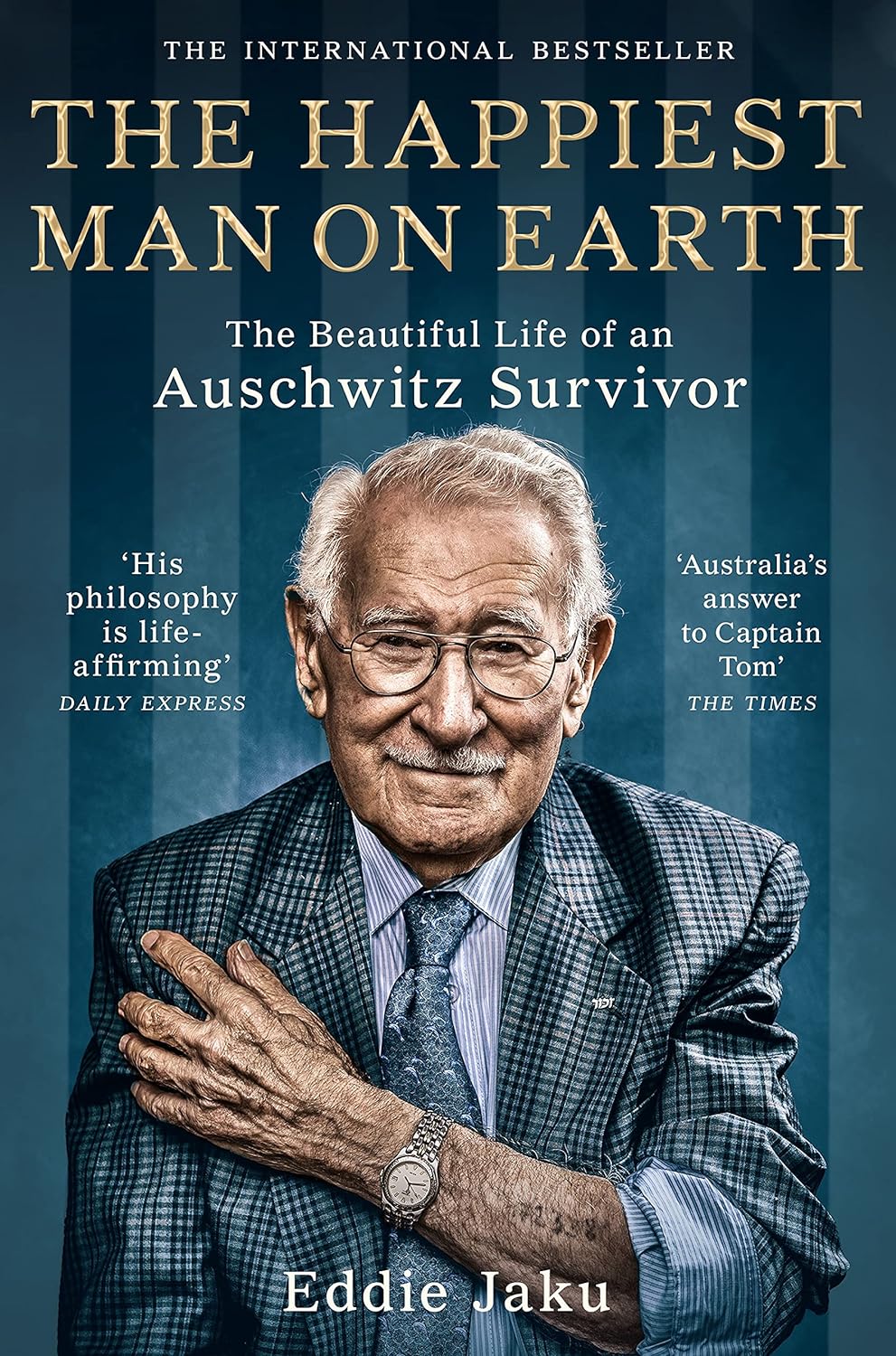
The Happiest Man on Earth by Eddie Jaku
The Happiest Man on Earth by Eddie Jaku is a deeply moving memoir about survival, hope, kindness, resilience and the choice to find happiness even after experiencing unimaginable suffering.
Eddie Jaku was born in Germany in 1920 and grew up considering himself a proud German. But his life changed dramatically under Nazi rule because he was Jewish.
In November 1938, Eddie was beaten, arrested and taken to a concentration camp. Over the following years, he endured imprisonment in Buchenwald and Auschwitz, survived a Nazi death march, lost family members and friends, and witnessed some of the darkest events of the twentieth century.
Yet Eddie refused to allow hatred to control the rest of his life.
After surviving the Holocaust, he eventually made a remarkable commitment: to appreciate life, value human connection and try to smile every day.
Why Read The Happiest Man on Earth?
One of the most powerful aspects of The Happiest Man on Earth is the contrast between Eddie Jaku’s experiences and the philosophy he later developed.
After everything he suffered, it would be understandable for him to spend the rest of his life feeling anger and bitterness.
Instead, Eddie chose another path.
He believed that hatred ultimately creates more suffering and that kindness, friendship, family and gratitude give life meaning.
This does not mean the book ignores what happened to him.
Eddie describes terrible experiences honestly.
But his story is ultimately about what happens after survival.
How do you rebuild your life?
How do you trust people again?
How do you find happiness after losing so much?
These questions give the memoir extraordinary emotional depth.
Eddie Jaku’s Early Life
Before the Holocaust, Eddie Jaku was a young man with dreams, ambitions and a family.
He was born Abraham Jakubowicz in Leipzig, Germany.
As antisemitism increased under the Nazi regime, the country he had once considered home became increasingly dangerous.
His identity as a Jewish man suddenly determined how authorities and many people around him treated him.
The transformation was devastating.
Eddie’s story reminds readers that historical events affect real individuals whose ordinary lives can change very quickly.
Instead of reading only dates and statistics, readers experience this period through the memories of someone who lived through it.
Surviving Buchenwald and Auschwitz
Eddie’s imprisonment eventually took him through some of the most notorious parts of the Nazi concentration-camp system.
He survived Buchenwald and later Auschwitz.
Life in the camps involved hunger, forced labour, fear, violence and constant uncertainty.
Prisoners could lose almost everything that had once defined their lives.
Their homes were gone.
Families were separated.
Basic freedoms disappeared.
And survival could depend on circumstances beyond their control.
The memoir does not treat these experiences as distant historical facts.
Eddie tells them through personal memories, helping readers understand the human reality behind the history.
Friendship Can Help Us Survive
One of the strongest themes in The Happiest Man on Earth is friendship.
In extreme circumstances, friendship can become much more than companionship.
Another person can provide emotional support, practical help and a reason to continue.
Eddie’s experiences taught him the enormous value of genuine human connection.
This lesson continues far beyond the historical setting of the book.
Most readers will never experience circumstances remotely comparable to Eddie’s.
But everyone can understand the importance of having people they can trust.
Good friendships can provide support during difficult moments and make joyful moments more meaningful.
Kindness Is a Powerful Choice
Another central lesson is kindness.
Eddie witnessed extraordinary cruelty.
That makes his later commitment to kindness particularly meaningful.
He understood what human beings were capable of doing to one another.
But he also experienced moments when people helped others despite danger and scarcity.
These experiences influenced his belief that small acts of kindness matter.
Kindness does not require wealth or status.
Listening to someone can be kindness.
Helping someone during a difficult moment can be kindness.
Treating a stranger with dignity can be kindness.
Eddie’s message encourages readers to consider how their everyday behaviour affects the people around them.
Choosing Hope After Suffering
Hope is another important theme throughout The Happiest Man on Earth.
Hope does not mean pretending that difficult experiences never happened.
It means believing that life can still contain something worthwhile afterward.
For Eddie, survival was followed by the difficult process of rebuilding.
His story eventually took him to Australia, where he built a new life with his family.
He married his wife Flore, and they were together for seventy-five years. Eddie later had children, grandchildren and great-grandchildren.
The family life he created became an important source of happiness.
His story therefore moves from destruction toward rebuilding.
Happiness Is Not About Having a Perfect Life
The title of the book can initially seem surprising.
How could someone who experienced so much suffering call himself the happiest man on earth?
That question is at the heart of the memoir.
Eddie does not suggest that happiness means never experiencing sadness.
His life contained enormous grief.
Instead, he developed a philosophy based on appreciating what remained.
Family.
Friendship.
Kindness.
Health.
Freedom.
Ordinary moments.
The book encourages readers to reconsider the idea that happiness will arrive only when everything in life becomes perfect.
There will always be problems.
There may always be something else we want.
Learning to appreciate meaningful parts of life now can change the way we experience it.
Do Not Let Hatred Control Your Life
One of Eddie Jaku’s most important messages concerns hatred.
He had more reasons than most people to hate.
He had witnessed systematic persecution and lost people he loved.
Yet Eddie came to believe that carrying hatred would continue harming him even after his oppressors were gone.
This is not the same as forgetting history.
The book itself exists partly because Eddie believed people should remember what happened.
Remembering injustice and refusing to become consumed by hatred are not contradictory.
His memoir demonstrates that people can acknowledge terrible events while still choosing what kind of person they want to become afterward.
The Importance of Family
Family becomes another major source of meaning in The Happiest Man on Earth.
After losing so much during the Holocaust, creating a family represented a new beginning for Eddie.
His later life demonstrates how relationships can help people rebuild after trauma and loss.
Success is often measured through careers, money or achievements.
Eddie’s story suggests another measure.
The people around us may ultimately matter much more.
The relationships we build, the way we treat others and the memories we create can become some of life’s most valuable achievements.
Gratitude for Ordinary Life
One of the most accessible lessons from the memoir is gratitude.
People naturally become accustomed to things they experience every day.
A safe home.
Food.
Family.
Friends.
Freedom.
The ability to walk outside without fear.
Because these things become normal, it is easy to stop noticing their value.
Eddie’s experiences gave him a different perspective.
Having lost fundamental freedoms, he understood how precious ordinary life could be.
His memoir encourages readers to notice the good things that are already present rather than focusing constantly on what is missing.
A True Story of Resilience
Resilience is not simply about being physically strong.
It is the ability to continue after difficult experiences.
Eddie’s life is an extraordinary example.
He survived persecution and imprisonment and then faced the challenge of rebuilding an entire life.
He eventually moved to Australia with his family in 1950.
Later, he became involved with the Sydney Jewish Museum, sharing his experiences and helping educate future generations about the Holocaust.
Rather than keeping his memories completely private, Eddie turned them into something that could teach others.
Why Remember Holocaust Stories?
Books such as The Happiest Man on Earth are important because historical events become more understandable when readers encounter individual experiences.
Millions of people were persecuted and murdered during the Holocaust.
The scale can be difficult to comprehend.
A personal memoir gives readers one human perspective within that enormous history.
Readers meet Eddie not simply as a survivor but as a son, husband, father, friend and individual with his own hopes and personality.
Remembering these stories helps preserve historical understanding for future generations.
An Inspirational Memoir Without Ignoring History
The Happiest Man on Earth is inspirational, but its optimism is meaningful precisely because the book does not avoid suffering.
Eddie’s message of happiness was developed after experiencing terrible events.
That gives his words a different weight from simple motivational advice.
When he discusses gratitude, he knows what it means to lose almost everything.
When he discusses friendship, he understands how important another person can become in desperate circumstances.
When he discusses kindness, he has seen both extraordinary cruelty and extraordinary humanity.
This combination makes the memoir powerful.
Who Should Read The Happiest Man on Earth?
This book is an excellent choice for readers interested in:
- Inspirational true stories
- Biography and memoir
- Holocaust history
- World War II history
- Resilience
- Hope and happiness
- Human courage
- Kindness
- Personal development
- Family and friendship
- Survival stories
- Historical non-fiction
- Life lessons
- Stories about overcoming adversity
It can appeal both to readers interested in twentieth-century history and those looking for books about finding meaning during difficult circumstances.
Is The Happiest Man on Earth Worth Reading?
If you enjoy true stories that are emotionally powerful while still offering hope, The Happiest Man on Earth is an excellent choice.
Eddie Jaku’s experiences are heartbreaking.
But the lasting message of the book is not despair.
It is the importance of choosing how we respond to life.
We may not control everything that happens to us.
But we can influence how we treat other people.
We can value our relationships.
We can practise kindness.
We can appreciate ordinary moments.
And even after difficult experiences, it may still be possible to find reasons for hope.
Buy The Happiest Man on Earth in Sri Lanka
If you are searching for The Happiest Man on Earth in Sri Lanka, Eddie Jaku’s bestselling memoir is a meaningful addition to any biography, history or inspirational-reading collection.
Follow the extraordinary life of a man who survived Buchenwald, Auschwitz and a Nazi death march yet refused to allow hatred to define the rest of his life.
Eddie Jaku transformed survival into a message about gratitude, friendship, family, hope and kindness.
Whether you are interested in Holocaust history, inspiring true stories or books that encourage a different perspective on happiness, The Happiest Man on Earth is a powerful and unforgettable read.
It reminds us that a meaningful life is not necessarily a life without suffering. Sometimes it is a life in which, despite suffering, we continue choosing kindness, connection and hope.
Learn more about The Happiest Man on Earth by Eddie Jaku on the official Pan Macmillan website.
Explore more memoirs and biographies at Bargain Books.


Reviews
There are no reviews yet.