
No products in the cart.
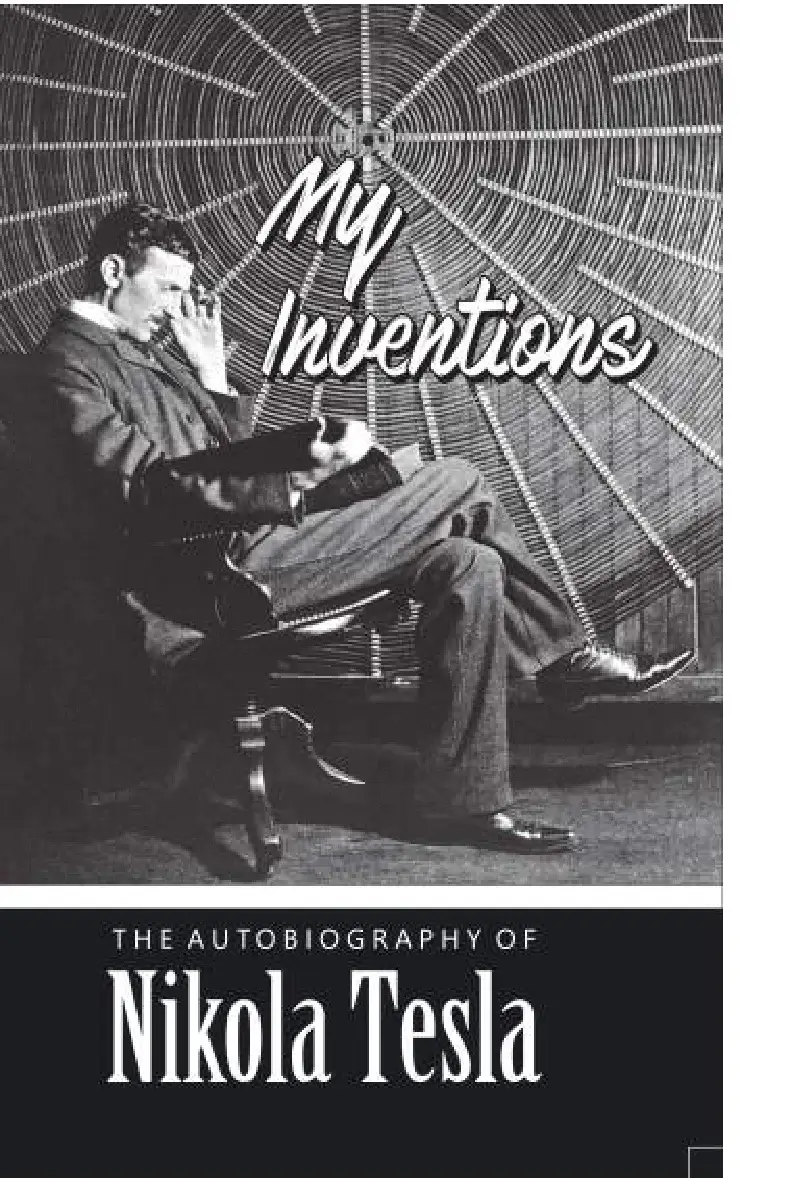




My Inventions: The Autobiography of Nikola Tesla by Nikola Tesla

රු1,650.00
3 X Rs. 550.00 or 8% Cashback with


or 3 X රු550.00 with


or up to 4 X රු412.50 with


My Inventions by Nikola Tesla is the fascinating autobiographical account of legendary inventor and electrical engineer Nikola Tesla. Through his own writings, Tesla describes his childhood, extraordinary imagination, creative process, development of the rotating magnetic field, AC motor, Tesla coil, wireless experiments, remote control and ambitious ideas for future technology. An excellent read for students, engineers, entrepreneurs and anyone interested in invention, electricity, innovation and the history of modern technology.
Out of stock
Email when stock available
My Inventions by Nikola Tesla is a fascinating autobiographical account that takes readers inside the mind of one of history’s most imaginative inventors, revealing his childhood, creative process, scientific discoveries, experiments and extraordinary vision for the technological future.
Nikola Tesla helped shape the modern electrical age.
His ideas contributed to the development of alternating-current electrical systems, electric motors, high-frequency technology, wireless experimentation and numerous inventions that influenced later technological progress.
But how did Tesla actually think?
Where did his ideas come from?
How could he imagine complicated machines before physically building them?
What experiences shaped his fascination with electricity?
And why was he often interested in technologies far ahead of what was practical during his lifetime?
In My Inventions by Nikola Tesla, Tesla answers many of these questions in his own voice.
Rather than being a conventional biography written by a historian, this book comes from Tesla’s autobiographical writings, originally published as a series of articles in 1919.
He reflects on:
His childhood.
His unusual imagination.
His early fascination with invention.
His education.
His development as an engineer.
The rotating magnetic field.
Alternating-current motors.
The Tesla coil.
High-frequency electrical experiments.
Wireless communication.
Remote control.
Energy transmission.
And his vision of an increasingly interconnected technological world.
The result is a rare opportunity to encounter Nikola Tesla not only as a famous historical inventor but as a person describing his own mind, habits and ambitions.
My Inventions by Nikola Tesla – Book Overview
My Inventions by Nikola Tesla is particularly fascinating because Tesla does not simply list inventions.
He tries to explain how he invented.
His creative process was highly unusual.
Tesla describes having an exceptionally vivid imagination and being able to construct machines mentally before building them physically.
He would imagine:
Individual components.
Movement.
Mechanical stresses.
Possible faults.
Changes in design.
Instead of immediately creating a physical prototype, he often claimed that he could test an invention inside his mind.
This gives the autobiography enormous value for readers interested in:
Engineering.
Creativity.
Innovation.
Visualization.
Problem-solving.
Scientific history.
Nikola Tesla’s Early Life
Nikola Tesla was born in 1856 in what is now Croatia, into a Serbian family.
From an early age, he displayed unusual curiosity and a powerful imagination.
His father was a Serbian Orthodox priest, while his mother possessed remarkable practical creativity and mechanical ability despite lacking formal technical education.
Tesla credited his mother as an important influence on his inventive abilities.
His Mother’s Influence
Tesla’s mother designed and improved practical household tools.
Watching this kind of problem-solving helped shape his understanding that everyday difficulties could inspire invention.
This is an important lesson in My Inventions by Nikola Tesla:
Innovation does not always begin in a laboratory.
It can begin by observing a problem.
Childhood Imagination
Tesla describes intense mental images during childhood.
Objects and scenes could appear extremely vividly in his mind.
Although these experiences sometimes troubled him when he was young, he eventually connected this powerful visualization ability to his later inventive process.
Turning an Unusual Mind Into an Advantage
One of the most interesting aspects of Tesla’s story is how something initially experienced as difficult eventually became useful.
His vivid mental imagery allowed him to imagine mechanical systems in extraordinary detail.
This demonstrates a broader lesson:
An unusual way of thinking can sometimes become an advantage when understood and directed productively.
The Inventor’s Mind
Tesla’s description of invention is one of the strongest parts of My Inventions by Nikola Tesla.
Some inventors:
Draw.
Prototype.
Test.
Modify.
Tesla often attempted much of this mentally first.
He would imagine a machine operating.
Then observe it in his imagination.
If something seemed wrong, he would alter the design.
Mental Prototyping
Today we might compare parts of this process with:
Computer simulation.
CAD modelling.
Digital prototypes.
Tesla did not have those tools.
His simulation environment was his imagination.
Of course, modern engineering still requires physical measurement and testing, but Tesla’s account shows how powerful visualization can support technical creativity.
Observation
Tesla paid intense attention to:
Natural phenomena.
Mechanical systems.
Human behavior.
Electricity.
Movement.
Small observations could trigger larger ideas.
Great inventions rarely appear from absolutely nothing.
They often begin when someone notices something others overlook.
Curiosity
Curiosity runs throughout My Inventions by Nikola Tesla.
Tesla continually wanted to understand:
Why?
How?
Could this work differently?
What if this limitation disappeared?
That questioning mindset is essential to innovation.
The Rotating Magnetic Field
One of Tesla’s most important technical breakthroughs was the concept of the rotating magnetic field.
This principle became fundamental to the development of practical alternating-current induction motors.
Tesla describes the moment when the idea became clear to him.
Alternating Current
Electricity can be delivered using different systems.
Tesla became strongly associated with alternating current, commonly known as AC.
Alternating current changes direction periodically.
Its advantages made it extremely important for transmitting electrical power efficiently over significant distances when combined with transformers and appropriate infrastructure.
The AC Motor
Tesla’s work on AC motors helped demonstrate how alternating current could be used not merely for lighting but also for mechanical power.
The induction motor became one of the major technologies associated with his legacy.
Why the Rotating Magnetic Field Matters
The rotating magnetic field makes it possible to create rotational movement electrically without relying on some of the mechanical arrangements required by earlier motor designs.
This principle remains fundamental in many electric motors.
Tesla and the Electrical Revolution
Tesla lived during an extraordinary period.
Electricity was rapidly moving from:
Scientific curiosity
to
industrial infrastructure.
Cities were being electrified.
Electrical companies were competing.
New technologies appeared rapidly.
Tesla became part of this transformation.
Tesla and Thomas Edison
Tesla is frequently discussed in connection with Thomas Edison.
Both became major figures in the history of electrical technology, although their approaches and business circumstances differed greatly.
Popular culture sometimes simplifies their relationship into a dramatic personal rivalry.
The real history is more complicated.
When discussing My Inventions by Nikola Tesla, it is better to see Tesla within the broader development of nineteenth-century electrical engineering rather than turning every event into a simple Tesla-versus-Edison story.
Tesla and George Westinghouse
Tesla’s alternating-current patents became important to businessman and inventor George Westinghouse and the development of AC power systems.
The connection between Tesla’s inventions and Westinghouse helped bring Tesla’s electrical ideas into large-scale practical use.
The Tesla Coil
Another famous invention discussed in My Inventions by Nikola Tesla is the Tesla coil.
Tesla coils produce very high-voltage, high-frequency alternating currents.
They became useful in Tesla’s experiments involving:
High-frequency electricity.
Electrical resonance.
Lighting.
Wireless effects.
Spectacular Experiments
Tesla became famous for dramatic electrical demonstrations.
High voltages.
Glowing lamps.
Electrical arcs.
Wireless illumination.
These demonstrations captured public imagination.
But behind the spectacle was serious experimentation with electrical frequency, resonance and transmission.
Wireless Technology
Tesla became deeply interested in transmitting information and energy without wires.
Today, wireless systems are everywhere.
Phones.
Wi-Fi.
Radio.
Bluetooth.
Satellites.
Tesla was experimenting with wireless possibilities during a period when even ordinary electrical infrastructure was still developing.
Radio and Wireless Communication
The history of radio involves contributions from multiple scientists, inventors and engineers.
Tesla performed important work relating to wireless transmission and patented relevant technologies.
However, claims that one individual alone “invented radio” usually oversimplify a complicated international technological development.
A responsible reading of My Inventions by Nikola Tesla should appreciate Tesla’s major contributions without turning historical complexity into mythology.
Remote Control
Tesla also demonstrated remote-control technology.
In 1898, he publicly demonstrated a radio-controlled boat.
Today, remote control feels ordinary.
But at the time, controlling a machine wirelessly was astonishing.
Some observers reportedly struggled even to understand what they were seeing.
Ideas Ahead of Their Time
Tesla imagined technological possibilities that were difficult to build with the infrastructure of his era.
This is one reason his reputation has grown so strongly in modern popular culture.
He thought about systems involving:
Wireless communication.
Automation.
Remote control.
Global information exchange.
Energy transmission.
The World System
Tesla envisioned technologies that could potentially connect distant parts of the world through wireless communication.
Some of his predictions sound strikingly modern.
But readers should distinguish between:
Tesla’s visions.
Tesla’s proven inventions.
Later technologies developed through many other researchers.
Admiring foresight does not require claiming that Tesla personally invented every later technology resembling one of his ideas.
Colorado Springs
Tesla conducted major high-voltage and wireless experiments in Colorado Springs.
The location gave him space to test extremely large electrical apparatus.
His experiments there became legendary.
Tesla investigated:
High voltage.
Resonance.
Electrical transmission.
Wireless phenomena.
These experiments contributed to his later ambitions for larger wireless systems.
Magnifying Transmitter
Tesla developed what he called a magnifying transmitter, building upon ideas associated with resonant electrical transformers.
He hoped such systems could play a role in long-distance wireless transmission.
Wardenclyffe and Bigger Ambitions
Tesla later became associated with the ambitious Wardenclyffe Tower project in New York.
His goals involved large-scale wireless communication and potentially much broader transmission concepts.
The project was never completed according to Tesla’s grand vision.
This part of his story demonstrates an important reality:
Being visionary does not guarantee commercial success.
Innovation Needs More Than Ideas
An invention may require:
Funding.
Infrastructure.
Business strategy.
Manufacturing.
Market timing.
Partners.
Customers.
Tesla was extraordinary at generating technical ideas.
But his career also illustrates that innovation and commercial execution are separate skills.
Inventor Versus Entrepreneur
Tesla’s life is especially interesting for entrepreneurs because he represents the tension between invention and business.
Creating something brilliant does not automatically mean:
People understand it.
Investors support it.
Companies manufacture it.
Customers adopt it.
Execution matters.
Vision Can Outrun Reality
A visionary may see possibilities decades ahead.
That sounds exciting.
But if:
Materials are unavailable.
Infrastructure does not exist.
Economics do not work.
Investors lose confidence.
the technology may fail commercially even if parts of the underlying idea are valuable.
Persistence
Tesla continued experimenting despite setbacks.
His life included periods of:
Recognition.
Financial success.
Failure.
Public attention.
Disappointment.
He remained deeply attached to his ideas.
Obsession and Focus
Tesla’s extraordinary concentration helped him accomplish remarkable work.
But his autobiography also reveals a personality capable of extreme fixation.
This creates an important distinction.
Focus can be powerful.
But sustainable achievement also requires:
Health.
Relationships.
Financial stability.
Practical judgment.
Work Habits
Tesla described working with enormous intensity.
Modern readers may find this inspiring.
But extreme work schedules should not automatically be treated as healthy models.
Long-term creativity depends not only on effort but also on recovery and health.
Memory
Tesla claimed an exceptional ability to remember technical information and visualize details.
This contributed to his distinctive engineering approach.
But readers should remember that My Inventions by Nikola Tesla is Tesla describing his own life.
As with any autobiography, events are presented from the author’s personal perspective.
Autobiography Versus Biography
This distinction matters.
A biography is written by someone about another person’s life.
An autobiography is written by the person whose life is being described.
Therefore, My Inventions by Nikola Tesla is valuable as a primary historical source.
Readers encounter Tesla’s own:
Memories.
Interpretations.
Opinions.
Claims.
That makes the book fascinating.
But autobiographical claims can also be compared with historical scholarship when precise factual questions matter.
Originally Published as Articles
The writings that became My Inventions originally appeared as a series of autobiographical articles in the magazine Electrical Experimenter in 1919.
They were later collected and republished in book form.
Because the underlying text is historical and has been issued by many publishers, modern editions can vary in:
Page count.
Introduction.
Formatting.
Illustrations.
Additional material.
Therefore, check the physical edition for exact publishing specifications when entering WooCommerce attributes.
Technology and Imagination
One of the central themes of My Inventions by Nikola Tesla is the relationship between imagination and engineering.
An invention begins before it exists physically.
Someone must first imagine:
A different machine.
A different system.
A different possibility.
But imagination must eventually meet reality.
Creativity Plus Engineering
A good idea alone is not enough.
Engineering requires understanding:
Physics.
Materials.
Constraints.
Safety.
Manufacturing.
Performance.
Tesla’s story sits at the intersection between imaginative vision and technical implementation.
Failure as Information
Not every Tesla project succeeded.
That matters.
Popular biographies sometimes turn famous inventors into people who constantly produce brilliant successes.
Real innovation involves:
Experiments that fail.
Ideas that change.
Funding that disappears.
Systems that cannot yet work economically.
Failure is part of invention.
Scientific Curiosity
Tesla was willing to explore questions whose practical applications were not always obvious immediately.
Basic curiosity can sometimes lead toward technologies that become useful much later.
Thinking Beyond Existing Technology
Most people ask:
How can this existing machine become better?
Visionary inventors sometimes ask:
Why must the machine work this way at all?
That second question can create entirely new categories of technology.
Simplicity
Tesla often sought elegant solutions.
A strong engineering design can sometimes remove unnecessary components rather than continually adding more.
Simplicity can improve:
Reliability.
Efficiency.
Manufacturing.
Maintenance.
Visualization for Problem-Solving
You do not need Tesla’s extraordinary mental imagery to use visualization.
Students and professionals can mentally rehearse:
A presentation.
A software architecture.
A mechanical design.
A business process.
A difficult conversation.
Visualization can help identify problems before action.
From Visualization to Testing
However, imagination should eventually be tested against reality.
A perfect mental model can still contain incorrect assumptions.
Strong problem-solving uses both:
Creative imagination
and
evidence.
The Importance of Experimentation
Tesla’s work reminds readers that ideas need experiments.
An experiment answers:
Does this actually work?
What changes?
What did we misunderstand?
What happens at larger scale?
Experimentation transforms speculation into knowledge.
Learning Across Disciplines
Tesla’s interests extended beyond narrow electrical engineering.
He thought about:
Mechanical systems.
Wireless communication.
Automation.
Energy.
Physics.
Human society.
Cross-disciplinary thinking can generate creative connections.
Read Outside Your Specialty
A programmer can learn from psychology.
A business owner can learn from engineering.
A designer can learn from biology.
Innovation often appears where fields overlap.
Question Assumptions
One of the strongest lessons from My Inventions by Nikola Tesla is to question assumptions.
What if electricity could be transmitted differently?
What if machines could be controlled remotely?
What if communication could become wireless?
Technology moves forward when somebody questions what everyone else treats as permanent.
Long-Term Thinking
Tesla often thought far beyond the immediate commercial opportunity.
That created both strengths and difficulties.
Long-term thinking allows bold ideas.
But it needs to be balanced with short-term feasibility.
Vision and Execution
A useful business lesson from Tesla’s life is:
Vision without execution remains an idea.
Execution without vision may produce only incremental improvement.
The strongest innovators need both.
Fame and Mythology
Nikola Tesla has become an almost mythological figure online.
Many exaggerated claims circulate about him.
Some portray him as the secret inventor of nearly every modern technology.
Others describe conspiracies without strong historical evidence.
The real Tesla does not need exaggeration to be fascinating.
His documented achievements are already extraordinary.
Read Tesla in His Own Words
That is one reason My Inventions by Nikola Tesla is valuable.
Instead of learning about him only through:
Memes.
Videos.
Quotes of uncertain origin.
Legends.
you can read his own autobiographical writings.
Tesla’s Personality
Readers encounter a person who was:
Highly imaginative.
Intensely focused.
Ambitious.
Confident in his abilities.
Sometimes eccentric.
Deeply fascinated by technological possibilities.
The book provides a more personal picture than a simple list of patents.
Invention and Identity
For Tesla, invention was not simply employment.
It was central to his identity.
He saw technological creation as something capable of transforming civilization.
That sense of mission drove much of his work.
Technology Should Solve Problems
The most meaningful inventions do more than demonstrate technical skill.
They improve something.
Energy.
Communication.
Transportation.
Health.
Productivity.
Tesla’s large ambitions frequently involved improving how people could access and use technology.
Responsible Innovation
Modern readers can add another question:
Just because we can build something, should we?
Today’s inventors work with technologies such as:
Artificial intelligence.
Biotechnology.
Automation.
Surveillance.
Autonomous systems.
Technical capability needs ethical judgment.
Tesla and Modern Innovators
Entrepreneurs and engineers today face many challenges Tesla would recognize:
Convincing investors.
Explaining unfamiliar technology.
Building prototypes.
Competing standards.
Scaling systems.
Balancing vision with economics.
That makes My Inventions by Nikola Tesla surprisingly relevant to modern innovators.
Lessons for Software Developers
Even software developers can apply ideas from Tesla’s working methods.
Visualize the system before writing code.
Understand the architecture.
Think about failure cases.
Test assumptions.
Simplify the design.
Then build.
Tesla worked with electricity and machinery, but the problem-solving principles travel across disciplines.
Lessons for Entrepreneurs
Entrepreneurs can learn another lesson:
Technology alone does not create a company.
You also need:
Customers.
Pricing.
Funding.
Operations.
Marketing.
Timing.
Tesla’s life demonstrates both the power and limitation of pure invention.
Lessons for Students
Students may find Tesla inspiring because his story emphasizes curiosity and continuous learning.
Do not study only to pass an examination.
Ask:
Why does this work?
How could it work differently?
What would happen if I changed this?
That curiosity turns education into exploration.
Is My Inventions by Nikola Tesla a Complete Biography?
No.
It is better understood as Tesla’s autobiographical writings rather than a comprehensive modern biography covering every stage of his entire life.
For a complete historical biography, readers may want to pair it with a well-researched biography written by a historian or Tesla scholar.
Is the Book Technical?
Parts discuss electrical and engineering concepts.
However, much of the book focuses on:
Memories.
Experiences.
Creative processes.
Ideas.
You do not need to be an electrical engineer to appreciate it.
Readers with technical knowledge may understand additional details, but general readers can still enjoy Tesla’s story.
Is It Good for Beginners?
Yes.
It can serve as an accessible introduction to Nikola Tesla because it allows readers to hear his story in his own voice.
Those who become more interested can then explore deeper histories of:
Electricity.
AC power.
Radio.
Wireless technology.
The late nineteenth-century electrical industry.
Is It a Science Book?
Partly.
It belongs most naturally under:
Biography & Memoir
but also strongly connects with:
Science.
Technology.
Engineering.
History of invention.
Who Was Nikola Tesla?
Nikola Tesla was a Serbian-American inventor and electrical engineer born in 1856.
He became particularly famous for his work involving:
Alternating-current electrical systems.
Induction motors.
Rotating magnetic fields.
High-frequency electrical technology.
Tesla coils.
Wireless experiments.
Remote control.
His name remains one of the most recognizable in the history of invention.
Why Is Tesla Still Famous?
Tesla’s reputation comes from a combination of:
Important documented inventions.
Unusual personality.
Bold futuristic ideas.
Dramatic experiments.
Professional struggles.
Later mythology.
Few historical inventors combine science, personality and legend quite like Tesla.
Important Themes
My Inventions by Nikola Tesla explores:
- Nikola Tesla
- Invention
- Electricity
- Alternating current
- Engineering
- Creativity
- Visualization
- Scientific discovery
- Innovation
- Rotating magnetic fields
- Electric motors
- Tesla coils
- Wireless communication
- Remote control
- Experimentation
- Future technology
- Persistence
- Scientific imagination
- Engineering history
- Autobiography
7 Powerful Lessons From My Inventions by Nikola Tesla
There are many lessons in My Inventions by Nikola Tesla, but seven stand out:
- Train your imagination before you begin building – Tesla’s remarkable ability to visualize machinery demonstrates how detailed mental modelling can help identify problems before committing resources to a physical design.
- Question what everyone else considers normal – Major innovation often begins by challenging assumptions about how a technology must work.
- Observation can generate invention – Tesla’s curiosity about natural and mechanical phenomena repeatedly contributed to his ideas.
- Experimentation converts imagination into evidence – Vision matters, but ideas must eventually be tested against physical reality.
- Persistence is essential when working on unfamiliar ideas – New technology may initially appear impossible, unnecessary or commercially unattractive to other people.
- Technical brilliance and commercial success are different skills – Tesla’s career demonstrates that inventions also need funding, execution, communication, timing and sustainable business models.
- Think beyond the technology of today – Tesla’s fascination with wireless communication, remote control and interconnected systems shows the creative power of asking what might become possible rather than limiting imagination to what already exists.
Why Read My Inventions by Nikola Tesla?
My Inventions by Nikola Tesla is an excellent choice for readers interested in:
- Nikola Tesla
- Autobiographies
- Famous inventors
- Electrical engineering
- Science history
- Technology
- Innovation
- Creativity
- Alternating current
- AC motors
- Tesla coils
- Wireless technology
- Remote control
- Scientific discovery
- Entrepreneurship
- Engineering
- Future technology
- Inventor biographies
- Historical science
- Creative thinking
It is especially valuable for readers who want to understand not only what Tesla invented, but how Tesla described his own way of thinking.
Who Should Read This Book?
My Inventions by Nikola Tesla may especially appeal to:
- Engineering students
- Science students
- Inventors
- Entrepreneurs
- Software developers
- Technology enthusiasts
- Nikola Tesla fans
- Readers interested in biographies
- Readers fascinated by electricity
- People interested in scientific history
- Creative thinkers
- Young innovators
- Readers interested in the history of modern technology
- Anyone curious about how extraordinary inventors think
My Inventions by Nikola Tesla – Inside the Mind of an Inventor
My Inventions by Nikola Tesla is ultimately more than a catalogue of electrical discoveries.
It is a journey inside a creative mind.
Tesla saw possibilities where others saw limitations.
He imagined machines before they existed.
He questioned accepted technological assumptions.
He experimented with electricity when the modern electrical world was still being created.
Some ideas succeeded.
Some did not.
Some were practical.
Others were too ambitious for the technology or economics of his era.
That is exactly what makes his story valuable.
Innovation is not a straight line from:
Idea
to
success.
It is often:
Observation.
Idea.
Experiment.
Failure.
Adjustment.
Another experiment.
Funding problem.
New discovery.
Another obstacle.
Progress.
Tesla’s life contains all of these.
It also provides an important warning against romanticizing genius.
Brilliant ideas alone are not enough.
Technology must eventually operate in the real world.
Resources matter.
Business matters.
Timing matters.
Collaboration matters.
But imagination matters too.
Before people could routinely:
Communicate wirelessly.
Control machines remotely.
Transmit information around the planet.
someone had to imagine that these things might be possible.
Tesla was one of the people willing to imagine on that scale.
For students, engineers, entrepreneurs, inventors and readers fascinated by technology, My Inventions by Nikola Tesla provides a rare opportunity to hear one of history’s most celebrated inventors explain his development, discoveries and extraordinary creative process in his own words.
Learn more about My Inventions by Nikola Tesla through Project Gutenberg.
Explore more science, technology, and biography books at Bargain Books.
Be the first to review “My Inventions: The Autobiography of Nikola Tesla by Nikola Tesla”
Related products
-18%
Out of stock
Original price was: රු2,800.00.රු2,300.00Current price is: රු2,300.00.
3 X Rs. 766.67 or 8% Cashback with
or 3 X රු766.67 with
or up to 4 X රු575.00 with
-13%
Out of stock
Non-Fiction & Knowledge
Original price was: රු3,900.00.රු3,400.00Current price is: රු3,400.00.
3 X Rs. 1,133.33 or 8% Cashback with
or 3 X රු1,133.33 with
or up to 4 X රු850.00 with
Out of stock
Non-Fiction & Knowledge
රු1,800.00
3 X Rs. 600.00 or 8% Cashback with
or 3 X රු600.00 with
or up to 4 X රු450.00 with
Out of stock
Autobiography
රු2,750.00
3 X Rs. 916.67 or 8% Cashback with
or 3 X රු916.67 with
or up to 4 X රු687.50 with
-33%
Non-Fiction & Knowledge
Original price was: රු2,850.00.රු1,900.00Current price is: රු1,900.00.
3 X Rs. 633.33 or 8% Cashback with
or 3 X රු633.33 with
or up to 4 X රු475.00 with
-14%
Out of stock
Non-Fiction & Knowledge
Original price was: රු3,500.00.රු3,000.00Current price is: රු3,000.00.
3 X Rs. 1,000.00 or 8% Cashback with
or 3 X රු1,000.00 with
or up to 4 X රු750.00 with
Non-Fiction & Knowledge
රු2,450.00
3 X Rs. 816.67 or 8% Cashback with
or 3 X රු816.67 with
or up to 4 X රු612.50 with
-24%
Non-Fiction & Knowledge
Original price was: රු2,300.00.රු1,750.00Current price is: රු1,750.00.
3 X Rs. 583.33 or 8% Cashback with
or 3 X රු583.33 with
or up to 4 X රු437.50 with
Reviews
There are no reviews yet.