
No products in the cart.
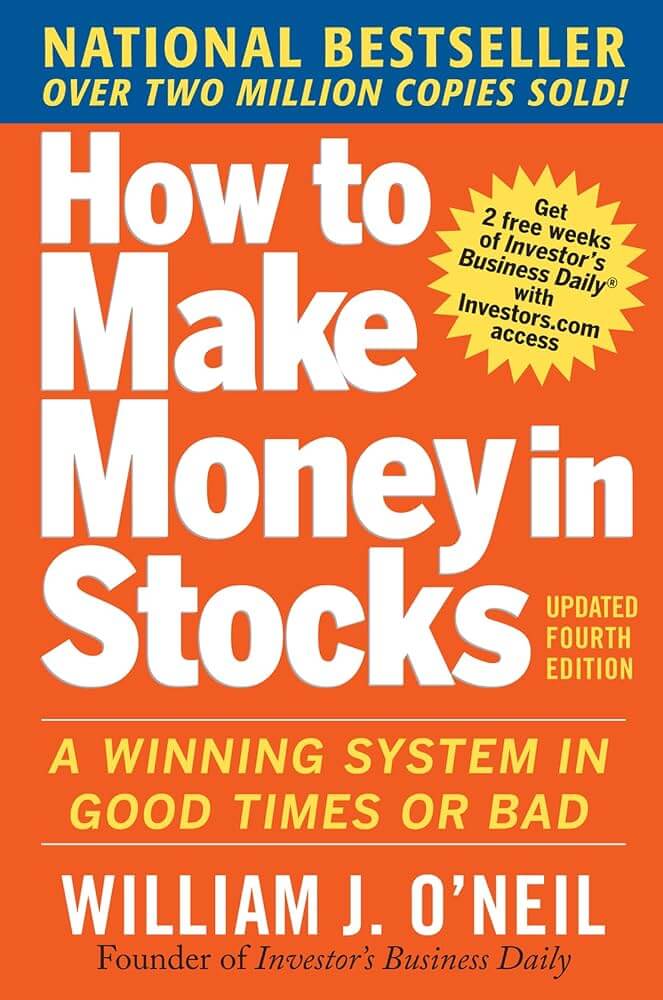
How to Make Money in Stocks: A Winning System in Good Times or Bad by William J. O’Neil – Fourth Edition

රු2,500.00
3 X Rs. 833.33 or 8% Cashback with


or 3 X රු833.33 with


or up to 4 X රු625.00 with


Learn William J. O’Neil’s famous CAN SLIM investing system with How to Make Money in Stocks: A Winning System in Good Times or Bad.
The Fourth Edition covers:
- CAN SLIM stock selection
- Current and annual earnings growth
- Growth-stock investing
- Market leaders
- Institutional sponsorship
- Market direction
- Price and volume analysis
- Stock chart patterns
- Buying and selling rules
- Cutting investment losses
- Portfolio management
- Common investor mistakes
- More than 100 historical charts
A comprehensive guide for readers interested in combining fundamental analysis, technical analysis and disciplined risk management.
Fourth Edition | Paperback | 464 pages | McGraw Hill Education India | ISBN 9789390491742
Financial note: This book is educational material. Investment returns are not guaranteed.
5 in stock
How to Make Money in Stocks by William J. O’Neil
How to Make Money in Stocks: A Winning System in Good Times or Bad by William J. O’Neil is one of the best-known practical books on growth-stock investing.
O’Neil developed the CAN SLIM investing system, an approach that combines company fundamentals, earnings growth, market leadership, institutional activity and technical price-and-volume analysis.
Rather than simply recommending that readers buy stocks and hold them indefinitely, the book attempts to give investors a structured framework for answering several important questions:
- Which stocks should I consider?
- When should I buy?
- How can I recognise strong companies?
- What chart patterns should I watch?
- When should I sell?
- How can I limit losses?
- How does the overall market affect individual stocks?
- What mistakes commonly hurt investors?
McGraw Hill describes the fourth edition as being based on O’Neil’s study of major stock-market winners and containing techniques for identifying potential leaders, choosing stocks, mutual funds and ETFs, studying chart patterns and avoiding common investing mistakes.
The CAN SLIM Investing System
The central framework in the book is CAN SLIM.
Each letter represents a characteristic O’Neil associates with historically successful growth stocks.
C – Current Quarterly Earnings
O’Neil places strong emphasis on recent earnings growth.
Instead of selecting a company simply because its share price looks inexpensive, CAN SLIM encourages investors to examine whether the company’s latest quarterly earnings show meaningful improvement.
The idea is to identify businesses demonstrating current operational momentum.
A – Annual Earnings Increases
One strong quarter alone may not be enough.
The second element looks at longer-term annual earnings growth.
O’Neil argues that historically successful stocks often came from companies demonstrating meaningful earnings progress over several years rather than companies experiencing only temporary improvement.
N – New Products, New Management, New Highs
The N represents something new.
That could involve:
- A new product
- A new service
- New management
- A major industry development
- A significant business change
- A stock reaching new price highs
The principle is that major stock-price advances often accompany meaningful changes in a company’s business or market perception.
S – Supply and Demand
Stock prices are ultimately influenced by supply and demand.
O’Neil asks readers to consider factors such as:
- Shares outstanding
- Trading volume
- Buying pressure
- Selling pressure
Volume plays a particularly important role in the book’s chart-analysis methods.
L – Leader or Laggard
CAN SLIM favours companies displaying relative strength rather than stocks merely appearing cheap.
The book encourages readers to distinguish between:
market leaders
and
market laggards.
O’Neil argues against buying weak stocks solely because their prices have already fallen substantially.
I – Institutional Sponsorship
Large professional investors can influence a stock significantly.
The book therefore examines institutional ownership and sponsorship from organisations such as:
- Mutual funds
- Pension funds
- Banks
- Investment firms
- Other large investors
O’Neil looks for quality institutional participation while also warning readers to analyse it carefully.
M – Market Direction
The final letter may be one of the most important:
Market Direction.
A strong company can still decline when the overall stock market is weak.
O’Neil therefore teaches investors to analyse broad market trends rather than treating individual shares in isolation.
McGraw Hill’s official fourth-edition contents organise the first seven chapters around these CAN SLIM principles.
Learning from Historical Market Winners
A major feature of How to Make Money in Stocks is its use of historical stock charts.
O’Neil studied companies that produced major price advances and looked for recurring characteristics appearing before those moves.
McGraw Hill states that the expanded fourth edition draws from a study of significant market winners between 1880 and 2009 and includes around 100 new charts to help readers study market trends.
This makes the book significantly more visual than a typical personal-finance guide.
Readers encounter numerous stock charts showing:
- Price movement
- Trading volume
- Breakouts
- Consolidations
- Relative strength
- Chart bases
- Historical market winners
The objective is to teach readers to recognise patterns rather than simply memorise financial ratios.
Reading Stock Charts
Chart reading is one of the most important practical skills covered.
O’Neil explains how investors can examine the relationship between:
- Price
- Volume
- Market trends
- Buying activity
- Selling activity
The book includes a dedicated chapter on reading charts and improving stock selection and timing.
One of the patterns most closely associated with O’Neil’s method is the:
Cup with Handle
This is a price pattern that O’Neil believes can sometimes appear before a stock breaks out into a significant advance.
Other concepts involve:
- Bases
- Breakout points
- Accumulation
- Distribution
- Relative strength
- Volume confirmation
The book therefore blends fundamental analysis and technical analysis rather than relying exclusively on one method.
Knowing When to Buy
Identifying a good company does not automatically mean that every price is a good buying opportunity.
O’Neil’s approach emphasises buying when both company fundamentals and market behaviour support the decision.
This can involve watching:
- Earnings growth
- Price patterns
- Trading volume
- Industry leadership
- Market direction
- Breakout behaviour
The aim is to avoid purchasing purely because a stock looks inexpensive or because someone has recommended it.
Knowing When to Sell
A major part of successful investing is deciding when to exit.
How to Make Money in Stocks devotes separate chapters to:
- Cutting losses
- Taking profits
O’Neil argues strongly that investors should avoid allowing relatively small losses to become much larger ones.
This is one of the defining characteristics of his approach.
The book encourages disciplined risk management rather than emotional attachment to a particular stock.
It also discusses taking profits when circumstances indicate that a stock’s advance may be ending.
Common Investor Mistakes
The fourth edition examines many mistakes investors commonly make.
These can include:
- Buying stocks simply because they are cheap
- Averaging down repeatedly
- Refusing to accept a loss
- Buying based on tips
- Ignoring overall market direction
- Holding poor-performing stocks too long
- Selling strong stocks too early
- Failing to study price and volume
- Making emotional decisions
- Confusing a famous company with a good stock opportunity
McGraw Hill specifically highlights strategies intended to help readers avoid common investor mistakes.
Fundamental and Technical Analysis Together
One reason this book remains distinctive is that O’Neil does not separate investing neatly into either:
fundamental analysis
or
technical analysis.
CAN SLIM uses both.
Fundamental considerations include:
- Quarterly earnings
- Annual earnings
- Business growth
- New products or services
- Industry leadership
Technical considerations include:
- Price action
- Volume
- Chart patterns
- Relative strength
- Market direction
The approach therefore asks investors to consider both the underlying company and the behaviour of its shares.
Stock-Market Leadership
O’Neil encourages readers to focus on companies that are leaders in their industries.
A stock may appear inexpensive because it has declined significantly, but that alone does not mean it is undervalued or ready to recover.
CAN SLIM instead focuses heavily on companies displaying:
- Strong growth
- Competitive leadership
- Strong earnings
- Positive price action
- Institutional interest
This growth-investing orientation distinguishes the book from traditional value-investing books such as The Intelligent Investor.
Investor’s Business Daily
William J. O’Neil founded Investor’s Business Daily, often abbreviated IBD.
The book explains how financial information, market data and stock screens can be used to find companies that meet the author’s criteria.
The fourth edition includes a chapter devoted to finding winning stocks using Investor’s Business Daily.
Readers should note that some references to websites, tools and subscription products reflect the period in which the edition was written, even though the underlying CAN SLIM concepts remain the book’s primary focus.
Market Sectors and Industry Groups
Strong stocks frequently emerge from strong industries.
The book therefore teaches readers to study not just individual companies but also:
- Market sectors
- Industry groups
- Competitors
- Sector leadership
One chapter specifically addresses selecting strong market sectors, industry groups and subgroups.
This adds another level to the investment process.
A company may look attractive individually, but its industry environment can still affect its prospects and share-price behaviour.
Portfolio Management
The book also goes beyond stock selection.
Topics include:
- Diversification
- Long-term investing
- Margin
- Short selling
- Options
- Mutual funds
- Portfolio management
O’Neil provides rules and opinions on how investors can manage positions after buying them.
This makes the book more comprehensive than a guide concerned only with choosing shares.
About William J. O’Neil
William J. O’Neil was an American investor, entrepreneur and author best known for developing the CAN SLIM investing methodology and founding Investor’s Business Daily.
His investment research focused heavily on studying characteristics shared by historically successful growth stocks.
His books include:
- How to Make Money in Stocks
- The Successful Investor
- 24 Essential Lessons for Investment Success
- How to Make Money Selling Stocks Short
How to Make Money in Stocks became his best-known work and has been revised through multiple editions.
McGraw Hill describes it as a bestselling investment system used by generations of investors.
Who Will Enjoy How to Make Money in Stocks?
This book may especially appeal to readers interested in:
- Stock-market investing
- Stock trading
- Growth stocks
- Technical analysis
- Fundamental analysis
- CAN SLIM
- Chart patterns
- Risk management
- Portfolio management
- William J. O’Neil
- Investor’s Business Daily
- Personal finance
It can be useful for investors who want a structured, rules-based framework rather than relying entirely on market tips or intuition.
Important Financial Note
How to Make Money in Stocks is an educational investment book.
Neither the CAN SLIM system nor any other investment strategy can guarantee:
- Profits
- Future stock performance
- Protection from every loss
- Financial independence
- Specific investment returns
Historical stock patterns do not guarantee that future markets will behave the same way.
For WooCommerce marketing, it is better to say:
“A practical investment guide explaining William J. O’Neil’s CAN SLIM stock-selection, chart-analysis and risk-management framework.”
Avoid wording such as:
“Guaranteed way to make money in stocks.”
Buy How to Make Money in Stocks in Sri Lanka
For readers looking to buy How to Make Money in Stocks by William J. O’Neil in Sri Lanka, ISBN 9789390491742 identifies the McGraw Hill Education India Fourth Edition paperback.
The publisher confirms this ISBN and edition, while current exact-ISBN bookseller records support a 464-page physical edition.
Physical records indicate approximately 550 g and dimensions around 23.1 × 15.4 × 1.9 cm, although a Sri Lankan bookseller lists a packaged/stock weight closer to 640 g.
Be the first to review “How to Make Money in Stocks: A Winning System in Good Times or Bad by William J. O’Neil – Fourth Edition”
Related products

Business, Finance & Economics
රු2,500.00
3 X Rs. 833.33 or 8% Cashback with
or 3 X රු833.33 with
or up to 4 X රු625.00 with
-32%
Business, Finance & Economics
Original price was: රු2,800.00.රු1,900.00Current price is: රු1,900.00.
3 X Rs. 633.33 or 8% Cashback with
or 3 X රු633.33 with
or up to 4 X රු475.00 with
-33%

Original price was: රු2,900.00.රු1,950.00Current price is: රු1,950.00.
3 X Rs. 650.00 or 8% Cashback with
or 3 X රු650.00 with
or up to 4 X රු487.50 with
-17%

Biography
Original price was: රු3,000.00.රු2,500.00Current price is: රු2,500.00.
3 X Rs. 833.33 or 8% Cashback with
or 3 X රු833.33 with
or up to 4 X රු625.00 with
-12%

Out of stock
Biography
Original price was: රු2,600.00.රු2,300.00Current price is: රු2,300.00.
3 X Rs. 766.67 or 8% Cashback with
or 3 X රු766.67 with
or up to 4 X රු575.00 with
-26%

Out of stock
Analysis & Strategy
Original price was: රු1,900.00.රු1,400.00Current price is: රු1,400.00.
3 X Rs. 466.67 or 8% Cashback with
or 3 X රු466.67 with
or up to 4 X රු350.00 with

Out of stock
Analysis & Strategy
රු1,750.00
3 X Rs. 583.33 or 8% Cashback with
or 3 X රු583.33 with
or up to 4 X රු437.50 with
-16%
Business, Finance & Economics
Original price was: රු3,150.00.රු2,650.00Current price is: රු2,650.00.
3 X Rs. 883.33 or 8% Cashback with
or 3 X රු883.33 with
or up to 4 X රු662.50 with
Reviews
There are no reviews yet.