
No products in the cart.
-10%
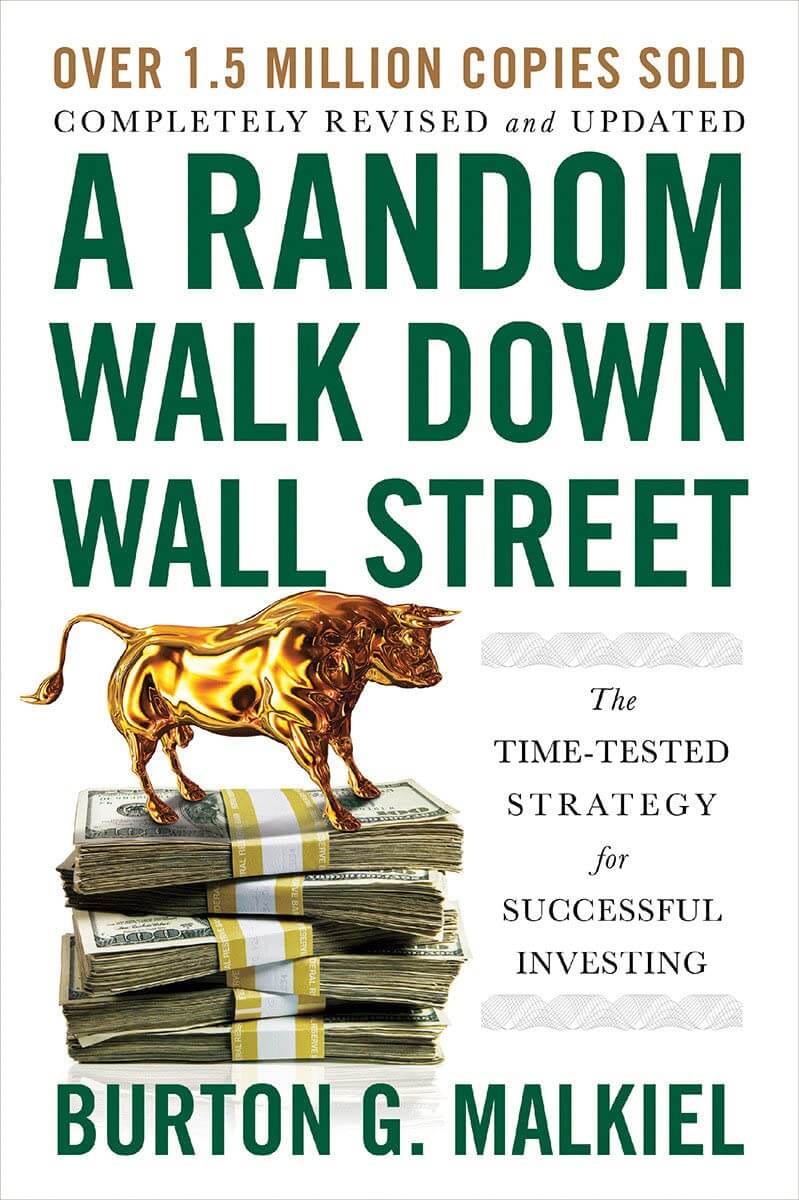
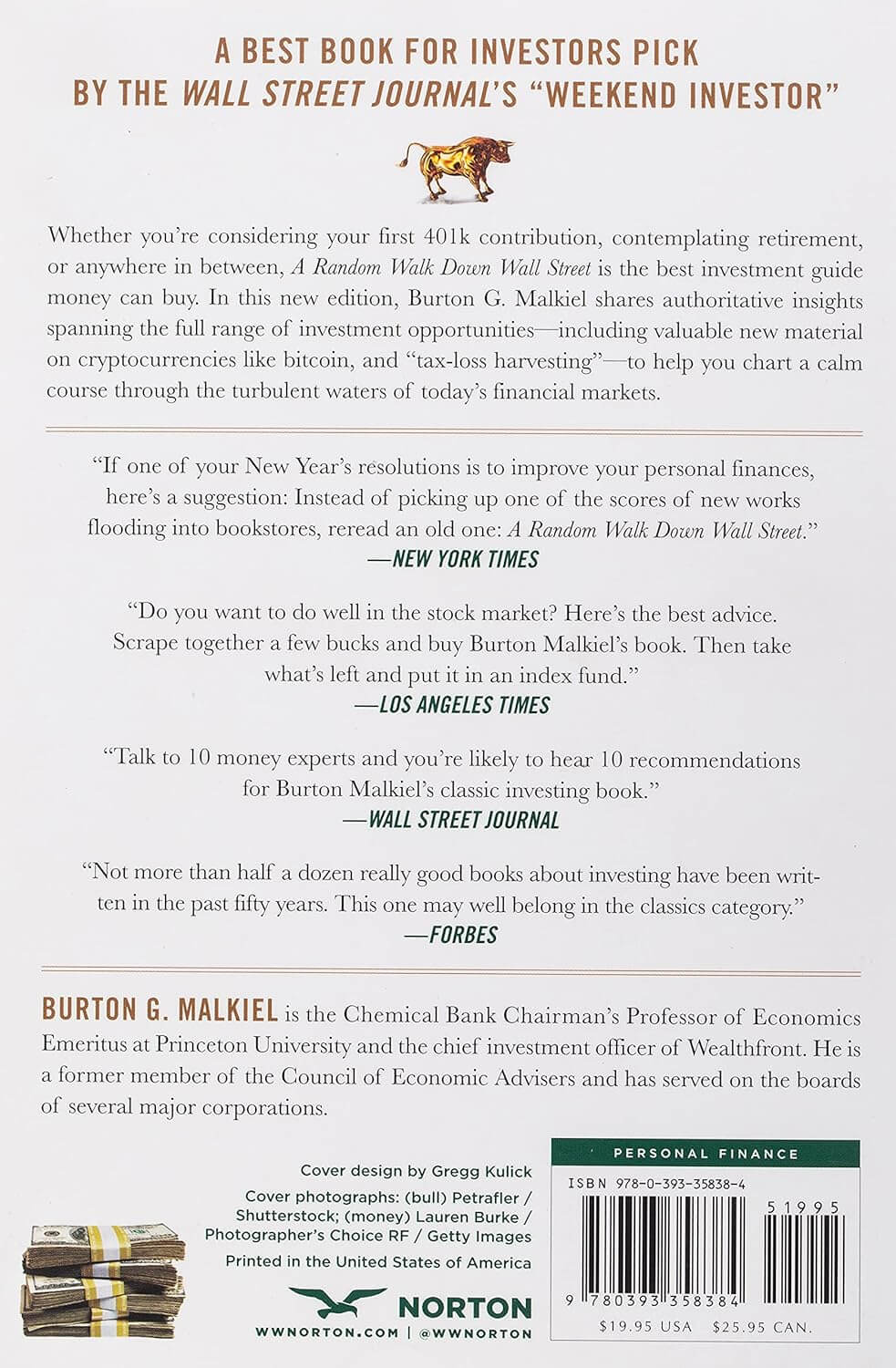

Random Walk Down Wall Street by Burton G Malkiel

Original price was: රු5,200.00.රු4,700.00Current price is: රු4,700.00.
3 X Rs. 1,566.67 or 8% Cashback with


or 3 X රු1,566.67 with


or up to 4 X රු1,175.00 with


A Random Walk Down Wall Street by Burton G Malkiel is a classic guide to long-term investing that explains why consistently beating the market is extremely difficult and why ordinary investors may benefit from diversified, low-cost index funds. Covering market history, bubbles, behavioral finance, asset allocation, risk, taxes, portfolio construction and investment psychology, Malkiel offers a practical alternative to market timing and speculative trading. Ideal for beginner and experienced investors who want a clear, research-based framework for building long-term wealth.
Out of stock
Email when stock available
A Random Walk Down Wall Street by Burton G Malkiel is a classic investing guide that challenges the idea that ordinary investors need to constantly predict stock prices, identify the next winning company or beat professional fund managers to build long-term wealth.
Wall Street is filled with promises.
Hot stocks.
Market forecasts.
Trading systems.
Technical indicators.
Investment gurus.
New technologies.
The next big opportunity.
Each claims to offer an advantage.
Burton G. Malkiel asks a more uncomfortable question:
What if consistently predicting the market is much harder than investors want to believe?
Drawing on economics, market history and investment research, Malkiel argues that security prices incorporate enormous amounts of available information and that consistently identifying mispriced investments before everyone else is exceptionally difficult.
Instead of building a financial future around prediction, A Random Walk Down Wall Street by Burton G Malkiel encourages investors to focus on the things they can control:
Saving consistently.
Keeping costs low.
Diversifying widely.
Matching risk to personal circumstances.
Investing for the long term.
Avoiding emotional decisions.
Using tax-efficient strategies where appropriate.
And refusing to chase every fashionable investment story.
The result is a book about investing that is surprisingly skeptical of the investment industry’s obsession with complexity.
A Random Walk Down Wall Street by Burton G Malkiel – Book Overview
A Random Walk Down Wall Street by Burton G Malkiel is built around the idea of a random walk.
In finance, this does not mean markets are completely meaningless.
It means that short-term price changes are extremely difficult to predict consistently because new information arrives unpredictably and is rapidly reflected in market prices.
If tomorrow’s important information were already known today, traders would act on it today.
That insight creates a major challenge for anyone promising easy market predictions.
What Does Random Walk Mean?
Imagine watching a stock price.
It rises today.
Does that mean it must rise tomorrow?
Not necessarily.
It falls for three days.
Does that guarantee a rebound?
No.
Past price movements alone do not automatically reveal the next move.
Malkiel uses this idea to challenge methods that claim to reliably forecast future prices from past patterns.
Technical Analysis
Technical analysis studies:
Price charts.
Trading volume.
Momentum.
Patterns.
Support and resistance.
Other market signals.
Malkiel is highly skeptical that ordinary chart patterns provide investors with a dependable long-term advantage after costs and competition are considered.
His broader argument is not that prices contain no information.
It is that profitable patterns tend to become difficult to exploit once many intelligent market participants know about them.
Fundamental Analysis
Fundamental investors study:
Revenue.
Profit.
Debt.
Cash flow.
Management.
Industry conditions.
Competitive advantages.
Future growth.
This approach seems very different from chart reading.
Yet Malkiel argues that fundamental analysis also faces a difficult problem:
Millions of investors and professional analysts are studying the same companies.
A company can be excellent and still be a poor investment if the share price already assumes extraordinary future growth.
A Great Company Is Not Always a Great Stock
This is one of the most useful ideas for beginners.
Investors sometimes think:
“This company is amazing, therefore its stock must be a good buy.”
But price matters.
Suppose investors already expect enormous growth.
The stock may be priced for near-perfection.
Even good results may disappoint if expectations were even higher.
Investment return depends not only on business quality but also on the price paid relative to future results.
The Firm-Foundation Theory
Malkiel discusses the idea that an investment has an underlying fundamental value based on future income or cash flows.
This can encourage investors to estimate what an asset should rationally be worth.
But estimating the future is difficult.
Small changes in assumptions about:
Growth.
Interest rates.
Margins.
Competition.
can dramatically change valuation.
The Castle-in-the-Air Theory
Another approach focuses less on fundamental value and more on what other investors may be willing to pay later.
Instead of asking:
“What is this asset worth?”
the investor asks:
“What will someone else pay for it?”
This type of thinking can help fuel speculative bubbles.
Investment Bubbles
Market history is filled with periods when excitement becomes disconnected from sober expectations.
Investors begin believing:
Prices will keep rising.
Everyone else is making money.
This time is different.
I can sell before the crash.
Malkiel uses historical bubbles to demonstrate how easily emotion can overwhelm careful investing.
The Greater-Fool Problem
An overpriced investment can continue rising.
That does not prove the price is rational.
Sometimes the strategy effectively becomes:
“I know this is expensive, but someone else will pay even more.”
That can work temporarily.
The difficulty is knowing when the next buyer disappears.
Market Psychology
Markets are made of humans.
Humans experience:
Fear.
Greed.
Overconfidence.
Regret.
Herd behavior.
Loss aversion.
Recency bias.
Investors therefore do not behave perfectly rationally.
Later editions of the book engage with behavioral-finance research while maintaining Malkiel’s skepticism that these predictable psychological tendencies are easy for ordinary investors to convert into reliable market-beating profits.
Overconfidence
Many investors believe they are better than average.
Better at choosing stocks.
Better at timing the market.
Better at recognizing turning points.
But everyone cannot be above average.
Overconfidence can lead to:
Excessive trading.
Concentration.
Poor diversification.
Higher costs.
Unnecessary risk.
Herd Behavior
When everyone appears to be making money from one investment, staying away can feel foolish.
This pressure becomes strongest near speculative booms.
The investor starts thinking:
Everyone understands something I do not.
Sometimes the crowd really has identified an important innovation.
But innovation and investment value are not the same thing.
Meme Stocks, Crypto and New Investment Fashions
The newer 13th edition updates Malkiel’s framework for recent market trends, including cryptocurrencies, NFTs and meme stocks. Norton describes the edition as also addressing factor investing, risk parity, ESG portfolios and tax-smart strategies.
This makes the core argument especially relevant today.
Technology changes.
Human excitement does not.
Index Funds
Perhaps the idea most strongly associated with A Random Walk Down Wall Street by Burton G Malkiel is the use of broad, low-cost index funds.
An index fund does not attempt to identify a small group of future winners.
Instead, it seeks to track a broad market index.
This approach offers several potential advantages:
Low costs.
Broad diversification.
Lower turnover.
Simplicity.
Less dependence on one manager’s predictions.
Why Costs Matter
Investment costs may look small.
1%.
0.5%.
0.1%.
But investing happens over decades.
Costs reduce the amount of money that remains invested and compounding.
The difference can become substantial over long periods.
This is one reason Malkiel repeatedly emphasizes controlling expenses.
You Cannot Control Market Returns
An investor cannot control what the stock market does next year.
You cannot command:
Interest rates.
Inflation.
Recessions.
Corporate profits.
Geopolitical events.
But you can influence:
Fees.
Diversification.
Savings rate.
Taxes.
Risk level.
Investment behavior.
This is a powerful shift in perspective.
Diversification
Diversification means avoiding dependence on one investment.
If your entire portfolio depends on:
One company.
One industry.
One country.
One asset.
one bad event can cause enormous damage.
A diversified portfolio spreads risk across many investments.
Diversification Does Not Eliminate Risk
This needs to be clear.
Diversification cannot guarantee profits.
A broad market can decline.
Different asset classes can fall together.
Unexpected events happen.
Diversification is about reducing unnecessary concentration risk, not creating an investment that cannot lose money.
Don’t Put Everything Into the Latest Winner
Recent success attracts attention.
If technology stocks have been rising, people want technology stocks.
If property is rising, people want property.
If crypto is rising, people want crypto.
But recent performance does not guarantee future performance.
Buying only what has recently performed best can produce a dangerously concentrated portfolio.
Asset Allocation
Asset allocation determines how much of a portfolio goes into categories such as:
Stocks.
Bonds.
Cash.
Other investments.
This decision can be more important than choosing between two individual shares.
The appropriate allocation depends on:
Age.
Goals.
Time horizon.
Income stability.
Risk tolerance.
Financial obligations.
Risk and Return
Higher expected returns generally require accepting greater uncertainty.
An investment promising:
Very high returns.
No volatility.
No risk.
should immediately invite skepticism.
Risk cannot be removed simply through clever marketing.
Know Your Time Horizon
Money needed next month should usually not be treated like money intended for retirement decades away.
Time horizon matters because volatile investments can experience severe short-term declines.
Long-term investors may have more time to recover.
Someone needing money immediately may not.
Life-Cycle Investing
Malkiel discusses adapting a portfolio as life circumstances change.
A young investor with decades before retirement may be able to tolerate more market volatility.
Someone approaching a major spending need may want greater stability.
But age alone is not enough.
Individual circumstances matter.
Emergency Savings Come First
Before taking substantial investment risk, people generally need enough financial resilience to handle unexpected expenses.
Without emergency savings, a market decline can become especially painful because an investor may be forced to sell at a bad time.
Long-term investments work best when short-term needs have been considered separately.
Dollar-Cost Averaging
Regular investing can reduce the pressure of trying to identify the perfect moment to enter the market.
Instead of asking:
“Is today the bottom?”
the investor follows a consistent plan.
This does not guarantee superior returns.
But it can reduce dependence on emotional timing decisions.
Market Timing
Market timing sounds attractive.
Sell before crashes.
Buy before recoveries.
The problem is that this requires being correct twice:
When to leave.
And when to return.
Someone who successfully avoids a decline but waits too long to reinvest may miss a powerful recovery.
The Best Market Days Are Difficult to Predict
Markets can change quickly.
Large gains can occur near periods of fear and volatility.
This makes sitting out the market while waiting for perfect certainty especially difficult.
The market usually does not send a clear message saying:
“Today is the ideal day to return.”
Long-Term Thinking
A Random Walk Down Wall Street by Burton G Malkiel repeatedly pushes investors away from short-term prediction.
Daily market movements attract attention because they are exciting.
But a long-term investor should care more about:
Savings.
Portfolio structure.
Costs.
Risk.
Taxes.
Time.
Compounding
Compounding occurs when investment returns themselves begin generating returns.
Time becomes extremely valuable.
The earlier money is invested and allowed to remain invested, the longer compounding has to work.
But compounding also magnifies the effect of costs.
That is another reason low fees matter.
Saving Rate Matters
People sometimes spend enormous effort searching for an investment that might produce an extra percentage point of return while ignoring how much they actually save.
For many investors, increasing the savings rate may have a more dependable effect than constantly switching investments.
Active Management
Active fund managers attempt to outperform a benchmark through security selection, timing or other strategies.
Some managers outperform.
The important question is:
Can investors reliably identify the future winners before the outperformance happens?
Past performance alone provides no certainty.
Some Investors Do Beat the Market
Malkiel’s argument should not be simplified into:
“Nobody ever beats the market.”
Some investors do.
The more difficult question is whether the average investor can reliably identify those outperformers in advance and whether they will continue outperforming after fees and taxes.
Indexing Is Not About Being Lazy
A passive investor may actually be making a deliberate decision.
Instead of trying to beat every professional trader, the investor chooses to capture broad market returns at low cost.
That can be an active decision to avoid unnecessary complexity.
Taxes
Investment return should be considered after:
Fees.
Taxes.
Trading costs.
A strategy that looks superior before expenses may look much less attractive afterward.
The 13th edition specifically expands its discussion of tax-smart investing.
Turnover
Frequent trading can create:
Transaction costs.
Tax consequences.
Emotional mistakes.
More opportunities to act on poor predictions.
A long-term strategy can reduce these pressures.
Investing Versus Trading
Investing usually focuses on owning productive assets over longer periods.
Trading focuses more heavily on price movements over shorter periods.
Both exist.
But A Random Walk Down Wall Street by Burton G Malkiel is primarily a guide for people trying to build long-term financial wealth rather than become short-term traders.
Ignore Financial Entertainment
Financial media needs something to discuss every day.
Your long-term strategy may not need to change every day.
This creates tension.
Television may ask:
What should investors buy this afternoon?
A sensible long-term investor may answer:
Nothing. My plan has not changed.
That is boring.
Boring can be useful.
Forecasts Sound More Certain Than They Are
Experts regularly make predictions about:
Interest rates.
Stock markets.
Currencies.
Economic growth.
Recessions.
Forecasts can be useful scenarios.
But investors should be careful about treating them as guaranteed knowledge.
Complex economic systems contain too many moving parts for perfect prediction.
Don’t Build a Portfolio Around One Forecast
Suppose someone predicts:
Interest rates will fall.
Even if the logic sounds strong, unexpected events can change the outcome.
A robust portfolio should ideally survive multiple possible futures rather than requiring one exact prediction to be correct.
Rebalancing
Over time, market movements can change your portfolio.
Imagine starting with a planned mix.
After one asset rises strongly, it may become much larger than intended.
Rebalancing means periodically restoring the target allocation.
This creates discipline.
Buy Low, Sell High Without Predicting
Rebalancing can systematically reduce exposure to assets that have become overweight and add to those that have become underweight.
It does not require predicting which asset will win next.
It simply maintains the chosen risk structure.
Behavioral Discipline
The best portfolio strategy can fail if the investor cannot stick with it.
During a market crash, a theoretically suitable portfolio may feel terrifying.
This is why risk tolerance must be realistic.
Do not choose a strategy based on how brave you feel during a bull market.
Consider how you may behave when prices fall sharply.
The Sleep Test
If normal market volatility prevents you from sleeping, your portfolio may be taking more risk than you can comfortably tolerate.
A slightly lower expected return may be better than an aggressive strategy you abandon during the first major decline.
Investment Fads
Every generation has new stories explaining why traditional rules no longer matter.
A new technology.
A revolutionary business model.
A new asset.
A new valuation method.
Some innovations genuinely change the world.
But investors must still ask:
What price am I paying?
What risk am I taking?
What assumptions are built into the price?
ESG Investing
The modern edition also discusses ESG portfolios, which consider environmental, social and governance factors.
Investors should understand that ESG labels can represent different methodologies.
A portfolio marketed as sustainable is still an investment portfolio and should be evaluated for:
Costs.
Diversification.
Risk.
Methodology.
Factor Investing
Factor investing attempts to systematically target characteristics associated with historical return patterns, such as value, size or profitability.
Malkiel discusses these newer approaches while maintaining his broader emphasis on simplicity, diversification and skepticism toward claims of easy excess returns.
Risk Parity
Risk-parity strategies attempt to balance contributions to portfolio risk rather than simply allocating the same amount of money across assets.
This illustrates how sophisticated portfolio techniques continue evolving.
But more sophistication does not automatically mean better outcomes for every investor.
Simplicity Is a Competitive Advantage
Complexity can make investors feel sophisticated.
More funds.
More trades.
More predictions.
More models.
But every extra component creates another opportunity for:
Costs.
Confusion.
Mistakes.
A simple strategy that someone understands and follows may outperform a brilliant plan that is constantly abandoned.
Investment Scams
The book’s skepticism is useful in an environment where people are frequently promised:
Guaranteed returns.
Secret methods.
Inside strategies.
Risk-free profits.
No legitimate investment can guarantee high returns with no meaningful risk.
Extraordinary promises deserve extraordinary caution.
Is A Random Walk Down Wall Street Beginner Friendly?
Yes.
The book explains many basic ideas about:
Stocks.
Bonds.
Risk.
Portfolio construction.
Investment theories.
Market history.
However, it is more detailed than a very short beginner’s personal-finance guide.
Readers willing to engage with the historical examples and investment concepts can gain much more from it.
Is It Only for American Investors?
The book is written mainly from a U.S. investment perspective.
It discusses U.S. accounts, tax rules, financial products and markets.
Readers in Sri Lanka or other countries can still learn valuable principles such as:
Diversification.
Low costs.
Risk management.
Long-term investing.
Skepticism toward market timing.
But specific tax, retirement-account and fund recommendations need adaptation to local regulations and locally available products.
Is It Financial Advice?
No.
The book provides educational investing ideas.
Individual investment decisions should consider:
Income.
Debt.
Emergency savings.
Goals.
Tax situation.
Time horizon.
Risk tolerance.
Local regulations.
Readers making significant financial decisions may benefit from qualified professional advice suited to their circumstances.
Is the Book Still Relevant?
Yes.
Markets and products change, which is why Malkiel has repeatedly updated the book.
The 13th edition is explicitly the fiftieth-anniversary update and addresses contemporary investing trends including crypto, NFTs, meme stocks and newer portfolio strategies.
But many of the core problems remain the same:
Investors chase performance.
Pay unnecessary fees.
Become overconfident.
React emotionally.
Try to predict unpredictable events.
Those behavioral challenges do not disappear when technology changes.
Burton G. Malkiel
Burton G. Malkiel is an economist and Chemical Bank Chairman’s Professor of Economics Emeritus at Princeton University. His background also includes service on the U.S. Council of Economic Advisers and leadership roles connected with investment management and academia.
His academic background helps explain why the book combines market history with practical portfolio advice.
Edition Note for Your Stock
Your current records contain two possible editions:
ISBN 9780393358384 – 2020 paperback / 12th edition, commonly listed at around 480 pages.
ISBN 9781324035435 – 2024 paperback / 13th edition, 480 pages, the fiftieth-anniversary edition titled The Best Investment Guide That Money Can Buy.
Use the ISBN printed on the physical book you are uploading.
Important Themes
A Random Walk Down Wall Street by Burton G Malkiel explores investing, index funds, diversification, market efficiency, behavioral finance, asset allocation, stock valuation, bonds, risk, compounding, market bubbles, technical analysis, fundamental analysis, market timing, taxes, investment costs, retirement planning, portfolio construction and long-term financial discipline.
7 Powerful Investing Lessons From A Random Walk Down Wall Street by Burton G Malkiel
- Consistently predicting short-term market movements is extremely difficult. New information arrives unpredictably, making repeated market timing far harder than hindsight suggests.
- Diversification is one of the most dependable forms of risk management. Holding many investments reduces dependence on a single company, sector or idea, although it cannot remove all market risk.
- Low costs matter enormously over long periods. Fees may appear small annually, but compounding allows those costs to reduce wealth significantly over decades.
- Broad index funds can provide a simple way to participate in market growth. Rather than betting on a small group of winners, investors can own a diversified portion of the market at relatively low cost.
- Investor psychology can be as dangerous as market volatility. Fear, greed, overconfidence and herd behavior can push people into buying high, selling low and chasing investment fads.
- Your portfolio should match your own life rather than someone else’s forecast. Age, financial obligations, goals, time horizon and genuine risk tolerance should influence asset allocation.
- Long-term discipline often matters more than financial excitement. Consistent saving, diversification, patience and avoiding unnecessary trading may appear boring, but boring can be extremely effective.
Why Read A Random Walk Down Wall Street by Burton G Malkiel?
A Random Walk Down Wall Street by Burton G Malkiel is an excellent choice for readers interested in investing, personal finance, stock markets, index funds, retirement planning, passive investing, portfolio management and financial independence.
It is particularly useful for anyone asking questions such as:
Should I choose individual stocks or index funds?
Can experts reliably predict market crashes?
How much do investment fees matter?
Why do investment bubbles happen?
How should younger and older investors think differently about risk?
Is frequent trading necessary?
How should I think about crypto and investment trends?
What actually matters when building a long-term portfolio?
The book does not promise an easy shortcut.
That is part of its value.
Its message is largely that successful investing may depend less on discovering a secret and more on avoiding expensive mistakes.
Who Should Read This Book?
A Random Walk Down Wall Street by Burton G Malkiel may especially appeal to beginner investors, finance students, business students, long-term investors, professionals beginning retirement planning, readers interested in index investing, people tired of market hype and anyone wanting a research-oriented framework for building and managing an investment portfolio.
Experienced investors may also find it useful because it challenges assumptions about:
Stock picking.
Timing.
Active management.
Market efficiency.
Investment fashion.
Even when readers disagree with parts of Malkiel’s argument, understanding the case for passive, low-cost investing is valuable.
Learn more about A Random Walk Down Wall Street by Burton G. Malkiel on the official W. W. Norton website.
Explore more investing and personal finance books at Bargain Books.
A Random Walk Down Wall Street by Burton G Malkiel – Investing Without Needing to Predict Tomorrow
A Random Walk Down Wall Street by Burton G Malkiel asks investors to give up something surprisingly difficult:
The feeling that they should know what happens next.
Which stock will rise?
When will the market crash?
What industry will dominate?
Will interest rates fall?
Which cryptocurrency will win?
Nobody likes uncertainty.
So markets create an enormous business around selling certainty.
Predictions.
Signals.
Research reports.
Trading systems.
Secret strategies.
But Malkiel’s message is that accepting uncertainty may actually make someone a better investor.
If you accept that tomorrow cannot be predicted perfectly, your strategy changes.
You diversify.
Because one idea might fail.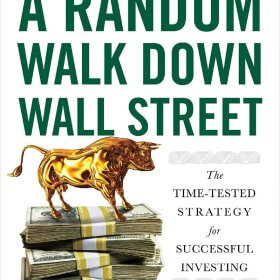
You keep costs low.
Because fees are real even when future returns are uncertain.
You invest consistently.
Because waiting for the perfect moment may leave you waiting forever.
You match risk to your life.
Because surviving a downturn matters more than looking aggressive during a boom.
And you become suspicious whenever someone claims to possess an effortless method for beating everyone else.
This does not make investing risk-free.
Nothing does.
Markets can fall.
Returns can disappoint.
Inflation can rise.
Economic conditions can change.
But the investor no longer needs every prediction to be right.
That may be the most powerful idea in A Random Walk Down Wall Street by Burton G Malkiel.
You do not need to know exactly where Wall Street walks tomorrow.
You need a sensible plan capable of surviving many different tomorrows.
For readers interested in personal finance, investing, index funds, market psychology and building wealth through patience rather than speculation, this remains one of the most influential introductions to long-term investing.
Learn more about A Random Walk Down Wall Street by Burton G. Malkiel on the official W. W. Norton website.
Explore more investing and personal finance books at Bargain Books.
| Author | Burton G Malkiel |
|---|---|
| Type | Hardcover |
| ISBN/ISSN | 1324002182, 978-1324002185 |
| Language | English |
| Pages | 432 |
Be the first to review “Random Walk Down Wall Street by Burton G Malkiel”
Related products

Out of stock
Analysis & Strategy
රු1,750.00
3 X Rs. 583.33 or 8% Cashback with
or 3 X රු583.33 with
or up to 4 X රු437.50 with
Out of stock
Analysis & Strategy
රු1,800.00
3 X Rs. 600.00 or 8% Cashback with
or 3 X රු600.00 with
or up to 4 X රු450.00 with
-39%
Out of stock
Analysis & Strategy
Original price was: රු2,800.00.රු1,700.00Current price is: රු1,700.00.
3 X Rs. 566.67 or 8% Cashback with
or 3 X රු566.67 with
or up to 4 X රු425.00 with
Analysis & Strategy
රු2,100.00
3 X Rs. 700.00 or 8% Cashback with
or 3 X රු700.00 with
or up to 4 X රු525.00 with
-26%

Out of stock
Analysis & Strategy
Original price was: රු1,900.00.රු1,400.00Current price is: රු1,400.00.
3 X Rs. 466.67 or 8% Cashback with
or 3 X රු466.67 with
or up to 4 X රු350.00 with
Out of stock
රු3,900.00
3 X Rs. 1,300.00 or 8% Cashback with
or 3 X රු1,300.00 with
or up to 4 X රු975.00 with
Damaged & Imperfect Books
රු550.00
3 X Rs. 183.33 or 8% Cashback with
or 3 X රු183.33 with
or up to 4 X රු137.50 with
Analysis & Strategy
රු1,750.00
3 X Rs. 583.33 or 8% Cashback with
or 3 X රු583.33 with
or up to 4 X රු437.50 with
Reviews
There are no reviews yet.