
No products in the cart.
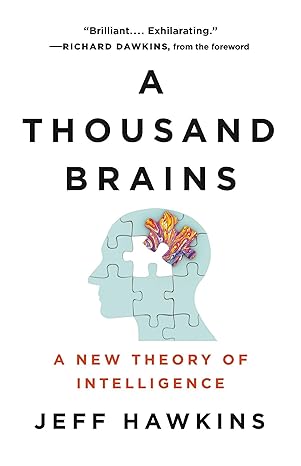
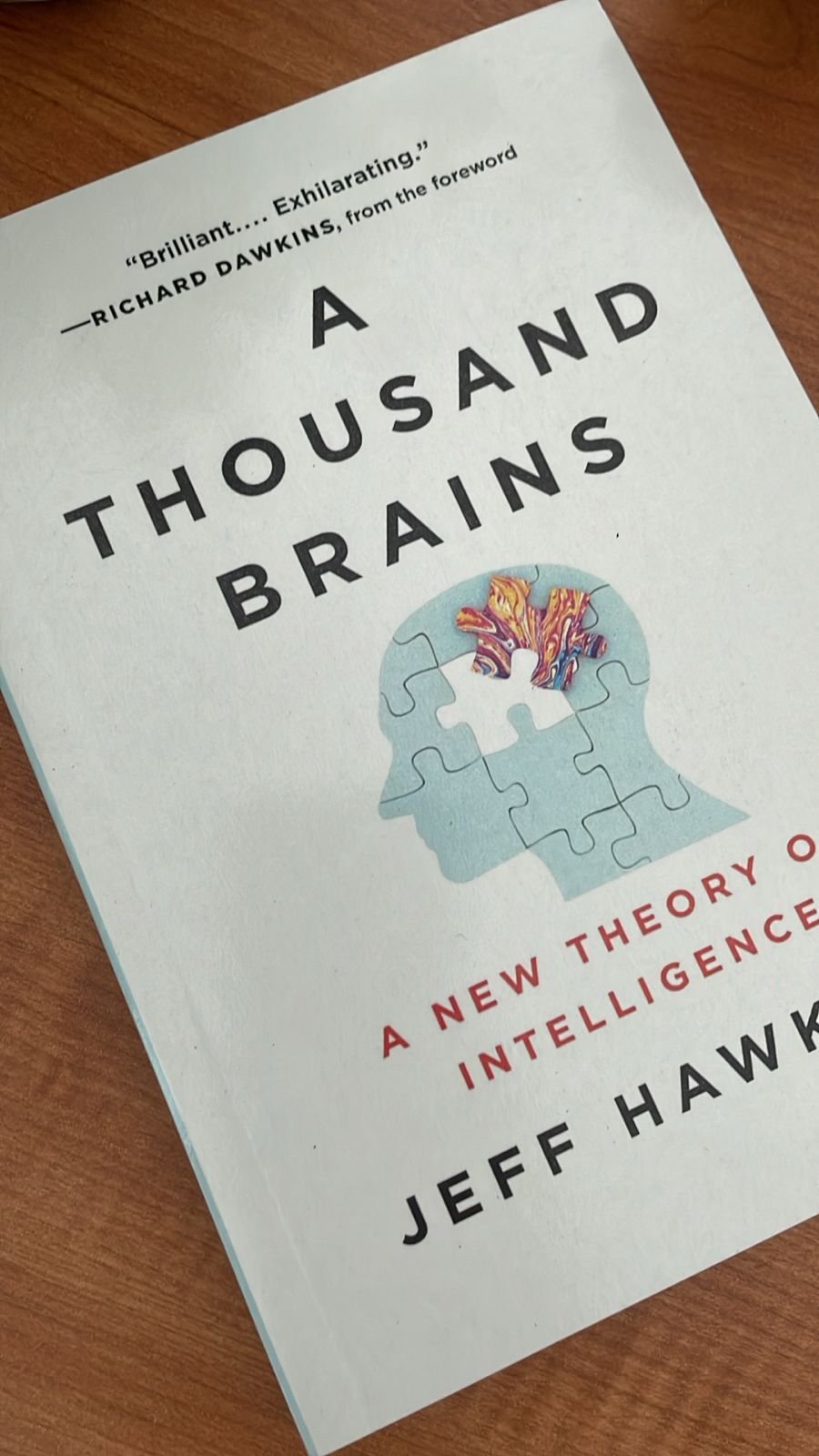


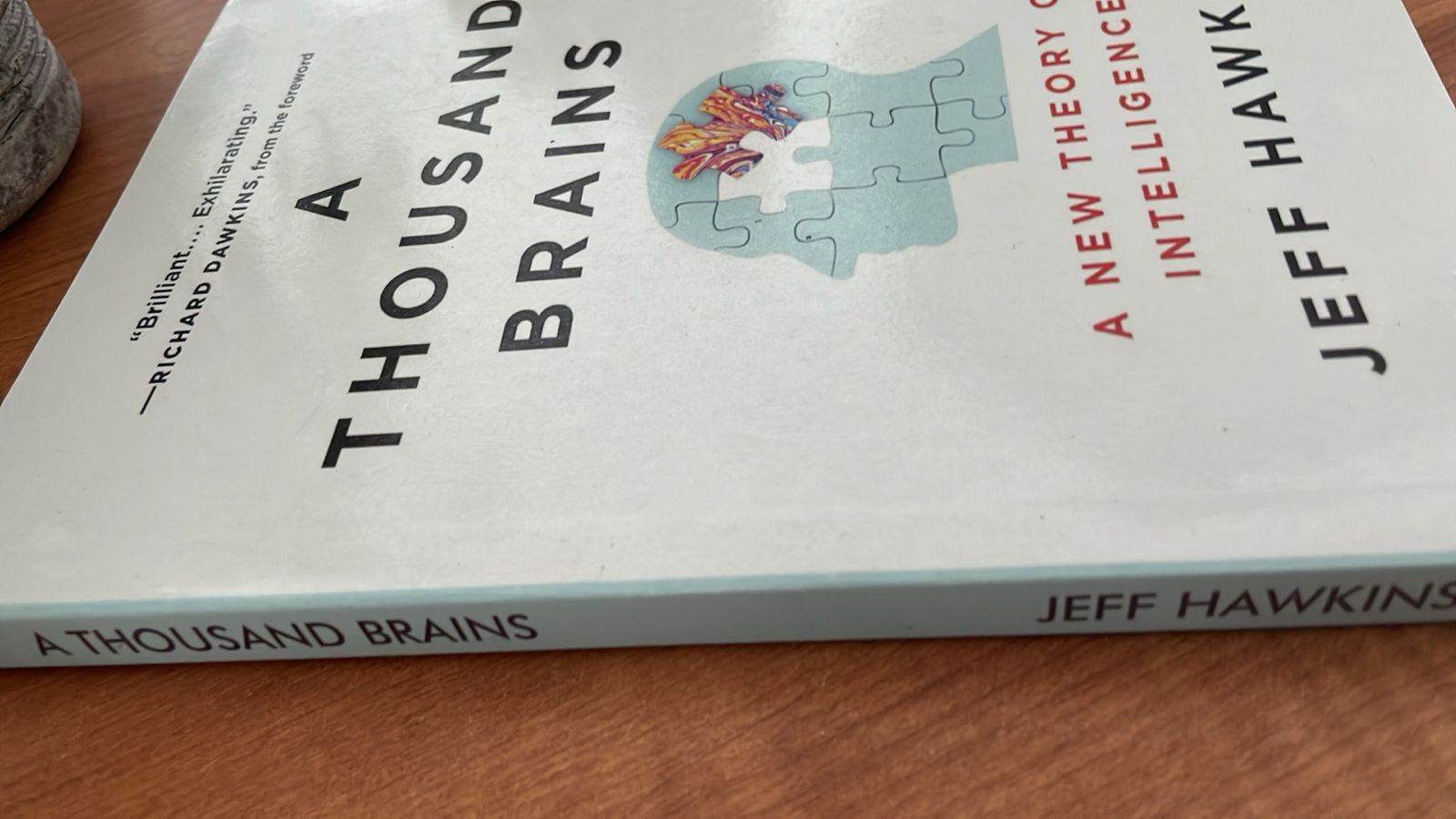



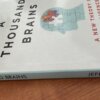
Thousand Brains by Jeff Hawkins

රු2,100.00
3 X Rs. 700.00 or 8% Cashback with


or 3 X රු700.00 with


or up to 4 X රු525.00 with


• Groundbreaking book exploring how intelligence and the brain truly work
• Introduces the Thousand Brains Theory of Intelligence
• Ideal for readers interested in neuroscience and AI
5 in stock
A Thousand Brains by Jeff Hawkins
A Thousand Brains by Jeff Hawkins is a fascinating science and technology book about intelligence, the human brain, perception, consciousness, artificial intelligence, and how the neocortex may create our understanding of the world.
Hawkins presents what he calls the Thousand Brains Theory of Intelligence.
His central idea is that the brain does not rely on one single model of reality.
Instead, many parts of the neocortex build their own models.
These models work together to create the unified experience we call perception and intelligence.
About A Thousand Brains
For decades, scientists have studied neurons, brain regions, and neural activity.
But one major question remains difficult.
How do billions of relatively simple brain cells produce intelligence?
A Thousand Brains attempts to answer that question.
Jeff Hawkins argues that the neocortex contains many cortical columns.
Each can learn models of objects and concepts using information connected to location and movement.
Rather than intelligence emerging from one centralized world model, many models may work together.
7 Powerful Ideas from A Thousand Brains
1. The Brain May Contain Many Models of the World
One of the most important ideas in A Thousand Brains is that the brain may not create a single model of each object.
Different cortical regions can build independent models.
For example, information from touch and vision may create separate representations.
These models can then cooperate.
Their combined activity produces a stable perception.
2. Reference Frames May Be Essential to Intelligence
Hawkins places great importance on reference frames.
A reference frame helps represent where something is located relative to something else.
Your brain needs to know not only what an object feels like.
It also needs to know where your fingers are touching it.
This relationship between location and sensation may be fundamental to how the brain learns objects.
3. Intelligence Is Closely Connected to Movement
Traditional discussions of intelligence often focus on abstract thought.
Hawkins emphasizes movement.
Humans learn about objects by moving their eyes, hands, and bodies.
Each movement produces new sensory information.
The brain then connects those sensations with locations.
This active process may be central to learning.
4. Cortical Columns May Work Like Independent Models
The neocortex contains repeating structures called cortical columns.
Hawkins argues that these columns may perform broadly similar computations.
Each column can learn a model.
Together, large numbers of columns can create complex knowledge.
This is one reason for the title A Thousand Brains.
It suggests that intelligence is distributed across many cooperating models rather than located in one single place.
5. Artificial Intelligence May Need a Different Architecture
Modern AI systems are powerful.
They can classify images.
They can generate text.
They can recognize speech.
But Hawkins argues that current AI does not necessarily work the way biological intelligence does.
He believes understanding the neocortex could inspire new forms of machine intelligence.
Such systems might learn through reference frames, movement, and structured models of the world.
6. Intelligence and Consciousness Are Different Questions
The book also explores consciousness and the sense of self.
Hawkins asks why humans experience one coherent world even though many brain regions process information separately.
His theory suggests that agreement between many models could help explain unified perception.
This does not settle every philosophical question about consciousness.
But it offers an interesting framework for thinking about the problem.
7. Intelligence Could Affect Humanity’s Future
The final sections of the book move beyond neuroscience.
Hawkins discusses artificial intelligence, long-term human survival, misinformation, and the future of civilization.
He asks what could happen if machines become more genuinely intelligent.
He also considers how humanity might use intelligence to protect knowledge across extremely long periods.
What Is the Neocortex?
The neocortex is the outer layer of the mammalian brain associated with many higher cognitive abilities.
It plays an important role in perception, language, planning, and abstract thinking.
Hawkins has spent decades studying how it may work.
A striking feature of the neocortex is its repeated structure.
Different areas process different types of information.
Yet their underlying architecture has many similarities.
This leads Hawkins to suggest that the brain may use a common algorithm across many areas.
The Thousand Brains Theory
The core theory proposes that many cortical columns learn complete models of objects.
Imagine touching a coffee cup.
One part of the brain receives information from one finger.
Another receives information from another finger.
Vision provides additional information.
Each system may build its own model.
These models then communicate.
Through a kind of collective agreement, the brain reaches a stable perception.
This distributed approach is central to A Thousand Brains.
Reference Frames Explained Simply
A reference frame is a coordinate system.
Imagine looking at a table.
You can describe where a cup sits relative to the table.
Your brain may use similar structures internally.
A sensory input alone is not always enough.
Location adds meaning.
Touching a smooth surface means something different depending on where that surface appears on an object.
Hawkins argues that combining sensation and location is essential to intelligence.
Intelligence Is Not Just Pattern Recognition
Modern AI is often extremely good at recognizing patterns.
Hawkins argues that true intelligence may require more.
An intelligent system should understand objects.
It should understand relationships.
It should know how things exist in structured environments.
This means intelligence may depend on models that persist even when sensory input changes.
For example, you still recognize a chair from different angles.
That suggests the brain is representing more than a simple visual pattern.
Learning Through Movement
Movement gives the brain new information.
When you turn an object in your hand, each new position changes what you feel.
Your brain predicts what should come next.
If reality matches the prediction, the model becomes stronger.
If it does not, the model may need updating.
This connection between movement and prediction is one of the book’s most interesting ideas.
Voting Between Models
Numenta describes the theory as involving many complementary models that effectively “vote” together to produce a single perception.
This helps explain why perception feels unified.
Different brain regions may have partial information.
Agreement between them allows the system to settle on one interpretation.
It is a very different picture from imagining the brain as one central computer.
Artificial Intelligence and the Brain
A Thousand Brains has important implications for AI.
Hawkins argues that engineers may eventually build more capable artificial systems by copying principles used by the neocortex.
That does not necessarily mean copying every biological detail.
Instead, AI researchers could borrow the underlying computational principles.
Reference frames are one example.
Continuous learning is another.
Distributed world models may be another.
Current AI Versus Biological Intelligence
Many modern AI systems learn from huge datasets.
Humans often learn differently.
A child can sometimes learn a concept from very few examples.
Humans can also transfer knowledge between situations.
Hawkins believes neuroscience may help explain these abilities.
That makes the book relevant not only to neuroscientists but also to people interested in machine learning and artificial intelligence.
The Sense of Self
The book also asks why humans experience a persistent sense of self.
If the brain contains many different models, why do we feel like one person?
Hawkins explores how distributed brain systems may still produce unified experience.
This section moves from neuroscience toward philosophy.
It raises questions that remain open and debated.
Old Brain and New Brain
Hawkins distinguishes between the older parts of the brain and the newer neocortex.
Older brain systems support basic drives and survival behaviors.
The neocortex supports more flexible intelligence.
Sometimes these systems can conflict.
A person may intellectually understand that something is irrational while still experiencing a strong emotional reaction.
This interaction becomes important when Hawkins discusses human behavior and society.
Intelligence and False Beliefs
Human intelligence is powerful.
But intelligent people can still believe false things.
The brain can build models that are inaccurate.
Groups can reinforce those models.
This is especially relevant in discussions of misinformation.
Hawkins argues that understanding how beliefs form may help explain why false ideas can become persistent.
The Future of Intelligent Machines
Hawkins is optimistic about some forms of AI.
He argues that intelligent machines do not automatically need the same motivations as humans.
Intelligence and biological drives are different.
A machine could be highly capable without possessing human-style fear, hunger, or reproductive drives.
This challenges common science-fiction assumptions about artificial intelligence.
Who Should Read This Book?
A Thousand Brains is ideal for readers interested in neuroscience, artificial intelligence, cognition, consciousness, psychology, and future technology.
It may especially appeal to software engineers and AI enthusiasts.
Students of neuroscience may appreciate its accessible presentation.
General readers can also follow the main ideas without advanced mathematical knowledge.
The book is written for a broad audience.
About Jeff Hawkins
Jeff Hawkins is a technologist, neuroscientist, and entrepreneur.
He co-founded Numenta, a neuroscience research company.
He also founded the Redwood Neuroscience Institute.
Earlier in his career, he became well known for his work in handheld computing.
His other major book is On Intelligence.
Numenta explains that A Thousand Brains presents the discoveries behind the Thousand Brains Theory and their potential implications for neuroscience and AI.
Readers can learn more through the official Numenta page for Jeff Hawkins’ books.
Product Details
Title: A Thousand Brains
Subtitle: A New Theory of Intelligence
Author: Jeff Hawkins
Foreword: Richard Dawkins
Genre: Neuroscience / Artificial Intelligence / Popular Science
Language: English
Publisher: Basic Books
Original Publication: March 2, 2021
Paperback ISBN-13: 9781541675797
Paperback Pages: 288
The trade paperback edition was released in 2022.
The original hardcover uses ISBN 9781541675810 and edition details may differ.
Always check the ISBN printed on your physical copy before entering final WooCommerce specifications.
Explore More Non-Fiction Books
A Thousand Brains offers a bold way to think about intelligence.
Instead of one central model, Hawkins proposes many models.
Instead of treating movement as separate from thinking, he makes movement central to learning.
And instead of seeing neuroscience and AI as unrelated fields, he argues that understanding the brain could transform machine intelligence.
Readers interested in science, technology, psychology, and big ideas can explore more Non-Fiction & Knowledge Books at Bargain Books.
For readers curious about how the brain creates intelligence and what that could mean for future AI, A Thousand Brains is an ambitious and thought-provoking read.
Be the first to review “Thousand Brains by Jeff Hawkins”
Related products

Non-Fiction & Knowledge
රු1,950.00
3 X Rs. 650.00 or 8% Cashback with
or 3 X රු650.00 with
or up to 4 X රු487.50 with
Non-Fiction & Knowledge
රු2,250.00
3 X Rs. 750.00 or 8% Cashback with
or 3 X රු750.00 with
or up to 4 X රු562.50 with
-19%

Out of stock
Biography
Original price was: රු2,400.00.රු1,950.00Current price is: රු1,950.00.
3 X Rs. 650.00 or 8% Cashback with
or 3 X රු650.00 with
or up to 4 X රු487.50 with
-33%

Non-Fiction & Knowledge
Original price was: රු2,850.00.රු1,900.00Current price is: රු1,900.00.
3 X Rs. 633.33 or 8% Cashback with
or 3 X රු633.33 with
or up to 4 X රු475.00 with
-26%
Non-Fiction & Knowledge
The 7 Habits of Highly Effective People by Stephen R. Covey – Blue Cover
Original price was: රු2,300.00.රු1,700.00Current price is: රු1,700.00.
3 X Rs. 566.67 or 8% Cashback with
or 3 X රු566.67 with
or up to 4 X රු425.00 with
-17%
Out of stock
Non-Fiction & Knowledge
Original price was: රු2,900.00.රු2,400.00Current price is: රු2,400.00.
3 X Rs. 800.00 or 8% Cashback with
or 3 X රු800.00 with
or up to 4 X රු600.00 with

Out of stock
Non-Fiction & Knowledge
රු1,900.00
3 X Rs. 633.33 or 8% Cashback with
or 3 X රු633.33 with
or up to 4 X රු475.00 with
-24%
Out of stock
Non-Fiction & Knowledge
Original price was: රු2,100.00.රු1,600.00Current price is: රු1,600.00.
3 X Rs. 533.33 or 8% Cashback with
or 3 X රු533.33 with
or up to 4 X රු400.00 with
Reviews
There are no reviews yet.