
No products in the cart.
-13%

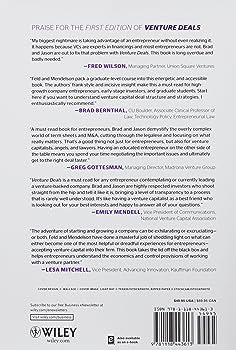


Venture Deals by Brad Feld, Jason Mendelson


Original price was: රු4,000.00.රු3,500.00Current price is: රු3,500.00.
3 X Rs. 1,166.67 or 8% Cashback with


or 3 X රු1,166.67 with


or up to 4 X රු875.00 with


Master the world of venture capital with “Venture Deals” by Brad Feld and Jason Mendelson. This comprehensive guide equips entrepreneurs and investors with the knowledge to navigate startup financing, from term sheets to negotiations. Whether you’re seeking funding or supporting startups, this hardcover edition is your roadmap to understanding venture capital.
Out of stock
Email when stock available
Venture Deals Hardcover by Brad Feld and Jason Mendelson
Venture Deals Hardcover by Brad Feld and Jason Mendelson is a practical guide to venture capital, startup financing, term sheets, valuation, ownership, control, negotiation, and the legal and economic structure behind investment deals.
The book is designed for founders, entrepreneurs, investors, lawyers, and anyone who wants to understand how venture financing actually works.
Startup fundraising can look complicated.
There are preferred shares.
Liquidation preferences.
Board seats.
Anti-dilution clauses.
Option pools.
Protective provisions.
Voting rights.
Convertible securities.
And many other terms that can affect founders long after the money enters the company.
Venture Deals explains these concepts in plain language.
About Venture Deals Hardcover
Venture Deals Hardcover focuses on what happens when entrepreneurs raise money from venture capital investors.
The book does not simply explain definitions.
It also explains incentives.
Why does an investor ask for a particular term?
Why should a founder care?
Which terms affect economics?
Which terms affect control?
Which terms matter later during an acquisition or another funding round?
Brad Feld and Jason Mendelson use their experience in venture capital and startup law to explain how deals are structured and negotiated.
7 Powerful Lessons from Venture Deals Hardcover
1. Valuation Is Only One Part of the Deal
Founders often focus heavily on valuation.
A higher valuation may look better.
But valuation is only one part of a financing agreement.
Other terms can matter just as much.
Liquidation preferences.
Participation rights.
Board control.
Protective provisions.
Option pool treatment.
A deal with a high headline valuation can still contain founder-unfriendly terms.
The book teaches readers to look at the whole structure.
2. Understand the Term Sheet
The term sheet is one of the most important documents in a venture financing round.
It outlines the main economic and control terms of the investment.
Some terms affect how money is divided later.
Others affect who gets to make decisions.
Understanding the term sheet gives founders a stronger position in negotiation.
It also reduces the chance of agreeing to something without understanding the long-term consequences.
3. Economics and Control Are Different
One of the most useful frameworks in Venture Deals Hardcover is the distinction between economics and control.
Economic terms determine how value is distributed.
Control terms determine who has influence over major company decisions.
For example, liquidation preferences are mainly economic.
Board seats are mainly about control.
Founders should understand both.
Giving up too much of either can create problems later.
4. Liquidation Preferences Matter
Liquidation preferences determine who gets paid first when a company is sold or liquidated.
This can become extremely important.
Two founders may think they own a large percentage of a company.
But if investors have strong liquidation preferences, the final payout can look very different from the headline ownership percentages.
The book explains how these preferences work and why they matter.
5. Negotiation Is About Relationships
Venture financing is not only a legal transaction.
It begins a long relationship between founders and investors.
That matters.
A hostile negotiation may create problems later.
But founders should not avoid asking hard questions.
The best deals usually come from clear communication.
Both sides need to understand expectations.
Trust matters.
So does alignment.
6. Dilution Is Normal
When a company raises new investment rounds, existing ownership percentages usually decrease.
This is dilution.
Dilution is not automatically bad.
If the company becomes much more valuable, owning a smaller percentage of a larger company can still be a good outcome.
The key is understanding how dilution works.
Founders should know how new financing, employee option pools, and convertible securities affect ownership.
7. Choose Investors Carefully
Money is not the only thing an investor brings.
Investors may influence strategy.
Hiring.
Future fundraising.
Board decisions.
Acquisitions.
Leadership changes.
That means choosing an investor can be as important as negotiating valuation.
Founders should think about reputation, alignment, experience, and working style.
What Is a Venture Deal?
A venture deal is an investment transaction where outside investors provide capital to a high-growth company.
In exchange, investors receive ownership.
The details of that ownership are negotiated.
The company may issue preferred shares.
Investors may receive rights that common shareholders do not have.
These rights can affect future fundraising and exits.
That is why deal structure matters.
Understanding Term Sheets
A term sheet is usually non-binding in many areas, but it sets the foundation for the final legal documents.
It often includes valuation.
Investment amount.
Type of security.
Liquidation preference.
Board structure.
Voting rights.
Protective provisions.
Founder vesting.
Option pool expectations.
The stronger your understanding of these terms, the easier it becomes to evaluate the deal.
Pre-Money and Post-Money Valuation
Pre-money valuation refers to the company’s value before new investment.
Post-money valuation includes the new capital.
For example, if a company is valued at $8 million pre-money and receives a $2 million investment, the post-money valuation is $10 million.
That affects ownership percentages.
Understanding this distinction is essential during fundraising.
Preferred Stock
Venture investors often receive preferred stock rather than ordinary common stock.
Preferred shares can include additional rights.
These may include liquidation preferences.
Voting rights.
Anti-dilution protections.
Conversion rights.
The book explains why preferred structures exist and how they affect founders.
Liquidation Preference
A liquidation preference determines how proceeds are distributed during an exit.
Imagine a company is sold for less than expected.
Investors with a liquidation preference may receive their money before common shareholders receive anything.
That can dramatically affect founder outcomes.
This is why headline valuation does not tell the whole story.
Participating vs. Non-Participating Preferred
Some preferred shares are participating.
Others are non-participating.
This distinction matters.
With non-participating preferred, an investor usually chooses between taking the preference or converting to common equity.
Participating preferred may allow the investor to receive the preference first and then participate in remaining proceeds.
That can significantly change payout economics.
Board Seats and Control
Board composition matters.
The board can influence major company decisions.
Hiring or removing senior executives.
Approving budgets.
Raising new financing.
Selling the company.
Founders should understand exactly who has board representation and how voting works.
Control can shift gradually if not tracked carefully.
Protective Provisions
Protective provisions give investors approval rights over certain decisions.
These may include issuing new shares.
Changing the company charter.
Selling the company.
Taking on significant debt.
These provisions are designed to protect investors.
But broad provisions can also reduce founder flexibility.
The book explains why the wording matters.
Anti-Dilution Protection
Anti-dilution clauses can protect investors if the company later raises money at a lower valuation.
That lower-priced round is often called a down round.
Different anti-dilution formulas can have very different effects.
Founders should understand these mechanics before agreeing to them.
Employee Option Pools
Option pools are used to grant equity to employees.
They help startups attract talent when cash salaries may be limited.
But the timing of an option pool increase can affect founder dilution.
If the pool is increased before investment, the dilution may fall mostly on existing shareholders.
This is one of the details that can materially change the economics of a deal.
Convertible Notes and SAFEs
Startups sometimes raise early money using convertible instruments rather than priced equity rounds.
These instruments may convert into equity later.
Terms such as valuation caps and discounts affect how much ownership investors eventually receive.
The exact legal mechanics differ by instrument and jurisdiction.
The broader lesson is to understand the conversion before signing.
Due Diligence
Investors usually investigate the company before completing a deal.
This can include:
Financial records.
Legal documents.
Intellectual property.
Customer contracts.
Employment agreements.
Cap tables.
Corporate structure.
Preparing these materials early can make fundraising smoother.
Cap Tables
A capitalization table shows who owns the company.
It may include founders.
Employees.
Investors.
Option holders.
Convertible security holders.
A clean cap table helps everyone understand ownership.
A messy cap table can create serious problems during fundraising.
Lawyers and Venture Deals
Legal advice matters in venture financing.
These deals can become complicated.
A good startup lawyer can help founders understand consequences.
The book also explains why founders should not simply outsource all understanding to lawyers.
A founder should still understand the business meaning of the major terms.
Negotiating With Investors
Negotiation does not mean fighting over every clause.
Some terms matter more than others.
Founders should know which points are essential.
They should also understand the investor’s priorities.
A good negotiation focuses attention where it matters most.
Raising the Right Amount
More money is not always better.
Raising too little can create constant fundraising pressure.
Raising too much can lead to unnecessary dilution or spending.
The right amount depends on milestones.
How much capital is needed to reach the next meaningful stage?
That question is often more useful than simply asking how much investors are willing to provide.
What Founders Should Protect
Founders should pay close attention to:
Ownership.
Board control.
Liquidation preferences.
Voting rights.
Vesting.
Option pools.
Future financing rights.
Information rights.
These terms can influence the company for years.
Why This Book Is Useful
Venture Deals Hardcover is valuable because venture capital can feel inaccessible.
Legal documents are dense.
Financial terms are technical.
Investors often have more experience with deals than founders.
The book helps reduce that information gap.
It gives entrepreneurs a framework for asking better questions.
Who Should Read This Book?
Venture Deals Hardcover is ideal for startup founders, entrepreneurs, angel investors, venture capital professionals, business students, lawyers, and anyone involved in early-stage companies.
It is especially useful before raising institutional funding.
Founders preparing for seed, Series A, or later rounds may find the term-sheet explanations particularly practical.
Readers interested in startups and entrepreneurship may also benefit even if they are not currently fundraising.
About Brad Feld and Jason Mendelson
Brad Feld is a venture capitalist and entrepreneur known for his work with startup ecosystems and venture-backed technology companies.
Jason Mendelson is an investor and former attorney with extensive experience in venture financing.
Together, they wrote Venture Deals to explain how venture capital transactions work from both the entrepreneur and investor perspectives.
Readers can learn more through the official Venture Deals website.
Product Details
Title: Venture Deals
Full Title: Venture Deals: Be Smarter Than Your Lawyer and Venture Capitalist
Authors: Brad Feld and Jason Mendelson
Genre: Business / Entrepreneurship / Venture Capital / Startup Finance
Language: English
Format: Hardcover
The book has been published in multiple editions.
Later editions include updated discussions of modern startup financing structures and venture-market practices.
Because ISBNs, page counts, and dimensions differ between editions, always check the barcode on your physical hardcover before entering final WooCommerce specifications.
Explore More Business and Startup Books
Venture Deals Hardcover gives founders something extremely valuable during fundraising: context.
It explains what investors are asking for.
Why they are asking for it.
What the terms mean.
And which terms may matter years later.
A good venture deal is not only about getting money into the company.
It is about understanding what happens after the deal closes.
Readers looking for more startup and entrepreneurship books can explore Business, Finance & Economics Books at Bargain Books.
For founders, investors, and startup professionals who want to understand venture capital without relying entirely on lawyers or finance teams, Venture Deals Hardcover is one of the most practical guides to the mechanics of startup funding.

| Author | Brad Feld, Jason Mendelson |
|---|---|
| Type | Hardcover |
| ISBN/ISSN | 1119594820, 978-1119594826 |
| Language | English |
| Pages | 368 |
Be the first to review “Venture Deals by Brad Feld, Jason Mendelson”
Related products
-39%

Out of stock
Self-Help & Psychology
Original price was: රු2,450.00.රු1,500.00Current price is: රු1,500.00.
3 X Rs. 500.00 or 8% Cashback with
or 3 X රු500.00 with
or up to 4 X රු375.00 with

Out of stock
රු3,900.00
3 X Rs. 1,300.00 or 8% Cashback with
or 3 X රු1,300.00 with
or up to 4 X රු975.00 with
-22%

Out of stock
Business, Finance & Economics
Original price was: රු2,250.00.රු1,750.00Current price is: රු1,750.00.
3 X Rs. 583.33 or 8% Cashback with
or 3 X රු583.33 with
or up to 4 X රු437.50 with

Out of stock
රු1,500.00
3 X Rs. 500.00 or 8% Cashback with
or 3 X රු500.00 with
or up to 4 X රු375.00 with

Business, Finance & Economics
රු2,500.00
3 X Rs. 833.33 or 8% Cashback with
or 3 X රු833.33 with
or up to 4 X රු625.00 with
-16%

Out of stock
Business, Finance & Economics
Original price was: රු1,900.00.රු1,600.00Current price is: රු1,600.00.
3 X Rs. 533.33 or 8% Cashback with
or 3 X රු533.33 with
or up to 4 X රු400.00 with
-32%
Out of stock
Business, Finance & Economics
Original price was: රු2,800.00.රු1,900.00Current price is: රු1,900.00.
3 X Rs. 633.33 or 8% Cashback with
or 3 X රු633.33 with
or up to 4 X රු475.00 with

Out of stock
රු2,500.00
3 X Rs. 833.33 or 8% Cashback with
or 3 X රු833.33 with
or up to 4 X රු625.00 with
Reviews
There are no reviews yet.