
No products in the cart.
-16%
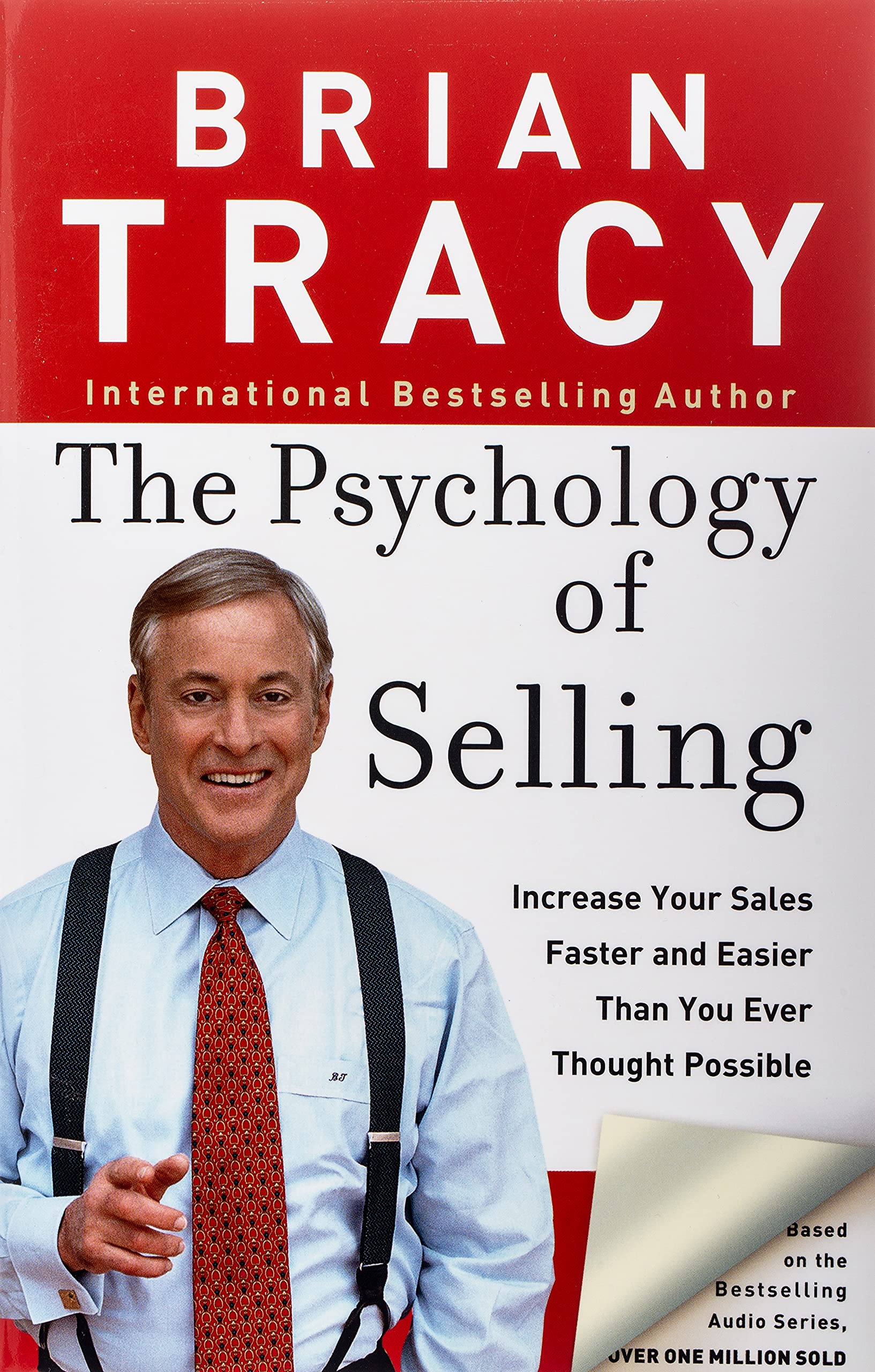
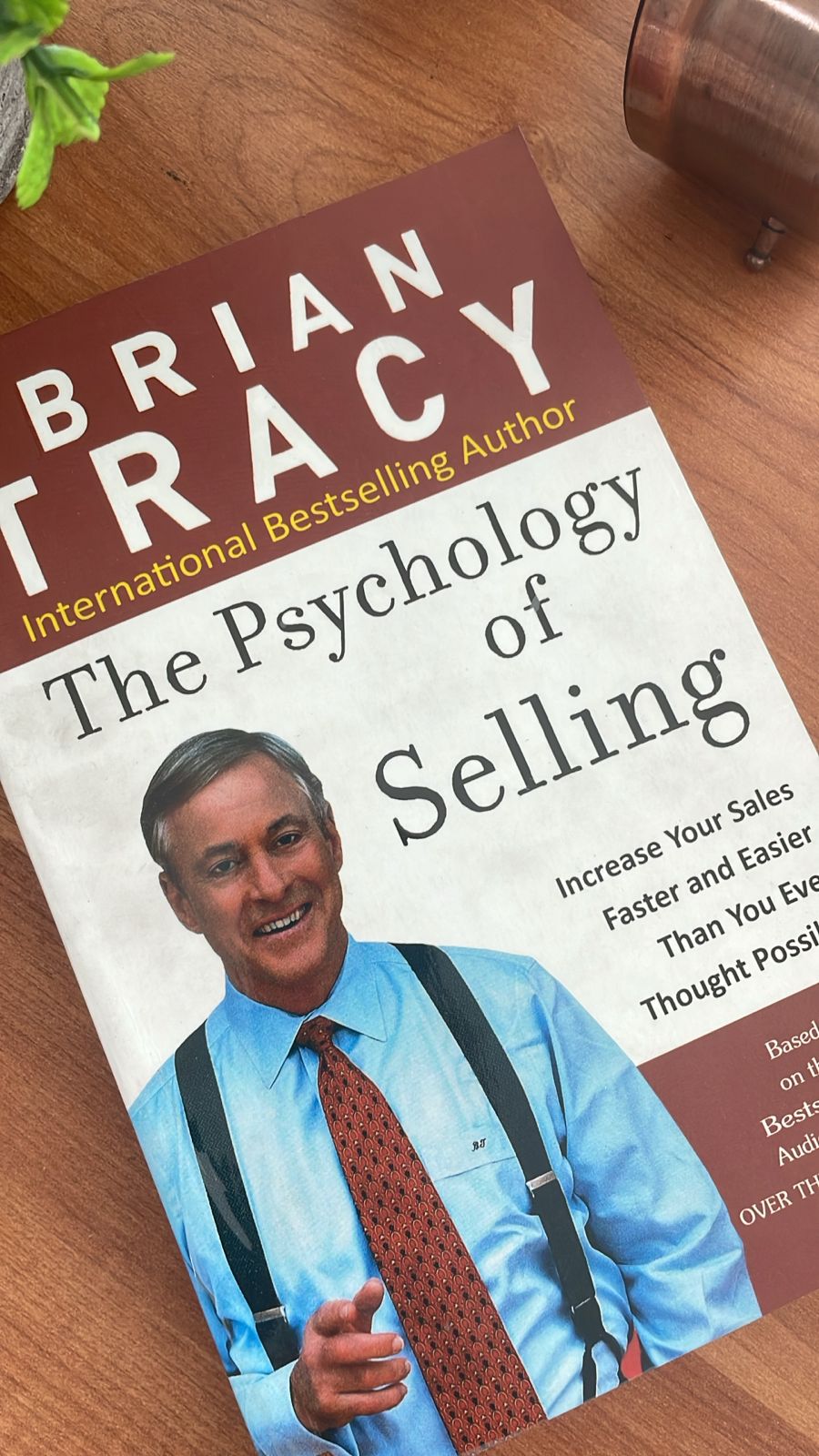
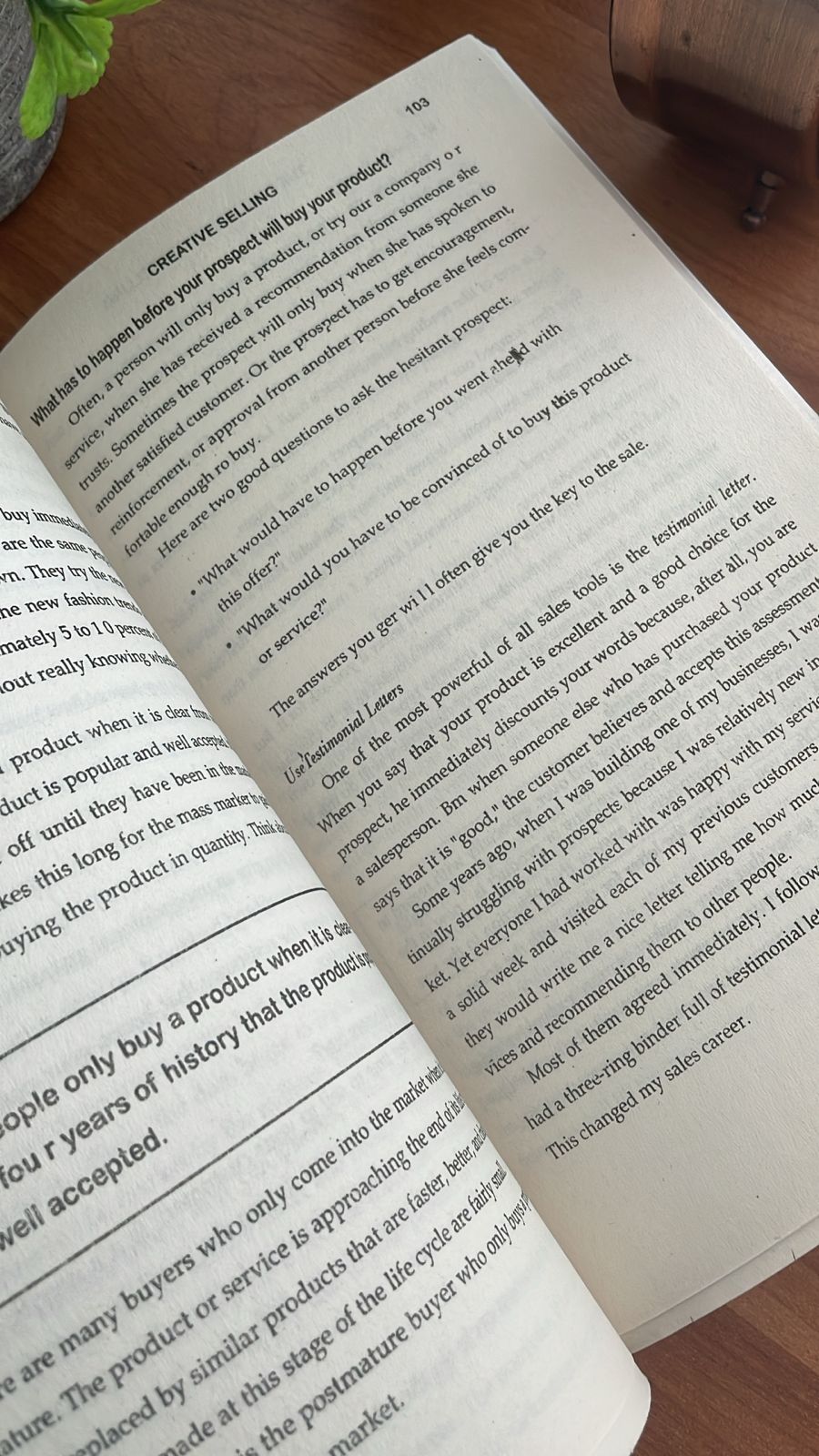

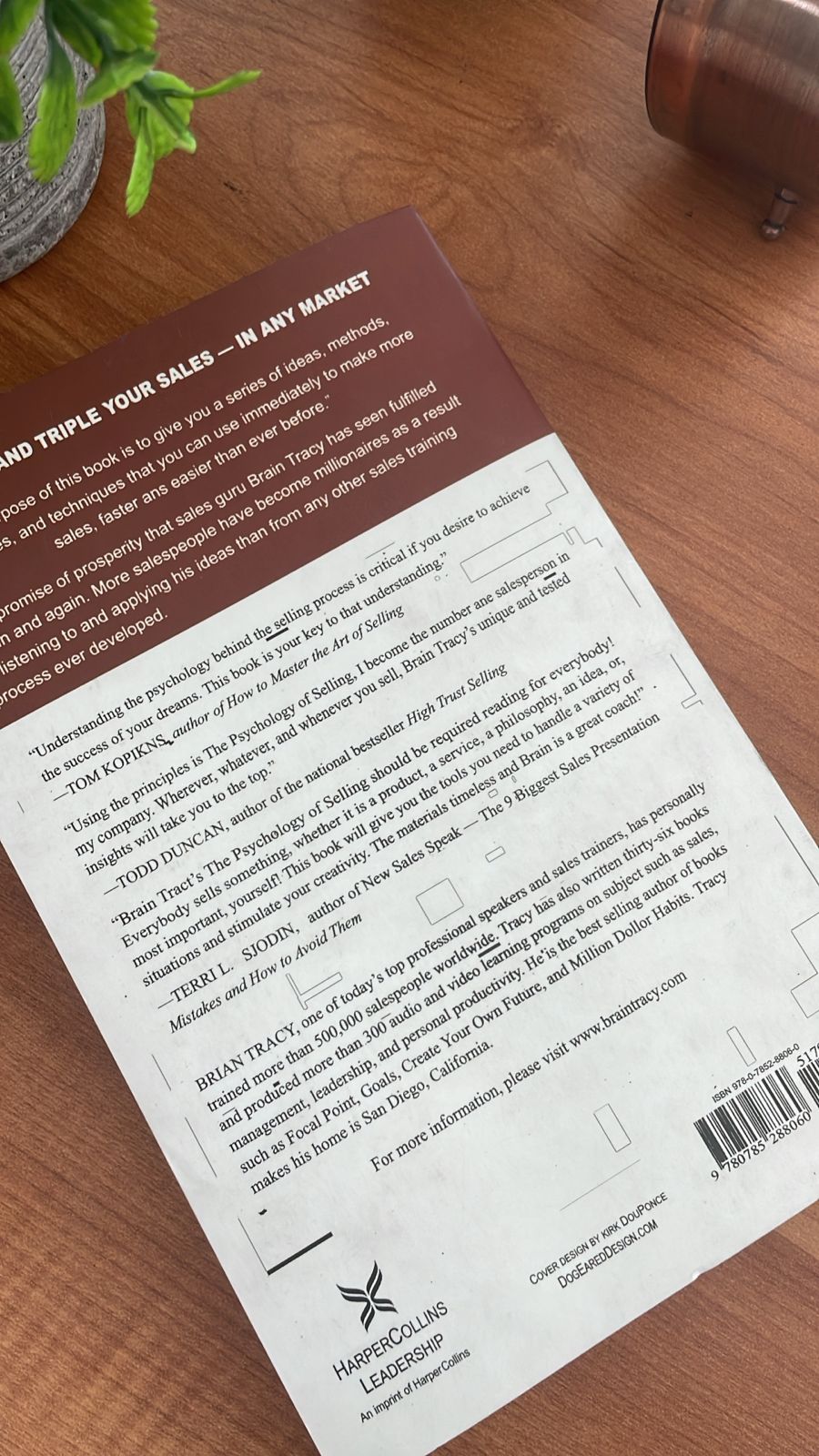



Psychology of Selling by Brian Tracy

Original price was: රු1,900.00.රු1,600.00Current price is: රු1,600.00.
3 X Rs. 533.33 or 8% Cashback with


or 3 X රු533.33 with


or up to 4 X රු400.00 with


The Psychology of Selling by Brian Tracy is a powerful guide designed to help sales professionals master the art of persuasion. Tracy shares practical techniques and psychological insights to boost confidence, overcome objections, and close more deals, making this book a must-read for anyone looking to excel in sales.
Out of stock
Email when stock available
The Psychology of Selling by Brian Tracy is a practical guide to becoming more confident, persuasive and effective in sales by understanding one of the most important parts of selling: human psychology.
Why does one salesperson succeed while another struggles with the same product?
Why do customers say no?
Why do some people hesitate even when they clearly need what is being offered?
Why does fear of rejection stop talented salespeople from making enough calls?
And what actually motivates a customer to buy?
Brian Tracy argues that sales success depends on much more than memorizing a sales script.
Your mindset matters.
Your confidence matters.
Your understanding of the customer matters.
Your ability to ask questions matters.
Your follow-up matters.
And your ability to continue after hearing “no” matters enormously.
The Psychology of Selling by Brian Tracy explores what Tracy calls the inner game of selling, including how salespeople can improve their thinking, manage rejection, build confidence and better understand why customers make purchasing decisions.
The book also provides practical guidance on prospecting, setting sales goals, getting appointments, presenting value, handling objections and closing.
For business owners, entrepreneurs, marketers and sales professionals, it offers a straightforward introduction to the psychology behind better sales conversations.
The Psychology of Selling by Brian Tracy – Book Overview
The Psychology of Selling by Brian Tracy begins with an important idea:
Selling is not only about the product.
Two people can sell the same thing.
At the same price.
To the same market.
One may dramatically outperform the other.
Why?
Because customers respond to more than specifications.
They respond to:
Trust.
Confidence.
Perceived value.
Emotion.
Risk.
Need.
Timing.
Clarity.
The way the salesperson communicates these elements can strongly influence the outcome.
The Inner Game of Selling
One of the central topics in the book is what Tracy calls the inner game of selling.
Before a salesperson can influence customers effectively, they need to manage their own:
Fear.
Self-doubt.
Expectations.
Attitude.
Reactions to rejection.
Selling involves frequent uncertainty.
You may make a presentation and still lose the sale.
You may call ten prospects and receive ten rejections.
If every “no” becomes emotionally personal, motivation quickly disappears.
Fear of Rejection
Fear of rejection is one of the biggest barriers in sales.
A salesperson may know exactly what to do.
Call the prospect.
Ask for the appointment.
Present the offer.
Ask for the order.
Yet fear creates hesitation.
What if they say no?
What if they are rude?
What if I look foolish?
Tracy’s approach encourages salespeople to treat rejection as part of the process rather than as a judgment of personal worth.
A No Is Not Always About You
A customer may refuse because:
The timing is wrong.
The budget is unavailable.
They already have another supplier.
They do not understand the value.
They are not the decision-maker.
They simply do not need the product.
None of these automatically means the salesperson is incompetent.
That distinction can protect confidence.
Confidence Matters
Customers often notice uncertainty.
If a salesperson appears unsure of:
The product.
The value.
The company.
The recommendation.
customers may become uncertain too.
Confidence does not mean being aggressive.
It means communicating with enough conviction that the customer feels they are dealing with someone who understands the solution.
Confidence Comes From Preparation
The strongest confidence is based on competence.
Know:
Your product.
Your customer.
Your competitors.
Your pricing.
Common objections.
Your success stories.
Preparation gives confidence something real to stand on.
Why People Buy
A major part of The Psychology of Selling by Brian Tracy focuses on understanding why customers make purchasing decisions.
People do not buy merely because a product exists.
They buy because they believe the product will create a desirable result.
A customer might want:
More revenue.
Less stress.
More convenience.
Higher status.
Better health.
More security.
Saved time.
Reduced cost.
The salesperson’s job is to understand which outcome matters most.
Features Versus Benefits
A feature describes the product.
A benefit explains what that feature does for the customer.
For example:
Feature: This laptop has a high-capacity battery.
Benefit: You can work longer without needing a charger.
Or:
Feature: This POS system automatically updates inventory.
Benefit: You spend less time manually checking stock and reduce the chance of selling an item you no longer have.
Customers usually care more about the result than the technical feature itself.
Sell the Result
A useful sales question is:
What changes for the customer after buying this?
That may be a better starting point than listing every feature.
Customers are often trying to move from:
Current problem
to
desired result.
Your product is the bridge.
Needs Come Before the Pitch
One of the biggest mistakes in selling is presenting too early.
The salesperson begins talking before understanding the customer.
A better approach is often:
Ask.
Listen.
Understand.
Then recommend.
A customer is more likely to value a solution that clearly connects with a problem they already recognize.
Ask Better Questions
Good sales questions can reveal:
What are you currently using?
What problem are you trying to solve?
What is most important to you?
What is not working with the current option?
What would an ideal solution look like?
What happens if this problem remains unsolved?
Questions turn selling from a speech into a conversation.
Listening
Listening is one of the most underrated sales abilities.
Salespeople sometimes feel pressure to constantly talk.
But the customer may reveal the entire selling strategy simply by explaining their situation.
Listen for:
Problems.
Priorities.
Concerns.
Deadlines.
Budget.
Decision criteria.
Then respond.
Value
Customers compare price with perceived value.
If the customer believes:
Value > Price
the purchase feels attractive.
If they believe:
Price > Value
they hesitate.
This means reducing price is not always the best solution.
Sometimes the real problem is that the salesperson has not communicated enough value.
Price Objections
When someone says:
“That is too expensive,”
it can mean several different things.
They may genuinely lack the money.
They may not understand the value.
They may be comparing you with a cheaper alternative.
They may simply be negotiating.
Strong salespeople try to understand the reason before immediately offering a discount.
Avoid Automatic Discounting
Discounting can help close some deals.
But constantly reducing price can create problems.
Lower margins.
Weaker positioning.
Customers waiting for discounts.
Pressure on future pricing.
Before changing the price, make sure the customer fully understands the value.
Prospecting
Sales cannot happen without enough potential customers.
This makes prospecting essential.
A salesperson may be extremely good at closing.
But if they only speak to two prospects per month, opportunities remain limited.
Prospecting creates the pipeline.
The Sales Pipeline
Think of sales as a process.
Prospects.
Conversations.
Appointments.
Presentations.
Proposals.
Follow-ups.
Sales.
Not everyone moves to the final stage.
Therefore, the salesperson needs enough activity at the beginning.
Activity Matters
A useful lesson from The Psychology of Selling by Brian Tracy is that salespeople should focus strongly on activities they can control.
You cannot force someone to buy.
But you can control:
How many calls you make.
How many prospects you contact.
How many follow-ups you send.
How well you prepare.
How clearly you present.
Set Sales Goals
Tracy emphasizes goal setting as part of sales performance.
A vague objective like:
“I want more sales”
is difficult to manage.
A better goal might be:
“I want Rs. 2 million in monthly sales.”
Then work backward.
How many orders are required?
How many proposals?
How many appointments?
How many prospects?
Now the large goal becomes measurable activity.
Work Backward From the Goal
Suppose:
Average sale = Rs. 20,000
Monthly target = Rs. 1,000,000
You need approximately 50 sales.
If 25% of qualified presentations become sales, you need around 200 presentations.
Now the question becomes:
How many prospects are required to generate those presentations?
This kind of thinking makes selling more systematic.
Appointments
Getting the meeting is itself an important sales skill.
The prospect usually does not want a twenty-minute speech during the first call.
They need enough reason to continue the conversation.
Your initial goal may simply be:
Get permission for the next step.
Keep the Initial Message Relevant
A prospect is more likely to listen when your message quickly answers:
Who are you?
Why are you contacting me?
Why might this matter to me?
What do you want me to do next?
Clarity reduces resistance.
The Power of Suggestion
One of the book’s chapters discusses the power of suggestion. The original contents include sections on the inner game of selling, sales goals, why people buy, creative selling, appointments, suggestion, making the sale and keys to selling success.
Customers form impressions from the entire interaction.
Your:
Appearance.
Confidence.
Words.
Materials.
Environment.
Professionalism.
can all influence perception.
Social Proof
People often become more comfortable when they know others have successfully purchased the same solution.
Useful social proof may include:
Testimonials.
Customer reviews.
Case studies.
Recognizable clients.
Sales numbers.
However, these claims should always be genuine and accurately represented.
Trust
Sales becomes much easier when customers trust the salesperson.
Trust can be built through:
Honesty.
Product knowledge.
Keeping promises.
Admitting when something is not suitable.
Following up.
Not exaggerating.
A short-term sale gained through misleading claims can destroy a long-term customer relationship.
Ethical Selling
Some older sales literature can sound highly focused on persuasion and closing.
Modern readers should apply these ideas ethically.
The goal should not be:
Make the customer buy regardless of whether they need it.
A better goal is:
Help the right customer confidently choose a solution that genuinely fits their needs.
That creates repeat business and referrals.
Objections
Objections are normal.
Common examples include:
Too expensive.
I need to think about it.
I need to ask my partner.
We already use another company.
Now is not the right time.
Strong salespeople do not automatically argue.
They first identify the real concern.
Clarify the Objection
If someone says:
“I need to think about it,”
you could ask:
“Of course. Is there anything specific you’d like more information about before you decide?”
Now you may discover the actual problem.
Price.
Trust.
Timing.
Features.
Internal approval.
Without clarification, you are guessing.
Closing the Sale
At some point, the salesperson must ask for a decision.
This can be surprisingly difficult.
Some people make excellent presentations and then never clearly ask the customer to buy.
A close can be simple.
“Would you like to go ahead?”
“Which option works best for you?”
“Shall we arrange delivery?”
The customer needs a clear next step.
Closing Is Not Pressure
Ethical closing is not forcing someone.
It means helping a qualified customer move from consideration to decision.
If the solution is wrong for them, the right outcome may be not to sell.
Follow-Up
Many sales are lost because follow-up stops too early.
A prospect may genuinely be interested but become distracted by:
Work.
Family.
Other priorities.
Budget approval.
A respectful follow-up can bring the conversation back.
Follow Up With Value
Instead of repeatedly sending:
“Any update?”
try sending something useful.
A case study.
Answer to a question.
Updated quotation.
Relevant comparison.
Available-stock notice.
Useful follow-up gives the customer a reason to respond.
Creativity in Selling
Tracy also discusses creative selling.
Salespeople should continually search for better ways to:
Find prospects.
Approach customers.
Explain value.
Demonstrate products.
Handle objections.
Ask for referrals.
There is rarely only one possible sales method.
Learn From Top Performers
If another salesperson consistently performs better, do not simply say:
“They are naturally good at sales.”
Observe them.
How do they open conversations?
What questions do they ask?
How do they follow up?
How do they explain price?
What can be adapted ethically to your own style?
Practice
Sales is a skill.
Skills improve through repetition.
Practice:
Opening statements.
Product explanations.
Objection responses.
Closing questions.
The objective is not to sound robotic.
It is to become comfortable enough that you can focus on the customer.
The 80/20 Principle in Sales
In many businesses, a small group of customers may generate a large percentage of revenue.
Likewise, certain sales activities may create much more value than others.
Identify the high-impact activities.
Then protect time for them.
A salesperson can stay busy all day without doing much actual selling.
Time Management
Salespeople often lose time through:
Unnecessary administration.
Social media.
Internal discussions.
Poor planning.
Repeatedly researching instead of contacting prospects.
The most productive sales activities usually involve customers and qualified prospects.
Repeat Customers
Selling to existing customers can be easier than constantly finding completely new ones.
If customers have already received good service, trust exists.
Ask:
What else might help them?
When will they need to reorder?
Would an upgraded solution create value?
Repeat business makes sales more sustainable.
Referrals
Satisfied customers can introduce new customers.
A referral begins with something cold prospecting lacks:
Trust transferred from another person.
But referrals should be earned through excellent customer experience.
Customer Service Is Part of Selling
The sale does not end when payment arrives.
What happens afterward can determine whether the customer:
Buys again.
Leaves a review.
Refers someone.
Complains.
Good after-sales service strengthens the entire sales system.
Sales for Entrepreneurs
Entrepreneurs often dislike the word “sales.”
They may prefer:
Product.
Development.
Operations.
Design.
But a business without sales eventually has a serious problem.
Founders need to understand how to:
Explain value.
Find customers.
Ask questions.
Present solutions.
Ask for payment.
Sales for Small Businesses
The Psychology of Selling by Brian Tracy can be useful for small-business owners because they often act as the salesperson themselves.
A bookstore owner is selling.
A café owner is selling.
A freelancer is selling.
A software company is selling.
Even when the environment looks different, the fundamentals remain similar:
Understand the customer.
Communicate value.
Build trust.
Ask for the decision.
Sales for Retail
Retail salespeople can use these ideas without becoming pushy.
Instead of immediately asking:
“Can I help you?”
and stopping after the customer says no, you might ask more naturally:
“What kind of book are you looking for?”
“Is it for you or a gift?”
“What type of books do you usually enjoy?”
The conversation helps narrow the recommendation.
Sales for Online Stores
Online selling removes much of the face-to-face conversation.
Therefore the website must answer common customer questions.
Clear product descriptions.
Good images.
Reviews.
Delivery information.
Payment options.
Return policies.
Frequently asked questions.
All influence purchase confidence.
Psychology Is Not Mind Control
The title should not be misunderstood.
Sales psychology is not magical manipulation.
You cannot ethically “hack” everyone into buying something.
Customer behavior is influenced by many factors.
Price.
Need.
Trust.
Income.
Timing.
Competition.
Personal preference.
The useful purpose of sales psychology is understanding decision-making—not overriding another person’s freedom.
Some Examples May Feel Dated
The Psychology of Selling by Brian Tracy was developed from earlier sales-training material and published in book form in the mid-2000s.
Sales technology has changed considerably since then.
Modern sales now often involves:
CRM systems.
Social selling.
Online meetings.
Automated email.
AI tools.
Ecommerce.
Digital advertising.
However, many underlying principles remain relevant:
Confidence.
Prospecting.
Listening.
Understanding needs.
Communicating value.
Following up.
Adapt the Principles to Modern Selling
The exact tools change.
The principle remains.
Old method:
Telephone prospecting.
Modern variation:
LinkedIn outreach.
Old method:
Printed sales presentation.
Modern variation:
Video call and digital proposal.
Old method:
Paper follow-up.
Modern variation:
CRM automation.
Technology changes the channel.
Human decision-making still matters.
Is The Psychology of Selling a Self-Help Book?
It contains personal-development ideas, particularly around:
Confidence.
Goals.
Fear.
Attitude.
Discipline.
But its main subject is sales and selling.
For your website, the best category would be:
Non-Fiction > Business, Leadership & Marketing
and, if you use secondary categories:
Self-Help & Personal Development can also be relevant.
Who Is Brian Tracy?
Brian Tracy is a business speaker and author known for books and training programs focused on sales, productivity, goals, leadership and personal development. His other widely known titles include Eat That Frog! and Goals!.
The Psychology of Selling grew out of his sales-training work and focuses particularly on practical sales performance.
Edition Details
Several editions exist, so check your physical copy.
A Thomas Nelson trade paperback is listed with:
Author: Brian Tracy
ISBN-13: 9780785288060
Pages: 220
Publisher: Thomas Nelson
Another later HarperCollins paperback commonly sold in Sri Lanka uses:
ISBN-13: 9781404108738
Pages: 240.
Use the ISBN printed on your actual copy rather than assuming every edition uses the same one.
7 Powerful Lessons From The Psychology of Selling by Brian Tracy
- Your mindset influences your sales performance. Fear, confidence and expectations can affect whether you prospect consistently, communicate clearly and ask confidently for the sale.
- Understand why the customer wants to buy. Good selling begins with the customer’s problem or desired result, not with a long list of product features.
- Ask questions before presenting solutions. The more accurately you understand the customer’s priorities, the more relevant your recommendation becomes.
- Treat rejection as part of the process. A “no” may reflect timing, budget or fit rather than your personal worth. Salespeople need enough resilience to continue prospecting.
- Communicate benefits, not only features. Customers usually care most about what changes for them after purchasing.
- Prospecting and follow-up are essential. Even excellent closing skills produce little without enough qualified conversations entering the pipeline.
- Ask for the sale. Once the customer understands the value and the solution genuinely fits, provide a clear next step instead of hoping they will somehow close themselves.
Why Read The Psychology of Selling by Brian Tracy?
The Psychology of Selling by Brian Tracy is a useful choice for readers interested in:
- Sales
- Marketing
- Entrepreneurship
- Business development
- Customer psychology
- Persuasion
- Negotiation
- Prospecting
- Closing sales
- Customer relationships
- Confidence
- Goal setting
- Sales management
- Retail
- Business communication
- Personal development
It can be especially valuable for new salespeople who need a simple framework for understanding how mindset, customer needs and sales activity work together.
Who Should Read This Book?
The Psychology of Selling by Brian Tracy may especially appeal to:
- Sales professionals
- Entrepreneurs
- Business owners
- Retail employees
- Marketing professionals
- Account managers
- Business-development executives
- Freelancers
- Real-estate professionals
- Insurance salespeople
- Students studying business
- Anyone uncomfortable with asking customers to buy
- People who want to become more confident in sales conversations
The Psychology of Selling by Brian Tracy – Better Selling Starts With Better Understanding
The Psychology of Selling by Brian Tracy ultimately argues that selling becomes easier when you stop treating it as a battle between buyer and seller.
The customer is not an opponent.
They have a problem.
A need.
A desire.
A goal.
Your job is to understand whether what you sell can help.
If it can, explain the value clearly.
If it cannot, forcing the sale may create a customer problem rather than a business success.
That is where psychology becomes useful.
Understand why people hesitate.
Understand why people buy.
Understand how fear affects you as the salesperson.
Understand how trust affects the customer.
Then improve the process.
Prospect consistently.
Prepare.
Ask questions.
Listen.
Communicate value.
Answer concerns.
Follow up.
Ask for the decision.
There is no magical phrase that guarantees every customer will say yes.
Good selling is a combination of:
Skill.
Activity.
Confidence.
Understanding.
Trust.
And repetition.
For salespeople, entrepreneurs and business owners who want practical principles they can apply immediately, The Psychology of Selling by Brian Tracy remains an accessible classic on the mental and human side of selling.
Learn more about The Psychology of Selling by Brian Tracy on the official Brian Tracy website.
Explore more sales, business, and personal development books at Bargain Books.
| Author | Brian Tracy |
|---|---|
| Language | English |
| Type | Paperback Printed Book (Second Quality Copy) |
Be the first to review “Psychology of Selling by Brian Tracy”
Related products
![Stories of bible [hardcover]](https://bargainbooks.lk/wp-content/uploads/Stories-of-bible-hardcover-2-300x450.jpeg)
Damaged & Imperfect Books
රු1,750.00
3 X Rs. 583.33 or 8% Cashback with
or 3 X රු583.33 with
or up to 4 X රු437.50 with

Damaged & Imperfect Books
රු1,700.00
3 X Rs. 566.67 or 8% Cashback with
or 3 X රු566.67 with
or up to 4 X රු425.00 with
-16%

Business, Finance & Economics
Original price was: රු3,150.00.රු2,650.00Current price is: රු2,650.00.
3 X Rs. 883.33 or 8% Cashback with
or 3 X රු883.33 with
or up to 4 X රු662.50 with

රු1,500.00
3 X Rs. 500.00 or 8% Cashback with
or 3 X රු500.00 with
or up to 4 X රු375.00 with

Damaged & Imperfect Books
රු1,700.00
3 X Rs. 566.67 or 8% Cashback with
or 3 X රු566.67 with
or up to 4 X රු425.00 with
-39%

Self-Help & Psychology
Original price was: රු2,450.00.රු1,500.00Current price is: රු1,500.00.
3 X Rs. 500.00 or 8% Cashback with
or 3 X රු500.00 with
or up to 4 X රු375.00 with
-21%
Non-Fiction & Knowledge
7 Secrets to Investing Like Warren Buffett by Mary Buffett & Sean Seah
Original price was: රු1,900.00.රු1,500.00Current price is: රු1,500.00.
3 X Rs. 500.00 or 8% Cashback with
or 3 X රු500.00 with
or up to 4 X රු375.00 with
-31%

Business, Finance & Economics
Original price was: රු1,600.00.රු1,100.00Current price is: රු1,100.00.
3 X Rs. 366.67 or 8% Cashback with
or 3 X රු366.67 with
or up to 4 X රු275.00 with
Reviews
There are no reviews yet.