
No products in the cart.
-22%
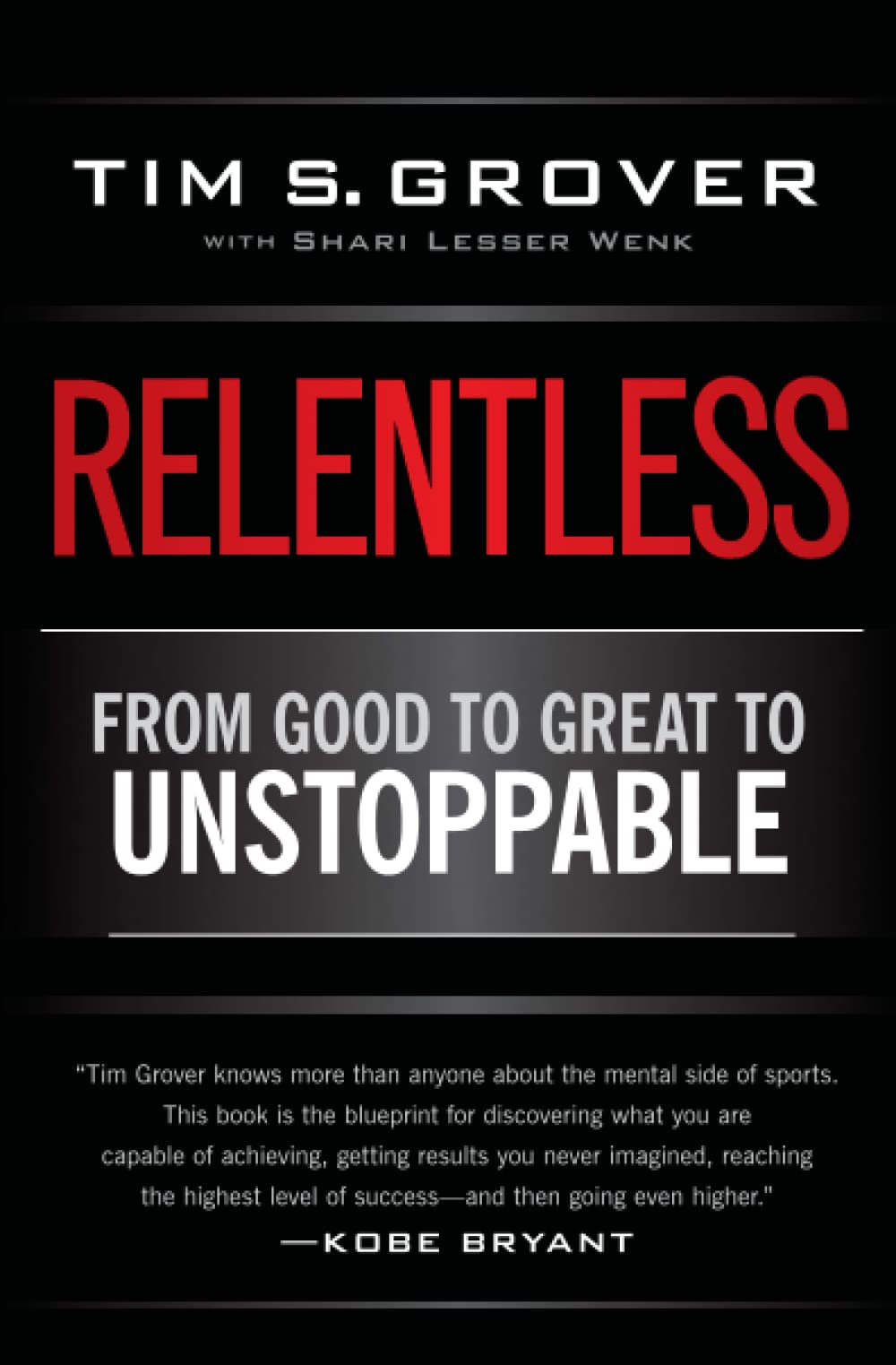
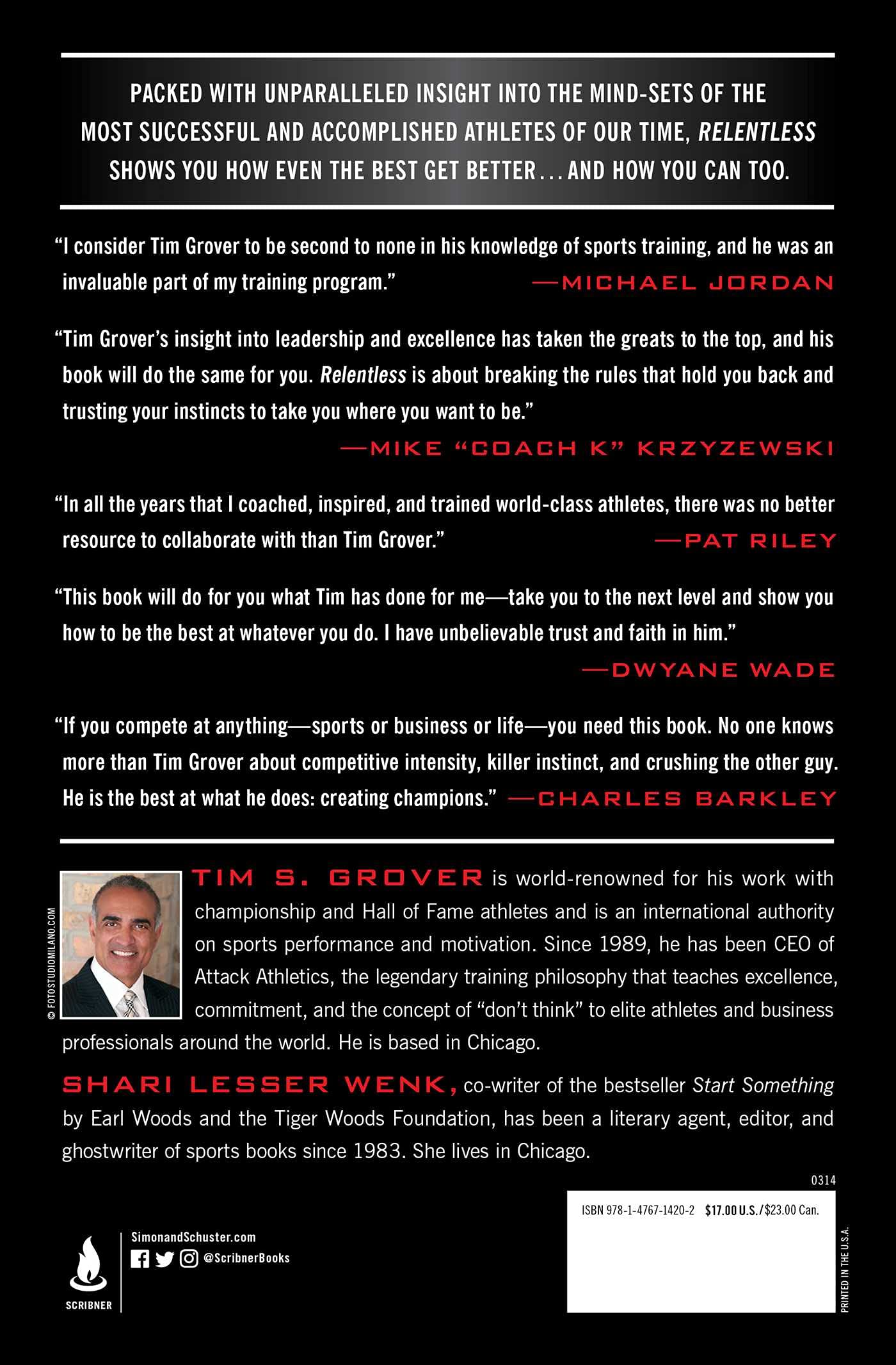


Relentless by Tim Grover


Original price was: රු2,300.00.රු1,800.00Current price is: රු1,800.00.
3 X Rs. 600.00 or 8% Cashback with


or 3 X රු600.00 with


or up to 4 X රු450.00 with


Relentless by Tim Grover is a powerful guide to mental toughness, discipline and elite performance from the trainer who worked with Michael Jordan, Kobe Bryant, Dwyane Wade and other top competitors. Through his Cooler, Closer and Cleaner framework and the Relentless 13, Grover explores pressure, instinct, preparation, failure, competitiveness and the mindset required to keep improving after others are satisfied. Ideal for athletes, entrepreneurs, students, leaders and anyone interested in developing stronger personal standards and a high-performance mentality.
Out of stock
Email when stock available
Relentless by Tim Grover is an intense guide to mental toughness, discipline, competitive performance and the mindset required to keep improving when everyone else is ready to stop.
For more than two decades, Tim Grover worked with some of basketball’s most famous competitors, including Michael Jordan, Kobe Bryant and Dwyane Wade. Rather than focusing only on physical training, Grover became fascinated by what separates talented performers from people who consistently deliver under pressure.
Why can two athletes possess similar physical talent while one repeatedly performs better in the biggest moments?
Why do some people need constant motivation while others seem driven internally?
Why do certain competitors become satisfied after succeeding, while others immediately raise their standards again?
And what happens when preparation, instinct, confidence and extreme competitiveness combine?
Those questions form the foundation of Relentless by Tim Grover.
Grover’s answer is direct: elite performance begins in the mind.
Physical ability matters.
Talent matters.
Training matters.
But when everyone at the highest level is already talented, the difference increasingly comes from how someone handles pressure, preparation, failure, emotion and expectations.
The book is deliberately intense. It is not gentle motivational encouragement. Grover challenges readers to examine whether they truly want exceptional results—or merely like the idea of success without accepting the work, discomfort and responsibility that come with it.
Relentless by Tim Grover – Book Overview
Relentless by Tim Grover is based on Grover’s experience coaching elite athletes and observing the mental habits of high performers.
The official publisher describes the book as an examination of the competitive instinct that separates good performers from great ones, with particular attention to mental and physical dominance, pressure, instinct and continuous improvement.
Grover organizes much of his philosophy around three types of competitors:
Coolers. Closers. Cleaners.
His own explanation associates them with three levels:
Good. Great. Unstoppable.
The book’s ideal is the Cleaner—someone who does not merely respond to pressure but seeks responsibility, adapts quickly, trusts preparation and continues raising the standard after success.
Cooler, Closer and Cleaner
Grover’s three-category model is one of the most recognizable ideas in Relentless by Tim Grover.
A Cooler can perform well but often needs external direction, motivation or favorable circumstances.
A Closer is capable of delivering at a high level, particularly when the moment demands it.
A Cleaner represents Grover’s highest category—the competitor who consistently creates opportunities, accepts pressure and refuses to become satisfied simply because everyone else considers the result impressive. Grover himself describes the categories as Cooler, Closer and Cleaner corresponding to good, great and unstoppable.
These are Grover’s motivational categories, not scientifically validated personality types. They are best treated as a framework for thinking about performance rather than a psychological diagnosis.
What Is a Cleaner?
The Cleaner is the central figure in Relentless by Tim Grover.
Grover’s official excerpt begins by describing a Cleaner as someone who keeps pushing after others have had enough. He connects this mindset with preparation, discipline, mental strength and the willingness to perform without needing constant external motivation.
A Cleaner does not wait for:
Perfect conditions.
Applause.
Motivation.
Permission.
Instead, the person develops a standard and repeatedly tries to meet it.
The Relentless 13
Grover calls the shared characteristics he observed among elite performers the Relentless 13.
Interestingly, the book intentionally presents thirteen principles even though the numbering structure has its own distinctive style.
The publisher describes these as essential traits shared by highly competitive achievers in sports, business and other fields.
The larger message is that becoming exceptional is not about one dramatic motivational moment.
It is about repeated patterns of behavior.
Mental Toughness
Mental toughness is at the center of Relentless by Tim Grover.
Grover argues that physical capability can only take someone so far.
At elite levels, almost everyone already possesses significant ability.
The difference becomes:
Who stays focused?
Who handles pressure?
Who prepares consistently?
Who keeps working when recognition disappears?
Who can recover after failure?
Grover’s official excerpt explicitly argues that mental conditioning should not be treated as an afterthought to physical training.
Talent Is Not Enough
Natural talent creates potential.
It does not guarantee achievement.
A talented person may still struggle because of:
Poor discipline.
Weak preparation.
Emotional inconsistency.
Complacency.
Fear of pressure.
Unwillingness to accept feedback.
Grover’s philosophy therefore focuses less on becoming talented and more on maximizing the talent already available.
Michael Jordan
Michael Jordan appears throughout Grover’s philosophy because Grover worked with him for many years.
Jordan is presented as an example of extreme competitiveness, preparation and an unusually high personal standard.
The important lesson is not simply:
“Be Michael Jordan.”
That is impossible.
The useful question is:
What can ordinary people learn from the habits that allowed an elite performer to keep demanding improvement after already reaching extraordinary levels?
Kobe Bryant
Kobe Bryant is another major example in Relentless by Tim Grover.
Grover worked with Bryant and discusses the mentality behind his preparation and desire to improve.
Bryant’s reputation for intense training fits naturally with Grover’s central idea:
Success does not permanently satisfy the highest-level competitor.
It becomes evidence of what may be possible next.
Dwyane Wade
Dwyane Wade also appears prominently in Grover’s examples.
The book uses elite basketball stories because professional sport makes performance unusually measurable.
Score.
Minutes.
Speed.
Wins.
Losses.
Championships.
But Grover repeatedly argues that the underlying mentality can also be applied outside sport. His official excerpt explicitly says the ideas can be adapted to business, school and other ambitions.
Pressure
Most people prefer situations where pressure decreases.
Grover encourages a different relationship with it.
Pressure reveals preparation.
When the stakes increase, someone who has rehearsed, trained and developed strong habits does not suddenly need to invent a new personality.
They rely on what has already been built.
Performing Under Pressure
A professional athlete cannot say:
“I’ll perform when I feel inspired.”
Neither can a surgeon, leader, salesperson or business owner always wait for perfect emotional conditions.
Professionalism requires the ability to produce useful work even when motivation fluctuates.
That does not mean ignoring illness, injury or exhaustion.
It means reducing dependence on temporary feelings.
Motivation Versus Discipline
Motivation can start action.
Discipline maintains it.
Someone may feel extremely motivated on January 1.
By February, motivation fades.
The person with a system continues.
This is one reason Relentless by Tim Grover appeals to readers tired of traditional motivational books built mainly around positive feelings.
Grover cares much more about execution.
Don’t Think
One of Grover’s memorable ideas is “don’t think.”
He does not mean becoming unintelligent.
The idea is that exceptional preparation eventually reduces hesitation.
An experienced performer has repeated a skill so often that the correct action can become instinctive.
Grover’s current training materials describe this as removing the mental hesitation that slows performance and learning to trust trained instincts.
Preparation Creates Instinct
Instinct at an elite level is usually not magic.
A basketball player recognizes a defensive movement because they have seen similar situations thousands of times.
A developer recognizes a familiar failure pattern because they have solved similar problems.
A business owner notices a customer problem because experience has created pattern recognition.
What appears spontaneous may actually be compressed experience.
The Zone
Relentless by Tim Grover also discusses getting into the Zone—a state of extreme concentration in which unnecessary distractions disappear and action becomes more automatic.
The publisher specifically highlights Grover’s discussion of trusting instinct and getting into the Zone.
The practical lesson is focus.
You cannot perform at your highest level while constantly splitting attention among:
Notifications.
Other people’s opinions.
Unrelated worries.
Internal debate.
Control What You Can
Elite performers do not control every result.
An athlete cannot control:
Officials.
Opponents.
Weather.
Injuries.
Luck.
A business owner cannot control:
Competitors.
The economy.
Every customer.
A professional cannot control every manager or coworker.
But they can influence:
Preparation.
Effort.
Response.
Standards.
Focus.
Grover’s approach directs energy toward those areas.
Adaptability
Being relentless does not mean repeating a failed strategy forever.
Grover emphasizes controlling and adapting to situations.
If circumstances change, the method may need to change too.
The goal remains.
The strategy evolves.
This distinction is important because stubbornness and persistence are not identical.
Competition
Competition is treated positively throughout the book.
Grover views strong competitors as people who use pressure and opposition to sharpen performance.
This mentality can be useful when competition encourages:
Preparation.
Skill development.
Higher standards.
However, not every area of life needs to become a competition.
Healthy collaboration and cooperation remain essential in work, relationships and teams.
Know Your Opponent
Grover encourages high performers to understand weaknesses—both their opponent’s and their own.
In sport, this may mean studying another player’s tendencies.
In business, it may mean understanding a competitor’s poor customer experience.
In personal development, the opponent may be your own:
Procrastination.
Fear.
Lack of preparation.
Inconsistency.
Your Greatest Opponent
Eventually, the competition becomes internal.
Can you maintain the standard when nobody is watching?
Can you continue after success?
Can you correct your own mistakes?
Can you admit weakness?
The difficult opponent is often the version of yourself that wants comfort without sacrificing ambition.
Standards
Goals describe desired outcomes.
Standards describe acceptable behavior.
Goal:
Finish the project.
Standard:
I complete important work before wasting time on distractions.
Goal:
Become fitter.
Standard:
I train consistently and recover properly.
Goals can be reached.
Standards continue.
That is why elite performers often think beyond individual achievements.
Success Can Become Dangerous
Failure creates obvious problems.
Success can create hidden ones.
After winning, people relax.
Recognition increases.
Others praise them.
The hunger that created the result may decline.
Grover’s Cleaner mentality treats success as another moment in the process rather than permission to stop improving.
Complacency
Being satisfied emotionally is healthy.
Becoming professionally complacent can be costly.
A business that says:
“We are already the best”
may stop noticing changes.
An athlete may train less.
A student may assume earlier performance guarantees future results.
Relentless by Tim Grover challenges this comfort.
Failure
Grover does not treat failure as something that should permanently damage identity.
High performers lose.
Miss shots.
Make mistakes.
Fail to close deals.
Build products nobody buys.
The important question becomes:
What happens next?
Failure can become information.
Don’t Live Inside Failure
A mistake should be analyzed.
But endlessly replaying it can become another form of paralysis.
Learn what happened.
Correct what can be corrected.
Return to execution.
This is one of the most useful ways to interpret Grover’s aggressive language about moving forward.
Responsibility
A Cleaner does not immediately search for someone else to blame.
That does not mean every problem is personally caused.
External circumstances absolutely matter.
But responsibility asks:
Given what has happened, what can I do now?
Blaming and responsibility are different.
Excuses
Grover has little patience for excuses.
That can be motivating, but readers should apply the principle intelligently.
Real constraints exist.
Injury.
Illness.
Disability.
Financial limitations.
Family responsibilities.
Discrimination.
Structural barriers.
Acknowledging reality is not automatically making an excuse.
The productive question is how to work effectively within the reality that actually exists.
Emotional Control
The book encourages competitors not to allow emotion to destroy execution.
That does not mean becoming emotionless.
Emotions carry information.
Anger may signal unfairness.
Fear may signal risk.
Sadness may signal loss.
Mental toughness means managing emotion well enough that it does not automatically control every decision.
The Dark Side
Grover also discusses what he calls the dark side of elite achievement.
He uses the term to describe intense internal drives, competitiveness and aspects of personality that highly driven people may prefer not to discuss publicly.
His own training materials encourage acknowledging and controlling this side rather than pretending it does not exist.
The useful interpretation is self-awareness.
Know what drives you.
Do not allow it to control you blindly.
Obsession
Extreme achievement can involve obsessive qualities.
That intensity may produce exceptional results.
It can also create costs.
Relationships.
Health.
Sleep.
Balance.
Mental wellbeing.
A mature reader should therefore distinguish between understanding elite competitive psychology and copying every extreme behavior.
Work Ethic
Grover’s stories repeatedly return to preparation.
Elite performers often do work the audience never sees.
Fans see the game.
They do not see every:
Workout.
Practice.
Recovery session.
Video review.
Repetition.
Meeting.
Successful performance is built largely in private.
Details Matter
When competitors are already excellent, small details become more important.
At beginner level, huge improvements are possible.
At elite level, gaining even a tiny advantage can require enormous effort.
This principle applies to professional work too.
Once the fundamentals are strong, improvement often comes from details.
Confidence
Real confidence is rarely created by repeating:
“I am the best.”
A stronger form comes from evidence.
You prepared.
You practiced.
You survived similar pressure.
You solved similar problems.
That creates grounded confidence.
Confidence Without Preparation
Confidence unsupported by skill becomes fragile.
The moment reality challenges it, it collapses.
Grover’s performers are confident because they repeatedly prepare at a high level.
The lesson is:
Earn confidence.
Focus on Results
Grover is strongly results-oriented.
Good intentions matter less if execution repeatedly fails.
That can sound harsh, but it offers a useful professional principle.
At some point, effort must produce outcomes.
A business needs customers.
A project needs completion.
An athlete needs performance.
A student needs learning.
Effort is essential, but feedback from results tells us whether the method is working.
Results Need Context
At the same time, not every outcome is fully controllable.
Someone can perform excellently and still lose.
Someone can make a good business decision that fails because conditions unexpectedly change.
Therefore, evaluate both:
Quality of process.
Actual result.
The combination gives better feedback than either alone.
Leadership
Cleaners often become leaders because they are willing to accept responsibility.
But leadership is not simply demanding more from everyone.
A strong leader should also create:
Clarity.
Resources.
Feedback.
Accountability.
Trust.
Grover’s style is intentionally confrontational, so readers should adapt its lessons to their own teams rather than assuming every employee responds well to extreme pressure.
High Standards and Other People
Expecting a lot from yourself is one thing.
Imposing the same intensity on everyone around you is another.
People have different:
Roles.
Goals.
Responsibilities.
Personalities.
Not everyone needs to become an elite competitor.
The book is most useful when applied primarily to your own standards.
Entrepreneurship
Entrepreneurs may find Relentless by Tim Grover particularly relevant.
Building a business often requires:
Working without immediate recognition.
Handling uncertainty.
Making decisions under pressure.
Learning from failed experiments.
Competing.
Adapting.
Continuing after setbacks.
The Cleaner mindset maps naturally onto many entrepreneurial challenges.
Students
Students can apply the ideas without turning education into unhealthy obsession.
The useful lessons are:
Prepare early.
Practice consistently.
Do difficult work before deadlines.
Learn from poor results.
Reduce excuses.
Build confidence through preparation.
A single exam does not require adopting the lifestyle of an NBA champion.
Software Developers and Professionals
The principles also apply to technical work.
A strong developer does not merely know syntax.
They:
Investigate problems.
Own mistakes.
Test assumptions.
Learn continuously.
Remain calm during incidents.
Improve systems after failures.
High performance looks different in a server room than on a basketball court, but the underlying standard can still matter.
Is Relentless a Sports Book?
Partly.
Many examples come from professional basketball and elite athletic training.
But Grover explicitly writes the philosophy for readers in sports, business, education and other competitive environments.
It fits well under:
Self-Help & Personal Development.
Performance Psychology.
Business Motivation.
Sports Performance.
Is It Only for Athletes?
No.
The publisher specifically positions the ideas for competitors and achievers across sports, business and other fields.
You do not need to play basketball to understand:
Pressure.
Discipline.
Complacency.
Focus.
Failure.
Personal standards.
Is Relentless a Motivational Book?
Yes, but its style differs substantially from gentle motivational books.
Grover is:
Direct.
Confrontational.
Competitive.
Sometimes deliberately uncomfortable.
He challenges rather than reassures.
Readers who enjoy hard-edged performance coaching may appreciate that.
Readers looking for a calm, compassionate self-help style may prefer something else.
Is It Scientifically Based?
It is primarily based on Grover’s professional experience, observations and philosophy as an elite performance trainer.
It should not be treated as a scientific psychology textbook.
Concepts such as Cooler, Closer and Cleaner are Grover’s own motivational framework rather than established clinical categories.
Relentless and Winning
Grover later wrote Winning: The Unforgiving Race to Greatness, which continues his broader work on elite performance.
Simon & Schuster lists both within the Tim Grover Winning Series.
You can read Relentless independently.
No previous book is required.
Official Edition Details
The original Scribner hardcover is listed as:
Title: Relentless: From Good to Great to Unstoppable
Author: Tim S. Grover
With: Shari Lesser Wenk
Publisher: Scribner
Publication: April 16, 2013
Pages: 256
ISBN-13: 9781476710938
The Scribner trade paperback is:
Pages: 272
ISBN-13: 9781476714202
Publication: March 11, 2014
Again, your procurement sheet’s 9781476757865 is incorrect for this title and belongs to Tony Robbins’s MONEY: Master the Game.
Content and Reading Considerations
Relentless by Tim Grover contains aggressive motivational language, intense competitive themes, strong emphasis on winning, discussions of obsession and the psychological “dark side” of elite achievement, and examples of pushing through discomfort.
Readers should interpret these ideas with context. Physical pain, injury, burnout and serious psychological distress should not simply be “pushed through.” Appropriate rest, recovery and professional medical or mental-health support remain important.
The book is performance philosophy, not medical advice.
7 Powerful Lessons From Relentless by Tim Grover
- Mental strength can separate talented performers. At high levels, skill alone may no longer create enough difference; preparation, discipline and pressure management become increasingly important.
- Build standards, not just goals. Goals can be achieved once. Standards influence how you work every day.
- Prepare until confidence becomes earned. The strongest confidence comes from repeated evidence that you have done the work required.
- Learn to perform without waiting for motivation. Motivation changes. Professional execution cannot always depend on how inspired you feel.
- Pressure reveals preparation. High-stakes situations become easier to handle when the necessary behaviors have already been practiced repeatedly.
- Use failure as information. Analyze what happened, correct the process and return to action rather than allowing one result to become your identity.
- Never allow success to become complacency. The core Cleaner mentality is not merely reaching a high level—it is continuing to improve after other people already consider the result exceptional.
Why Read Relentless by Tim Grover?
Relentless by Tim Grover is especially useful for readers interested in mental toughness, high performance, competition, discipline, leadership, entrepreneurship, sports psychology, personal development and the mindset of elite athletes.
It may particularly appeal to people who are tired of motivational advice that says only:
Believe in yourself.
Stay positive.
Dream big.
Grover’s message is different.
Decide what you want.
Prepare.
Work.
Perform.
Accept responsibility.
Handle pressure.
Then improve again.
That directness is precisely why some readers find the book energizing.
Who Should Read This Book?
Relentless by Tim Grover may especially appeal to athletes, entrepreneurs, business owners, sales professionals, managers, students, coaches, high-performance professionals, Michael Jordan fans, Kobe Bryant fans, basketball readers and anyone interested in how elite competitors think.
It is particularly suited to readers who respond well to intense, challenging coaching rather than gentle encouragement.
Relentless by Tim Grover – When Great Is No Longer Enough
Relentless by Tim Grover begins from an uncomfortable idea.
Being talented is not enough.
Being good is not enough.
For some people, even being great is not enough.
Once everyone around you is skilled, another level of competition begins.
Who prepares better?
Who notices details?
Who performs under pressure?
Who takes responsibility after failure?
Who continues improving after success?
Grover spent years watching elite athletes answer those questions through action.
Michael Jordan did not need another person telling him he was talented.
Kobe Bryant did not need another motivational poster.
High performers already know they are capable.
The challenge is getting more from capability.
That is why Grover focuses so heavily on the mind.
A person can possess extraordinary physical ability and still hesitate.
A brilliant employee can still avoid difficult responsibility.
A talented entrepreneur can still quit when the first strategy fails.
A gifted student can still rely too heavily on natural ability and eventually be overtaken by someone more disciplined.
Potential is only potential.
Execution converts it into something useful.
This is also why Relentless by Tim Grover should not be misunderstood as simply a book about working longer hours.
The more useful message is about becoming dependable under pressure.
Knowing your standard.
Preparing enough to trust yourself.
Taking ownership.
Adapting when necessary.
And refusing to allow praise to convince you that improvement is finished.
Grover’s philosophy is extreme because the people he trained operated in extreme competitive environments.
Not every reader needs that lifestyle.
But almost anyone can use a healthier version of the central question:
What would happen if I stopped negotiating with the standards I already know I should meet?
For readers seeking an intense, direct and unapologetically competitive guide to discipline, performance and mental toughness, Relentless by Tim Grover offers a memorable look inside the mindset Grover developed while working with some of basketball’s most accomplished competitors.
Learn more about Relentless: From Good to Great to Unstoppable by Tim S. Grover on the official Simon & Schuster website.
Explore more motivation, performance, and personal development books at Bargain Books.
| Author | Tim Grover |
|---|---|
| Language | English |
| Type | Paperback Printed Book (Second Quality Copy) |
Be the first to review “Relentless by Tim Grover”
Related products

Non-Fiction & Knowledge
රු2,450.00
3 X Rs. 816.67 or 8% Cashback with
or 3 X රු816.67 with
or up to 4 X රු612.50 with

Non-Fiction & Knowledge
රු1,700.00
3 X Rs. 566.67 or 8% Cashback with
or 3 X රු566.67 with
or up to 4 X රු425.00 with
-24%

Non-Fiction & Knowledge
Original price was: රු2,300.00.රු1,750.00Current price is: රු1,750.00.
3 X Rs. 583.33 or 8% Cashback with
or 3 X රු583.33 with
or up to 4 X රු437.50 with
Non-Fiction & Knowledge
රු2,250.00
3 X Rs. 750.00 or 8% Cashback with
or 3 X රු750.00 with
or up to 4 X රු562.50 with

රු2,000.00
3 X Rs. 666.67 or 8% Cashback with
or 3 X රු666.67 with
or up to 4 X රු500.00 with

Out of stock
Self-Help & Psychology
රු2,200.00
3 X Rs. 733.33 or 8% Cashback with
or 3 X රු733.33 with
or up to 4 X රු550.00 with

Non-Fiction & Knowledge
රු1,950.00
3 X Rs. 650.00 or 8% Cashback with
or 3 X රු650.00 with
or up to 4 X රු487.50 with
-24%

Out of stock
Non-Fiction & Knowledge
Original price was: රු2,500.00.රු1,900.00Current price is: රු1,900.00.
3 X Rs. 633.33 or 8% Cashback with
or 3 X රු633.33 with
or up to 4 X රු475.00 with
Reviews
There are no reviews yet.