
No products in the cart.
-21%
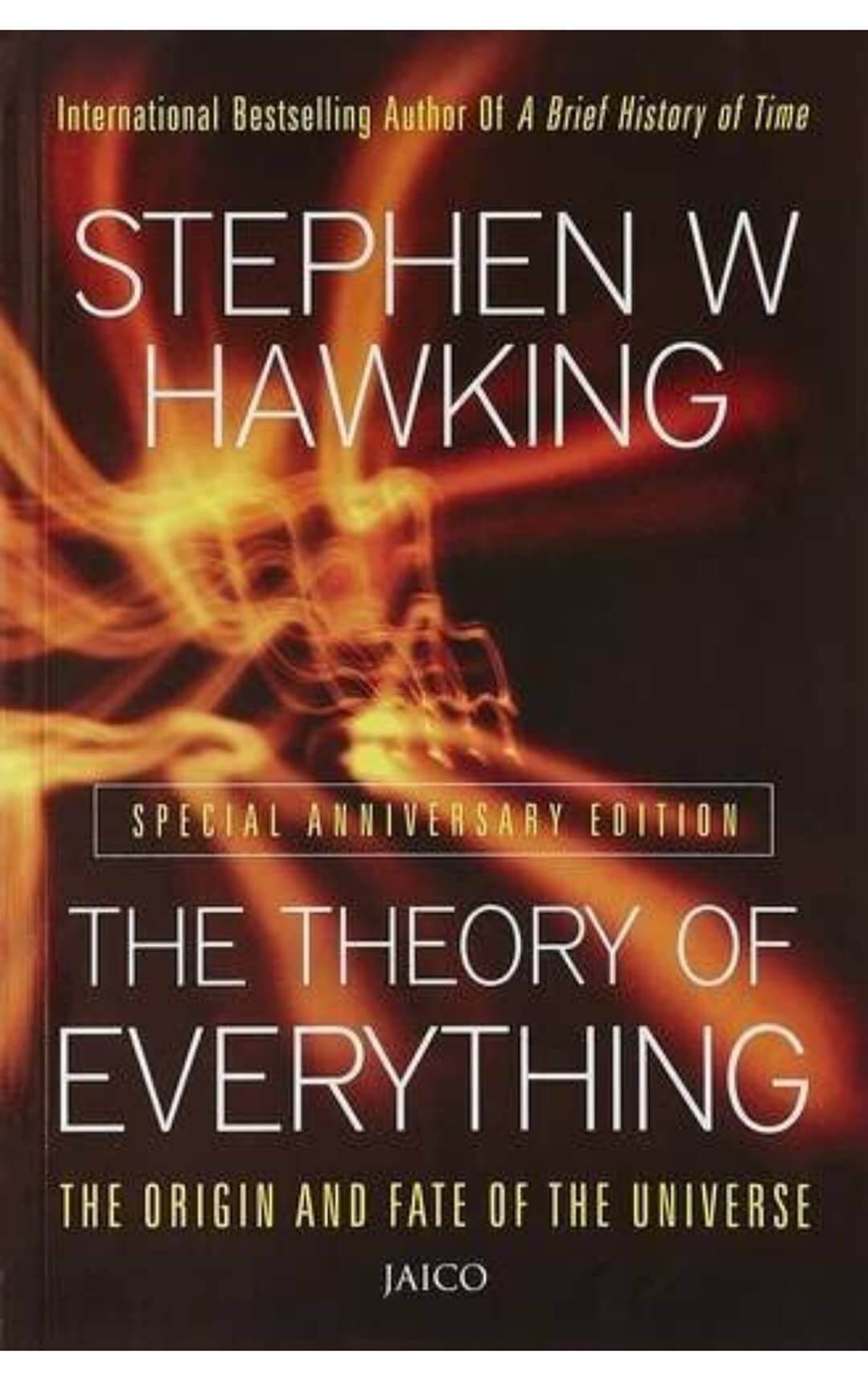
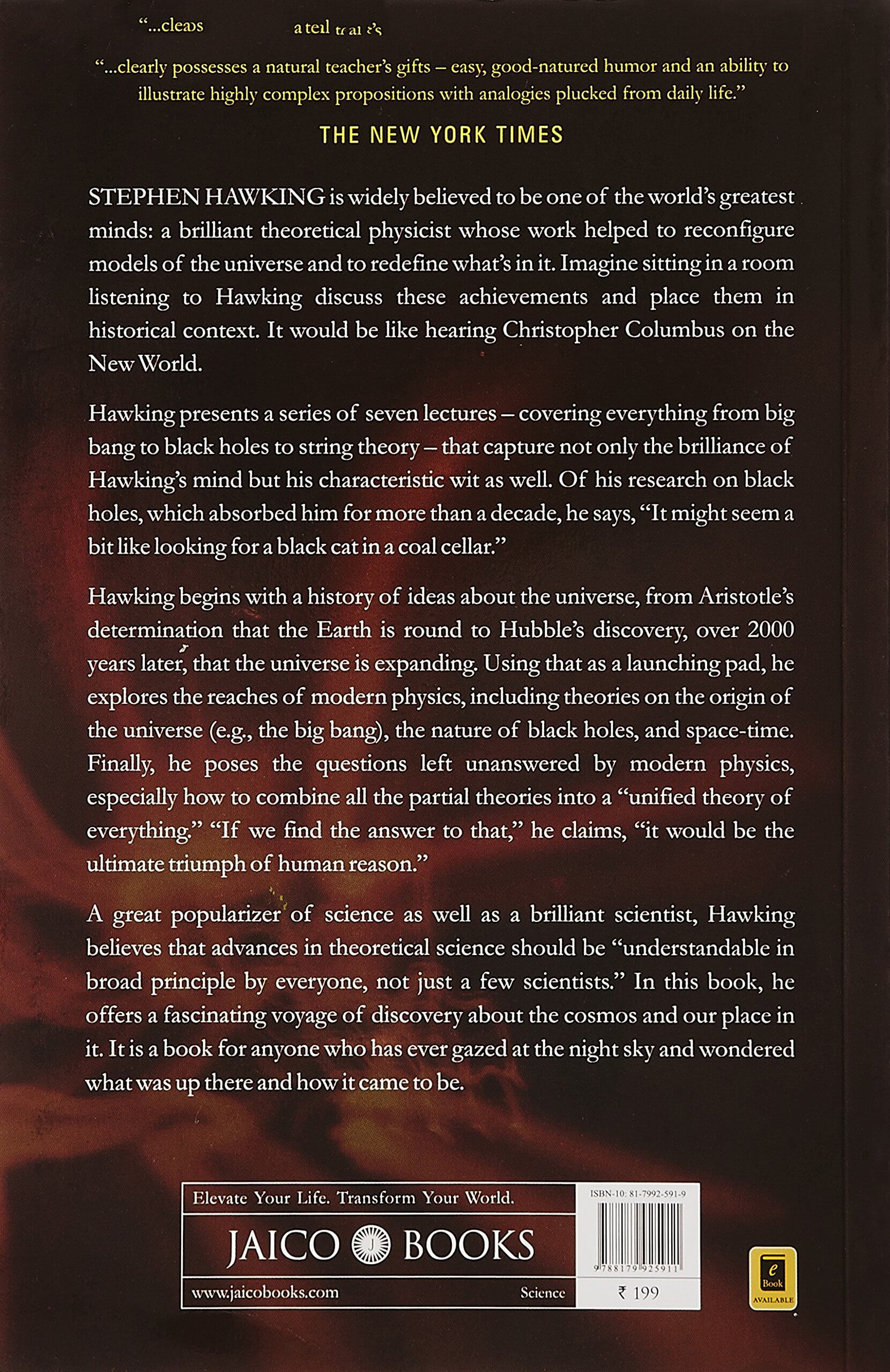

Theory of Everything by Stephen Hawking


Original price was: රු1,900.00.රු1,500.00Current price is: රු1,500.00.
3 X Rs. 500.00 or 8% Cashback with


or 3 X රු500.00 with


or up to 4 X රු375.00 with


“The Theory of Everything” by Stephen Hawking is a fascinating exploration of the universe’s greatest mysteries, offering a concise yet profound overview of the major scientific theories that explain the origins, structure, and future of the cosmos. Drawing on his groundbreaking research, Hawking presents complex ideas in an accessible manner, making this book a must-read for anyone interested in understanding the fundamental principles that govern our universe.
Out of stock
Email when stock available
The Theory of Everything by Stephen Hawking
The Theory of Everything by Stephen Hawking is an accessible introduction to some of the biggest questions in modern physics and cosmology.
Where did the universe come from?
How did it begin?
What exactly is a black hole?
How does time behave?
And could scientists one day discover a single theory capable of explaining the fundamental laws of the universe?
Stephen Hawking explores these extraordinary questions in a way designed for general readers rather than only professional physicists.
About The Theory of Everything
The Theory of Everything brings together a series of lectures in which Hawking explains major developments in our understanding of the universe.
The book begins with early ideas about the cosmos.
It then moves through the discoveries that transformed physics.
Readers are introduced to the expanding universe, the Big Bang, black holes, quantum mechanics, space-time, and the search for a unified theory.
The result is a compact journey through some of the most important ideas in modern science.
7 Powerful Ideas from The Theory of Everything
1. Our Understanding of the Universe Has Changed Dramatically
For centuries, people had very different ideas about the structure of the universe.
Some believed the Earth occupied a special central position.
Scientific observation gradually changed that picture.
Astronomy revealed a universe far larger and more complex than earlier civilizations imagined.
Hawking explains how scientific models change when new evidence becomes available.
2. The Universe Is Expanding
One of the most important discoveries in modern cosmology is that the universe is expanding.
Distant galaxies are generally moving away from one another.
This observation led scientists to ask an important question.
If everything is expanding now, what happens when we mathematically run the process backwards?
That question leads toward the idea of the Big Bang.
3. The Big Bang Changed Cosmology
The Theory of Everything discusses the idea that the observable universe developed from an extremely hot and dense early state.
As the universe expanded, it cooled.
Matter eventually formed.
Stars and galaxies developed over enormous periods of time.
The Big Bang does not simply describe an explosion occurring somewhere inside space.
It refers to the expansion of space itself.
4. Black Holes Challenge Our Intuition
Black holes are among the most fascinating objects in physics.
Their gravity is so strong that beyond a certain boundary, even light cannot escape.
Hawking became famous for his work on black holes.
His research helped change the scientific understanding of these objects.
Black holes are not simply cosmic vacuum cleaners.
They are deeply connected to gravity, thermodynamics, quantum theory, and information.
5. Space and Time Are Connected
Einstein’s theories transformed the way scientists understand space and time.
Rather than existing as completely separate things, they are part of a combined structure known as space-time.
Gravity can affect this structure.
Massive objects can curve space-time.
This means gravity can be understood in a very different way from the simple idea of an invisible pulling force.
6. Quantum Physics Changes the Rules
Physics behaves very differently at extremely small scales.
Quantum theory describes a world of probabilities, uncertainty, and strange behavior.
Particles do not always behave in ways that match ordinary everyday intuition.
This creates a major challenge.
Einstein’s theory of gravity works extremely well on large scales.
Quantum theory works extremely well on small scales.
Combining them remains one of physics’ biggest problems.
7. Scientists Continue Searching for a Unified Theory
The title The Theory of Everything refers to the dream of finding a unified framework capable of explaining all fundamental physical forces.
Such a theory would connect areas of physics that currently require different models.
Hawking explores why this goal is so important.
A successful unified theory could deepen our understanding of the origin and behavior of the universe.
The Big Bang
The Big Bang is one of the central subjects in the book.
Scientists observed that galaxies are moving apart.
This suggested that the universe was once much smaller.
If we go far enough back in time, conditions become extremely hot and dense.
Cosmology uses observations, mathematical models, and physical laws to study these early conditions.
Hawking explains how ideas about the beginning of the universe evolved.
Black Holes
Black holes were central to Hawking’s scientific career.
They form when enough matter becomes concentrated within a sufficiently small region.
The resulting gravity becomes incredibly strong.
The boundary surrounding a black hole is called the event horizon.
Anything that crosses this boundary cannot normally return to the outside universe.
However, Hawking showed that quantum effects complicate this picture.
Hawking Radiation
One of Hawking’s most famous contributions was the idea that black holes can emit radiation.
This is now known as Hawking radiation.
The idea combines concepts from quantum mechanics, gravity, and thermodynamics.
It suggests that black holes are not completely black.
Over extremely long periods, they can lose energy.
This discovery created major new questions about the relationship between gravity and quantum physics.
Space-Time
The Theory of Everything also introduces readers to the concept of space-time.
According to relativity, space and time are interconnected.
Mass and energy influence the geometry of space-time.
This provides a way of understanding gravity.
Planets orbit stars not merely because an invisible force pulls them.
They move through curved space-time created by mass.
Quantum Mechanics
Quantum mechanics describes phenomena at the atomic and subatomic level.
It is one of the most successful scientific frameworks ever developed.
But it often seems strange.
Quantum systems can be described using probabilities.
Uncertainty is built into the theory.
This creates deep philosophical questions about what can actually be known about physical reality.
General Relativity and Quantum Theory
General relativity explains gravity remarkably well.
Quantum mechanics explains microscopic physics remarkably well.
But combining the two theories is difficult.
Extreme environments such as the early universe and black holes require both.
This is one reason scientists search for a deeper unified theory.
What Would a Theory of Everything Explain?
A true unified theory would aim to describe the fundamental forces and particles within one consistent mathematical framework.
It would not literally answer every possible question about life or human experience.
Instead, it would provide a deeper physical explanation of how the universe operates at its most fundamental level.
This distinction is important.
The phrase sounds philosophical.
But the scientific objective is highly specific.
Science and Changing Ideas
One of the valuable lessons in The Theory of Everything is that science changes.
Scientific models are not accepted simply because famous scientists proposed them.
They must match evidence.
New observations can modify old ideas.
Sometimes they can replace them entirely.
This willingness to revise explanations is one of science’s greatest strengths.
Making Complex Science Accessible
Stephen Hawking became famous not only because of his research but also because he helped bring advanced cosmology to general readers.
He discusses difficult ideas without requiring readers to work through pages of mathematical equations.
Some concepts are still challenging.
But the writing encourages curiosity.
The book is especially useful for readers who want an introduction before moving into more technical physics.
Who Should Read This Book?
The Theory of Everything is suitable for readers interested in astronomy, cosmology, physics, black holes, space, and the origin of the universe.
Students may find it useful as an introduction to major scientific ideas.
Readers who enjoyed A Brief History of Time may also appreciate this shorter exploration.
You do not need an advanced physics background to begin reading it.
Curiosity is more important.
About Stephen Hawking
Stephen Hawking was a British theoretical physicist, cosmologist, author, and professor.
His research made major contributions to the scientific study of black holes and cosmology.
He served for decades at the University of Cambridge and became one of the best-known scientists of the modern era.
His books include A Brief History of Time, The Universe in a Nutshell, The Grand Design, Black Holes and Baby Universes, and Brief Answers to the Big Questions.
Readers can learn more about this edition through the Google Books page for The Theory of Everything.
Product Details
Title: The Theory of Everything
Subtitle: The Origin and Fate of the Universe
Author: Stephen Hawking
Genre: Science / Physics / Cosmology / Astronomy
Language: English
Publisher: Jaico Publishing House
Common ISBN-13: 9788179925911
Pages: 132
Approximate Dimensions: 8.5 × 5.5 × 0.6 inches
Different publishers have released different editions of the book.
For example, another New Millennium Press edition carries ISBN 9781893224797 and contains approximately 176 pages.
Always use the ISBN and specifications printed on your physical copy when entering final WooCommerce details.
Explore More Science and Knowledge Books
The Theory of Everything takes readers from early ideas about the cosmos to some of the deepest questions in modern physics.
It explores the Big Bang.
It examines black holes.
It introduces space-time and quantum mechanics.
And it explains why scientists continue searching for a unified description of nature.
Readers interested in science, history, philosophy, and knowledge can explore more Non-Fiction & Knowledge Books at Bargain Books.
For readers fascinated by the universe and the scientific ideas used to understand it, The Theory of Everything provides an accessible introduction to Stephen Hawking’s extraordinary field of study.
| Weight | 0.047 kg |
|---|---|
| Dimensions | 12.7 × 1.27 × 20.96 cm |
| Author | Stephen Hawking |
| Language | English |
| Type | Paperback Printed Book (Second Quality Copy) |
| ISBN/ISSN | 9788179925911 |
| Pages | 140 |
Be the first to review “Theory of Everything by Stephen Hawking”
Related products
-24%

Out of stock
Non-Fiction & Knowledge
Original price was: රු2,500.00.රු1,900.00Current price is: රු1,900.00.
3 X Rs. 633.33 or 8% Cashback with
or 3 X රු633.33 with
or up to 4 X රු475.00 with
-26%

Out of stock
Non-Fiction & Knowledge
Original price was: රු2,000.00.රු1,490.00Current price is: රු1,490.00.
3 X Rs. 496.67 or 8% Cashback with
or 3 X රු496.67 with
or up to 4 X රු372.50 with
-19%

Out of stock
Biography
Original price was: රු2,400.00.රු1,950.00Current price is: රු1,950.00.
3 X Rs. 650.00 or 8% Cashback with
or 3 X රු650.00 with
or up to 4 X රු487.50 with

Out of stock
Non-Fiction & Knowledge
රු1,800.00
3 X Rs. 600.00 or 8% Cashback with
or 3 X රු600.00 with
or up to 4 X රු450.00 with
-24%
Out of stock
Non-Fiction & Knowledge
Original price was: රු2,100.00.රු1,600.00Current price is: රු1,600.00.
3 X Rs. 533.33 or 8% Cashback with
or 3 X රු533.33 with
or up to 4 X රු400.00 with

Non-Fiction & Knowledge
රු1,950.00
3 X Rs. 650.00 or 8% Cashback with
or 3 X රු650.00 with
or up to 4 X රු487.50 with
-28%

Self-Help & Psychology
Original price was: රු1,800.00.රු1,300.00Current price is: රු1,300.00.
3 X Rs. 433.33 or 8% Cashback with
or 3 X රු433.33 with
or up to 4 X රු325.00 with

Out of stock
Self-Help & Psychology
රු2,200.00
3 X Rs. 733.33 or 8% Cashback with
or 3 X රු733.33 with
or up to 4 X රු550.00 with
Reviews
There are no reviews yet.