
No products in the cart.
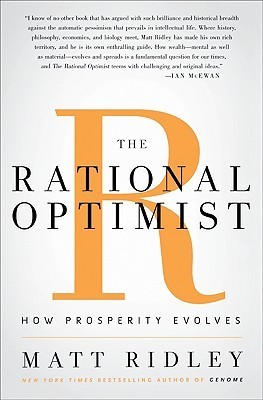
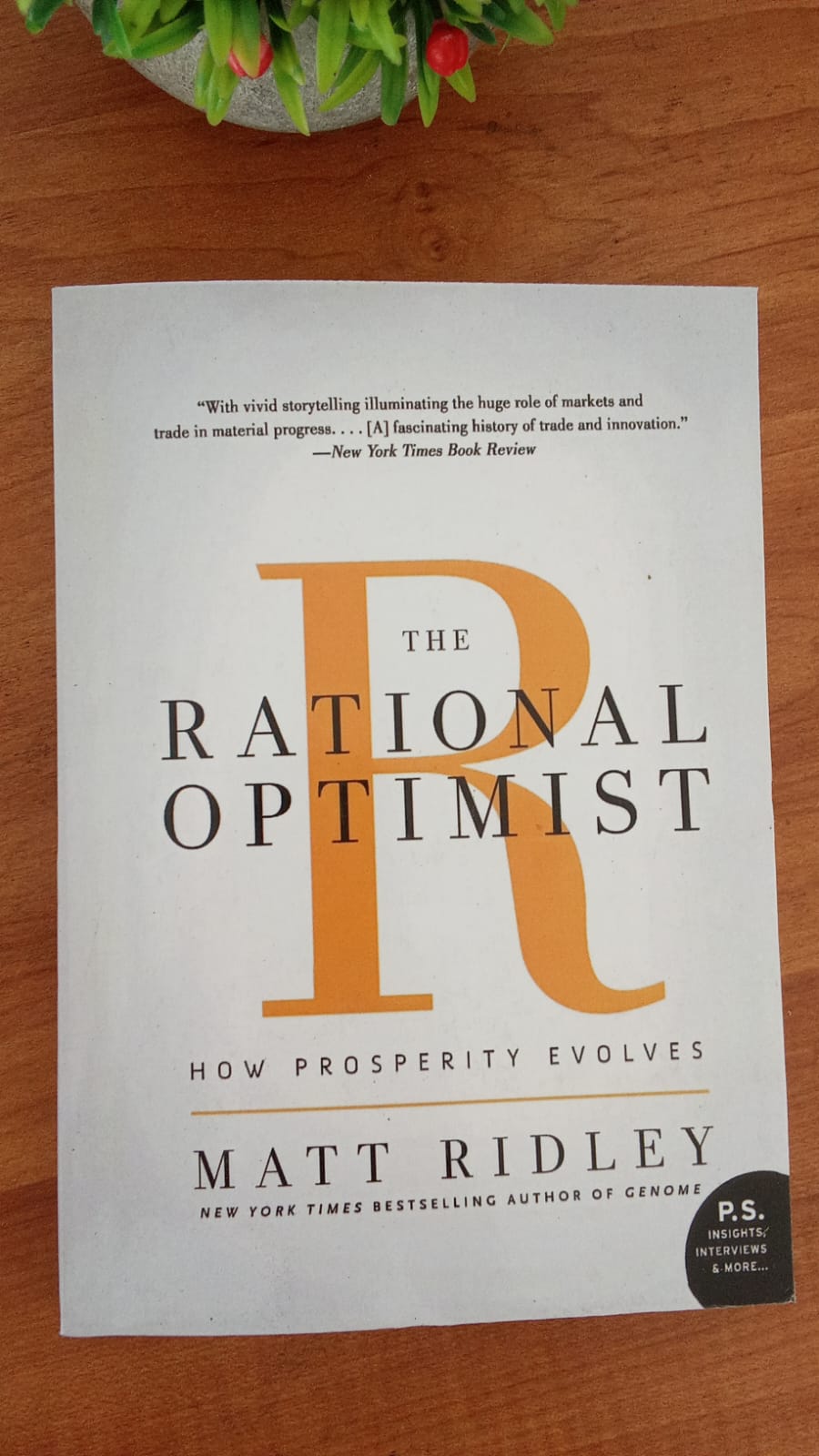
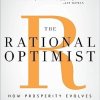
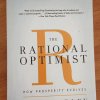
Rational Optimist by Matt Ridley


රු1,900.00
3 X Rs. 633.33 or 8% Cashback with


or 3 X රු633.33 with


or up to 4 X රු475.00 with


The Rational Optimist by Matt Ridley is a thought-provoking exploration of how trade, specialization, innovation and the exchange of ideas have driven human prosperity across thousands of years. Moving from the Stone Age to the modern global economy, Ridley challenges predictions of inevitable decline and argues that humanity’s ability to cooperate, adapt and invent has repeatedly produced solutions to difficult problems. Ideal for readers interested in economics, history, technology, entrepreneurship, innovation and the future of human progress.
6 in stock
The Rational Optimist by Matt Ridley is a provocative and thought-provoking exploration of human progress, arguing that trade, specialization, innovation and the exchange of ideas have repeatedly helped societies overcome scarcity, disease, poverty and technological limitations.
Turn on the news and the world can appear to be moving constantly toward disaster.
Economic crises.
Environmental problems.
Conflict.
Population pressures.
Resource shortages.
Technological disruption.
It is easy to conclude that the future must inevitably be worse than the past.
Matt Ridley challenges that assumption.
Instead of asking only what is going wrong today, he takes a much longer historical view.
How did humans move from small communities with limited technology to a global civilization capable of producing food, medicine, electricity, transportation, computers and instant communication for billions of people?
Why did living standards rise so dramatically?
Why did innovation accelerate?
And why have repeated predictions of permanent scarcity often failed to anticipate the ways people adapt?
Ridley’s answer centers on something surprisingly simple:
Exchange.
When people specialize in different activities and trade with one another, knowledge becomes distributed across society.
One person does not need to know how to produce everything.
Instead, millions of people contribute different skills.
Ideas meet other ideas.
Techniques improve.
Specialization deepens.
Innovation compounds.
The Rational Optimist by Matt Ridley argues that this process—what Ridley sometimes describes through the memorable idea of “ideas having sex”—has been one of the most important engines of human prosperity.
The Rational Optimist by Matt Ridley – Book Overview
The Rational Optimist by Matt Ridley is not simply a book telling readers to think positively.
The word rational is important.
Ridley attempts to build his optimism from historical patterns, economic development and technological change rather than from motivational slogans.
His argument is not:
Everything is perfect.
It is closer to:
Human beings have repeatedly found ways to improve living standards through cooperation, exchange and innovation, so predictions of inevitable collapse should be treated carefully.
That makes the book both optimistic and deliberately controversial.
What Does “Rational Optimism” Mean?
Ordinary optimism may simply mean believing things will turn out well.
Rational optimism asks for evidence.
What has happened to:
Life expectancy?
Food availability?
Income?
Technology?
Communication?
Transportation?
Health?
Productivity?
Ridley argues that across long periods of history many measures of human welfare improved substantially, even though people living through each period often believed decline was imminent.
Progress Is Not the Same as Perfection
This distinction is essential.
Saying that conditions improved does not mean:
Poverty disappeared.
War disappeared.
Disease disappeared.
Environmental problems disappeared.
Inequality disappeared.
Progress means comparing conditions across time and asking whether the average person gained access to things previous generations lacked.
A society can have serious problems and still have improved enormously compared with its past.
The Long View of History
Human beings naturally focus on recent events.
A recession feels enormous while we are experiencing it.
A political crisis dominates attention.
A natural disaster produces immediate fear.
But short-term events can obscure long-term trends.
Ridley therefore moves across thousands of years rather than examining only one decade.
From that perspective, the transformation of human life becomes much more visible.
Specialization
One of the most important ideas in The Rational Optimist by Matt Ridley is specialization.
Imagine trying to produce everything you use yourself.
Grow food.
Build a house.
Make clothing.
Produce medicine.
Create a computer.
Generate electricity.
Build a car.
Impossible.
Modern prosperity depends on people specializing.
A doctor does not need to build the hospital.
A programmer does not need to manufacture the laptop.
A farmer does not need to design a tractor engine.
Different people contribute different capabilities.
Comparative Advantage
Specialization becomes especially powerful when combined with trade.
People, regions and countries can focus more heavily on activities where they have advantages and exchange outputs with others.
This allows everyone to access more variety than they could produce alone.
The principle is not limited to international trade.
It operates inside almost every organization.
A Company Is a Network of Specialists
Think about a bookstore.
One person may manage:
Purchasing.
Another:
Marketing.
Another:
Website development.
Another:
Accounting.
Another:
Customer service.
The business becomes more capable because no single person needs to master everything.
Specialization makes complex organizations possible.
Trade Creates Cooperation Between Strangers
Trade is interesting because two people do not necessarily need to be close friends to cooperate.
A customer and seller may have completely different backgrounds.
Yet both can benefit from exchange.
Ridley treats this ability to cooperate beyond family or tribe as one of humanity’s major advantages.
Trust
Exchange requires some level of trust.
Will the seller provide what was promised?
Will the buyer pay?
Will the contract be respected?
Will the currency still have value?
Markets therefore depend not only on money but also on:
Rules.
Reputation.
Institutions.
Predictability.
Trust reduces the cost of cooperation.
Ideas Can Be Shared
Physical objects behave differently from ideas.
If I give you my chair, I no longer have the chair.
But if I explain an idea to you, both of us can possess it.
You may then improve it.
Someone else combines it with another idea.
That makes knowledge unusually powerful.
“Ideas Having Sex”
One of Ridley’s best-known metaphors is that innovation happens when ideas meet and combine.
An invention may combine:
Existing materials.
Existing science.
Existing manufacturing.
Existing business models.
Existing customer needs.
Very few innovations appear from absolutely nothing.
Most emerge from recombination.
Ridley connects this exchange of ideas to the rise of cumulative human culture.
The Collective Brain
No single human being knows how to build modern civilization.
Yet civilization exists because knowledge is distributed.
One person understands semiconductors.
Another understands logistics.
Another understands finance.
Another understands software.
Another understands manufacturing.
Together they form something like a collective intelligence.
Innovation Is Cumulative
A smartphone required earlier inventions.
Electricity.
Transistors.
Computer processors.
Wireless communication.
Battery chemistry.
Satellites.
Software.
The internet.
Touchscreen technology.
Each innovation builds on others.
This cumulative process is one reason technological progress can accelerate.
Stone Age to Modern Economy
Ridley compares the extremely limited material options available to ancient humans with the variety available today.
Modern people—even without being individually wealthy by contemporary standards—may access things that ancient rulers could not obtain:
Antibiotics.
Electric light.
Instant global communication.
Refrigeration.
Modern transport.
Recorded music.
Digital information.
These comparisons help illustrate what economic growth actually means.
Wealth Is More Than Money
Money itself is not the only measure of prosperity.
Prosperity can mean access to:
Time.
Food.
Health.
Transportation.
Information.
Comfort.
Safety.
Entertainment.
Technology.
A person becomes effectively wealthier when important goods and services become cheaper, better or more accessible.
The Value of Time
Suppose something once required ten hours of labor but now requires one.
That technological improvement effectively gives people time.
Washing machines.
Computers.
Transportation.
Online banking.
Automation.
All can reduce the time required for ordinary tasks.
Time saved is a form of wealth.
Innovation Reduces Costs
Technologies often begin expensive.
Over time they may become:
Cheaper.
Smaller.
Faster.
More reliable.
More widely available.
Computing is an obvious example.
Capabilities once available only to governments or giant corporations now exist inside ordinary smartphones.
The Importance of Exchange
Ridley argues that human beings became dramatically more innovative when exchange allowed specialization.
A person who does everything alone has limited time for improvement.
A specialist can become extremely good at one activity.
Trade lets people benefit from each other’s specialization.
Self-Sufficiency Sounds Better Than It Often Is
Complete self-sufficiency may sound attractive.
But historically, self-sufficient communities often had limited access to:
Medical care.
Specialized tools.
Varied foods.
Advanced technology.
Education.
Trade can make people dependent on one another, but that interdependence can also create extraordinary prosperity.
Interdependence
Modern society is deeply interdependent.
Your morning coffee may involve:
Farmers.
Exporters.
Shipping companies.
Warehouses.
Roasters.
Packaging companies.
Banks.
Retailers.
Software systems.
Electricity providers.
Thousands of people cooperate indirectly to produce something that looks simple.
Globalization
Ridley generally treats exchange across borders as an extension of the same process.
When people trade internationally, markets expand.
Larger markets can support greater specialization.
Greater specialization can support innovation.
But global trade also creates real debates about:
Labor standards.
Environmental impact.
Economic dependence.
National security.
Local industries.
Readers do not need to agree with every conclusion to benefit from understanding the argument.
The Malthusian Problem
The book spends significant attention on pessimistic predictions involving population and resources.
Historically, thinkers influenced by Thomas Malthus worried that population growth would eventually outrun food production.
Ridley argues that these predictions repeatedly underestimated technological change.
Agriculture did not remain fixed.
Humans developed:
Better crops.
Fertilizers.
Irrigation.
Machinery.
Logistics.
Food preservation.
Agricultural science.
The amount of food society could produce changed.
Resources Are Not Simply Fixed in Economic Terms
A physical quantity can be finite while its usefulness changes dramatically.
Technology can:
Discover new deposits.
Use materials more efficiently.
Substitute one material for another.
Recycle.
Develop completely different technologies.
For example, a resource that seems essential today may become less important after innovation.
Scarcity Creates Incentives
When something becomes scarce and expensive, people gain incentives to:
Use less.
Find alternatives.
Improve efficiency.
Develop substitutes.
Explore new sources.
This does not guarantee every shortage will be solved.
But it explains why simply extending current consumption trends indefinitely can produce misleading forecasts.
Energy
Energy is central to economic development.
Human societies moved through different energy systems:
Wood.
Coal.
Oil.
Gas.
Nuclear.
Renewables.
Each transition changed what society could produce.
Ridley’s broader argument is that technological innovation changes the practical constraints humanity faces.
Population Growth
Population growth is another major theme.
The relationship between population and prosperity is complicated.
More people require more resources.
But more people can also mean:
More inventors.
More specialists.
More ideas.
Larger markets.
Ridley emphasizes this creative side of population growth.
More People, More Ideas?
This is one of the book’s provocative claims.
A larger connected population may generate more innovation because there are more minds capable of producing and exchanging ideas.
However, this benefit depends heavily on institutions.
A large population without:
Education.
Freedom.
Markets.
Communication.
Infrastructure.
may not automatically become more innovative.
Innovation Needs Connection
A brilliant idea isolated from the rest of society may accomplish little.
Innovation spreads faster when people can communicate.
This is why:
Cities.
Universities.
Markets.
Trade networks.
The internet.
can become centers of innovation.
They increase the number of possible connections between people and ideas.
Cities
Cities allow enormous specialization.
A small village may support only a limited number of professions.
A large city can support highly specialized:
Doctors.
Engineers.
Artists.
Researchers.
Restaurants.
Businesses.
Specialized professions become economically viable because enough people exist nearby to support them.
The Internet
The internet dramatically expands the potential collective brain.
A developer in Sri Lanka can learn from documentation written in the United States.
A designer can watch a tutorial from Europe.
A small business can buy from overseas suppliers.
A student can access research from universities around the world.
Distance becomes less limiting.
Innovation Through Combination
Consider a modern ecommerce business.
It combines:
Web technology.
Digital payments.
Logistics.
Inventory systems.
Advertising platforms.
Cloud computing.
Mobile devices.
None of these needs to be invented by the store owner.
Entrepreneurs create value by combining existing systems in new ways.
This fits closely with Ridley’s theory of innovation.
Entrepreneurship
Entrepreneurs are important because they experiment with combinations.
A business asks:
Can this technology solve this customer problem?
Can this service become cheaper?
Can these two existing ideas be combined?
Most experiments fail.
Some succeed.
Successful combinations spread.
Trial and Error
Human progress is rarely perfectly planned.
Innovation often emerges through:
Experiment.
Failure.
Modification.
Competition.
Unexpected discovery.
This evolutionary process means society can improve without one person knowing the perfect answer in advance.
Bottom-Up Change
Ridley is generally skeptical of the idea that progress is created primarily through centralized planning.
He emphasizes bottom-up experimentation.
Individuals and organizations try different approaches.
Successful methods spread.
Unsuccessful ones disappear.
This argument is influential but also debatable, especially because governments have historically played major roles in infrastructure, science, public health and technological development.
Institutions Still Matter
Even if innovation often develops from decentralized experimentation, functioning markets require institutions.
Property rights.
Contracts.
Courts.
Infrastructure.
Education.
Stable currency.
Public safety.
The debate is therefore not simply:
Government or market.
The more useful question is which institutions help experimentation, exchange and correction function effectively.
Optimism Is Not Complacency
A common misunderstanding would be:
If things have improved, we do not need to solve problems.
That does not follow.
Past progress happened because people addressed problems.
Disease declined because people developed:
Sanitation.
Medicine.
Vaccines.
Healthcare.
Food production improved because people innovated.
Optimism can therefore motivate action rather than eliminate it.
Rational Optimism Versus Blind Optimism
Blind optimism says:
Everything will work out somehow.
Rational optimism says:
Human beings have repeatedly demonstrated the ability to solve problems through knowledge, cooperation and experimentation, so improvement is possible—but requires action.
That distinction makes The Rational Optimist by Matt Ridley more interesting than a motivational book.
Pessimism Has Advantages
Pessimism can sometimes be useful.
Warnings can reveal:
Risks.
Weaknesses.
Danger.
Future problems.
An engineer should think about what might fail.
A business should analyze threats.
The problem arises when pessimism assumes:
Failure is inevitable.
Nothing can improve.
Humans never adapt.
Good decision-making can combine realistic caution with confidence in problem-solving.
Media and Negative News
Negative events naturally attract attention.
A disaster happens in one day.
Long-term improvements happen gradually.
That creates an information imbalance.
A newspaper can report:
A plane crash.
It rarely reports:
Millions of flights landed safely again today.
Slow progress becomes less visible than sudden catastrophe.
Progress Can Be Uneven
Human improvement has never occurred in a straight line.
There are:
Wars.
Recessions.
Pandemics.
Political failures.
Environmental disasters.
Technological disruptions.
Long-run optimism does not deny short-run suffering.
The two can exist simultaneously.
Environmental Questions
Ridley’s treatment of environmental issues, including climate change and limits to growth, has been debated by critics.
Readers should approach these sections critically.
The book was written around 2010, and scientific, technological and policy discussions have continued evolving since then.
For contemporary environmental decisions, readers should compare Ridley’s arguments with current scientific assessments rather than treating a fifteen-year-old nonfiction book as the last word.
Data Can Age
This is important for any economics or technology book.
Statistics describe a particular period.
Since the book appeared, the world has experienced:
A global pandemic.
Rapid growth in renewable energy.
Major advances in AI.
New geopolitical conflicts.
Changes in global trade.
Updated poverty and demographic trends.
The conceptual argument remains interesting, but specific figures should be checked against current sources when used for research.
A Provocative Perspective, Not a Neutral Textbook
The Rational Optimist by Matt Ridley presents an argument.
It is not a neutral encyclopedia.
Ridley selects historical and economic evidence to defend a broadly optimistic interpretation of progress.
Readers can gain the most by asking:
Which evidence supports him?
Where might critics disagree?
What assumptions does the argument make?
Which predictions aged well?
Which did not?
Reading actively turns disagreement into learning.
Economic Growth
Ridley views economic growth positively because growth can expand access to:
Food.
Healthcare.
Education.
Technology.
Housing.
Leisure.
But growth also raises questions about:
Distribution.
Environmental cost.
Resource use.
Quality of life.
A strong reading does not reduce these questions to one simple answer.
Prosperity and Inequality
A society can become richer overall while inequality remains high or increases.
These are different measurements.
Therefore, when discussing prosperity, readers should ask both:
Are average living conditions improving?
And:
How are the benefits distributed?
This makes the analysis more complete.
Innovation and Inequality
New technologies often begin expensive.
Wealthier people may gain access first.
Later, costs can fall and access expand.
Smartphones are one example.
But that process is not guaranteed in every sector.
Healthcare, housing and education can behave differently.
Human Problem-Solving
Perhaps the most valuable idea in the book is confidence in human problem-solving.
Future generations are not limited to current technology.
A prediction based only on today’s methods may miss tomorrow’s invention.
That does not guarantee every future problem will be solved.
It means predictions should account for adaptation.
The Danger of Linear Forecasting
Suppose resource consumption grows 3% annually.
A simple forecast extends that rate forward forever.
But real systems change.
Prices rise.
Technology improves.
Policies shift.
People substitute.
Behavior changes.
Linear extrapolation often misses those feedback effects.
Technology Changes Constraints
Imagine trying to predict modern communication in 1900.
A forecaster might calculate how much copper would be needed for billions of additional telephone lines.
Then radio, fiber optics, satellites and wireless networks transform the problem.
Innovation changes what must be predicted.
Human Wants Also Change
Prosperity does not merely produce more material goods.
As societies become wealthier, people may spend more on:
Education.
Healthcare.
Experiences.
Digital services.
Entertainment.
Travel.
Convenience.
Economic value becomes less closely tied to physical material consumption.
Dematerialization
Technology can sometimes deliver more value with less physical material.
A smartphone replaces:
Camera.
Calculator.
Map.
MP3 player.
Alarm clock.
Dictionary.
Video player.
Many physical objects become software.
This illustrates how innovation can alter resource use.
Knowledge as a Resource
Knowledge behaves differently from oil or iron.
Using knowledge does not necessarily consume it.
One piece of software can be copied millions of times at low marginal cost.
That makes knowledge-based economies potentially very different from purely material economies.
Education
If ideas drive progress, education becomes enormously important.
Education increases people’s ability to:
Learn.
Create.
Adapt.
Communicate.
Combine knowledge.
A society that expands human capability increases the number of potential solutions available to future problems.
Freedom to Experiment
Innovation also requires room for mistakes.
If every failed experiment is punished severely, people stop experimenting.
Businesses need permission to test.
Researchers need room to investigate.
Entrepreneurs need the ability to fail and try again.
Competition
Competition can accelerate improvement because different people test different approaches.
Consumers can compare.
Businesses copy successful ideas.
Poor products disappear.
However, competition works best when rules prevent fraud, coercion and anti-competitive domination.
Cooperation and Competition
Markets contain both.
Businesses compete for customers.
But they also cooperate with:
Suppliers.
Employees.
Payment providers.
Banks.
Technology platforms.
Logistics companies.
Modern economies cannot be described as purely competitive or purely cooperative.
They combine both forces.
Why the Book Is Useful for Entrepreneurs
Entrepreneurs may especially appreciate The Rational Optimist by Matt Ridley because it frames economic progress as a process of combining ideas.
You do not always need to invent a completely new technology.
You can innovate by combining:
An existing problem.
An existing technology.
A better business model.
A different customer segment.
A more efficient process.
This is how many successful businesses emerge.
Why the Book Is Useful for Technology Readers
Software, AI and digital platforms provide modern examples of Ridley’s central argument.
Open-source development is especially interesting.
Thousands of developers can contribute:
Libraries.
Documentation.
Bug fixes.
Tools.
Other developers build on top of them.
Ideas combine at extraordinary speed.
Why the Book Is Useful for Students
Students may find the book valuable because it challenges instinctive thinking.
When everyone says:
The future is hopeless,
ask for evidence.
When someone says:
Technology will solve everything,
ask for evidence too.
Rationality requires skepticism in both directions.
Is The Rational Optimist a Self-Help Book?
No.
It may make readers feel more hopeful, but it is primarily a work of:
Economic history.
Social history.
Popular science.
Ideas.
Technology and innovation.
It should not be marketed primarily as a motivational self-help manual.
Is It an Economics Book?
Yes, partly.
The book explores:
Trade.
Specialization.
Economic growth.
Exchange.
Technology.
Markets.
But it also draws heavily on:
Anthropology.
History.
Biology.
Evolution.
Demography.
Science.
It is designed for general readers rather than professional economists only.
Is It Difficult to Read?
The book covers a wide range of subjects, but Ridley writes for a general audience.
Readers do not need formal economics training.
The main challenge is the breadth of the argument rather than technical mathematics.
Is The Rational Optimist Still Relevant?
Yes, particularly as a framework for thinking about:
Innovation.
Technological change.
Trade.
Human adaptation.
Long-term progress.
However, it should be read with awareness that it was published in 2010 and that later evidence should be consulted for current statistical or environmental claims.
Matt Ridley
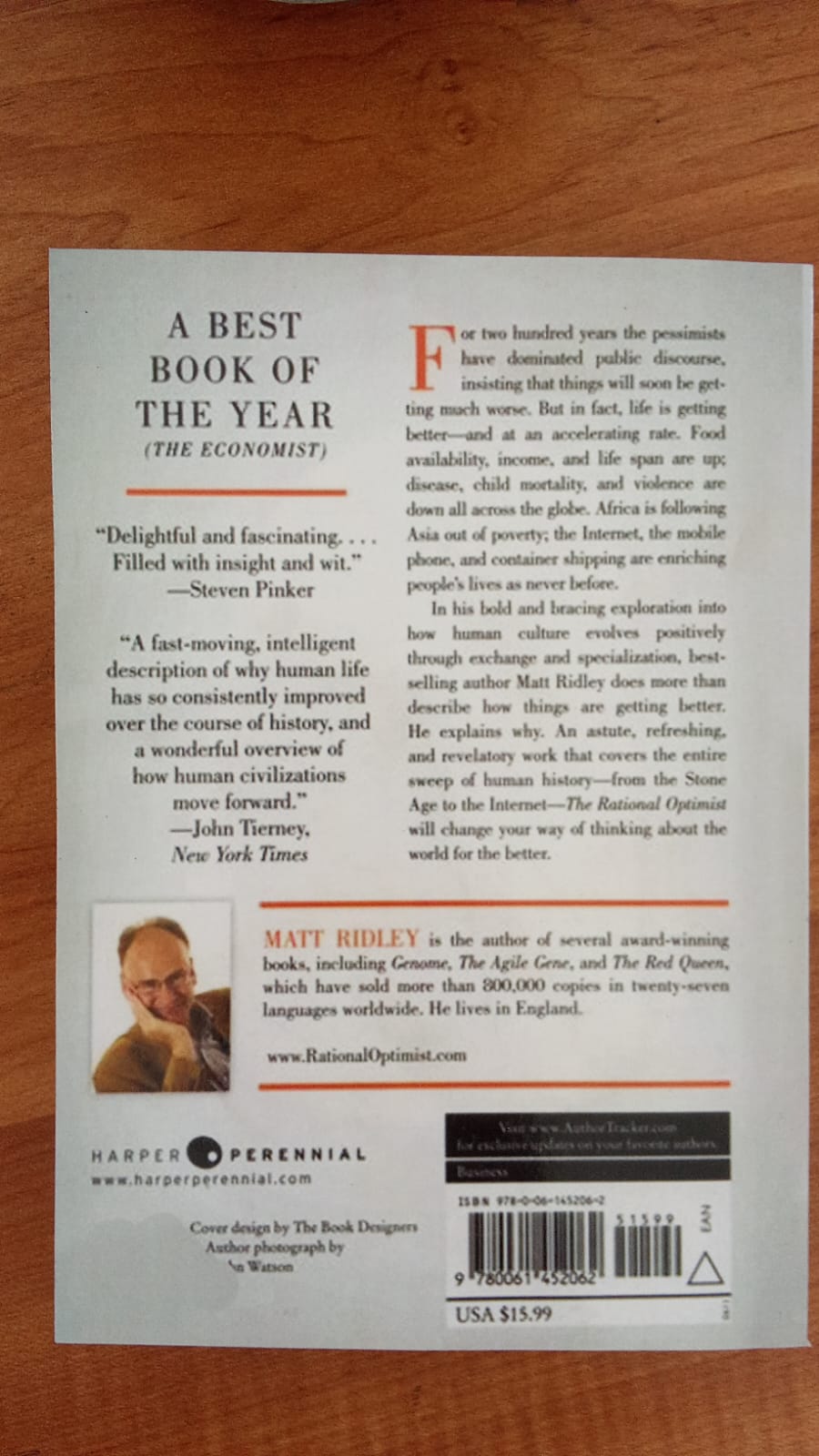
Matt Ridley is a British science writer and author whose books include The Red Queen, Genome, The Origins of Virtue, The Evolution of Everything and How Innovation Works. His official biography describes The Rational Optimist as an argument that living standards rise through the exchange and recombination of ideas.
Edition Note
Several editions exist.
Examples include:
Fourth Estate 2011 edition
ISBN: 9780007267125
Length: 453 pages.
Another HarperCollins edition is listed with ISBN 9780007374816 and 448 pages.
Because page counts and ISBNs differ by edition, use the details printed on your exact physical copy when filling WooCommerce attributes.
Important Themes
The Rational Optimist by Matt Ridley explores human progress, economic growth, trade, specialization, exchange, innovation, technology, entrepreneurship, population, resources, energy, globalization, knowledge, cooperation, competition, collective intelligence, economic history, pessimism, adaptation and the future of prosperity.
7 Powerful Ideas From The Rational Optimist by Matt Ridley
- Exchange allows specialization. People become more productive when they can focus on particular skills and trade for everything else they need.
- Ideas become more valuable when they combine. Innovation often comes from connecting existing discoveries, technologies and business models rather than inventing everything from zero.
- Human progress is cumulative. Each generation can build upon knowledge created by earlier generations, allowing technological capability to accelerate.
- More information about problems does not necessarily mean the world is getting worse. Modern societies often detect and publicize problems more effectively than earlier societies, which can make progress psychologically difficult to see.
- Scarcity can encourage innovation and substitution. When resources become expensive or difficult to access, people gain stronger incentives to use them efficiently or develop alternatives.
- Large networks can become collective brains. Trade, cities, universities and digital communication allow millions of specialized individuals to contribute knowledge that no single person could possess.
- Optimism should be based on problem-solving capacity, not wishful thinking. The strongest case for optimism is not that future problems will be easy, but that humans have repeatedly developed new tools, institutions and ideas when conditions changed.
Why Read The Rational Optimist by Matt Ridley?
The Rational Optimist by Matt Ridley is an excellent choice for readers interested in economic history, innovation, entrepreneurship, technology, global development, human progress, trade and big-picture thinking.
It can be especially useful for readers who enjoy books such as:
Factfulness
Sapiens
Enlightenment Now
How Innovation Works
or other nonfiction books that examine long-term trends rather than daily headlines.
The book may not convince every reader.
That is part of its value.
It presents a strong thesis that encourages you to examine your assumptions about:
Scarcity.
Population.
Innovation.
Technology.
Economic growth.
Human cooperation.
And the future.
Who Should Read This Book?
The Rational Optimist by Matt Ridley may especially appeal to entrepreneurs, business owners, economics students, technology professionals, history readers, investors, policy readers, innovation enthusiasts and anyone interested in whether human civilization is actually progressing despite the constant flow of negative news.
It is especially useful for readers willing to engage critically rather than treating either optimism or pessimism as automatically correct.
The Rational Optimist by Matt Ridley – Why the Future May Be Better Than It Looks
The Rational Optimist by Matt Ridley asks readers to look beyond today’s headlines.
The argument begins with history.
Humans once lived in small groups with limited technology.
Today, billions of people participate in vast networks of exchange.
No individual understands the whole system.
Yet the system can produce:
Medicines.
Aircraft.
Computers.
Food.
Electricity.
Books.
Phones.
Software.
All because people specialize and share knowledge.
That does not make the world perfect.
Far from it.
Humanity still faces enormous challenges.
Climate change.
Disease.
Conflict.
Poverty.
Resource pressures.
Technological risks.
But Ridley argues that describing a problem is not the same as proving it cannot be solved.
History contains countless examples of people changing:
Methods.
Technology.
Institutions.
Energy sources.
Business models.
Behavior.
That ability to adapt makes simple predictions of inevitable catastrophe unreliable.
The deepest lesson of the book is therefore not:
“Everything will definitely be fine.”
It is:
“Do not underestimate what people can create when ideas are allowed to meet.”
A future generation will not attack tomorrow’s problems using only today’s tools.
They will inherit:
Today’s knowledge.
Today’s mistakes.
Today’s technology.
And then add their own ideas.
That compounding process is why Ridley believes prosperity can continue evolving.
For readers interested in economics, technology, innovation, human history and a challenging alternative to constant pessimism, The Rational Optimist by Matt Ridley offers a bold and highly readable argument that humanity’s greatest resource may not be something buried underground.
It may be our ability to cooperate, exchange and invent.
Learn more about The Rational Optimist by Matt Ridley on the official Matt Ridley website.
Explore more economics, science, and personal development books at Bargain Books.
Be the first to review “Rational Optimist by Matt Ridley”
Related products

Out of stock
Non-Fiction & Knowledge
රු1,900.00
3 X Rs. 633.33 or 8% Cashback with
or 3 X රු633.33 with
or up to 4 X රු475.00 with
-28%
Self-Help & Psychology
Original price was: රු1,800.00.රු1,300.00Current price is: රු1,300.00.
3 X Rs. 433.33 or 8% Cashback with
or 3 X රු433.33 with
or up to 4 X රු325.00 with
-24%
Out of stock
Non-Fiction & Knowledge
Original price was: රු2,500.00.රු1,900.00Current price is: රු1,900.00.
3 X Rs. 633.33 or 8% Cashback with
or 3 X රු633.33 with
or up to 4 X රු475.00 with
රු2,000.00
3 X Rs. 666.67 or 8% Cashback with
or 3 X රු666.67 with
or up to 4 X රු500.00 with
-24%
Out of stock
Non-Fiction & Knowledge
Original price was: රු2,100.00.රු1,600.00Current price is: රු1,600.00.
3 X Rs. 533.33 or 8% Cashback with
or 3 X රු533.33 with
or up to 4 X රු400.00 with
Non-Fiction & Knowledge
රු2,250.00
3 X Rs. 750.00 or 8% Cashback with
or 3 X රු750.00 with
or up to 4 X රු562.50 with
Out of stock
Self-Help & Psychology
රු2,200.00
3 X Rs. 733.33 or 8% Cashback with
or 3 X රු733.33 with
or up to 4 X රු550.00 with
Non-Fiction & Knowledge
රු2,450.00
3 X Rs. 816.67 or 8% Cashback with
or 3 X රු816.67 with
or up to 4 X රු612.50 with
Reviews
There are no reviews yet.