
No products in the cart.
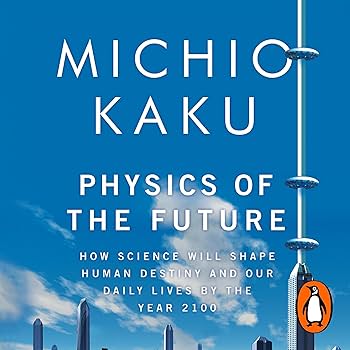
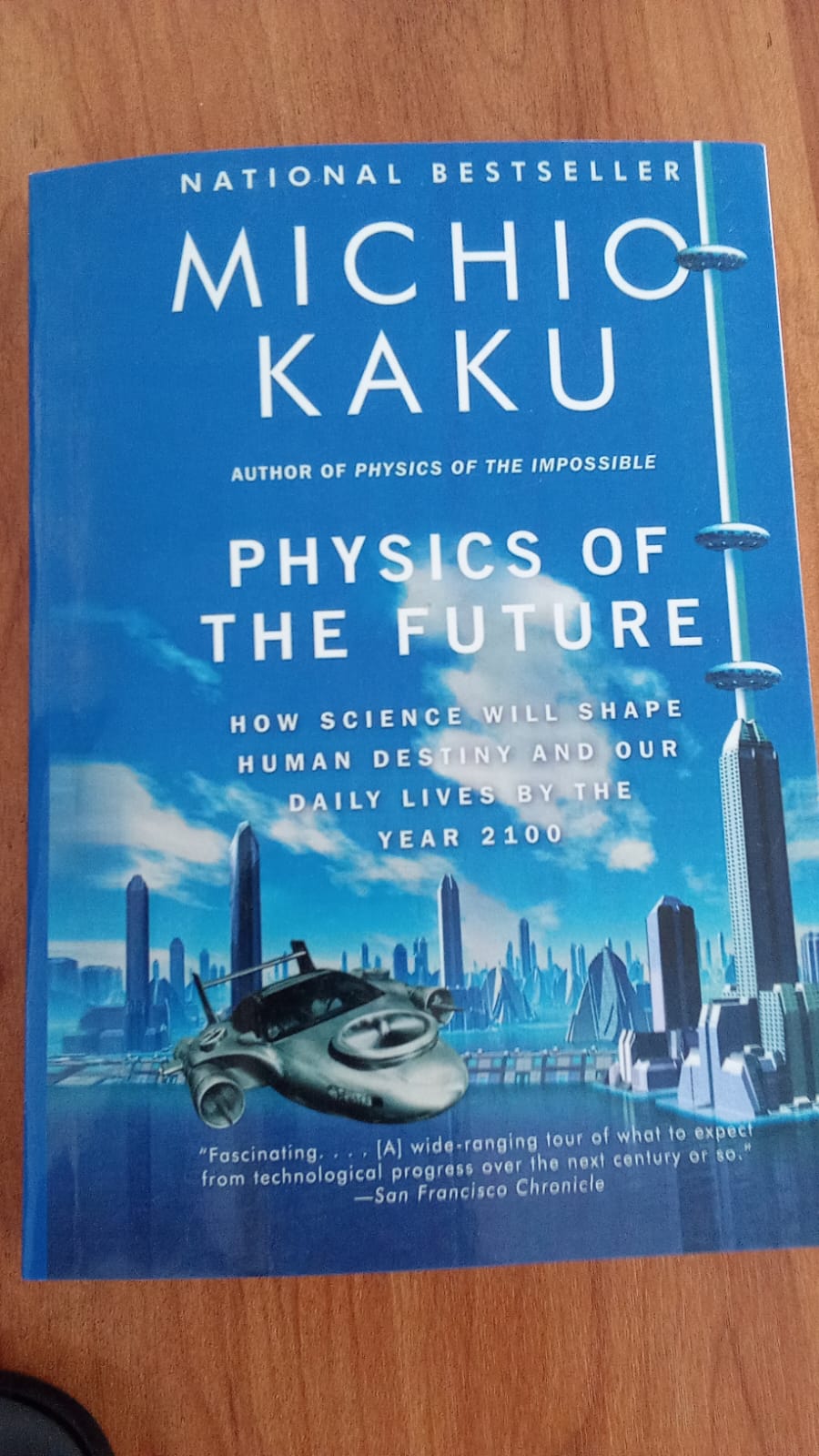
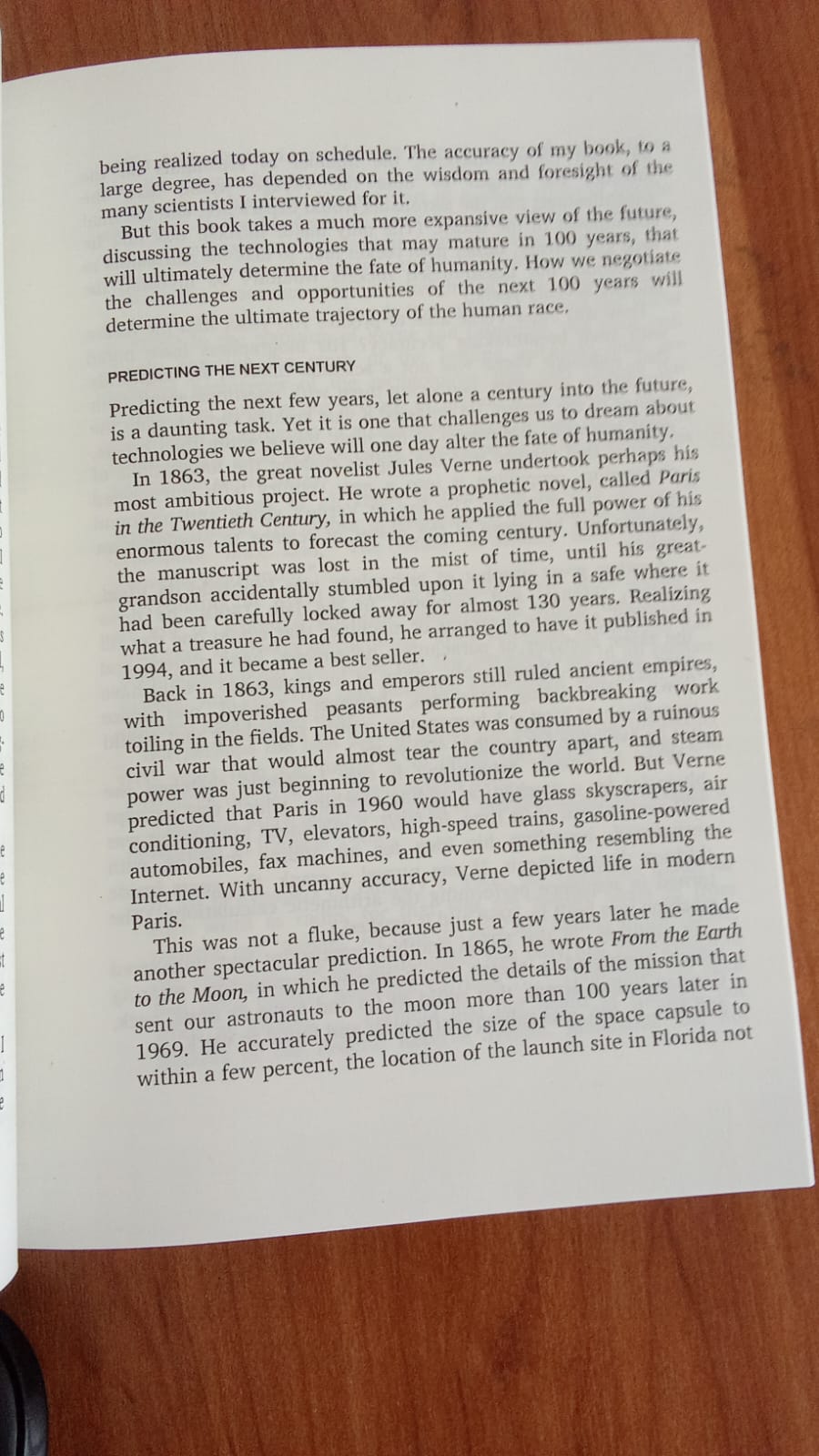
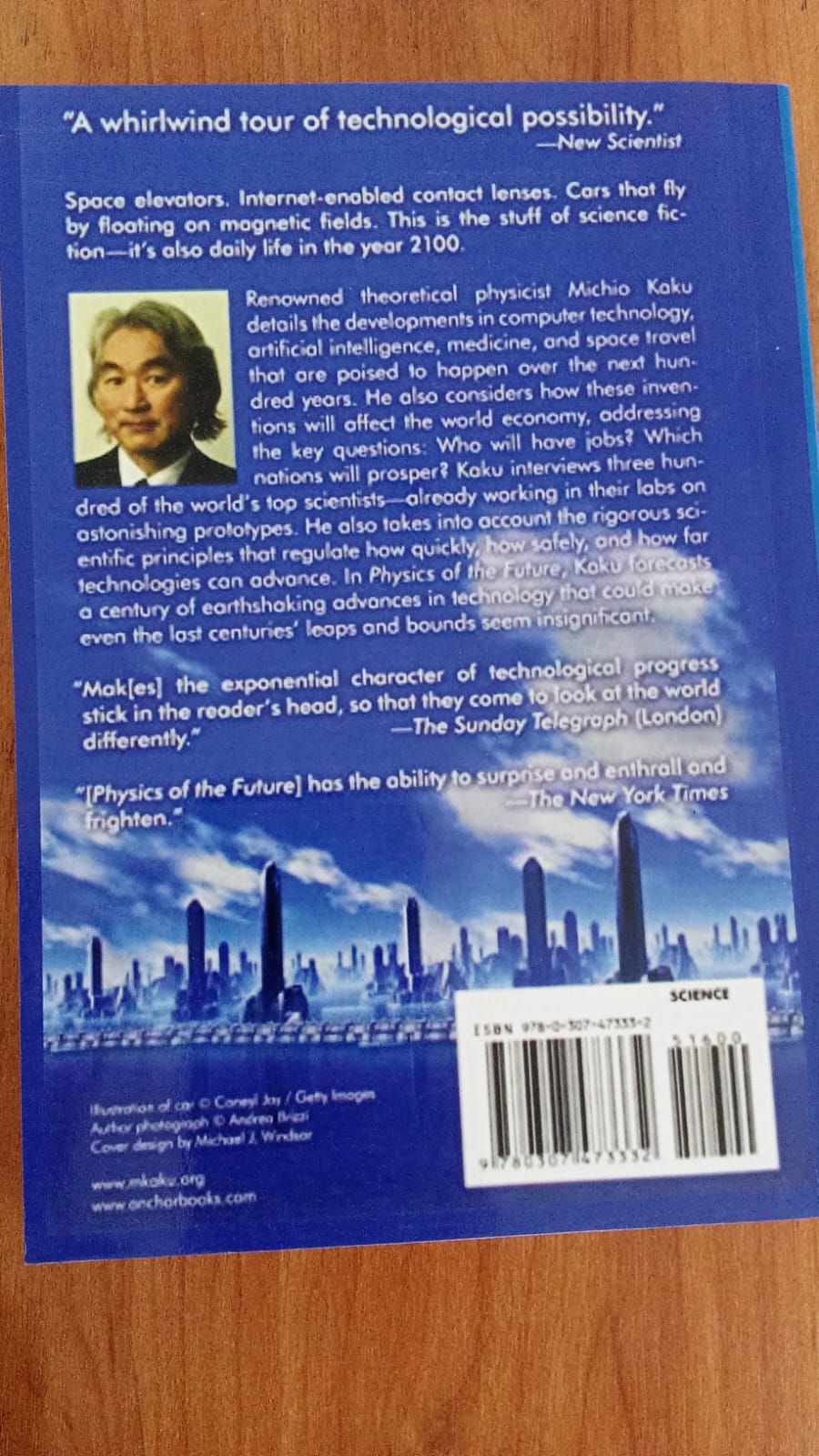


Physics Of The Future by Michio Kaku


රු2,400.00
3 X Rs. 800.00 or 8% Cashback with


or 3 X රු800.00 with


or up to 4 X රු600.00 with


Physics of the Future by Michio Kaku is an eye-opening science book that explores how technology will shape the next 100 years. Covering artificial intelligence, medicine, and space exploration, this insightful read explains future innovations in a simple and engaging way—perfect for anyone curious about how the world will evolve.
4 in stock
Physics of the Future by Michio Kaku is a fascinating journey into the scientific and technological developments that could transform human life during the twenty-first century, from artificial intelligence and advanced medicine to nanotechnology, space travel, robotics and entirely new ways of interacting with computers.
What will everyday life look like in 2050?
What about 2100?
Will computers disappear into our surroundings?
Could doctors use microscopic machines to detect disease inside the body?
Will artificial intelligence become part of ordinary work?
Could humans establish permanent settlements beyond Earth?
And which technologies that currently sound like science fiction might eventually become normal?
Rather than relying purely on imagination, Michio Kaku bases the book on interviews with more than 300 scientists and researchers working at the frontiers of science and technology. Penguin describes the book as a tour through advances in medicine, computers, quantum physics and space travel that could reshape civilization.
The result is an accessible work of popular science that looks toward the year 2100 while explaining the scientific principles behind the possibilities.
Physics of the Future by Michio Kaku – Book Overview
Physics of the Future by Michio Kaku asks readers to imagine a century in which technology becomes increasingly integrated into ordinary life.
Kaku examines areas where scientific research was already progressing when the book was written and asks what might happen if that progress continues.
The book discusses developments in computing, artificial intelligence, medicine, biotechnology, nanotechnology, energy, space exploration and the global economy.
It is not presented as a guarantee that every prediction will happen exactly as described.
Instead, Kaku tries to identify developments supported by real research and then explore where they could lead.
That distinction is important.
A forecast is not the same as a prophecy.
Science Fiction Becoming Science
Many technologies people now consider normal would have sounded impossible to earlier generations.
Smartphones.
Video calls.
GPS navigation.
Instant access to global information.
Robotic surgery.
Reusable rockets.
Modern artificial intelligence.
Kaku uses this pattern to ask which apparently futuristic technologies may become similarly ordinary in the future.
The Future of Computers
One of the major subjects in Physics of the Future by Michio Kaku is computing.
Kaku imagines computers becoming increasingly invisible.
Instead of constantly interacting with a separate machine, computing could become integrated into:
Walls.
Glasses.
Clothing.
Cars.
Homes.
Workplaces.
That general direction is already visible today through smart devices, wearable technology, connected homes and augmented-reality systems.
Computers Everywhere
The earliest computers occupied entire rooms.
Then they moved onto desks.
Then into laptops.
Then into phones.
The next stage may involve computing becoming so widely embedded that people stop thinking of individual devices as “computers.”
Technology may simply become part of the environment.
Smart Glasses and Contact Lenses
Kaku discusses the possibility of receiving information directly through visual interfaces.
Instead of constantly checking a phone, future users could potentially see digital information layered over the physical world.
Today this idea is usually discussed under terms such as:
Augmented reality.
Mixed reality.
Wearable computing.
The exact hardware may change, but the broader idea is already an active area of development.
Artificial Intelligence
Artificial intelligence is one of the areas where Physics of the Future by Michio Kaku feels especially relevant to modern readers.
AI systems can now:
Generate text.
Recognize images.
Translate languages.
Assist with programming.
Create images.
Analyze large datasets.
Recommend content.
Help automate business processes.
The rapid development of AI shows how quickly a technology can move from specialist research into ordinary life.
AI Does Not Automatically Mean Human-Level Intelligence
It is important to distinguish between systems that perform specific tasks and systems possessing broad human-like intelligence.
AI can be extremely powerful while still making mistakes.
It can misunderstand context.
Produce incorrect information.
Reflect weaknesses in its training data.
Technology should therefore be treated as a tool requiring human judgment rather than as an automatically perfect source of truth.
Robots
Kaku also considers the future of robotics.
Robots may become increasingly useful in environments involving:
Factories.
Warehouses.
Hospitals.
Disaster zones.
Homes.
Space exploration.
Rather than imagining robots only as human-shaped machines, the more useful question is often:
What task needs to be automated?
A robot designed for surgery may look nothing like a household robot.
A warehouse robot may look nothing like a Mars rover.
Humans and Machines
The most realistic future may not involve humans simply being replaced by machines.
Instead, many professions may involve humans working alongside increasingly capable software and robotics.
A doctor may use AI-assisted diagnostics.
An engineer may use automated design tools.
A teacher may use personalized learning software.
A programmer may work with AI coding assistants.
The important question becomes how humans adapt.
The Future of Medicine
Medicine is another major subject in Physics of the Future by Michio Kaku.
Kaku examines how advances in:
Genetics.
Imaging.
Stem cells.
Biotechnology.
Nanotechnology.
Computing.
could change the way diseases are detected and treated.
Earlier Detection
One of medicine’s biggest advantages often comes from detecting problems before they become severe.
Future health systems may increasingly combine:
Genetic information.
Continuous monitoring.
Advanced imaging.
AI analysis.
Biomarkers.
to identify risks earlier.
The broader movement is toward medicine becoming more predictive and personalized.
Personalized Medicine
Traditional medicine often treats people using broad categories.
But two patients with apparently similar conditions may respond differently because of:
Genetics.
Age.
Environment.
Lifestyle.
Other illnesses.
Future medicine may become increasingly tailored to individual biology.
Genetics
The ability to analyze DNA has improved dramatically.
Genetic information can already help researchers understand certain inherited disorders and disease risks.
Kaku explores the possibility that greater understanding of the genome may lead to increasingly sophisticated medical treatments.
However, genetics also raises difficult ethical questions.
Who owns genetic data?
Who should access it?
Could employers or insurers misuse it?
Scientific capability must be accompanied by responsible rules.
Stem Cells and Regenerative Medicine
Regenerative medicine asks whether damaged tissues or organs can eventually be repaired or replaced.
The possibility of using stem cells to restore damaged biological structures could transform treatment for some conditions.
This is one of many areas where Physics of the Future by Michio Kaku demonstrates how medicine may shift from simply managing disease toward repairing the body.
Nanotechnology
Nanotechnology works at incredibly small scales.
Kaku explores ideas such as microscopic devices capable of interacting with the human body.
In a highly advanced future, tiny systems might potentially help:
Detect disease.
Deliver medication.
Monitor biological processes.
Assist diagnosis.
Some ideas remain highly speculative, but nanomedicine continues to be an important research area.
Technology Inside the Body
The boundary between medical device and human body may become increasingly blurred.
We already have technologies such as:
Pacemakers.
Cochlear implants.
Artificial joints.
Advanced prosthetics.
Continuous glucose monitors.
Future versions may become much more sophisticated.
This raises an interesting question:
At what point does technology stop feeling external and simply become part of the person?
Brain-Computer Interfaces
Kaku also considers technology capable of linking computers more directly with the human brain.
Researchers have explored brain-computer interfaces for applications including helping people with paralysis communicate or control devices.
The potential is enormous.
So are the ethical questions.
If neural technologies become more capable, societies will need to consider privacy at an entirely new level.
Your browsing history is private.
Your thoughts are even more private.
The Future of Transportation
Transportation has repeatedly transformed civilization.
Ships expanded trade.
Railways connected cities.
Automobiles reshaped everyday life.
Airplanes compressed global distance.
Future transportation may again change how people understand location.
Kaku considers technologies ranging from advanced vehicles to more ambitious concepts involving magnetic systems and space travel.
Autonomous Vehicles
Self-driving technology illustrates how transportation can become an information problem as much as a mechanical one.
A vehicle must understand:
Roads.
Other vehicles.
Pedestrians.
Weather.
Unexpected events.
The difficult part is not simply making the car move.
It is making reliable decisions in a complicated real environment.
Energy
Future technology depends heavily on energy.
More computing.
More industry.
More transportation.
More infrastructure.
All require power.
Physics of the Future by Michio Kaku explores possible developments in energy technologies and the need for systems capable of supporting advanced civilization.
Renewable Energy
Solar and wind power have become increasingly important in global electricity systems.
Energy storage has also become a major challenge because renewable generation can vary with conditions.
The future of energy will likely involve combinations of:
Generation.
Storage.
Transmission.
Efficiency.
Grid management.
The transition is not merely about inventing one perfect technology.
It is about building entire systems.
Nuclear Technology
Nuclear energy remains one of the most debated technologies.
It can produce large quantities of low-carbon electricity, but concerns include:
Cost.
Waste.
Safety.
Construction time.
Public acceptance.
Future advances could change these trade-offs, but policy and economics matter alongside physics.
Fusion
Nuclear fusion has long represented one of the most exciting possibilities in energy research.
Fusion powers the Sun.
Scientists have spent decades trying to create controlled fusion systems capable of producing practical energy on Earth.
Progress has occurred, but commercially useful fusion remains an engineering challenge.
This is a useful reminder that scientific possibility and practical deployment are not the same thing.
Space Travel
Space is one of the most exciting sections of Physics of the Future by Michio Kaku.
Humanity has already:
Landed people on the Moon.
Sent robotic spacecraft across the Solar System.
Operated space stations.
Landed rovers on Mars.
Observed extremely distant galaxies.
The next question is how far humans themselves will go.
Returning to the Moon
The Moon may play an important role in future space exploration.
Potential uses include:
Scientific research.
Technology testing.
Long-duration habitation experiments.
Preparation for deeper-space missions.
The Moon is much closer than Mars, making it a natural location for testing technologies needed for long-term human presence beyond Earth.
Mars
Mars remains one of the most discussed destinations for future human exploration.
But visiting Mars is extremely difficult.
Challenges include:
Radiation.
Distance.
Life support.
Launch mass.
Medical emergencies.
Psychological isolation.
Returning safely.
A Mars settlement would be an extraordinary engineering achievement, not simply a longer version of an ordinary flight.
Space Tourism
Commercial companies have already helped shift spaceflight away from being exclusively government-controlled.
Space tourism may gradually expand, though cost and risk remain major limitations.
As technology improves, activities once available only to professional astronauts may become accessible to more people.
Space Elevators
One of the more spectacular possibilities discussed in popular future science is a space elevator.
The concept involves extending an extremely strong cable from Earth toward space so payloads could travel upward without conventional rockets.
The physics is intriguing.
The material requirements are extraordinarily demanding.
This is a good example of the difference between:
A concept allowed by physical principles
and
a technology we currently know how to build economically.
The Future of Wealth
Technology does not affect only science.
It changes economies.
When machines become more capable, some jobs disappear.
Others change.
New industries appear.
The Industrial Revolution created huge economic growth but also disrupted existing forms of work.
AI and automation may create another period of major transition.
Which Jobs Will Survive?
Kaku examines how automation could affect employment.
Jobs based entirely on repetitive rules may be easier to automate.
Roles involving combinations of:
Human judgment.
Creativity.
Leadership.
Trust.
Complex interpersonal interaction.
Unpredictable environments.
may be more difficult to automate completely.
But even these jobs may change through AI assistance.
Education and Lifelong Learning
If technology changes quickly, education cannot end at graduation.
People may need to learn repeatedly throughout their careers.
A skill that is valuable today may become less valuable.
A completely new profession may appear.
Adaptability becomes economically important.
Knowledge Workers
Technology can increase the productivity of people who work with information.
Writers.
Developers.
Researchers.
Managers.
Designers.
Analysts.
AI may automate portions of their work while also enabling one person to accomplish tasks that once required much larger teams.
That creates both opportunity and disruption.
Winners and Losers
Technological progress is not automatically distributed equally.
A new technology can create enormous wealth while also disrupting industries.
The people who own:
Platforms.
Intellectual property.
Data.
Infrastructure.
Capital.
may gain disproportionate benefits.
Therefore the future of technology is also a question about economics and inequality.
Science and Society
One of the most useful aspects of Physics of the Future by Michio Kaku is that science does not exist independently of society.
A technology can be physically possible but still fail because of:
Cost.
Regulation.
Culture.
Ethics.
Politics.
Consumer resistance.
Infrastructure.
This is why forecasting is so difficult.
Technology Is Not Destiny
Scientific progress creates possibilities.
Humans decide how those possibilities are used.
Artificial intelligence can help discover medicines.
It can also generate misinformation.
Genetic technology can help treat disease.
It may also create privacy concerns.
Surveillance technology can improve security.
It can also threaten freedom.
Tools do not automatically decide the values of the society using them.
Predictions Versus Guarantees
Readers should keep one important point in mind.
Physics of the Future by Michio Kaku was originally published in the early 2010s.
Technology has already changed considerably since then.
Some developments Kaku discusses have progressed quickly.
Others remain experimental.
Some may take much longer than predicted.
Others may never become practical.
That does not make the book useless.
In fact, it creates another fascinating reading experience:
You can compare earlier scientific forecasts with the world developing around us today.
Forecasting Is Extremely Difficult
Future technology depends on more than scientific discovery.
A breakthrough may exist in a laboratory but take decades to become affordable.
Another technology may suddenly accelerate because several innovations become available simultaneously.
For example:
Better processors.
Cheaper sensors.
Larger datasets.
Improved algorithms.
Cloud computing.
Together can produce developments much faster than any one technology could alone.
Exponential Change
One reason the future can surprise us is that technological progress is not always linear.
Humans naturally imagine tomorrow by extending today’s rate of change.
But technologies can improve rapidly once they pass certain thresholds.
That helps explain why fields such as computing and AI sometimes appear to accelerate suddenly.
Why Physics Matters
Kaku is a theoretical physicist, and physics provides the boundaries within which technology must operate.
An idea may sound exciting.
But does it violate known physical laws?
If it does, the probability of building it becomes extremely low.
If physics allows it, the next questions become:
Can engineers build it?
Can it become affordable?
Can society use it safely?
Science Fiction as Inspiration
Science fiction has often imagined technologies before engineers created practical versions.
Satellites.
Robots.
Video communication.
Advanced computers.
That does not mean science fiction predicts the future perfectly.
Its value is partly that it encourages people to imagine possibilities.
Curiosity
The strongest feeling produced by Physics of the Future by Michio Kaku is curiosity.
What comes next?
That question has driven science for centuries.
Why does this happen?
Can this be improved?
What would happen if we tried this?
Could something currently impossible become possible with a new discovery?
Curiosity is the beginning of innovation.
Optimism With Caution
Kaku’s approach is generally optimistic about scientific progress.
He presents technology as capable of solving enormous problems.
But modern readers should balance technological optimism with awareness of:
Environmental impact.
Inequality.
Privacy.
Security.
Ethical questions.
Scientific power becomes most useful when paired with responsible judgment.
Is Physics of the Future a Physics Textbook?
No.
Despite the title, Physics of the Future by Michio Kaku is not a university physics textbook.
You do not need to solve equations.
It is popular science written for general readers.
Kaku explains ideas through stories, examples and predictions rather than mathematical derivations.
Do You Need a Science Background?
No.
The book is designed for general readers interested in science and technology.
You may encounter advanced concepts, but they are presented at an accessible level.
This makes the book suitable for readers who enjoy science without having formal scientific training.
Is It Still Worth Reading Today?
Yes, particularly if you read it as both a future-science book and a historical forecast.
Because the book was written more than a decade ago, readers can ask:
Which predictions are already beginning to happen?
Which remain distant?
Which developed differently?
That comparison makes the book unusually interesting in the 2020s.
Is It About AI?
AI is one important part of the book, but Physics of the Future by Michio Kaku is much broader.
It covers computing, medicine, biotechnology, nanotechnology, energy, space exploration and economic change.
Readers looking only for a modern AI book may want something more recent.
Readers who want a broad scientific picture of the twenty-first century will find much more here.
Michio Kaku
Michio Kaku is a theoretical physicist, science communicator and professor at the City University of New York. Penguin identifies him as a co-founder of string field theory and the author of popular science books including Hyperspace, Parallel Worlds, Physics of the Impossible, Physics of the Future and The God Equation.
His strength as a writer lies in making very large scientific ideas understandable to readers outside specialist research.
Your BookLounge Edition
Your BookLounge records show the full title Physics of the Future: How Science Will Shape Human Destiny and Our Daily Lives by the Year 2100 by Michio Kaku, product code 10313.
The associated BookLounge product imagery uses 9780141044248, and Penguin confirms that exact ISBN for its paperback edition.
For that edition:
Author: Michio Kaku
Publisher/Imprint: Penguin
ISBN-13: 9780141044248
Format: Paperback
Pages: 416
Publication: 2012
Important Themes
Physics of the Future by Michio Kaku explores artificial intelligence, computing, robotics, medicine, genetics, biotechnology, nanotechnology, brain-computer interfaces, energy, transportation, space exploration, automation, employment, wealth, technological change, scientific innovation and humanity’s future.
7 Powerful Predictions From Physics of the Future by Michio Kaku
- Computing will become increasingly invisible. Rather than thinking of computers only as separate machines, digital intelligence may become embedded throughout homes, workplaces, clothing, vehicles and visual interfaces.
- Artificial intelligence will become part of everyday work. AI and robotics may automate many routine tasks while creating new forms of human-machine collaboration.
- Medicine will become increasingly personalized and predictive. Genetics, advanced diagnostics, biotechnology and continuous monitoring could allow doctors to identify some health risks earlier and tailor treatment more closely to individuals.
- Humans may increasingly merge with technology. Advanced prosthetics, implanted devices, brain-computer interfaces and other technologies may reduce the traditional boundary between biological and technological systems.
- Space will become increasingly commercial. Governments may no longer dominate every aspect of space exploration as private companies expand launches, satellites, tourism and potentially deeper-space infrastructure.
- Automation will transform the economy. Some jobs may disappear or change dramatically while new professions emerge, making lifelong learning and adaptability increasingly important.
- Scientific possibility does not guarantee social success. Even if physics allows a technology, economics, ethics, politics, infrastructure and human behavior ultimately influence whether it becomes part of ordinary life.
Why Read Physics of the Future by Michio Kaku?
Physics of the Future by Michio Kaku is an excellent choice for readers interested in science, technology, AI, robotics, future studies, medicine, biotechnology, nanotechnology, space travel, computing and innovation.
It is particularly enjoyable for readers who constantly ask:
What will the world look like in fifty years?
Which technologies that sound impossible today may eventually become normal?
How will AI change work?
Could medicine prevent diseases before symptoms appear?
Will humans live beyond Earth?
What professions will survive automation?
And how will technology change what it means to be human?
This book does not provide certain answers.
Nobody can.
Instead, it provides scientifically informed possibilities.
That is what makes future thinking valuable.
The purpose is not simply predicting exactly what will happen.
It is understanding the forces capable of shaping what happens next.
Who Should Read This Book?
Physics of the Future by Michio Kaku may especially appeal to science enthusiasts, technology professionals, software developers, engineering students, entrepreneurs, innovators, AI enthusiasts, science-fiction readers, university students and anyone curious about how scientific research may influence the world by 2100.
Because it is written as popular science rather than a technical textbook, readers do not need advanced knowledge of physics.
Physics of the Future by Michio Kaku – What Will Life Look Like in 2100?
Physics of the Future by Michio Kaku asks readers to imagine something extremely difficult:
A world almost a century ahead.
Imagine explaining today’s world to someone living in 1910.
A small object in your pocket can:
Access billions of pages of information.
Show your exact location.
Translate languages.
Capture high-resolution video.
Communicate instantly across the planet.
Use artificial intelligence.
That person might reasonably think you were describing magic.
Yet every one of those technologies follows physical laws.
That is the foundation of Kaku’s approach.
Instead of asking:
“What impossible thing would be entertaining?”
he asks:
“What extraordinary thing might become possible if technologies already being researched continue developing?”
The result is a future containing intelligent machines, increasingly sophisticated medicine, new forms of human-computer interaction, advanced space exploration and technologies that could fundamentally change ordinary life.
Some predictions will almost certainly be wrong.
That is unavoidable.
History rarely develops exactly according to forecasts.
But that uncertainty is part of the fascination.
Reading the book today allows us to watch the race between prediction and reality.
Artificial intelligence has already moved rapidly.
Private spaceflight has expanded.
Genetic technology has advanced.
Wearable computing has grown.
Brain-computer interfaces are being actively researched.
Other ideas remain much further away.
The future is therefore neither exactly what Kaku predicted nor completely disconnected from his vision.
It is being built gradually through:
Laboratories.
Universities.
Startups.
Governments.
Engineering teams.
Scientific experiments.
And millions of small innovations.
For readers who want to understand the scientific ideas that may shape the coming decades, Physics of the Future by Michio Kaku offers an accessible, imaginative and thought-provoking tour of the technologies that could transform human civilization.
Learn more about Physics of the Future by Michio Kaku on the official Michio Kaku website.
Explore more science and technology books at Bargain Books.
Be the first to review “Physics Of The Future by Michio Kaku”
Related products
-19%

Out of stock
Non-Fiction & Knowledge
Original price was: රු2,650.00.රු2,150.00Current price is: රු2,150.00.
3 X Rs. 716.67 or 8% Cashback with
or 3 X රු716.67 with
or up to 4 X රු537.50 with
-29%

Self-Help & Psychology
Original price was: රු1,750.00.රු1,250.00Current price is: රු1,250.00.
3 X Rs. 416.67 or 8% Cashback with
or 3 X රු416.67 with
or up to 4 X රු312.50 with

Out of stock
Non-Fiction & Knowledge
රු1,900.00
3 X Rs. 633.33 or 8% Cashback with
or 3 X රු633.33 with
or up to 4 X රු475.00 with

Non-Fiction & Knowledge
රු1,950.00
3 X Rs. 650.00 or 8% Cashback with
or 3 X රු650.00 with
or up to 4 X රු487.50 with

Out of stock
Self-Help & Psychology
රු1,500.00
3 X Rs. 500.00 or 8% Cashback with
or 3 X රු500.00 with
or up to 4 X රු375.00 with
-28%

Self-Help & Psychology
Original price was: රු1,800.00.රු1,300.00Current price is: රු1,300.00.
3 X Rs. 433.33 or 8% Cashback with
or 3 X රු433.33 with
or up to 4 X රු325.00 with

Out of stock
Self-Help & Psychology
රු1,900.00
3 X Rs. 633.33 or 8% Cashback with
or 3 X රු633.33 with
or up to 4 X රු475.00 with

Out of stock
Autobiography
රු2,750.00
3 X Rs. 916.67 or 8% Cashback with
or 3 X රු916.67 with
or up to 4 X රු687.50 with
Reviews
There are no reviews yet.