
No products in the cart.
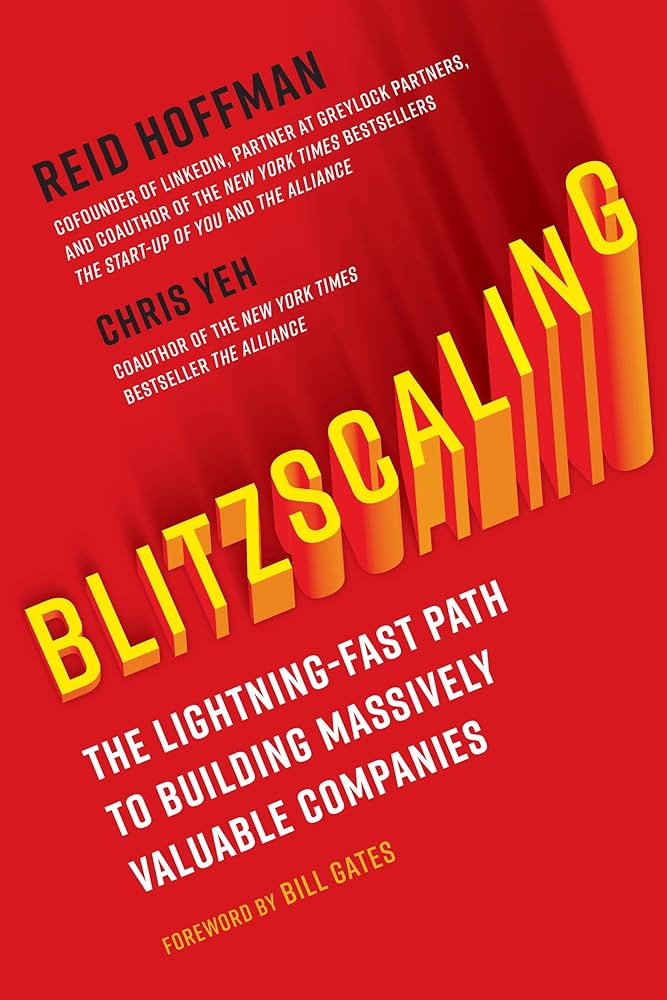












Blitzscaling by Reid Hoffman and Chris Yeh
Blitzscaling by Reid Hoffman and Chris Yeh is a business and entrepreneurship book about building companies at extraordinary speed.
The authors describe blitzscaling as a set of practices for managing rapid growth while operating in uncertain conditions.
Instead of always focusing on maximum efficiency, the approach can require companies to prioritize speed when being first to achieve scale offers an important competitive advantage.
Why Read Blitzscaling?
Blitzscaling is especially useful for entrepreneurs, startup founders, managers, business students, and leaders interested in rapid company growth.
The book explores how businesses can move from startup to scale-up while dealing with major changes in strategy, management, organization, and business models.
It also examines the challenges that appear when a company grows faster than its existing systems can comfortably handle.
Speed Over Efficiency
Traditional businesses often try to grow carefully.
They improve processes.
They reduce waste.
They aim for efficiency.
Blitzscaling takes a different approach in certain situations.
When a market is developing quickly, moving faster than competitors may become more important than operating perfectly.
The authors describe this as prioritizing speed over efficiency while uncertainty remains high.
From Startup to Scale-Up
A small startup can operate informally.
A few people may make most decisions.
Communication is simple.
Processes can remain flexible.
But rapid growth changes everything.
More customers arrive.
More employees need to be hired.
New departments appear.
Infrastructure becomes more complicated.
Blitzscaling examines how management needs to change as a company moves through different levels of scale.
Business Model Innovation
Fast growth requires more than a popular product.
The underlying business model must support expansion.
The book includes dedicated discussion of business model innovation, growth factors, growth limiters, and the principles that allow a company to expand quickly.
A business that grows demand faster than it can serve customers may create serious problems.
Scalability therefore matters.
Growth Creates New Problems
Growth sounds positive.
But growth can also create pressure.
Hiring becomes harder.
Communication becomes slower.
Quality can become inconsistent.
Management responsibilities change.
Systems that worked for fifty employees may fail when the company reaches five hundred.
The official book description emphasizes the management challenges that appear as organizations grow rapidly.
Leadership Must Change
Leadership at a small startup is different from leadership at a large company.
A founder may initially be involved in almost every decision.
That becomes impossible as the company expands.
The book specifically examines how the founder’s role changes at different stages and the organizational transitions required during rapid growth.
Good leaders must learn when to delegate.
They also need to build teams capable of making decisions without constant founder involvement.
Strategy Changes With Scale
Blitzscaling emphasizes that a strategy suitable for one stage of growth may not work at the next stage.
A startup searching for product-market fit has different priorities from a company already serving millions of customers.
As the organization grows, strategy must evolve.
The authors discuss necessary strategic shifts at each level of scale.
Competition and Market Leadership
Rapid growth can be particularly important when markets reward the company that achieves scale first.
Network effects, customer habits, distribution advantages, and brand recognition can make a larger competitor increasingly difficult to challenge.
In those situations, growing slowly may create its own risk.
The goal of blitzscaling is therefore not simply growth for the sake of growth.
It is rapid growth when speed can create lasting market leadership.
Efficiency Still Matters
The book does not suggest that businesses should remain inefficient forever.
Rapid scaling is appropriate only under certain conditions.
Eventually, organizations need sustainable systems, stronger processes, financial discipline, and operational stability.
Google Books lists a dedicated section titled “When Should I Stop Blitzscaling?”, showing that the authors explicitly address when the approach should end.
Managing Uncertainty
Uncertainty is unavoidable in startups.
Founders may not know exactly how large a market will become.
Customer behaviour can change.
Competitors may appear unexpectedly.
Technology can shift quickly.
Blitzscaling offers a framework for making growth decisions even when complete information is unavailable.
The goal is not to eliminate uncertainty.
It is to manage it while preserving enough speed to capture opportunity.
Counterintuitive Rules
Some rapid-growth practices can appear uncomfortable to traditional managers.
The book includes nine counterintuitive rules of blitzscaling, along with discussions of business-model innovation, strategy innovation, organizational transitions, and responsible scaling.
These ideas encourage leaders to reconsider assumptions about how quickly organizations should become perfectly structured.
Learning From Major Companies
The book uses case studies to explain how companies achieved rapid growth.
Google Books specifically notes examples including companies such as Airbnb and WeChat, while the official site describes the framework as drawing on the authors’ experience scaling startups into billion-dollar businesses.
These case studies help turn abstract growth principles into practical business examples.
7 Powerful Lessons from Blitzscaling
- Speed can become a competitive advantage. In certain markets, reaching scale first can matter enormously.
- Rapid growth requires a scalable business model. Demand alone is not enough.
- Management must evolve with company size. What works for a startup may fail at scale.
- Efficiency is not always the first priority. Sometimes controlled inefficiency is accepted temporarily to gain speed.
- Founders must change their role. Growth requires delegation and stronger management systems.
- Strategy must evolve continually. Each stage of growth creates different challenges.
- Know when to stop blitzscaling. Companies eventually need to shift toward sustainability and operational efficiency.
About Reid Hoffman and Chris Yeh
Reid Hoffman and Chris Yeh co-authored Blitzscaling after previously working together on The Alliance. The official book site describes Hoffman as a LinkedIn co-founder and investor, while Yeh is an entrepreneur, writer, and mentor.
Their backgrounds in entrepreneurship, investing, and scaling companies form the basis for many of the book’s ideas.
Book Details
Google Books lists a HarperCollins edition published in 2018 with 320 pages and ISBN 9780008303655.
Check the ISBN and page count printed on your physical copy before entering edition-specific WooCommerce details.
Perfect for Readers Interested In
Blitzscaling is a strong choice for readers interested in business strategy, entrepreneurship, startups, leadership, innovation, business growth, venture capital, company management, competitive strategy, scaling, and technology businesses.
It is especially useful for readers interested in understanding how companies move from small startups to large organizations.
Buy Blitzscaling in Sri Lanka
Looking for Blitzscaling in Sri Lanka?
Reid Hoffman and Chris Yeh’s business guide is an excellent choice for entrepreneurs, managers, founders, and business readers interested in rapid growth, strategy, innovation, leadership, competition, and scaling companies.
Learn how organizations can prioritize speed, adapt their management practices, and navigate the challenges of rapid growth.
Add Blitzscaling to your business and entrepreneurship collection today.
Be the first to review “Blitzscaling by Reid Hoffman”
Related products

Out of stock
Self-Help & Psychology
රු1,500.00
3 X Rs. 500.00 or 8% Cashback with


or 3 X රු500.00 with


or up to 4 X රු375.00 with


Non-Fiction & Knowledge
රු2,250.00
3 X Rs. 750.00 or 8% Cashback with
or 3 X රු750.00 with
or up to 4 X රු562.50 with
-34%

Self-Help & Psychology
Original price was: රු2,350.00.රු1,550.00Current price is: රු1,550.00.
3 X Rs. 516.67 or 8% Cashback with
or 3 X රු516.67 with
or up to 4 X රු387.50 with
-39%

Out of stock
Self-Help & Psychology
Original price was: රු2,450.00.රු1,500.00Current price is: රු1,500.00.
3 X Rs. 500.00 or 8% Cashback with
or 3 X රු500.00 with
or up to 4 X රු375.00 with

Out of stock
Non-Fiction & Knowledge
රු1,500.00
3 X Rs. 500.00 or 8% Cashback with
or 3 X රු500.00 with
or up to 4 X රු375.00 with
-13%

Out of stock
Non-Fiction & Knowledge
Original price was: රු3,900.00.රු3,400.00Current price is: රු3,400.00.
3 X Rs. 1,133.33 or 8% Cashback with
or 3 X රු1,133.33 with
or up to 4 X රු850.00 with

Non-Fiction & Knowledge
රු1,950.00
3 X Rs. 650.00 or 8% Cashback with
or 3 X රු650.00 with
or up to 4 X රු487.50 with

Out of stock
Self-Help & Psychology
රු2,200.00
3 X Rs. 733.33 or 8% Cashback with
or 3 X රු733.33 with
or up to 4 X රු550.00 with
Reviews
There are no reviews yet.