
No products in the cart.







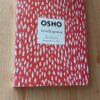
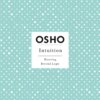
Intelligence: The Creative Response to Now (Osho Insights for a New Way of Living) by Osho
රු900.00
3 X Rs. 300.00 or 8% Cashback with


or 3 X රු300.00 with


or up to 4 X රු225.00 with


Book Details / WooCommerce
| Field | Enter This |
|---|---|
| Title | Intelligence: The Creative Response to Now |
| Author | Osho |
| ISBN-13 | 9780312320720 |
| ISBN-10 | 0312320728 |
| Series | Osho Insights for a New Way of Living |
| Series Position | 8 |
| Format | Trade Paperback |
| Publisher | St. Martin’s Publishing Group |
| Imprint | St. Martin’s Griffin / currently catalogued by St. Martin’s Essentials |
| Publication Date | 1 June 2004 |
| Pages | 208 |
| Language | English |
| Audience | Adult / General |
| Genre | Self-Help / Spirituality / Personal Development |
| Weight | Approx. 0.270 kg |
| Length | Approx. 21.3 cm |
| Width | Approx. 14.0 cm |
| Height / Thickness | Approx. 1.3 cm |
| Dimensions | Approx. 21.3 × 14.0 × 1.3 cm |
1 in stock
A Different Way of Thinking About Intelligence
Intelligence: The Creative Response to Now by Osho is a reflective work of spirituality and personal development exploring the difference between intellect and intelligence.
Part of the bestselling Osho Insights for a New Way of Living series, the book challenges the idea that intelligence is simply the ability to memorise information, perform well academically or solve problems through logic.
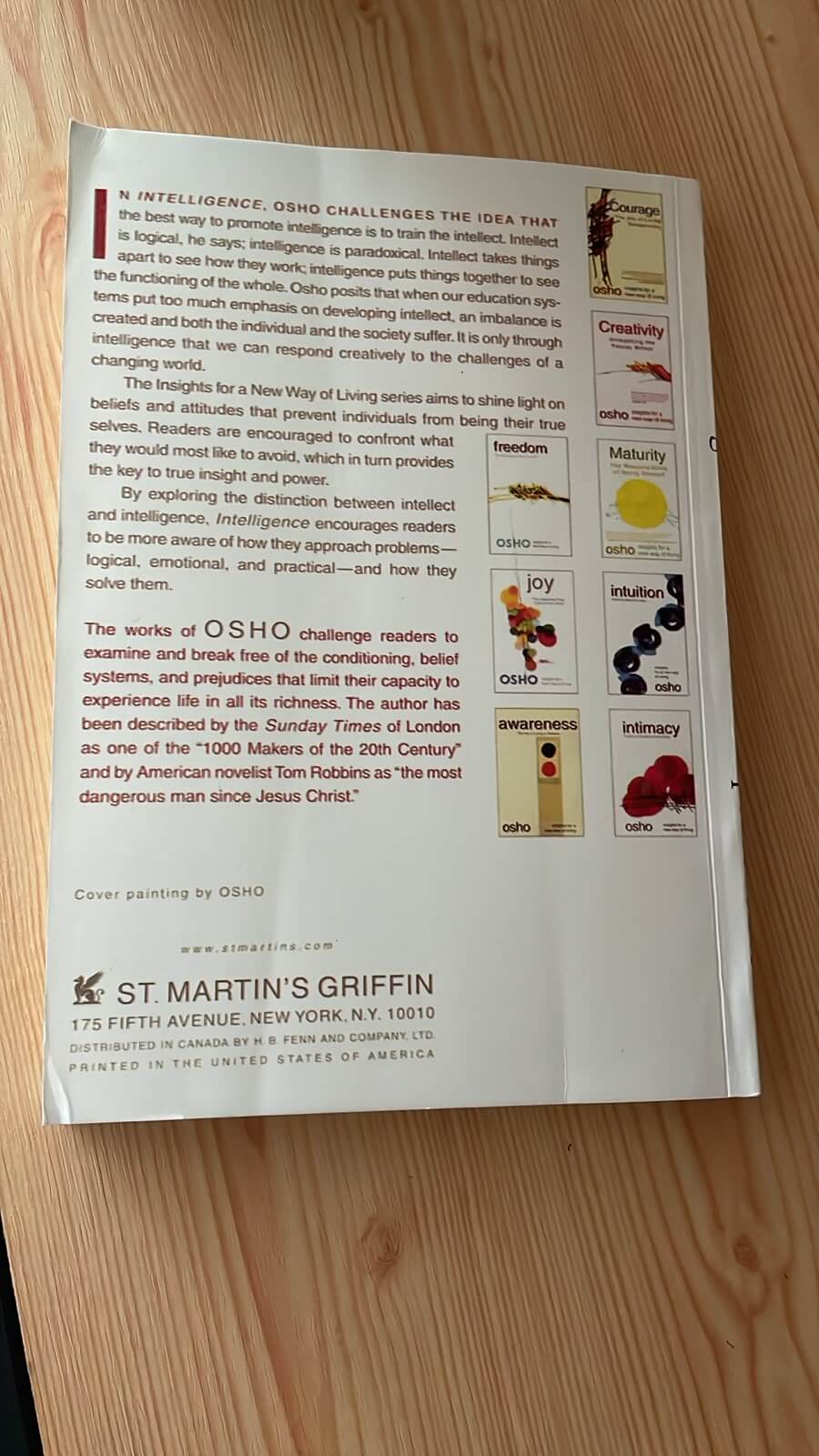
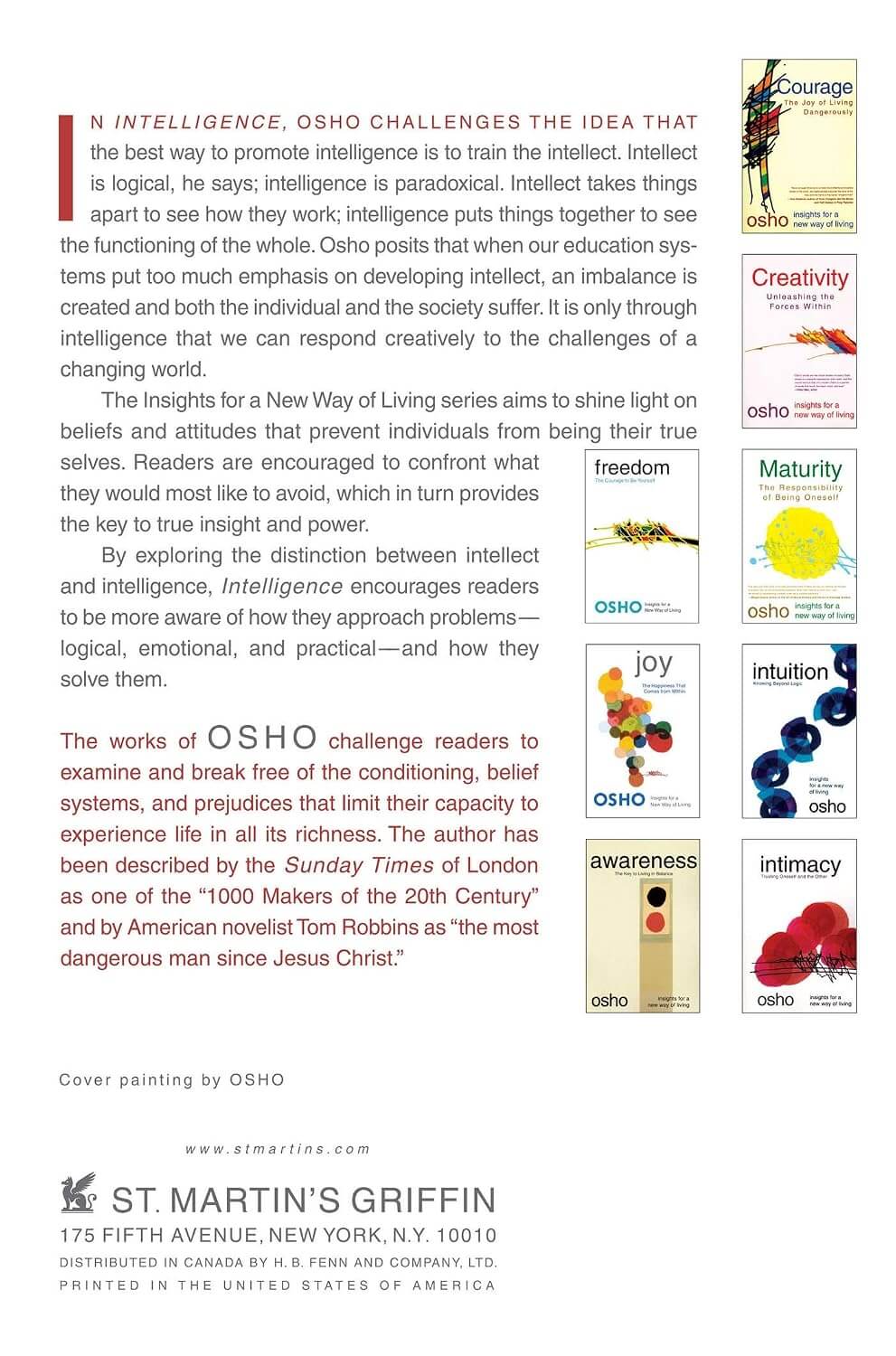
Macmillan’s official description explains Osho’s central distinction: intellect analyses things by taking them apart, while what he calls intelligence looks at the whole situation and responds creatively to what is happening in the present.
Rather than presenting a conventional academic theory of intelligence, the book approaches the subject through Osho’s spiritual philosophy.
Intelligence Versus Intellect
One of the book’s central ideas is that intellect and intelligence are not necessarily the same thing.
In Osho’s framework, intellect is strongly connected with:
- Logic
- Analysis
- Memory
- Information
- Learned knowledge
- Formal education
- Established methods
Intelligence, by contrast, is described as the ability to respond freshly to circumstances rather than simply repeating what has been learned before.
Osho argues that a person can possess a large amount of information and still struggle to respond creatively when circumstances change.
This is why the subtitle is:
The Creative Response to Now
The emphasis is on responding to the present situation rather than relying automatically on answers inherited from the past.
Creativity and Problem-Solving
Creativity is therefore an important theme throughout the book.
A changing world constantly produces situations that cannot always be solved by repeating familiar methods.
Osho encourages readers to examine how they respond to problems:
- Do they automatically follow what they were taught?
- Do they react through habit?
- Do they become afraid of unfamiliar situations?
- Or can they observe the situation and respond creatively?
Macmillan summarises the book as encouraging readers to become more conscious of how they approach logical, emotional and practical problems and how they solve them.
Education and Conditioning
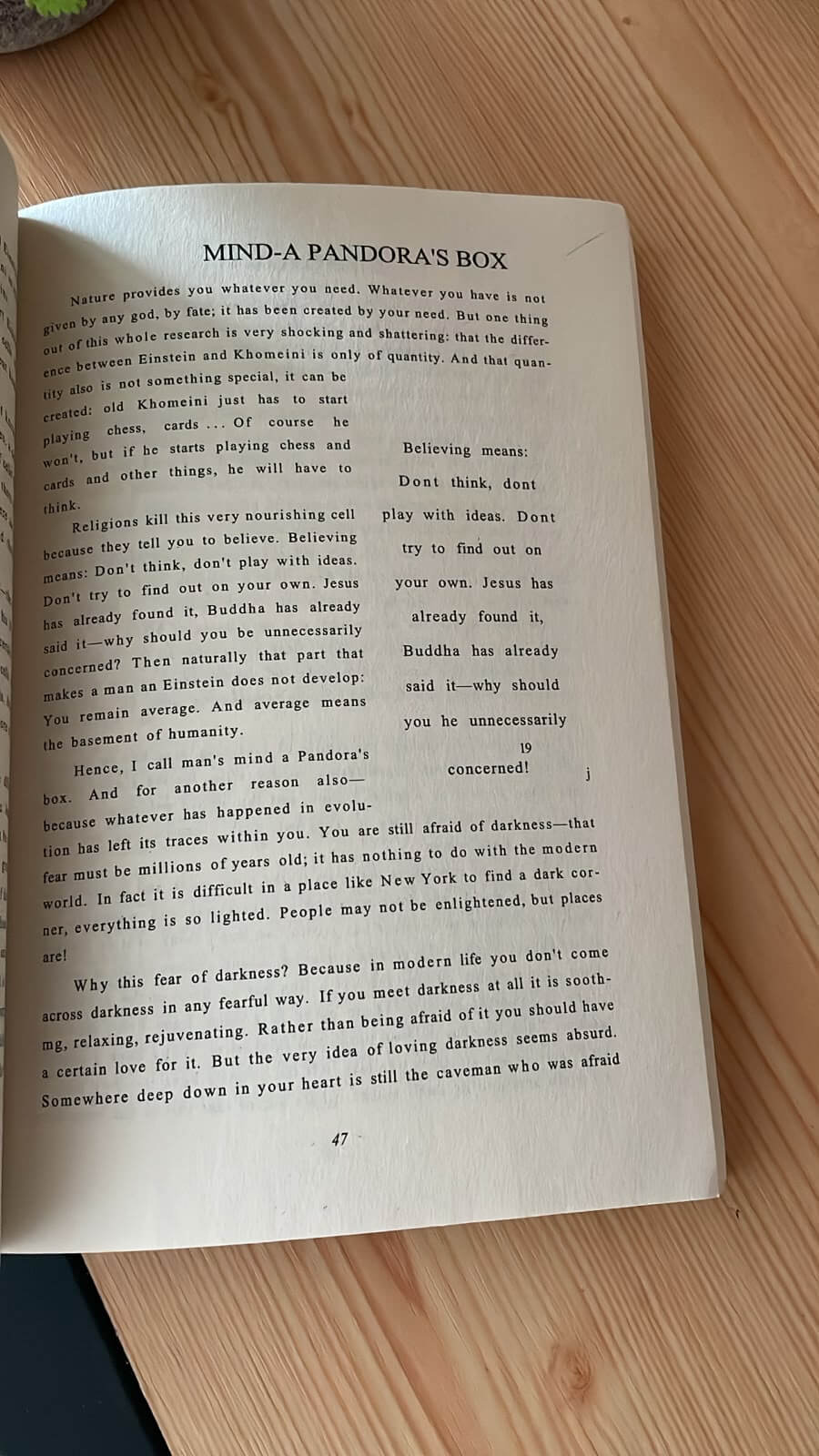
Osho is especially critical of educational systems that, in his view, place too much emphasis on memory and intellectual training.
His argument is that education can sometimes reward people for repeating correct information without equally encouraging:
- Curiosity
- Creativity
- Independent thinking
- Flexibility
- Awareness
- Original responses
This does not mean that education or knowledge has no value.
Rather, Osho questions what happens when knowledge becomes rigid.
The wider Insights for a New Way of Living series similarly challenges readers to examine beliefs, prejudices and habits that may have been absorbed through social conditioning.
Breaking Free from Conditioning
Conditioning is another recurring subject.
People learn beliefs and behaviours from:
- Family
- School
- Society
- Culture
- Religion
- Authority figures
- Previous experiences
Some learned knowledge is necessary and useful.
But Osho asks readers to consider whether they have become so dependent on inherited answers that they struggle to see situations for themselves.
The book encourages questioning:
Is this genuinely my understanding, or am I repeating something I have been taught?
That question connects Intelligence with other Osho titles such as Awareness, Intuition and Freedom.
Intelligence and Fear
Fear can also limit creative responses.
When people are frightened of making mistakes, appearing foolish or challenging established ideas, they may choose the safest familiar answer even when another response would be more appropriate.
Osho therefore connects intelligence with the willingness to face uncertainty.
His idea is not that fear should simply be ignored.
Instead, he encourages readers to notice when fear is controlling their response.
This theme closely connects with another book in the series:
Courage: The Joy of Living Dangerously
Living in the Present
The word “Now” in the subtitle is particularly important.
Osho repeatedly emphasises that the present moment cannot always be fully understood using answers created for the past.
Circumstances change.
People change.
Relationships change.
Societies change.
The same response that worked yesterday may not automatically be right today.
The book therefore presents intelligence as something dynamic.
In this philosophical framework, intelligent living requires:
- Awareness
- Flexibility
- Observation
- Creativity
- Openness
- The ability to respond rather than mechanically react
Intelligence and Awareness
This makes Intelligence closely related to Osho’s earlier volume:
Awareness: The Key to Living in Balance
Awareness allows a person to observe what is happening.
Intelligence, in Osho’s framework, is the ability to respond creatively to that reality.
Without awareness, people may simply repeat automatic reactions.
Without flexibility, even useful knowledge can become restrictive.
Is Intelligence a Psychology or Neuroscience Book?
No.
Although Intelligence discusses:
- Thinking
- Creativity
- Education
- Conditioning
- Problem-solving
- Decision-making
- Human behaviour
it is primarily a work of spiritual philosophy and personal development.
Osho’s distinction between intellect and intelligence represents his philosophical perspective rather than an established scientific model of intelligence.
The book should therefore not be marketed as a neuroscience textbook, clinical psychology guide or scientifically validated cognitive-training programme.
For WooCommerce, the best categories are:
- Self-Help
- Personal Development
- Spirituality
- Philosophy
- Creativity
Osho Insights for a New Way of Living
Pan Macmillan currently identifies Intelligence as Book #8 in the series.
The current sequence is:
- Courage
- Creativity
- Maturity
- Awareness
- Intimacy
- Intuition
- Freedom
- Intelligence
- Compassion
- Joy
- Trust
- Happiness
- Forgiveness
Each title focuses on a different aspect of personal growth, so they can generally be read in any order.
Who Will Enjoy Intelligence?
This book may particularly appeal to readers interested in:
- Personal development
- Creativity
- Spirituality
- Independent thinking
- Self-awareness
- Philosophy
- Meditation
- Education
- Problem-solving
- Conscious living
- Breaking habitual thinking
- Osho’s teachings
Readers who enjoyed Intuition: Knowing Beyond Logic, Awareness: The Key to Living in Balance or Creativity: Unleashing the Forces Within may find Intelligence especially relevant.
About Osho
Osho was an Indian spiritual teacher whose recorded talks were later transcribed and published extensively.
Pan Macmillan notes that his books are largely based on transcriptions of talks delivered to international audiences rather than conventional manuscripts written as books.
His published work covers themes including:
- Meditation
- Awareness
- Freedom
- Creativity
- Intelligence
- Intuition
- Relationships
- Consciousness
- Personal transformation
For Sri Lankan readers interested in spirituality, creativity and reflective self-development, Intelligence: The Creative Response to Now offers an accessible exploration of Osho’s ideas about thinking independently and responding creatively to a changing world.
Be the first to review “Intelligence: The Creative Response to Now (Osho Insights for a New Way of Living) by Osho”
Related products
-34%
Non-Fiction & Knowledge
Original price was: රු2,250.00.රු1,490.00Current price is: රු1,490.00.
3 X Rs. 496.67 or 8% Cashback with
or 3 X රු496.67 with
or up to 4 X රු372.50 with
-29%
Self-Help & Psychology
Original price was: රු1,750.00.රු1,250.00Current price is: රු1,250.00.
3 X Rs. 416.67 or 8% Cashback with
or 3 X රු416.67 with
or up to 4 X රු312.50 with
Non-Fiction & Knowledge
රු1,950.00
3 X Rs. 650.00 or 8% Cashback with
or 3 X රු650.00 with
or up to 4 X රු487.50 with
-23%
Non-Fiction & Knowledge
Original price was: රු2,200.00.රු1,700.00Current price is: රු1,700.00.
3 X Rs. 566.67 or 8% Cashback with
or 3 X රු566.67 with
or up to 4 X රු425.00 with
Out of stock
Self-Help & Psychology
රු1,900.00
3 X Rs. 633.33 or 8% Cashback with
or 3 X රු633.33 with
or up to 4 X රු475.00 with
-24%
Out of stock
Non-Fiction & Knowledge
Original price was: රු2,500.00.රු1,900.00Current price is: රු1,900.00.
3 X Rs. 633.33 or 8% Cashback with
or 3 X රු633.33 with
or up to 4 X රු475.00 with
-19%
Out of stock
Non-Fiction & Knowledge
Original price was: රු2,650.00.රු2,150.00Current price is: රු2,150.00.
3 X Rs. 716.67 or 8% Cashback with
or 3 X රු716.67 with
or up to 4 X රු537.50 with
-13%
Out of stock
Non-Fiction & Knowledge
Original price was: රු3,900.00.රු3,400.00Current price is: රු3,400.00.
3 X Rs. 1,133.33 or 8% Cashback with
or 3 X රු1,133.33 with
or up to 4 X රු850.00 with
Reviews
There are no reviews yet.