
No products in the cart.
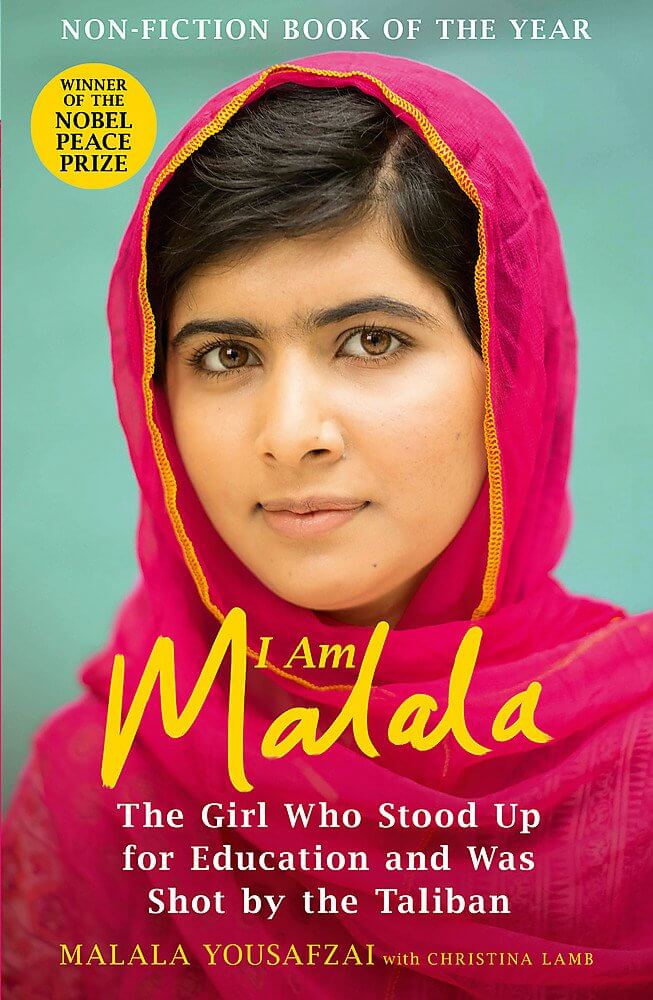
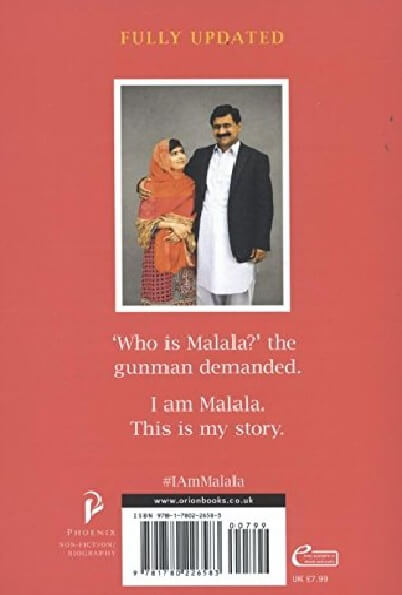

I Am Malala by Malala Yousafzai and Christina Lamb is a powerful and inspiring memoir about courage, education, equality, family, resilience, freedom, and the extraordinary impact one young person’s voice can have on the world.
Malala Yousafzai grew up in Pakistan’s beautiful Swat Valley, surrounded by mountains, family, school, and a community she loved.
From a young age, education was an important part of her life.
Her father, Ziauddin Yousafzai, was a teacher and school owner who strongly believed that girls deserved the same opportunities to learn as boys.
Malala shared that belief.
But when the Taliban gained influence in the Swat Valley, everyday life began to change.
Restrictions increased.
Fear spread.
Schools were threatened and destroyed.
Girls were increasingly told that education was not something they should pursue.
Malala refused to accept that.
She began speaking publicly about the importance of education and the right of girls to attend school.
Her determination eventually made her internationally known.
It also made her a target.
On October 9, 2012, while returning home from school, Malala was shot by a Taliban gunman.
She survived.
And instead of silencing her, the attack amplified her voice around the world.
I Am Malala by Malala Yousafzai and Christina Lamb tells that extraordinary story from Malala’s own perspective.
I Am Malala by Malala Yousafzai and Christina Lamb – Book Overview
I Am Malala by Malala Yousafzai and Christina Lamb begins with Malala’s family, childhood, culture, community, and deep love of education.
The memoir helps readers understand that Malala’s story did not begin with the attack that made international headlines.
Long before that day, she was a student.
A daughter.
A sister.
A friend.
A young girl who enjoyed learning and wanted a future in which education was available to everyone.
The book also explains the political and social changes that affected the Swat Valley.
Readers see how extremism can gradually transform ordinary life.
Rules change.
Fear grows.
People become afraid to speak.
Opportunities disappear.
For Malala, education becomes more than something she enjoys.
It becomes something she must defend.
Growing Up in the Swat Valley
The Swat Valley plays an important role in I Am Malala by Malala Yousafzai and Christina Lamb.
Malala describes a place she loves deeply.
Its natural beauty, mountains, rivers, communities, traditions, and family connections shape her identity.
This is important because international news reports may present places affected by conflict only through violence.
Malala presents a fuller picture.
Swat is not simply a location where terrorism occurred.
It is her home.
She remembers school.
Family gatherings.
Friendships.
Competitions with classmates.
Arguments with her brothers.
Dreams for the future.
These ordinary experiences make the later changes in the valley feel even more powerful.
Malala’s Love of Education
Education is the central theme of I Am Malala by Malala Yousafzai and Christina Lamb.
Malala does not view school simply as a requirement.
She sees education as opportunity.
Education allows people to understand the world.
It can create independence.
It can expand career possibilities.
It can help communities improve.
And it can give people the confidence to question injustice.
For Malala, denying girls an education means denying them choices about their own futures.
This is why she becomes willing to speak publicly even when doing so becomes dangerous.
The Influence of Malala’s Father
Malala’s father, Ziauddin, is one of the most important people in I Am Malala by Malala Yousafzai and Christina Lamb.
He is an educator and school owner who believes strongly in the power of learning.
His support helps Malala develop confidence.
In a society where boys may sometimes receive more opportunities than girls, Ziauddin encourages his daughter to speak.
Think.
Learn.
Question.
Dream.
His influence demonstrates the importance of families supporting children’s ambitions.
Malala’s courage is her own.
But the environment created by her father gives her space to develop that courage.
Their relationship becomes one of the emotional foundations of the memoir.
The Rise of the Taliban
As Taliban influence grows in the Swat Valley, life becomes increasingly difficult.
I Am Malala by Malala Yousafzai and Christina Lamb shows how extremist control can affect ordinary people.
Public messages become more threatening.
Music and entertainment face restrictions.
Women and girls experience increasing limitations.
Schools become targets.
People become afraid.
The pressure does not appear all at once.
It develops gradually.
This makes the memoir an important account of how communities can change under fear and authoritarian control.
For Malala, the issue becomes extremely personal when girls are told they should not attend school.
Speaking Out for Girls’ Education
Malala begins speaking publicly about education despite the risks.
She gives interviews.
She participates in public discussions.
She talks about the importance of girls continuing to learn.
At one point, using the pseudonym Gul Makai, she writes about life under Taliban influence for BBC Urdu.
Her voice begins reaching people beyond the Swat Valley.
I Am Malala by Malala Yousafzai and Christina Lamb shows how powerful communication can become when someone describes injustice through personal experience.
Malala does not begin as a politician or international celebrity.
She begins as a student explaining why she wants to continue going to school.
The simplicity of that demand makes the situation even more powerful.
The Attack on Malala
The most widely known event in I Am Malala by Malala Yousafzai and Christina Lamb occurs on October 9, 2012.
Malala is fifteen years old.
She is traveling home from school when a Taliban gunman attacks her.
She is shot in the head.
Two other girls are also wounded.
The attack attracts international attention.
Malala requires extensive medical treatment.
Her survival is uncertain.
Eventually, she is transferred to Birmingham, England, where doctors continue treating her.
The attack is a horrifying moment in the memoir.
But it does not become the end of Malala’s story.
Instead, it becomes another beginning.
Recovery and Resilience
Recovery is an important theme in I Am Malala by Malala Yousafzai and Christina Lamb.
Surviving a violent attack does not mean immediately returning to normal life.
Malala faces medical procedures.
Physical recovery.
Separation from home.
A new environment.
International attention.
And the emotional reality that someone tried to kill her because she spoke about education.
Yet Malala continues.
Her recovery becomes a powerful example of resilience.
She refuses to allow the attack to define what she can or cannot do.
The attempt to silence her ultimately gives her message an even larger audience.
One Voice Can Create Change
One of the most inspiring ideas in I Am Malala by Malala Yousafzai and Christina Lamb is that age does not determine whether someone can make a difference.
Malala was still a teenager when she became internationally recognized for her advocacy.
She did not begin with enormous political power.
She did not control a government.
She did not have vast financial resources.
She had a voice.
She had conviction.
And she was willing to use both.
Her story demonstrates how personal courage can influence public conversations far beyond one person’s community.
Courage Does Not Mean Having No Fear
Malala’s story provides a useful definition of courage.
Courage does not mean never feeling afraid.
Courage means recognizing fear and still deciding that something matters enough to act.
I Am Malala by Malala Yousafzai and Christina Lamb repeatedly shows the risks Malala and her family understood.
They knew speaking publicly could attract danger.
But remaining silent also had consequences.
If everyone stayed silent, girls could lose access to education without anyone challenging the decision.
Malala’s courage therefore comes from choosing action despite uncertainty.
The Importance of Family
Family is another major theme in I Am Malala by Malala Yousafzai and Christina Lamb.
Malala’s story is not presented as something she experienced entirely alone.
Her father plays a major role.
Her mother provides strength and support.
Her brothers appear throughout her memories of ordinary family life.
After the attack, the family’s life changes dramatically.
They must adapt to a new environment in England while continuing to think about the home they left behind.
This adds emotional depth to the memoir.
International recognition may look glamorous from the outside.
But it also came with enormous personal disruption.
Girls’ Education and Equality
The memoir makes a strong argument that girls’ education benefits entire communities.
When girls receive education, they gain more opportunities to participate in society.
Education can contribute to:
- Greater independence
- Improved employment opportunities
- Stronger communities
- Better health knowledge
- Greater political participation
- Economic development
- More informed decision-making
I Am Malala by Malala Yousafzai and Christina Lamb shows why education should not be treated as a privilege reserved for certain groups.
Learning is presented as a fundamental opportunity that should be available regardless of gender.
Freedom of Speech
The story also explores freedom of expression.
Malala becomes a target because she speaks publicly.
This creates a larger question:
What happens when expressing an opinion becomes dangerous?
I Am Malala by Malala Yousafzai and Christina Lamb demonstrates why freedom of speech matters especially when powerful groups want silence.
Speaking openly can expose problems that would otherwise remain hidden.
But speaking can also carry serious personal consequences.
Malala’s story demonstrates both the power and the cost of using one’s voice.
Education as Resistance
In the context of the Swat Valley under Taliban pressure, simply going to school becomes an act of resistance.
That is one of the most powerful ideas in I Am Malala by Malala Yousafzai and Christina Lamb.
Normally, attending class may appear ordinary.
But when someone attempts to remove that right, ordinary actions become political.
Carrying books.
Entering a classroom.
Taking an examination.
Speaking about education.
These simple acts become symbols of freedom.
This helps readers understand why education can be threatening to extremist movements.
Educated people can question authority.
They can compare ideas.
They can imagine alternatives.
Culture, Religion and Identity
The memoir also gives readers insight into Malala’s cultural and religious identity.
Her story is not a rejection of her home or faith.
Malala repeatedly expresses love for Pakistan, the Swat Valley, her family, and her Muslim identity.
This distinction matters.
The conflict is not presented simply as religion versus education.
Instead, Malala challenges extremist interpretations used to restrict people.
I Am Malala by Malala Yousafzai and Christina Lamb therefore offers a more nuanced perspective than simplified headlines sometimes provide.
From Swat Valley to the United Nations
Malala’s journey eventually takes her far beyond Pakistan.
After recovering, she continues speaking about education internationally.
Her voice reaches global institutions and audiences.
The contrast is remarkable.
A schoolgirl from the Swat Valley who once faced restrictions simply for wanting to attend school eventually becomes one of the world’s most recognizable advocates for education.
This transformation is one reason I Am Malala by Malala Yousafzai and Christina Lamb is such an inspiring memoir.
The story demonstrates how local struggles can become global movements.
Nobel Peace Prize
In 2014, Malala Yousafzai received the Nobel Peace Prize, sharing the award with children’s-rights activist Kailash Satyarthi.
At seventeen, Malala became the youngest Nobel laureate.
The recognition reflected the global impact of her advocacy for children’s education.
Although I Am Malala by Malala Yousafzai and Christina Lamb was originally published before she received the Nobel Prize, her later achievement adds another extraordinary chapter to the story readers encounter in the memoir.
Education Can Change Generations
Education benefits more than one student.
An educated person can share knowledge with others.
A teacher can influence hundreds of students.
A parent can encourage children to learn.
A graduate may create opportunities for an entire family.
This is why I Am Malala by Malala Yousafzai and Christina Lamb treats education as something much larger than classroom achievement.
Education can influence generations.
Malala’s story encourages readers to appreciate opportunities to learn that may sometimes be taken for granted.
7 Powerful Lessons From I Am Malala
I Am Malala by Malala Yousafzai and Christina Lamb contains many important lessons, but seven stand out:
- Education is powerful – Learning creates opportunity, independence, and the ability to question injustice.
- One voice can matter – You do not need enormous power to begin making a difference.
- Courage requires action – Courage means continuing even when fear is present.
- Family support can transform a life – Encouragement from parents and loved ones can help young people believe in their abilities.
- Equality matters – Girls deserve the same opportunities to learn and build their futures as boys.
- Extremism grows when fear silences people – Speaking against injustice can help prevent harmful ideas from becoming accepted as normal.
- Resilience can turn suffering into purpose – Malala survived an attempt to silence her and continued advocating for education on an even larger scale.
Why Read I Am Malala by Malala Yousafzai and Christina Lamb?
I Am Malala by Malala Yousafzai and Christina Lamb is an excellent choice for readers interested in:
- Memoirs
- Autobiographies
- Education
- Women’s rights
- Girls’ education
- Human rights
- Courage
- Personal development
- Pakistan
- Social justice
- Inspirational true stories
- Resilience
- Freedom of speech
- Nobel Peace Prize winners
- Global affairs
The book combines a deeply personal story with wider questions about education, politics, culture, equality, and freedom.
Who Should Read This Book?
I Am Malala by Malala Yousafzai and Christina Lamb may especially appeal to:
- Students
- Teachers
- Parents
- Educators
- Young adults
- Memoir readers
- History readers
- Human-rights readers
- Readers interested in Pakistan
- People interested in women’s education
- Readers seeking inspirational true stories
- Social-science students
- Readers interested in global issues
- Anyone who believes education can change lives
It is particularly meaningful for students because Malala’s story can change the way ordinary access to education is viewed.
An Inspiring Story of Courage and Education
I Am Malala by Malala Yousafzai and Christina Lamb is ultimately the story of a girl who wanted something that should have been ordinary:
The right to go to school.
Yet in Malala’s circumstances, that simple desire became an act of courage.
Her story takes readers from childhood in the Swat Valley through the rise of Taliban influence, threats against girls’ education, her growing public advocacy, the attack that nearly killed her, and her remarkable recovery.
But the story is larger than one individual.
It is about what education means.
It is about what happens when people are denied opportunities because of gender.
It is about families who support their children’s dreams.
It is about the dangers of extremism.
And it is about the extraordinary power of refusing to remain silent.
For readers interested in education, equality, courage, resilience, human rights, Pakistan, and inspirational true stories, I Am Malala by Malala Yousafzai and Christina Lamb is an unforgettable memoir about the power of one voice to inspire change.
Learn more about I Am Malala by Malala Yousafzai and Christina Lamb on the official Hachette Book Group website.
Explore more biography and memoir books at Bargain Books.
| Author | Christina Lamb, Malala Yousafzai |
|---|---|
| Language | English |
| Type | Paperback Printed Book (Second Quality Copy) |
Be the first to review “I Am Malala by Malala Yousafzai, Christina Lamb”
Related products
-13%
Out of stock
Non-Fiction & Knowledge
Original price was: රු3,900.00.රු3,400.00Current price is: රු3,400.00.
3 X Rs. 1,133.33 or 8% Cashback with


or 3 X රු1,133.33 with


or up to 4 X රු850.00 with

-26%
Out of stock
Non-Fiction & Knowledge
Original price was: රු2,000.00.රු1,490.00Current price is: රු1,490.00.
3 X Rs. 496.67 or 8% Cashback with
or 3 X රු496.67 with
or up to 4 X රු372.50 with
-24%
Out of stock
Non-Fiction & Knowledge
Original price was: රු2,100.00.රු1,600.00Current price is: රු1,600.00.
3 X Rs. 533.33 or 8% Cashback with
or 3 X රු533.33 with
or up to 4 X රු400.00 with
Out of stock
Non-Fiction & Knowledge
රු1,600.00
3 X Rs. 533.33 or 8% Cashback with
or 3 X රු533.33 with
or up to 4 X රු400.00 with
Out of stock
Self-Help & Psychology
රු2,200.00
3 X Rs. 733.33 or 8% Cashback with
or 3 X රු733.33 with
or up to 4 X රු550.00 with
Out of stock
Autobiography
රු2,750.00
3 X Rs. 916.67 or 8% Cashback with
or 3 X රු916.67 with
or up to 4 X රු687.50 with
-24%
Out of stock
Non-Fiction & Knowledge
Original price was: රු2,500.00.රු1,900.00Current price is: රු1,900.00.
3 X Rs. 633.33 or 8% Cashback with
or 3 X රු633.33 with
or up to 4 X රු475.00 with
-34%
Non-Fiction & Knowledge
Original price was: රු2,250.00.රු1,490.00Current price is: රු1,490.00.
3 X Rs. 496.67 or 8% Cashback with
or 3 X රු496.67 with
or up to 4 X රු372.50 with
Reviews
There are no reviews yet.