
No products in the cart.
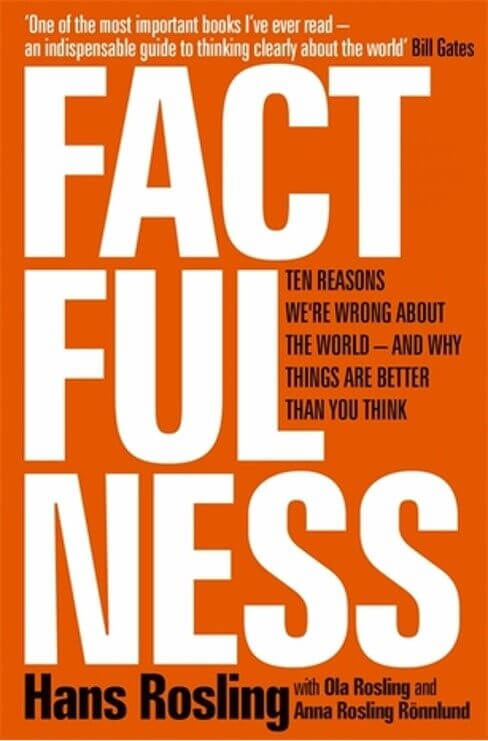
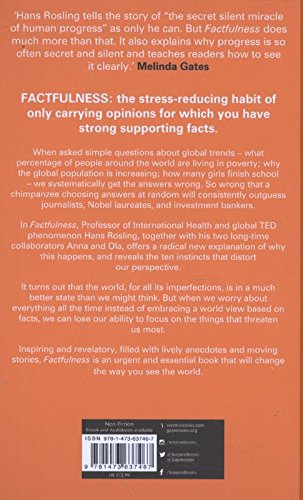




Factfulness by Hans Rosling, Ola Rosling, and Anna Rosling Rönnlund is a fascinating book about facts, critical thinking, human bias, global development and understanding the world more accurately.
How well do you understand the world?
Is global poverty increasing?
Are most children receiving an education?
Is the world becoming more dangerous?
How quickly is the global population changing?
Many people feel confident answering questions like these.
But the answers are often surprisingly wrong.
The authors of Factfulness found that people regularly misunderstand basic global trends—even highly educated professionals.
Their argument is not that people are unintelligent.
Instead, human beings have predictable mental habits that can make dramatic information feel more important than accurate information.
Why Read Factfulness?
Factfulness teaches readers how to build a more realistic worldview.
It is not a book claiming that everything in the world is perfect.
Wars still happen.
Poverty exists.
Disease remains a serious problem.
Climate change matters.
Inequality matters.
But recognizing genuine problems does not require believing that everything is always getting worse.
Hans Rosling argues that understanding progress accurately is important because exaggerated pessimism can make it harder to identify where attention and resources are genuinely needed.
Factfulness and a Fact-Based Worldview
The central principle of Factfulness is simple.
Do not build your worldview entirely from dramatic headlines.
Look at the data.
Check the context.
Compare numbers.
Ask whether something is improving or worsening over time.
Consider more than one perspective.
Gapminder describes Factfulness as a critical-thinking habit that helps people recognize common ways information gets misinterpreted.
This does not mean numbers are always perfect.
It means opinions become stronger when they are supported by reliable evidence.
Why We Misunderstand the World
Human attention naturally reacts to dramatic events.
Violence attracts attention.
Disasters attract attention.
Conflict attracts attention.
Bad news travels quickly.
Slow improvements rarely create the same excitement.
A country gradually improving childhood survival over twenty years may receive little attention.
A single disaster can dominate the news immediately.
That difference can distort our perception.
Factfulness teaches readers to notice these patterns before forming conclusions.
The 10 Instincts in Factfulness
The authors identify ten common instincts that can distort our worldview:
- The Gap Instinct
- The Negativity Instinct
- The Straight Line Instinct
- The Fear Instinct
- The Size Instinct
- The Generalization Instinct
- The Destiny Instinct
- The Single Perspective Instinct
- The Blame Instinct
- The Urgency Instinct
Each instinct explains a different way our brains can simplify a complicated world.
Factfulness and the Gap Instinct
People often divide the world into two groups.
Rich and poor.
Developed and developing.
Us and them.
Good and bad.
But reality is often more complicated.
Gapminder explains that the Gap Instinct makes us imagine two clearly separated groups even when most people are actually somewhere in the middle.
This matters because extreme examples can make the world appear far more divided than it really is.
Instead of immediately accepting two opposing categories, ask:
Where is the majority?
Is there really a clear gap?
Do the groups overlap?
Those questions can produce a more accurate picture.
Factfulness and the Negativity Instinct
Bad news is powerful.
When something goes wrong, we notice.
When something slowly improves, we may not.
This creates the impression that everything is becoming worse.
But two statements can be true simultaneously:
A situation can still be bad.
And it can also be getting better.
For example, a serious global problem may still affect millions of people while being significantly smaller than it was decades earlier.
Factfulness encourages readers to separate the current level of a problem from its direction of change.
That distinction is extremely important.
The Straight Line Instinct
People often assume a trend will continue in a straight line.
If something is increasing today, we imagine it will keep increasing at exactly the same rate forever.
Real-world trends rarely behave so simply.
Growth can slow.
Flatten.
Accelerate.
Decline.
Change direction.
Population trends, technology adoption, economic development, and health outcomes can all follow different shapes.
The lesson is simple:
Do not automatically extend a line into the future.
Look at the pattern first.
Factfulness and the Fear Instinct
Fear attracts attention faster than statistics.
A frightening event can feel extremely dangerous even when the statistical risk is relatively low.
Gapminder advises readers to distinguish between something being scary and something representing a large actual risk.
Their framework considers both danger and exposure when evaluating risk.
This is useful far beyond global statistics.
It can improve decisions involving:
Health.
Travel.
Business.
Investing.
News.
Technology.
Safety.
Fear is information.
But fear should not automatically become the final decision-maker.
The Size Instinct
Large numbers can sound terrifying.
One million.
Ten million.
One billion.
But numbers without comparison can mislead.
Suppose a headline reports 10,000 cases of something.
Is that high?
You cannot know without context.
Compared with what?
How large is the population?
What was the number last year?
What percentage does it represent?
Has the total increased or decreased?
Factfulness encourages readers to compare numbers rather than reacting to isolated figures.
Ratios, percentages and historical comparisons often reveal far more than a large number alone.
Factfulness and the Generalization Instinct
Categories are useful.
They help us understand complicated information.
But categories can also create stereotypes.
We may assume that everyone from one country behaves similarly.
Or that all people within an income group share the same lifestyle.
Or that one dramatic example represents an entire population.
Gapminder specifically warns readers to be cautious with broad claims about “the majority” and vivid examples that may actually be exceptions.
Good critical thinking requires curiosity.
Ask how people differ within groups as well as between them.
The Destiny Instinct
People sometimes assume countries, cultures or societies cannot change.
“This country will always be poor.”
“That culture will never change.”
“Those people have always behaved that way.”
History tells a different story.
Values change.
Economies change.
Technology changes.
Education changes.
Cultures change.
Gapminder describes the Destiny Instinct as failing to notice gradual change because it happens slowly. Small yearly improvements can become enormous transformations over decades.
This is one of the most valuable ideas in Factfulness.
Slow change is still change.
The Single Perspective Instinct
People like simple explanations.
One problem.
One cause.
One solution.
Reality is usually more complicated.
A doctor may see every issue through medicine.
An economist may focus primarily on incentives.
An engineer may search for technological solutions.
A politician may see policy.
Each perspective can provide useful information.
None necessarily explains everything.
Gapminder recommends building a toolbox of perspectives rather than treating one favourite idea as the solution to every problem.
Factfulness and Intellectual Humility
One of the strongest lessons from Factfulness is learning to say:
“I don’t know.”
That is not weakness.
It is intellectual honesty.
The world changes.
Data changes.
Our knowledge becomes outdated.
Experts can be wrong.
Old assumptions may no longer match reality.
A fact-based worldview therefore requires constant updating.
Strong thinkers are not people who never change their opinions.
They change their opinions when better evidence appears.
The Blame Instinct
When something goes wrong, humans naturally look for someone to blame.
A politician.
A company.
A country.
A wealthy individual.
A particular group.
Sometimes individuals really are responsible.
But focusing too heavily on one villain can distract from deeper systems.
Problems may involve:
Incentives.
Regulations.
Institutions.
Economic pressures.
Historical conditions.
Technology.
Human behaviour.
A better question is not only:
“Who caused this?”
It is also:
“What system allowed this to happen?”
That question can lead to better solutions.
The Urgency Instinct
Urgency can damage careful thinking.
“Act immediately.”
“There is no time.”
“This is our only chance.”
Messages like these activate emotion.
Sometimes a situation genuinely is urgent.
But not every decision is.
Gapminder recommends slowing down when possible, asking for relevant data, examining uncertainty, and being cautious about drastic actions that have not been properly tested.
That lesson is valuable in business and everyday decision-making.
Urgency should not become an excuse to stop thinking.
Factfulness and the News
News organizations naturally report unusual events.
That is their job.
A plane landing safely is not news.
A plane crash is.
Thousands of ordinary peaceful days rarely become international headlines.
A war does.
This creates what can be called an availability problem.
What we see frequently feels common.
But news frequency and statistical frequency are not necessarily the same.
Factfulness helps readers consume news more critically without simply dismissing journalism.
Ask:
Is this event representative?
What is the longer-term trend?
What does the data show?
Factfulness and Global Progress
One of the book’s strongest messages is that important global improvements can occur without receiving much attention.
Progress is often slow.
Incremental.
Uneven.
And incomplete.
That makes it less dramatic than catastrophe.
But progress still matters.
The authors argue that acknowledging improvement should not create complacency.
Instead, understanding what has improved can help identify which interventions actually work.
The book repeatedly emphasizes that the world can simultaneously contain serious problems and substantial progress.
Data Does Not Mean Blind Optimism
It would be easy to misunderstand Factfulness as saying:
“Everything is fine.”
That is not its argument.
The book acknowledges real threats and serious global challenges.
Its argument is closer to:
Understand the situation accurately before deciding what to do about it.
Unnecessary pessimism can be misleading.
Blind optimism can also be misleading.
The goal is realism.
Factfulness for Business Decisions
The principles in Factfulness can be useful in business.
Imagine sales decrease for one month.
A manager panics.
But is one month enough information?
What is the yearly trend?
Was that month seasonal?
Did one unusually large order affect last year’s comparison?
Good decisions require context.
The same applies to:
Revenue.
Customer behaviour.
Advertising.
Inventory.
Employee performance.
Market growth.
Before reacting emotionally, examine the data.
Factfulness for Students
Students can use the book to develop stronger critical-thinking skills.
Do not simply memorize claims.
Ask:
What is the source?
What period does the data cover?
Is the percentage being presented without the total?
Is one extreme example being generalized?
Could there be another explanation?
These habits are useful across almost every academic subject.
Factfulness and Social Media
Social media makes dramatic information spread extremely quickly.
Anger creates engagement.
Fear creates engagement.
Surprise creates engagement.
Nuanced explanations often travel more slowly.
That makes the principles in Factfulness even more useful today.
Before sharing a shocking statistic:
Check it.
Find the original source.
Look for context.
Check the date.
Compare it with previous years.
Ask whether the claim accurately represents the larger picture.
10 Powerful Lessons From Factfulness
- Look for the Majority – Reality is often less divided than extreme categories suggest.
- Expect Bad News to Receive More Attention – Negative events are more noticeable than gradual improvements.
- Do Not Assume Straight-Line Growth – Trends can change shape.
- Separate Fear From Risk – Something frightening is not automatically the biggest danger.
- Put Numbers in Context – Compare totals, percentages and historical trends.
- Avoid Overgeneralizing – One person or event may not represent an entire group.
- Remember That Societies Change – Slow progress can become enormous over time.
- Use Multiple Perspectives – Complicated problems rarely have one simple explanation.
- Look Beyond Blame – Systems are often more important than individual villains.
- Be Careful With Urgency – Slow down, examine evidence and consider alternatives when possible.
What You Can Learn From Factfulness
Readers can explore:
- Critical thinking
- Global development
- Statistics
- Human psychology
- Cognitive bias
- Data literacy
- Decision-making
- Poverty
- Population
- Health
- Education
- News and media
- Risk
- Global progress
- Problem-solving
- Evidence-based thinking
- Human behaviour
Who Should Read Factfulness?
Factfulness is ideal for readers interested in understanding the modern world.
Students can use it to strengthen critical-thinking skills.
Business leaders can apply its principles to data-driven decision-making.
Managers can learn to question dramatic conclusions.
Journalists and researchers may appreciate its focus on context and statistics.
Readers interested in economics, psychology, global development or human behaviour can also find plenty to explore.
It is particularly valuable for anyone who regularly reads headlines, statistics or social-media claims and wants to become better at separating emotional reactions from evidence.
A Powerful Guide to Seeing the World Clearly
Factfulness challenges readers to examine the stories they automatically believe.
The world is complicated.
It contains progress and failure.
Opportunity and suffering.
Improvement and serious danger.
Seeing only one side produces a distorted picture.
Hans Rosling, together with Ola Rosling and Anna Rosling Rönnlund, developed the book around years of work teaching global-development data and combating widespread misconceptions through the Gapminder Foundation.
The goal is not optimism.
It is accuracy.
Check the facts.
Question dramatic claims.
Put numbers in context.
Understand uncertainty.
Update outdated knowledge.
And remain willing to change your mind when the evidence changes.
For readers interested in critical thinking, psychology, statistics, global development and making smarter decisions, Factfulness is an essential addition to any nonfiction collection.
Book Details
Full Title: Factfulness: Ten Reasons We’re Wrong About the World – and Why Things Are Better Than You Think
Authors: Hans Rosling, Ola Rosling & Anna Rosling Rönnlund
Genre: Nonfiction / Critical Thinking / Global Development / Statistics / Social Science
Original Publication: 2018.
UK / Sceptre Edition
A commonly sold Sceptre edition is listed as:
ISBN-13: 9781473637467
Publisher: Sceptre
Publication Date: April 3, 2018
Pages: approximately 342 pages.
U.S. Edition
The original U.S. Flatiron Books edition is listed as:
ISBN-13: 9781250123817
Publisher: Flatiron Books
Publication Date: April 3, 2018
Pages: 288 in that edition.
A later Flatiron edition with ISBN 9781250123824 is listed at 352 pages.
Edition Note
There are several international editions of Factfulness, and the page count varies significantly between them.
For your website, check the ISBN printed on your physical copy before entering the exact page count, dimensions or weight. https://yourwebsite.com/factfulness/
| Author | et al., Hans Rosling, Richard Harries |
|---|---|
| Language | English |
| Type | Paperback Printed Book (Second Quality Copy) |
Be the first to review “Factfulness by Hans Rosling, Richard Harries, et al.”
Related products
-24%
Out of stock
Non-Fiction & Knowledge
Original price was: රු2,100.00.රු1,600.00Current price is: රු1,600.00.
3 X Rs. 533.33 or 8% Cashback with


or 3 X රු533.33 with


or up to 4 X රු400.00 with

-24%

Out of stock
Non-Fiction & Knowledge
Original price was: රු2,500.00.රු1,900.00Current price is: රු1,900.00.
3 X Rs. 633.33 or 8% Cashback with
or 3 X රු633.33 with
or up to 4 X රු475.00 with
-17%
Out of stock
Non-Fiction & Knowledge
Original price was: රු2,900.00.රු2,400.00Current price is: රු2,400.00.
3 X Rs. 800.00 or 8% Cashback with
or 3 X රු800.00 with
or up to 4 X රු600.00 with
-24%
Out of stock
Non-Fiction & Knowledge
Original price was: රු2,100.00.රු1,600.00Current price is: රු1,600.00.
3 X Rs. 533.33 or 8% Cashback with
or 3 X රු533.33 with
or up to 4 X රු400.00 with
-13%

Out of stock
Non-Fiction & Knowledge
Original price was: රු3,900.00.රු3,400.00Current price is: රු3,400.00.
3 X Rs. 1,133.33 or 8% Cashback with
or 3 X රු1,133.33 with
or up to 4 X රු850.00 with

Out of stock
Autobiography
රු2,750.00
3 X Rs. 916.67 or 8% Cashback with
or 3 X රු916.67 with
or up to 4 X රු687.50 with
-19%
Out of stock
Non-Fiction & Knowledge
Original price was: රු2,650.00.රු2,150.00Current price is: රු2,150.00.
3 X Rs. 716.67 or 8% Cashback with
or 3 X රු716.67 with
or up to 4 X රු537.50 with

Non-Fiction & Knowledge
රු1,950.00
3 X Rs. 650.00 or 8% Cashback with
or 3 X රු650.00 with
or up to 4 X රු487.50 with
Reviews
There are no reviews yet.