
No products in the cart.
-29%
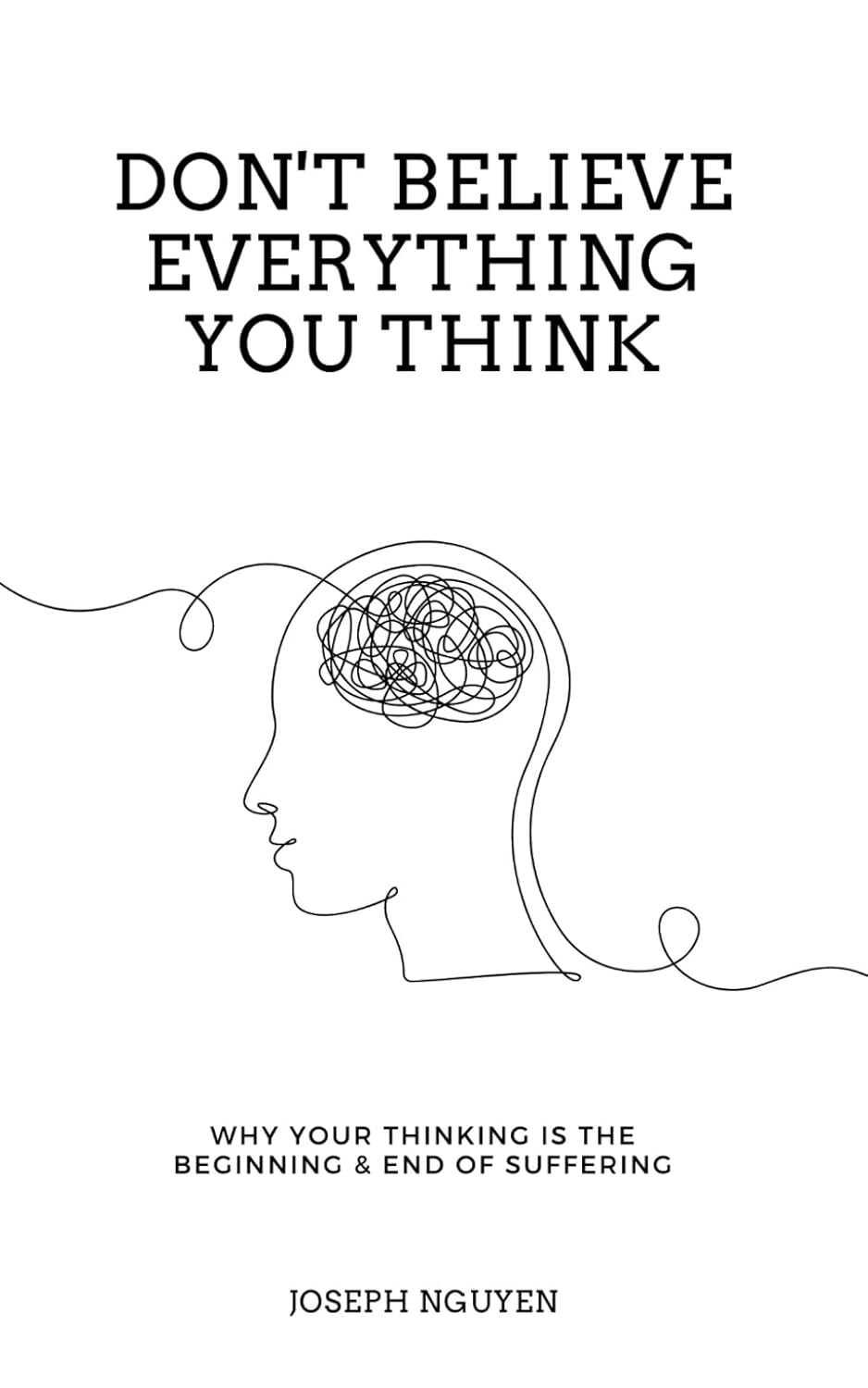


Don’t Believe Everything You Think by Joseph Nguyen


Original price was: රු1,700.00.රු1,200.00Current price is: රු1,200.00.
3 X Rs. 400.00 or 8% Cashback with


or 3 X රු400.00 with


or up to 4 X රු300.00 with


“Challenge your thoughts, embrace clarity. Discover ‘Don’t Believe Everything You Think,’ a mind-expanding journey towards self-awareness and truth.”
6 in stock
Don’t Believe Everything You Think by Joseph Nguyen is a thought-provoking personal-development book about overthinking, mental suffering, awareness and discovering greater peace.
Many people believe every thought that appears in their minds.
A negative thought appears, and anxiety follows.
A difficult memory appears, and emotional pain returns.
A worry about the future appears, and suddenly the mind creates dozens of possible problems.
Joseph Nguyen challenges this pattern.
Don’t Believe Everything You Think explores the idea that our relationship with thinking can strongly influence how we experience life. The author emphasizes that the book is not simply about positive thinking, changing the past or forcing yourself to eliminate unwanted thoughts.
Why Read Don’t Believe Everything You Think?
Don’t Believe Everything You Think is especially relevant for people who regularly overanalyse situations.
You may replay conversations in your mind.
You may worry about things that have not happened.
You may constantly ask whether you made the right decision.
Sometimes thinking helps solve problems.
But sometimes additional thinking only creates more stress.
Nguyen invites readers to examine this difference.
The goal is not to stop using your mind.
It is to recognise when thinking is useful and when it becomes a source of unnecessary suffering.
Don’t Believe Everything You Think and Overthinking
Overthinking often begins with a simple concern.
Then the mind adds another thought.
Then another.
Eventually, one small issue can feel enormous.
Don’t Believe Everything You Think encourages readers to become more aware of this process.
The author presents a distinction between thoughts that naturally arise and the additional thinking we repeatedly add to them.
That distinction is central to the book’s approach to emotional freedom.
Thoughts Are Not Always Facts
A thought can feel completely true without actually being true.
You may think:
“I am going to fail.”
That is a thought.
It is not automatically a fact.
You may think:
“Everyone is judging me.”
Again, that thought may feel convincing.
But feeling certain does not prove that the thought accurately describes reality.
Don’t Believe Everything You Think encourages readers to create more distance between having a thought and immediately believing it.
That small difference can completely change how someone responds emotionally.
Understanding Psychological Suffering
One of the central themes in Don’t Believe Everything You Think is the relationship between thinking and psychological suffering.
Joseph Nguyen argues that much emotional suffering comes not only from events themselves but also from the thinking we continuously create around those events.
Two people can experience similar circumstances and respond very differently.
The external situation matters.
But interpretation matters too.
The mind can replay an event for hours, days or even years.
Recognising that process can help readers understand why certain problems continue affecting them long after the original situation has passed.
You Do Not Need to Control Every Thought
Trying to control every thought can create another problem.
The more strongly someone tries not to think about something, the more attention they may give it.
Don’t Believe Everything You Think does not ask readers to win a battle against their own minds.
Instead, it presents a different relationship with thinking.
A thought can appear.
You can notice it.
You do not necessarily have to follow it.
This can create more mental space.
Don’t Believe Everything You Think and Inner Peace
Don’t Believe Everything You Think connects peace with reducing unnecessary mental activity.
People often believe they will finally feel peaceful when every external problem disappears.
But life always contains uncertainty.
Plans change.
Relationships change.
Unexpected problems happen.
If peace requires perfect circumstances, lasting peace becomes almost impossible.
Nguyen’s approach instead asks readers to examine what is happening internally.
The book describes its broader purpose as helping readers discover greater freedom from suffering regardless of external circumstances.
Stop Fighting With Your Mind
People can spend enormous amounts of energy arguing with themselves.
“Why did I do that?”
“What if something goes wrong?”
“Why can’t I stop thinking about this?”
These questions can generate even more thinking.
Don’t Believe Everything You Think encourages a less combative relationship with the mind.
Instead of treating every unwanted thought as a problem that must immediately be solved, readers can learn to observe what is happening.
Awareness creates space between thought and reaction.
The Difference Between Thought and Thinking
The distinction between thought and thinking is an important idea within Joseph Nguyen’s teaching around the book.
Thoughts can arise naturally.
Thinking is what happens when the mind begins actively engaging with, analysing and expanding those thoughts.
For example:
A thought appears: “What if I make a mistake?”
Thinking may then continue:
“What will everyone think?”
“What if I lose this opportunity?”
“What if I never recover?”
“What if everything goes wrong?”
One thought has now produced an entire imagined future.
Don’t Believe Everything You Think encourages readers to notice when this process begins.
Let Go of the Need to Know Everything
Uncertainty can be uncomfortable.
People naturally want answers.
Will this relationship work?
Will the business succeed?
Will I get the job?
Did I make the correct decision?
Sometimes no immediate answer exists.
Trying to force certainty can lead to endless analysis.
Don’t Believe Everything You Think encourages readers to become more comfortable with not knowing everything.
Not every uncertainty needs to be solved immediately.
Sometimes clarity appears when the mind becomes quieter.
Overthinking and Decision-Making
Overthinking can make even simple decisions difficult.
Someone considers option A.
Then option B.
Then they reconsider option A.
Then they imagine ten possible outcomes.
Eventually, they become more confused than when they started.
Don’t Believe Everything You Think encourages a different approach.
Rather than assuming that more thinking always creates better decisions, readers can recognise when analysis has stopped being useful.
This can help create greater clarity.
You Are More Than Your Thoughts
People sometimes identify strongly with their thoughts.
A negative thought appears, and they believe something must be wrong with them.
An anxious thought appears, and they immediately define themselves as anxious.
But thoughts constantly change.
A thought that feels important today may seem irrelevant next week.
Don’t Believe Everything You Think encourages readers to recognise that thoughts are experiences occurring within awareness.
They do not necessarily define who you are.
Happiness Does Not Require Perfect Circumstances
Many people postpone happiness.
“I’ll be happy when I earn more money.”
“I’ll relax after I finish this project.”
“I’ll feel good when this problem disappears.”
Then another problem arrives.
The finish line keeps moving.
Don’t Believe Everything You Think encourages readers to examine whether happiness really needs to depend completely on external circumstances.
A calmer internal relationship with thinking can change how everyday life feels.
Stop Creating Problems That Do Not Exist Yet
The human mind can imagine the future.
That ability is useful.
It helps people plan.
But imagination can also create fear.
Someone can emotionally experience a disaster that has never happened.
They imagine losing their job.
They imagine a relationship ending.
They imagine failing.
Their body begins responding to an imagined event as if the event were already real.
Don’t Believe Everything You Think helps readers recognise how easily thinking can create unnecessary emotional suffering.
Awareness Before Reaction
A thought appears.
Then an emotion follows.
Then an action may follow.
Creating awareness between these stages can change the outcome.
Instead of immediately reacting, pause.
Notice what is happening.
You may discover that the thought does not require action at all.
This simple shift is one of the practical ideas readers can take from Don’t Believe Everything You Think.
7 Powerful Lessons From Don’t Believe Everything You Think
- Thoughts Are Not Always Facts – Something can feel true without accurately representing reality.
- Overthinking Can Create Suffering – More thinking does not automatically create better solutions.
- You Don’t Need to Control Every Thought – Thoughts can appear without requiring your attention or reaction.
- Awareness Creates Freedom – Observing mental activity can create distance from automatic reactions.
- Uncertainty Is Part of Life – You do not need an immediate answer to every question.
- Peace Does Not Require Perfect Circumstances – Internal experience is influenced by more than external events.
- You Are More Than Your Mind – Thoughts come and go; they do not have to define your identity.
What You Can Learn From Don’t Believe Everything You Think
Readers can explore:
- Overthinking
- Negative thoughts
- Inner peace
- Self-awareness
- Mental clarity
- Emotional suffering
- Present-moment awareness
- Letting go
- Decision-making
- Stress
- Fear
- Personal growth
- Happiness
- Consciousness
- Understanding thoughts
- Self-development
Who Should Read Don’t Believe Everything You Think?
Don’t Believe Everything You Think is suitable for readers interested in personal development and self-awareness.
It may especially appeal to people who feel trapped in cycles of overthinking.
Readers interested in mindfulness may appreciate its emphasis on awareness.
It can also be useful for people who constantly analyse decisions or worry about uncertain future events.
The book’s official description emphasizes that its approach is not conventional positive thinking or simply trying to rewrite the past.
Instead, it encourages a different understanding of how human experience and mental suffering arise.
A Powerful Guide to Freedom From Overthinking
Don’t Believe Everything You Think challenges one of the assumptions many people rarely question.
Just because your mind says something does not mean you must believe it.
Thoughts can appear.
Fear can appear.
Uncertainty can appear.
But you can learn to experience them without automatically becoming trapped in endless thinking.
Joseph Nguyen encourages readers to examine the relationship between thought, consciousness and psychological suffering rather than relying only on temporary tactics.
For readers looking for a simple and thought-provoking book about overthinking, awareness, mental clarity and inner peace, Don’t Believe Everything You Think is a valuable addition to any personal-development bookshelf.
Book Details
Title: Don’t Believe Everything You Think
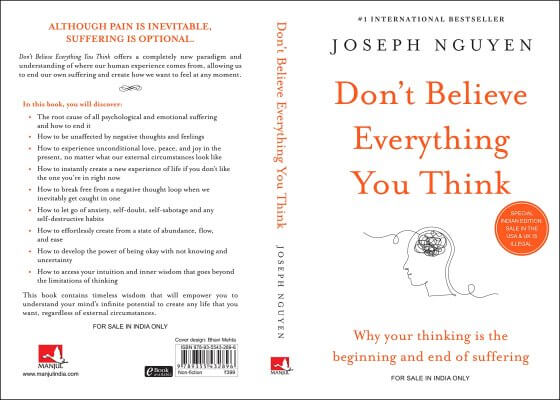
Subtitle: Why Your Thinking Is the Beginning & End of Suffering
Author: Joseph Nguyen
Category: Personal Development / Self-Help / Mindfulness / Psychology
Expanded Edition: An expanded edition is also available, adding further material to the original work.
https://yourwebsite.com/dont-believe-everything-you-think/
| Author | Joseph Nguyen |
|---|---|
| Type | Paperback Printed Book |
| ISBN/ISSN | 935543135X, 978-9355431356 |
| Language | English |
| Pages | 128 |
Be the first to review “Don’t Believe Everything You Think by Joseph Nguyen”
Related products
-14%

Out of stock
Self-Help & Psychology
Original price was: රු2,900.00.රු2,500.00Current price is: රු2,500.00.
3 X Rs. 833.33 or 8% Cashback with
or 3 X රු833.33 with
or up to 4 X රු625.00 with
-33%

Self-Help & Psychology
Original price was: රු2,300.00.රු1,550.00Current price is: රු1,550.00.
3 X Rs. 516.67 or 8% Cashback with
or 3 X රු516.67 with
or up to 4 X රු387.50 with
-23%

Non-Fiction & Knowledge
Original price was: රු2,200.00.රු1,700.00Current price is: රු1,700.00.
3 X Rs. 566.67 or 8% Cashback with
or 3 X රු566.67 with
or up to 4 X රු425.00 with
-34%

Non-Fiction & Knowledge
Original price was: රු2,250.00.රු1,490.00Current price is: රු1,490.00.
3 X Rs. 496.67 or 8% Cashback with
or 3 X රු496.67 with
or up to 4 X රු372.50 with

Out of stock
Self-Help & Psychology
රු2,200.00
3 X Rs. 733.33 or 8% Cashback with
or 3 X රු733.33 with
or up to 4 X රු550.00 with
-17%

Out of stock
Non-Fiction & Knowledge
Original price was: රු2,900.00.රු2,400.00Current price is: රු2,400.00.
3 X Rs. 800.00 or 8% Cashback with
or 3 X රු800.00 with
or up to 4 X රු600.00 with
-24%
Out of stock
Non-Fiction & Knowledge
Original price was: රු2,100.00.රු1,600.00Current price is: රු1,600.00.
3 X Rs. 533.33 or 8% Cashback with
or 3 X රු533.33 with
or up to 4 X රු400.00 with

Out of stock
Non-Fiction & Knowledge
රු1,900.00
3 X Rs. 633.33 or 8% Cashback with
or 3 X රු633.33 with
or up to 4 X රු475.00 with
Reviews
There are no reviews yet.