
No products in the cart.

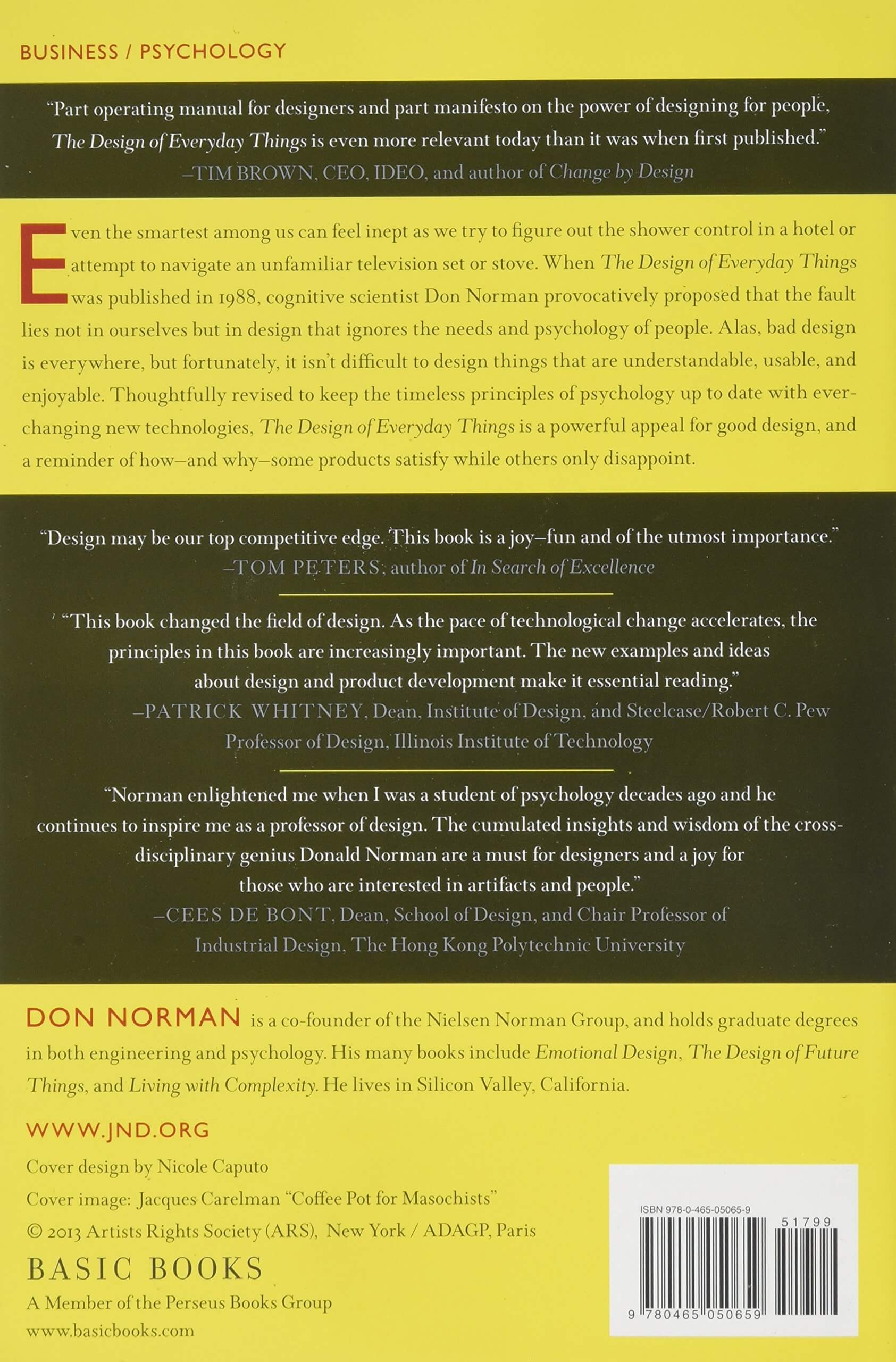




The Design of Everyday Things by Don Norman is an influential guide to understanding why some products are easy to use while others leave people confused and frustrated.
The book explores the relationship between people, objects and design.
Norman argues that when people repeatedly struggle to use an object, the problem may lie in the design rather than in the user.
From doors and switches to appliances and digital interfaces, everyday objects constantly communicate information about how they should be used.
Good design makes those instructions clear.
Poor design forces people to guess.
The Design of Everyday Things is especially valuable for designers, developers, engineers, product managers, entrepreneurs and anyone interested in understanding human behaviour.
Why Read The Design of Everyday Things?
The Design of Everyday Things teaches readers to look differently at ordinary objects.
Consider a door.
Should you push it?
Should you pull it?
If the user must stop and think about such a simple action, the design may not be communicating clearly.
Norman uses everyday examples to explain broader principles of usability and human-centered design.
Once you understand these principles, you may begin noticing good and bad design everywhere.
The Design of Everyday Things and Human-Centered Design
Human-centered design begins with understanding people.
Designers should consider how users think, behave and interpret information.
A product should not require users to understand the designer’s thinking.
Instead, the design itself should help users understand what they can do.
The revised edition of The Design of Everyday Things includes human-centered design as an important part of its discussion.
This principle applies to physical products as well as websites, applications and digital services.
Good Design Should Be Understandable
A well-designed product communicates its purpose.
Users should be able to identify what actions are possible.
They should also understand what happens after an action is taken.
If a user presses a button and nothing appears to happen, uncertainty follows.
Did the button work?
Should they press it again?
Good design reduces this uncertainty.
The Design of Everyday Things encourages designers to make important information visible and understandable.
Affordances and Signifiers
Two important ideas associated with The Design of Everyday Things are affordances and signifiers.
Affordances relate to the possible interactions between a person and an object.
Signifiers communicate where or how an action should happen.
For example, a door handle may suggest pulling.
A flat plate may suggest pushing.
Norman clarified and expanded his discussion of these concepts in the revised edition.
These ideas have become highly useful in product and interface design.
The Design of Everyday Things and Feedback
Feedback tells users what happened after they performed an action.
Imagine pressing an elevator button.
A light appears.
That light confirms that the system registered your request.
Without feedback, the user may become uncertain.
Digital interfaces work similarly.
A loading indicator tells users that something is happening.
A confirmation message tells them that an action succeeded.
The Design of Everyday Things highlights feedback as an essential part of understandable interaction.
Mapping Makes Products Easier to Understand
Mapping describes the relationship between controls and their results.
Good mapping feels natural.
Imagine four switches controlling four lights.
If the switches are arranged in the same pattern as the lights, users can understand them quickly.
If the relationship is random, people need to remember which switch controls which light.
The Design of Everyday Things shows why natural relationships between controls and outcomes can make products easier to use.
Stop Blaming the User
One of the most powerful ideas in The Design of Everyday Things is that designers should avoid immediately blaming users for mistakes.
A confusing system may create predictable errors.
If many people repeatedly make the same mistake, that pattern may reveal a design problem.
The designer’s responsibility is therefore not simply to make something technically functional.
The product should also help people use it correctly.
Norman’s broader argument emphasizes designing systems around human capabilities and limitations.
Human Error and Better Design
People forget things.
They become distracted.
They misunderstand instructions.
They occasionally press the wrong button.
Good design takes these realities into account.
Instead of expecting perfect behaviour, designers can create systems that reduce the likelihood or consequences of mistakes.
This approach becomes especially important when errors could be expensive or dangerous.
The Design of Everyday Things therefore treats human behaviour as a core part of the design process.
Make Important Actions Visible
Visibility helps people understand what they can do.
Important controls should not be unnecessarily hidden.
Useful information should appear when it is needed.
When users can easily see available actions and the current state of a system, they can make better decisions.
This principle is especially relevant in digital interfaces.
Complex menus and hidden controls may make even powerful software frustrating to use.
Understand the User’s Mental Model
People create mental models of how things work.
When a product behaves according to expectations, it feels intuitive.
When it behaves completely differently, users become confused.
Designers therefore need to consider what users already understand.
A familiar symbol can communicate information quickly.
An unfamiliar interaction may require additional explanation.
The Design of Everyday Things explores conceptual models as part of creating understandable products.
The Seven Stages of Action
Norman describes a framework often referred to as the seven stages of action.
It examines the process from forming a goal through performing an action and evaluating its result.
In simplified form, people:
- Decide what they want.
- Form an intention.
- Determine an action.
- Perform the action.
- Observe what happened.
- Interpret the result.
- Decide whether the goal was achieved.
Understanding this process helps designers identify where users may become confused.
The Gulf of Execution and Evaluation
A user may know what they want but not know how to make a system do it.
That creates difficulty in execution.
Another user may perform an action but struggle to understand what happened afterward.
That creates difficulty in evaluation.
Good design reduces both problems.
The Design of Everyday Things encourages designers to make available actions clear and results easy to interpret.
The Design of Everyday Things for UX and UI Designers
Although the book discusses many physical objects, its principles apply naturally to digital products.
A website needs clear navigation.
An app needs understandable buttons.
An online checkout needs useful feedback.
A form needs clear error messages.
The technology may change, but people still need to understand what actions are available and what happened after those actions.
That is why The Design of Everyday Things remains relevant to UX and UI professionals.
Useful for Product Designers
Product designers need to think beyond appearance.
A beautiful product can still be frustrating.
A visually simple product can still be difficult to understand.
Good design combines appearance with usability.
The user should be able to accomplish their goal without unnecessary confusion.
Norman’s work is therefore useful for anyone responsible for designing tools, products or services.
Useful for Software Developers
Developers also influence usability.
Technical decisions can shape how users experience a product.
A system may work perfectly according to its code while still confusing the people using it.
Reading The Design of Everyday Things can help developers think beyond whether a feature technically works.
They can also consider whether users understand it.
Design Is About Solving Human Problems
Design is not simply decoration.
A product exists because someone needs to accomplish something.
Understanding that goal should influence the solution.
This is one reason The Design of Everyday Things has become influential across design and technology disciplines.
Norman connects design decisions with psychology and human behaviour rather than treating products only as physical or visual objects.
7 Powerful Lessons From The Design of Everyday Things
- Design for Humans – Understand how real people think and behave.
- Make Actions Clear – Users should easily see what they can do.
- Provide Feedback – Every important action should produce an understandable response.
- Use Natural Mapping – Controls should relate logically to their results.
- Don’t Automatically Blame Users – Repeated mistakes may reveal design problems.
- Create Clear Mental Models – Help users understand how a product works.
- Design for Errors – Assume people will sometimes make mistakes and create systems that help them recover.
What You Can Learn From The Design of Everyday Things
Readers can explore:
- Human-centered design
- Product design
- UX design
- UI design
- Usability
- Human psychology
- Affordances
- Signifiers
- Feedback
- Mapping
- Conceptual models
- User behaviour
- Error prevention
- Product development
- Interaction design
- Design thinking
Who Should Read The Design of Everyday Things?
The Design of Everyday Things is ideal for designers.
UX and UI professionals can apply its principles to digital interfaces.
Software developers can gain a better understanding of usability.
Product managers can use its ideas when defining product experiences.
Engineers can benefit from thinking about how people actually interact with systems.
Entrepreneurs may also find it valuable when developing products for customers.
Students studying design, psychology, technology or engineering can use it as a strong introduction to human-centered thinking.
A Powerful Guide to Better Design
The Design of Everyday Things changes the way readers look at ordinary objects.
A confusing door is no longer simply annoying.
A badly placed button becomes a design problem.
An unclear website becomes an example of poor communication between product and user.
Don Norman demonstrates that effective design begins with understanding people.
Products should communicate clearly.
Actions should be understandable.
Feedback should be visible.
Mistakes should be anticipated.
For anyone interested in UX, product development, psychology or creating products that people genuinely enjoy using, The Design of Everyday Things is an essential addition to a design and business bookshelf.
Book Details
Title: The Design of Everyday Things
Author: Don Norman / Donald A. Norman
Category: Design / Psychology / UX / Product Design
Original Title: The Psychology of Everyday Things
Original Publication: 1988
Revised & Expanded Edition: 2013
Publisher: Basic Books (US revised edition) https://yourwebsite.com/the-design-of-everyday-things/
| Author | Don Norman |
|---|---|
| Type | Paperback Brand new Printed (Indian Locally published) |
| ISBN/ISSN | 978-0465050659, 9780465050659 |
| Language | English |
| Pages | 368 |
Be the first to review “Design Of Everyday Things by Don Norman”
Related products
-29%

Self-Help & Psychology
Original price was: රු1,750.00.රු1,250.00Current price is: රු1,250.00.
3 X Rs. 416.67 or 8% Cashback with


or 3 X රු416.67 with


or up to 4 X රු312.50 with


Out of stock
Self-Help & Psychology
Surrounded by Psychopaths: or, How to Stop Being Exploited by Others by Thomas Erikson (551)
රු1,200.00
3 X Rs. 400.00 or 8% Cashback with
or 3 X රු400.00 with
or up to 4 X රු300.00 with

Out of stock
Self-Help & Psychology
රු2,200.00
3 X Rs. 733.33 or 8% Cashback with
or 3 X රු733.33 with
or up to 4 X රු550.00 with

Damaged & Imperfect Books
රු950.00
3 X Rs. 316.67 or 8% Cashback with
or 3 X රු316.67 with
or up to 4 X රු237.50 with
-24%

Out of stock
Non-Fiction & Knowledge
Original price was: රු2,500.00.රු1,900.00Current price is: රු1,900.00.
3 X Rs. 633.33 or 8% Cashback with
or 3 X රු633.33 with
or up to 4 X රු475.00 with
-33%

Self-Help & Psychology
Original price was: රු2,300.00.රු1,550.00Current price is: රු1,550.00.
3 X Rs. 516.67 or 8% Cashback with
or 3 X රු516.67 with
or up to 4 X රු387.50 with
-34%

Non-Fiction & Knowledge
Original price was: රු2,250.00.රු1,490.00Current price is: රු1,490.00.
3 X Rs. 496.67 or 8% Cashback with
or 3 X රු496.67 with
or up to 4 X රු372.50 with

Out of stock
Damaged & Imperfect Books
රු2,500.00
3 X Rs. 833.33 or 8% Cashback with
or 3 X රු833.33 with
or up to 4 X රු625.00 with
Reviews
There are no reviews yet.