
No products in the cart.
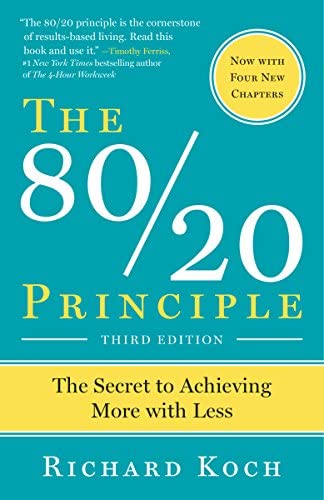
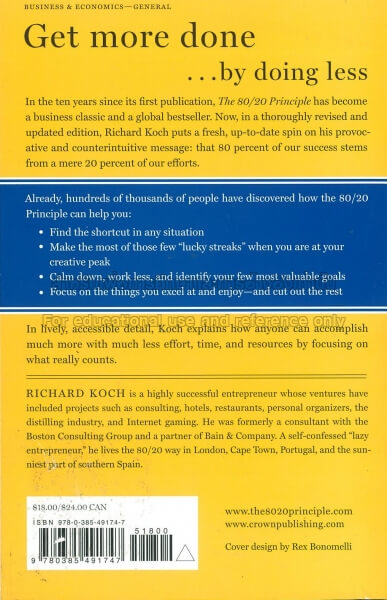

The 80/20 Principle by Richard Koch


රු1,550.00
3 X Rs. 516.67 or 8% Cashback with


or 3 X රු516.67 with


or up to 4 X රු387.50 with


The 80 20 Principle can be particularly useful in business.
A company may sell hundreds of products, while only a small number generate most of the profit.
Another company may have thousands of customers, while a relatively small group accounts for most of its revenue.
12 in stock
The 80/20 Principle by Richard Koch
80 20 Principle by Richard Koch is a classic guide to productivity, effectiveness and achieving better results by concentrating on the relatively small number of activities that create the greatest impact.
The central idea is that results are rarely distributed evenly. In many situations, a minority of causes produces a majority of outcomes.
80 20 Principle
The 80 20 Principle is commonly associated with the idea that approximately 80 percent of results may come from around 20 percent of causes.
The exact numbers do not have to be 80 and 20 in every situation.
The important lesson is imbalance.
Some customers are more valuable than others.
Some products generate far more profit than others.
Some tasks create much greater progress than others.
Richard Koch encourages readers to identify these high-impact areas and give them more attention.
The Pareto Principle
The idea is also known as the Pareto Principle.
It is associated with economist Vilfredo Pareto and observations about unequal distributions.
Koch takes this general pattern and applies it to business, productivity, careers and personal effectiveness.
The practical question becomes:
Which small number of inputs creates most of my useful results?
That question can change how people approach both work and life.
Work Smarter by Identifying High-Value Activities
Many people assume that every task deserves approximately equal attention.
In reality, some activities contribute much more to important goals.
A business owner may discover that a small number of products generates most profits.
A salesperson may discover that a minority of customers creates most revenue.
A professional may find that only a few tasks produce most meaningful progress.
80 20 Principle encourages readers to identify those differences.
The goal is not simply to become busier.
It is to become more effective.
Separate Activity from Results
Being active does not necessarily mean being productive.
A person can spend an entire day answering messages, attending meetings and completing minor administrative tasks.
They may feel extremely busy.
Yet very little important work may actually move forward.
A more useful question is:
Which activity produces the biggest result?
That shift places results above visible busyness.
Find Your Most Valuable 20 Percent
The book encourages readers to examine where their strongest results actually come from.
Possible areas include:
- Customers
- Products
- Marketing channels
- Employees
- Projects
- Skills
- Relationships
- Daily tasks
- Investments of time
- Business activities
A relatively small portion may account for much of the value.
Once that portion is identified, resources can be allocated more deliberately.
Apply the Principle to Business
The 80 20 Principle can be particularly useful in business.
A company may sell hundreds of products.
Only a small number may generate most profits.
Another company may have thousands of customers.
A relatively small group may account for most revenue.
Understanding these patterns helps leaders decide where to invest time and money.
Instead of treating every product or customer identically, businesses can identify which areas deserve special attention.
Focus on Profitable Customers
Revenue alone does not tell the complete story.
Some customers may purchase frequently and require little support.
Others may generate similar revenue while consuming large amounts of service time.
The most valuable customers are not always simply the largest.
Businesses should consider profitability, loyalty and long-term potential.
80 20 Principle encourages this type of selective analysis.
Focus on Your Best Products
The same thinking applies to products.
Some products may sell well but produce very little profit.
Others may generate strong margins and repeat demand.
Business owners can examine:
- Revenue
- Profit
- Growth
- Inventory requirements
- Customer demand
- Returns
- Marketing cost
This can reveal which products deserve greater attention.
Improve Time Management
Time management is another natural application of the principle.
A person may have twenty tasks on a list.
Only three or four may significantly affect the most important goal.
The challenge is identifying them.
Before beginning the day, ask:
- Which task creates the greatest result?
- Which task affects revenue?
- Which task prevents a major problem?
- Which task moves an important project forward?
- Which tasks can wait?
These questions help distinguish important work from background activity.
Eliminate Low-Value Work
80 20 Principle is not only about doing more of what works.
It is also about reducing what contributes very little.
Low-value activities may include:
- Unnecessary meetings
- Repetitive manual processes
- Excessive reporting
- Constant email checking
- Unprofitable products
- Ineffective marketing
- Tasks that could be delegated
Removing these activities creates time for higher-value work.
Simplification Can Improve Results
Complexity often grows naturally.
Businesses add products.
Teams add meetings.
Individuals add commitments.
Over time, complexity can consume resources without producing proportional value.
The 80/20 approach encourages simplification.
Ask:
What can be removed without damaging the important result?
This can reveal surprising opportunities.
Apply 80/20 to Sales
Sales teams can analyse where their strongest results originate.
A small number of customers may produce most revenue.
A small group of salespeople may produce a large share of total sales.
Certain lead sources may convert much better than others.
The principle encourages managers to examine these differences instead of relying only on averages.
Once high-performing areas are visible, the business can study why they work.
Apply It to Marketing
Marketing budgets are rarely equally productive.
One advertising channel may generate strong sales.
Another may consume money while creating almost no conversions.
The same can happen with:
- Social media
- Email campaigns
- Search advertising
- Influencers
- Content marketing
- Offline advertising
Measure results.
Then allocate more resources toward what genuinely works.
Stop Treating Every Opportunity Equally
Opportunities differ in quality.
Some projects may consume months while producing little benefit.
Others may create substantial results from relatively modest effort.
80 20 Principle encourages greater selectivity.
Saying yes to everything can prevent enough attention being given to the opportunities that matter most.
Sometimes effectiveness requires saying no.
Apply the Principle to Your Career
Professionals can use the same idea when thinking about career development.
Certain skills may create much greater value than others.
A salesperson may benefit enormously from improving communication and negotiation.
A software engineer may discover that mastering one high-value technology creates more opportunities than learning many tools superficially.
A manager may benefit more from improving delegation than from completing additional administrative work.
Identify the skills that create disproportionate value.
Then invest heavily in them.
Focus on Your Strengths
People often spend significant energy trying to become average at things they dislike.
Some weaknesses certainly need improvement.
However, exceptional outcomes often come from building on strengths.
Readers can ask:
- What am I unusually good at?
- Which activities produce my best results?
- What work gives me energy?
- Where do other people consistently value my contribution?
These questions can reveal high-impact strengths.
Understand the Difference Between Effort and Reward
One of the more provocative lessons in the book is that effort and reward are not always proportional.
Ten hours of low-value work may create less benefit than one hour spent solving an important problem.
This challenges the assumption that more effort always means more success.
Effort still matters.
The important question is where the effort is directed.
Create More with Less
The phrase “achieve more with less” does not mean avoiding all hard work.
It means avoiding unnecessary work.
When someone identifies the activities that create the greatest value, they can devote more energy to them.
This may increase both productivity and quality.
The result is greater leverage.
Use Data Instead of Assumptions
People often believe they know which activities matter most.
Evidence may tell a different story.
Businesses can analyse sales data.
Professionals can track project outcomes.
Individuals can examine how they actually spend time.
Useful measurements may include:
- Revenue by product
- Profit by customer
- Sales by channel
- Time spent by task
- Results by project
- Conversion rates
Good data makes 80/20 analysis more useful.
Conduct an 80/20 Review
A simple exercise is to review one important area.
Choose a category such as customers, products or tasks.
List the items.
Then measure the result generated by each one.
Rank them from highest to lowest impact.
Look for concentration.
You may discover that a surprisingly small group creates most of the value.
Use 80/20 for Personal Productivity
The principle can also be applied outside business.
Think about what consistently improves your life.
Perhaps a small number of habits creates most of your well-being.
These could include:
- Exercise
- Reading
- Time with family
- Quality sleep
- Financial planning
- Meaningful friendships
- Focused work
Giving these activities greater priority can create disproportionate benefits.
Relationships Can Also Be Unequal in Impact
Some relationships provide encouragement, opportunity and emotional support.
Others may repeatedly consume energy.
The purpose is not to evaluate people purely as business assets.
The broader lesson is to recognise where meaningful relationships deserve more time.
Strong relationships often require deliberate attention.
Avoid Perfectionism
Perfectionism can cause large amounts of time to be spent improving details that customers or colleagues barely notice.
80 20 Principle encourages readers to consider whether the additional work creates meaningful value.
Sometimes excellent is necessary.
Sometimes good enough is genuinely enough.
Knowing the difference protects time.
Make Decisions with Leverage in Mind
Leverage means producing larger results from limited resources.
Whenever choosing between activities, ask:
Which option has the highest potential impact?
This does not guarantee perfect decisions.
It creates a useful filter.
Over time, repeatedly choosing higher-leverage activities can substantially improve results.
80/20 Is Not an Exact Mathematical Rule
Readers should not assume every situation will divide precisely into 80 percent and 20 percent.
Sometimes the relationship may be 70/30.
In other situations it could be 90/10.
The practical idea is that inputs and outputs are often highly unequal.
Recognising that imbalance is more important than forcing every dataset into exact numbers.
Use the Principle Without Ignoring Necessary Work
Not every low-impact activity can be eliminated.
Businesses still need accounting, administration, compliance and customer support.
Individuals still need routine tasks.
The goal is to distinguish necessary maintenance from the work that creates growth.
Then structure time accordingly.
About Richard Koch
Richard Koch is an author, entrepreneur and investor known especially for popularising practical applications of the 80/20 Principle.
Hachette notes that The 80/20 Principle has sold well over one million copies and has been published in dozens of languages. Koch previously worked at Boston Consulting Group, became a partner at Bain & Company and co-founded LEK Consulting.
His other books include Living the 80/20 Way, The 80/20 Manager, The Star Principle and Simplify.
Who Should Read This Book?
80 20 Principle may appeal to:
- Entrepreneurs
- Business owners
- Managers
- Professionals
- Salespeople
- Marketers
- Productivity enthusiasts
- Students
- Team leaders
- Personal-development readers
It is particularly useful for people who feel busy but want to identify which activities actually create meaningful progress.
Product Details
Product title: The 80/20 Principle
Subtitle: Achieve More with Less
Author: Richard Koch
Publisher: Nicholas Brealey Publishing / John Murray Press
Format: Paperback
Language: English
Edition: Revised and Updated 2022 Edition
Page count: 432 pages
ISBN-13: 9781529370454
ISBN-10: 1529370450
Publication date: 20 January 2022
Dimensions: 214 × 134 × 34 mm
Weight: 434 grams
Categories: Business, Productivity, Time Management and Personal Development
Key themes: Pareto Principle, effectiveness, focus, prioritisation, leverage and productivity
Why Choose 80 20 Principle?
80 20 Principle provides a powerful way to question how time, money and effort are being allocated.
Richard Koch shows readers how unequal results can appear throughout business and personal life.
By identifying the minority of activities responsible for the majority of valuable outcomes, readers can make better decisions about customers, products, projects and priorities.
The principle is simple enough to remember but broad enough to apply repeatedly.
For entrepreneurs, managers and readers interested in productivity, 80 20 Principle is a valuable addition to a business and personal-development bookshelf.
Explore our complete business and productivity books collection to discover more titles about time management, strategy, entrepreneurship and achieving better results.

View the official publication details for
The 80/20 Principle by Richard Koch
.
| Author | Richard Koch |
|---|---|
| Language | English |
| Type | Paperback Printed Book (Second Quality Copy) |
| ISBN/ISSN | 1473656877, 978-1473656871 |
| Pages | 432 |
Be the first to review “The 80/20 Principle by Richard Koch”
Related products

Out of stock
Self-Help & Psychology
රු1,900.00
3 X Rs. 633.33 or 8% Cashback with
or 3 X රු633.33 with
or up to 4 X රු475.00 with

Out of stock
Autobiography
රු2,750.00
3 X Rs. 916.67 or 8% Cashback with
or 3 X රු916.67 with
or up to 4 X රු687.50 with

Non-Fiction & Knowledge
රු1,950.00
3 X Rs. 650.00 or 8% Cashback with
or 3 X රු650.00 with
or up to 4 X රු487.50 with
-24%
Out of stock
Non-Fiction & Knowledge
Original price was: රු2,100.00.රු1,600.00Current price is: රු1,600.00.
3 X Rs. 533.33 or 8% Cashback with
or 3 X රු533.33 with
or up to 4 X රු400.00 with

Non-Fiction & Knowledge
රු1,700.00
3 X Rs. 566.67 or 8% Cashback with
or 3 X රු566.67 with
or up to 4 X රු425.00 with

Out of stock
Non-Fiction & Knowledge
රු1,500.00
3 X Rs. 500.00 or 8% Cashback with
or 3 X රු500.00 with
or up to 4 X රු375.00 with
-34%

Self-Help & Psychology
Original price was: රු2,350.00.රු1,550.00Current price is: රු1,550.00.
3 X Rs. 516.67 or 8% Cashback with
or 3 X රු516.67 with
or up to 4 X රු387.50 with
Non-Fiction & Knowledge
රු2,250.00
3 X Rs. 750.00 or 8% Cashback with
or 3 X රු750.00 with
or up to 4 X රු562.50 with
Reviews
There are no reviews yet.