
No products in the cart.
-30%
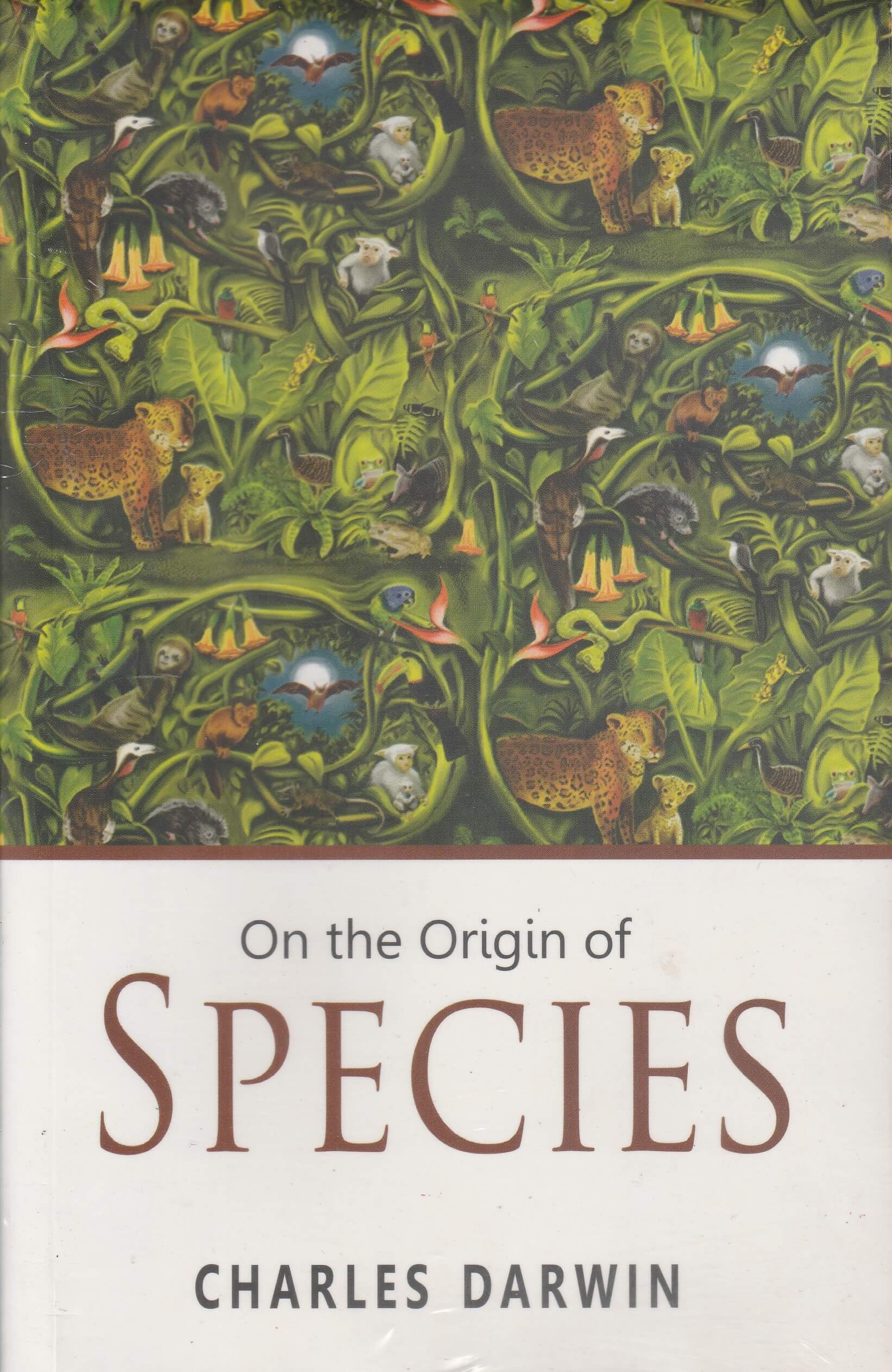
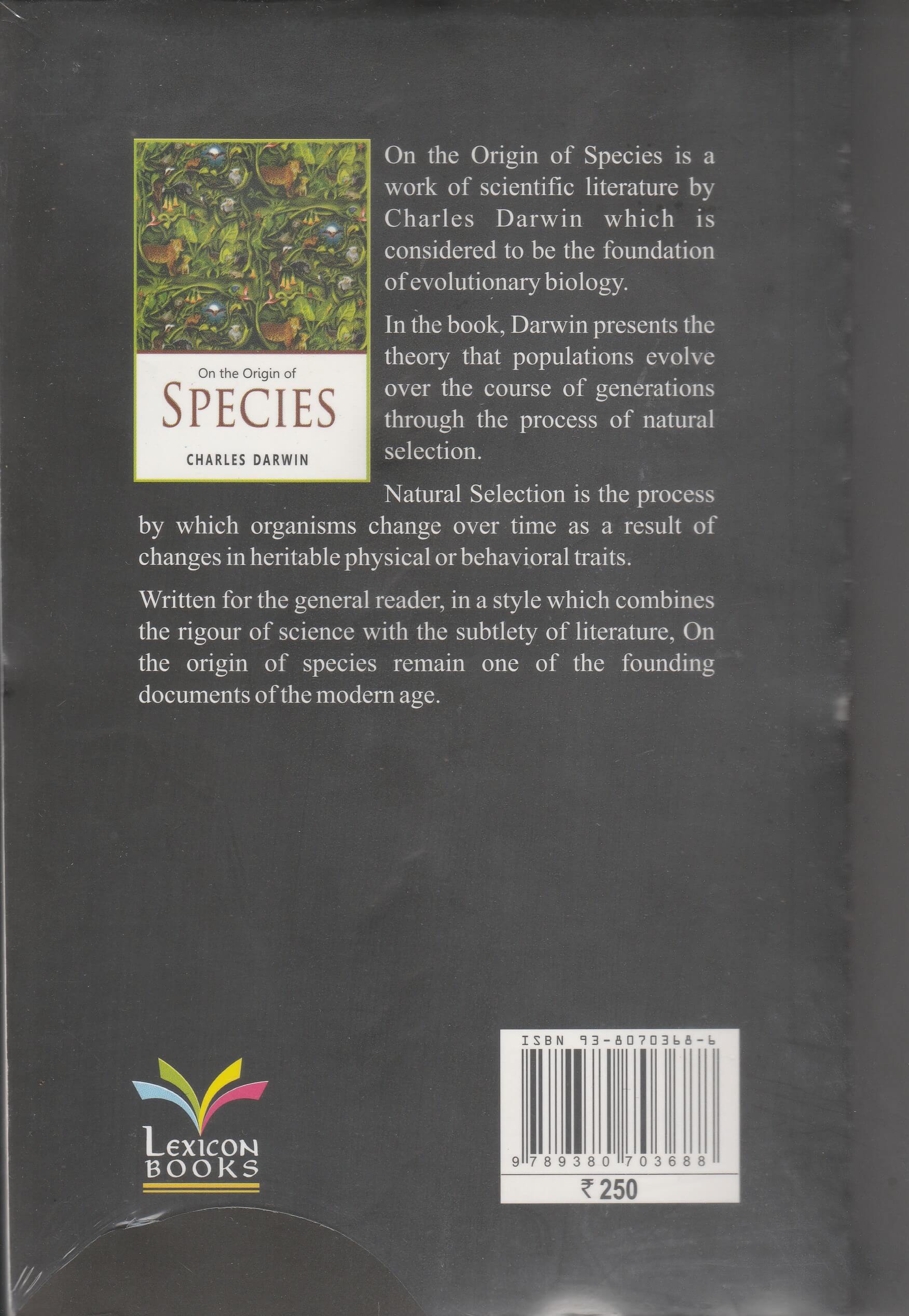

The Origin of Species by Charles Darwin


Original price was: රු1,650.00.රු1,150.00Current price is: රු1,150.00.
3 X Rs. 383.33 or 8% Cashback with


or 3 X රු383.33 with


or up to 4 X රු287.50 with


Explore the groundbreaking work that reshaped our understanding of life on Earth with ‘On the Origin of Species’ by Charles Darwin. In this seminal book, Darwin presents the theory of evolution through natural selection, revolutionizing biology and challenging prevailing beliefs. This edition offers readers a window into the profound ideas that transformed our understanding of the diversity of life.
Out of stock
Email when stock available
Origin of Species by Charles Darwin is one of the most influential scientific books ever published, presenting the groundbreaking argument that species change over generations and that natural selection can help explain how organisms become adapted to their environments.
First published in 1859, Darwin’s work transformed biology.
Before modern genetics.
Before scientists understood DNA.
Before genes and mutations were known in their present scientific sense.
Darwin assembled observations from animals, plants, fossils, geography, selective breeding and the struggle for survival to build a powerful explanation for the diversity of life.
His central argument was revolutionary but surprisingly simple.
Individuals within a species vary.
Some differences affect survival and reproduction.
Organisms produce more offspring than can all survive.
When certain inherited variations help organisms reproduce more successfully, those traits can become more common across generations.
Over very long periods, this process can produce substantial biological change.
Darwin called this process natural selection.
Origin of Species by Charles Darwin also develops the idea that different species are connected through descent from earlier forms of life.
Instead of viewing every species as independently created and permanently fixed, Darwin proposed a branching history of life in which populations change, diverge and sometimes give rise to new species.
Today, evolutionary biology has advanced enormously beyond Darwin’s original nineteenth-century account.
Modern genetics, DNA sequencing, molecular biology, population genetics and evolutionary developmental biology have added mechanisms and evidence Darwin could not have known.
Yet the core idea of evolution by natural selection remains foundational to modern biology.
Origin of Species by Charles Darwin – Book Overview
Origin of Species by Charles Darwin is not a modern textbook.
It is a historical scientific argument written by a naturalist trying to persuade readers that species are not permanently fixed.
Darwin builds his case gradually.
He begins with variation under domestication.
Then variation in nature.
Then competition for resources.
Then natural selection.
He considers objections.
He examines fossils.
He discusses geographical distribution.
He explores classification, anatomy and embryology.
The structure is important because Darwin knew his argument would challenge deeply established assumptions.
He therefore tried to show that many observations from different areas of natural history made more sense when species were understood as changing over time.
Charles Darwin
Charles Darwin was an English naturalist born in 1809.
His voyage aboard HMS Beagle from 1831 to 1836 became one of the major formative experiences of his scientific life.
During the voyage, Darwin observed:
Animals.
Plants.
Fossils.
Geology.
Island ecosystems.
Variation across geographical regions.
These observations contributed to questions that would occupy him for decades.
Why are similar species found near one another geographically?
Why do island organisms resemble nearby continental forms while still being distinct?
Why does the fossil record contain extinct organisms similar to living species in the same region?
These questions gradually contributed to his evolutionary thinking.
The Voyage of the Beagle
The Beagle voyage is often associated strongly with the Galápagos Islands.
The Galápagos were important, but Darwin’s theory did not suddenly appear there in one dramatic moment.
His understanding developed gradually after years of:
Observation.
Specimen collection.
Reading.
Correspondence.
Breeding studies.
Geological thinking.
Scientific debate.
The development of a major theory is usually less like a sudden flash and more like assembling many pieces over time.
Species Were Traditionally Viewed as Fixed
During Darwin’s lifetime, many people assumed species were essentially fixed forms.
A lion remained a lion.
A finch remained a finch.
Species might vary slightly, but the basic forms were thought to remain permanent.
Darwin challenged that idea.
He argued that small variations accumulated over enormous periods could eventually produce major differences.
Variation
Variation is essential to Darwin’s argument.
Members of a species are not perfectly identical.
Some may be:
Larger.
Smaller.
Faster.
More resistant to disease.
Better camouflaged.
Better able to tolerate heat.
Different in countless subtle ways.
Without variation, natural selection would have very little material to act upon.
Heritable Differences
For natural selection to produce evolutionary change, useful differences must be capable of passing between generations.
Darwin understood that heredity mattered.
However, he did not know the modern genetic mechanism behind inheritance.
Gregor Mendel’s work on inheritance existed during Darwin’s lifetime, but its significance was not incorporated into Darwin’s theory.
DNA would not be understood until much later.
This is one of the most important differences between Darwinian theory in 1859 and modern evolutionary biology.
More Offspring Are Produced Than Can Survive
Organisms often produce more offspring than the environment can support.
Plants may produce thousands of seeds.
Fish may produce enormous numbers of eggs.
Only a fraction survive long enough to reproduce.
This creates competition—not necessarily constant physical fighting, but a broader struggle for:
Food.
Space.
Mates.
Light.
Water.
Shelter.
Survival.
The Struggle for Existence
Darwin uses the phrase struggle for existence broadly.
An organism might struggle because:
Food is limited.
Predators are present.
Disease spreads.
Weather changes.
Competition increases.
A plant in a dry environment may be in a “struggle” for water even though it is not physically fighting another plant.
The idea concerns ecological pressure.
Natural Selection
Natural selection is the central mechanism associated with Origin of Species by Charles Darwin.
Suppose a population contains variation.
Some individuals possess traits that improve their chances of surviving and reproducing under local conditions.
If those traits are inherited, the next generation may contain more individuals with them.
Repeat this across many generations.
The population changes.
No organism decides to evolve.
There is no conscious goal.
Natural selection results from differences in reproductive success.
Natural Selection Is Not “Trying” to Improve Organisms
This is a common misunderstanding.
Evolution does not say:
A species needed a trait, so it developed one.
Instead, variation already exists or arises.
Environmental conditions determine which variations tend to increase reproductive success.
Evolution is therefore not a conscious design process.
Adaptation
An adaptation is a characteristic shaped by evolutionary processes that improves reproductive success in a particular environment.
Examples can involve:
Camouflage.
Body structure.
Behavior.
Physiology.
Feeding strategies.
But adaptation is always context-dependent.
A trait useful in one environment may be disadvantageous in another.
Artificial Selection
Darwin begins much of his argument with something people already understood:
Selective breeding.
Humans have bred:
Dogs.
Pigeons.
Cattle.
Crops.
to emphasize desired traits.
Breeders select which individuals reproduce.
Over generations, striking changes can result.
Darwin asked:
If human selection can produce substantial change, what might happen when nature continuously “selects” through differential survival and reproduction over immense periods?
Artificial Selection Versus Natural Selection
Artificial selection involves human choices.
A breeder may choose:
Larger fruit.
Faster horses.
Specific dog characteristics.
Natural selection has no breeder.
Environmental conditions influence which individuals reproduce more successfully.
The process emerges naturally.
Common Descent
Another major idea in Origin of Species by Charles Darwin is common descent.
Species are related historically.
Life resembles a branching tree.
One ancestral population may split.
Different populations experience different conditions.
They gradually diverge.
Eventually, descendants may become sufficiently different to be classified as separate species.
The Tree of Life
Darwin famously used a branching-tree image to represent evolutionary relationships.
This model remains central to biology.
Modern evolutionary trees attempt to reconstruct how organisms are related through common ancestry.
DNA now provides evidence Darwin could never have accessed.
Speciation
Speciation refers to the formation of new species.
Darwin was interested in how small differences within populations could eventually become larger differences between species.
Modern biology recognizes several mechanisms that can contribute to speciation, often involving reduced gene flow between populations.
Geographical separation is one important example.
Islands
Islands were especially important to nineteenth-century naturalists.
Island species often resemble species from the nearest continent while also showing unique differences.
Why?
Common descent provides a strong explanation.
Ancestors reach an island.
Populations become isolated.
Different environmental pressures and genetic changes accumulate.
Over generations, unique island forms may emerge.
The Galápagos
The Galápagos Islands became strongly associated with Darwin because their organisms contributed to his thinking about geographical variation.
Finches later became particularly famous in evolutionary studies.
But it is important not to reduce Darwin’s entire theory to:
“He saw finches and instantly invented evolution.”
The historical process was much longer and more complicated.
Fossils
The fossil record provides evidence that many organisms once existed but are now extinct.
Darwin asked how extinct organisms relate to living ones.
Evolution predicts patterns of continuity and change through time.
Modern paleontology has since discovered enormous amounts of evidence unavailable in Darwin’s era.
Extinction
Evolution does not imply that every species must survive.
Most species that have existed are extinct.
Environmental change.
Competition.
Predation.
Disease.
Catastrophic events.
Many forces can contribute.
Natural selection operates within changing ecological systems.
Geological Time
Evolution requires immense spans of time.
Darwin was strongly influenced by geological thinking that showed Earth had undergone gradual physical change.
Modern science now dates Earth to approximately 4.54 billion years old, far older than Darwin could precisely establish in 1859.
Deep time gives evolutionary processes enormous opportunity to accumulate change.
Biogeography
Biogeography studies where organisms live and why.
Darwin considered geographical patterns powerful evidence.
Why do nearby regions often contain related but different species?
Why do oceanic islands have distinctive organisms?
Why are some groups absent from apparently suitable habitats?
Common ancestry combined with migration, isolation and environmental change helps explain these patterns.
Homology
Different organisms often share underlying anatomical structures.
A human arm.
A bat wing.
A whale flipper.
may perform very different functions yet contain related arrangements of bones.
Evolutionary biology interprets such homologies as evidence of common ancestry modified for different functions.
Embryology
Darwin also discussed embryological similarities.
Developmental patterns can preserve evidence of evolutionary relationships.
Modern developmental biology has greatly expanded this field.
The relationship between development and evolution is now studied at genetic and molecular levels Darwin could not have imagined.
Classification
Biologists classify organisms into groups.
Darwin argued that classification makes deeper sense if it reflects genealogy.
Organisms resemble one another partly because they share ancestors.
Modern phylogenetics continues this approach using anatomical and especially genetic evidence.
DNA Changed Evolutionary Biology
Darwin developed natural selection without knowing DNA existed as the hereditary material.
Today, evolution is understood through genetics.
Mutations create new genetic variation.
Recombination reshuffles existing variation.
Natural selection changes frequencies of traits and genes.
Genetic drift can change populations randomly.
Gene flow moves genetic variation between populations.
Modern evolutionary theory is therefore broader than Darwin’s original explanation.
Mutation
A mutation is a change in genetic material.
Mutations are not produced because an organism “needs” them.
Most are neutral or harmful in a particular context.
Occasionally, a mutation may improve reproductive success under specific conditions.
Natural selection can then increase its frequency.
Genetic Drift
Not all evolutionary change is caused by natural selection.
Genetic drift describes random changes in gene frequencies, particularly important in small populations.
This is a major development beyond the simpler popular picture of evolution as “everything happens because of natural selection.”
Sexual Selection
Darwin also developed the concept of sexual selection more fully in later work.
Some traits may evolve because they improve mating success rather than survival alone.
Peacock tails are a familiar example.
A trait can be costly for survival yet still spread if it strongly improves reproductive success.
“Survival of the Fittest”
The phrase “survival of the fittest” is often treated as if Darwin invented it.
He did not.
It was coined by philosopher Herbert Spencer after reading Darwin.
Darwin later adopted the phrase in later editions.
More importantly, “fittest” does not simply mean:
Strongest.
Biggest.
Most aggressive.
In evolutionary terms, fitness relates to reproductive success in a particular environment.
Evolution Is Not a Ladder
Another common misunderstanding is imagining evolution as a ladder:
Simple → advanced → perfect.
Modern evolutionary biology instead uses a branching-tree model.
Species adapt to different environments.
One living species is not automatically “more evolved” than another.
All living species have evolutionary histories extending back through time.
Humans Did Not Descend From Modern Monkeys
Evolution does not claim humans descended from the monkeys alive today.
Humans and other primates share earlier common ancestors.
This is a branching relationship.
The same principle applies throughout the tree of life.
What Does Origin of Species Say About Humans?
Interestingly, Origin of Species by Charles Darwin focuses mainly on plants, animals, variation and the general mechanism of evolution.
It does not provide Darwin’s full argument about human evolution.
He treated that subject much more directly in his later book The Descent of Man, published in 1871.
So customers looking specifically for a detailed book on human evolution should know that Origin of Species is broader and more foundational.
The Book Is Not About the Origin of Life
This is another important clarification.
Origin of Species by Charles Darwin is primarily about how species change and diversify.
It does not provide a scientific explanation of how the first life originally arose from nonliving chemistry.
The study of life’s chemical beginnings is called abiogenesis, a separate field of research.
Evolutionary theory primarily addresses what happens once populations of reproducing organisms exist.
Darwin Did Not Invent the Idea of Evolution
Thinkers before Darwin had proposed that life changes over time.
Darwin’s major contribution was providing a powerful mechanism—natural selection—supported by a broad body of evidence.
Alfred Russel Wallace independently developed a similar idea of natural selection, and his work was presented jointly with Darwin’s in 1858.
This historical context matters because scientific discoveries often involve multiple contributors.
Alfred Russel Wallace
Wallace’s independent insight pushed Darwin toward publication.
Both men recognized natural selection as a major evolutionary mechanism.
Darwin’s extensive evidence and long-developed argument then appeared in On the Origin of Species in 1859.
Wallace therefore deserves significant recognition in the history of evolutionary theory.
Why the Book Was Revolutionary
Darwin challenged the assumption that species were fixed.
He offered a natural mechanism capable of explaining:
Adaptation.
Diversity.
Common structural patterns.
Geographical distribution.
The relationship between extinct and living organisms.
This provided biology with a unifying framework.
Evolution Today
Modern evolutionary theory is supported by evidence from fields including genetics, molecular biology, paleontology, biogeography, anatomy, developmental biology and observed evolutionary change.
Scientists continue debating many details of evolutionary history and mechanisms.
But evolution itself is foundational to modern biology.
Medicine and Evolution
Evolutionary thinking helps scientists understand:
Antibiotic resistance.
Viral evolution.
Cancer evolution.
Pathogen adaptation.
Drug resistance.
This shows that evolutionary biology is not merely about fossils from the distant past.
It has direct modern applications.
Antibiotic Resistance
When bacteria vary in resistance and antibiotics kill susceptible bacteria, resistant variants may survive and reproduce.
Over time, populations can become increasingly resistant.
This is natural selection occurring on timescales humans can observe.
Agriculture
Evolution also matters in agriculture.
Pests can evolve resistance to pesticides.
Pathogens can evolve against crop defenses.
Breeders use artificial selection.
Understanding evolutionary processes helps manage these challenges.
Conservation Biology
Small populations can lose genetic diversity.
Isolated populations may experience stronger genetic drift.
Changing climates alter selective pressures.
Evolutionary biology therefore contributes to conservation strategies for endangered species.
Historical Limitations
Origin of Species by Charles Darwin should be read both as a scientific classic and as a nineteenth-century book.
Some terminology is old.
Some scientific details are outdated.
Darwin lacked genetics.
He lacked modern molecular evidence.
Some hypotheses he considered have been revised or rejected.
That does not reduce the book’s historical importance.
It helps readers understand how science develops.
Science Changes
One of the most valuable lessons from reading historical science is seeing that scientific knowledge is not static.
Darwin proposed explanations.
Later scientists tested them.
Some ideas survived.
Some were modified.
New mechanisms were discovered.
This is how science works.
Science Does Not Require Founders to Be Perfect
Modern evolutionary theory is not accepted because Charles Darwin was famous.
It is accepted because generations of evidence support evolutionary processes.
Science does not depend on permanent loyalty to one historical author.
If evidence contradicts an old idea, the old idea can be replaced.
Religion and Evolution
The publication of Origin of Species became connected with major religious and philosophical debates.
Different religious traditions and individuals have responded to evolution in different ways.
Some reject evolutionary theory.
Others accept evolution while maintaining religious belief.
The scientific question and theological interpretations are not identical questions.
For a product description, it is best to present Darwin’s scientific argument accurately without suggesting that all religious believers or traditions respond in the same way.
Why Read the Original?
Modern textbooks explain evolution more accurately and comprehensively than Darwin could in 1859.
So why read Origin of Species by Charles Darwin today?
Because reading the original allows you to see:
How a major scientific argument was constructed.
What evidence Darwin considered persuasive.
How scientific thinking developed historically.
How one book changed biology.
It is therefore valuable for both science and intellectual history.
Is Origin of Species Difficult to Read?
The ideas are accessible, but the writing is Victorian.
Sentences can be long.
Darwin provides many examples.
The argument develops gradually.
Readers expecting a modern popular-science style may find it slower.
A good strategy is to focus first on the major concepts:
Variation.
Struggle for existence.
Natural selection.
Common descent.
Then follow the supporting evidence.
Is It a Biology Textbook?
No.
It is a historical scientific work.
For current biological knowledge, use a modern evolution or biology textbook.
For understanding Darwin’s original argument and the history of science, Origin of Species by Charles Darwin remains essential.
Is It Still Scientifically Important?
Yes, historically and conceptually.
Modern evolutionary biology has changed substantially since 1859, but natural selection and common descent remain foundational concepts.
The book is therefore important even though many modern details come from later research.
Important Themes
Origin of Species by Charles Darwin explores natural selection, evolution, adaptation, variation, heredity, competition, common descent, speciation, extinction, biogeography, fossils, classification, artificial selection, biological diversity and the changing history of life.
7 Powerful Ideas From Origin of Species by Charles Darwin
- Species are not permanently fixed. Populations can change across generations, and long-term change can eventually produce new species.
- Variation provides the raw material for evolution. Individuals within populations differ, and some inherited differences affect survival and reproduction.
- Natural selection can produce adaptation. Traits that improve reproductive success in a particular environment may become more common over generations.
- All living things are connected through common descent. The diversity of life is better understood as a branching evolutionary tree than as completely separate biological creations.
- Geography preserves clues to evolutionary history. Island species and regional patterns make sense when migration, isolation and common ancestry are considered together.
- Extinction is part of evolutionary history. Evolution produces new forms while environmental change and competition can also cause lineages to disappear.
- Science grows by testing and revising ideas. Darwin’s work transformed biology, but modern genetics, DNA research and population biology later expanded and corrected parts of his original framework.
Why Read Origin of Species by Charles Darwin?
Origin of Species by Charles Darwin is an excellent choice for readers interested in biology, evolution, natural history, genetics, ecology, the history of science, Charles Darwin and the development of scientific thought.
It is particularly valuable for readers who want to understand evolutionary theory at its historical turning point.
Rather than simply learning the modern summary—
“species evolve through natural selection”—
you see Darwin trying to establish why readers should accept that conclusion.
He moves from observation to explanation.
From domestic breeding to wild populations.
From variation to competition.
From fossils to geography.
From anatomy to classification.
That makes the book not only a scientific classic but also a fascinating example of how a large argument is built from many smaller pieces of evidence.
Who Should Read This Book?
Origin of Species by Charles Darwin may especially appeal to biology students, science readers, university students, teachers, history-of-science readers, philosophy-of-science readers, natural-history enthusiasts and anyone curious about one of the books that fundamentally changed how humanity understands life.
It is also useful for readers who frequently encounter debates about evolution and want to understand what Darwin actually argued rather than relying only on simplified summaries.
Origin of Species by Charles Darwin – A Book That Changed Our Understanding of Life
Origin of Species by Charles Darwin changed biology because it offered a new way to understand an enormous question.
Why does life have so many different forms?
Why do organisms seem so well suited to their environments?
Why do species in nearby regions resemble one another?
Why do extinct fossils resemble living organisms?
Why does classification look like a branching hierarchy?
Darwin argued that these observations are connected.
Life changes.
Populations vary.
Organisms reproduce.
Not every individual leaves the same number of descendants.
Useful inherited variations can spread.
Populations diverge.
Lineages branch.
Some disappear.
Others continue.
Across vast stretches of time, simple processes can generate extraordinary biological diversity.
Darwin did not know everything.
He did not know DNA.
He did not understand mutation in the modern genetic sense.
He lacked today’s fossil record.
He had no genome sequencing.
That makes his achievement more remarkable, but it also reminds readers not to treat the book as the final word on evolution.
Science continued.
Mendelian genetics was rediscovered.
Population genetics developed.
DNA was identified as hereditary material.
Molecular biology transformed evolutionary research.
Genomes now allow scientists to compare relationships at a level Darwin could never have imagined.
The strongest way to read Darwin today is therefore not as an untouchable authority.
Read him as a scientist making an extraordinary argument with the evidence available in his century.
Then compare that argument with the much larger body of evidence available now.
For anyone interested in biology, evolution, natural history or the history of scientific ideas, Origin of Species by Charles Darwin remains one of the essential books for understanding how a single scientific framework reshaped humanity’s view of the living world.
Learn more about On the Origin of Species by Charles Darwin on the official Project Gutenberg website.
Explore more science and classic books at Bargain Books.
| Author | Charles Darwin |
|---|---|
| Type | Paperback Printed Book |
| ISBN/ISSN | 9390896991, 978-9390896998 |
| Language | English |
| Pages | 440 |
Be the first to review “The Origin of Species by Charles Darwin”
Related products

Non-Fiction & Knowledge
රු1,950.00
3 X Rs. 650.00 or 8% Cashback with
or 3 X රු650.00 with
or up to 4 X රු487.50 with
Non-Fiction & Knowledge
රු1,550.00
3 X Rs. 516.67 or 8% Cashback with
or 3 X රු516.67 with
or up to 4 X රු387.50 with

Out of stock
Autobiography
රු2,750.00
3 X Rs. 916.67 or 8% Cashback with
or 3 X රු916.67 with
or up to 4 X රු687.50 with

රු2,000.00
3 X Rs. 666.67 or 8% Cashback with
or 3 X රු666.67 with
or up to 4 X රු500.00 with
-24%

Out of stock
Non-Fiction & Knowledge
Original price was: රු2,500.00.රු1,900.00Current price is: රු1,900.00.
3 X Rs. 633.33 or 8% Cashback with
or 3 X රු633.33 with
or up to 4 X රු475.00 with
-24%
Out of stock
Non-Fiction & Knowledge
Original price was: රු2,100.00.රු1,600.00Current price is: රු1,600.00.
3 X Rs. 533.33 or 8% Cashback with
or 3 X රු533.33 with
or up to 4 X රු400.00 with
-23%

Non-Fiction & Knowledge
Original price was: රු2,200.00.රු1,700.00Current price is: රු1,700.00.
3 X Rs. 566.67 or 8% Cashback with
or 3 X රු566.67 with
or up to 4 X රු425.00 with
Non-Fiction & Knowledge
රු2,450.00
3 X Rs. 816.67 or 8% Cashback with
or 3 X රු816.67 with
or up to 4 X රු612.50 with
Reviews
There are no reviews yet.