No products in the cart.
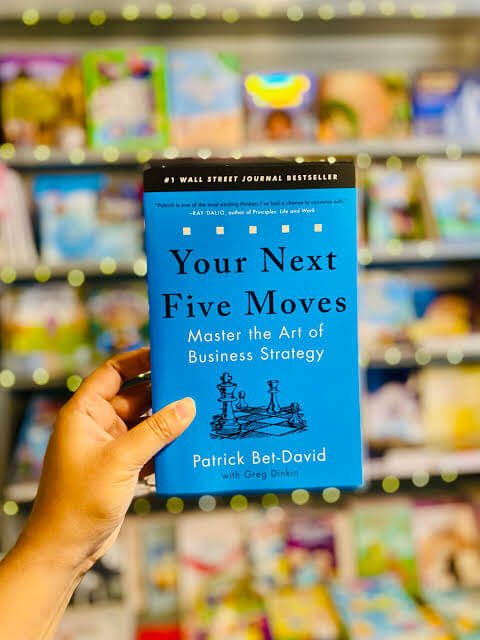
Your Next Five Moves: Master the Art of Business Strategy by Patrick Bet-David

රු1,900.00
3 X Rs. 633.33 or 8% Cashback with


or 3 X රු633.33 with


or up to 4 X රු475.00 with


Great entrepreneurs think like strong chess players: they do not focus only on the move in front of them—they think several moves ahead.
In Your Next Five Moves, Patrick Bet-David, with Greg Dinkin, presents a practical framework for improving business strategy and decision-making.
Learn about:
- Strategic Thinking
- Entrepreneurship
- Business Growth
- Problem Solving
- Leadership
- Building the Right Team
- Competitive Strategy
- Power & Leverage
- Decision-Making
- Long-Term Planning
A practical business guide for entrepreneurs, executives, managers and anyone who wants to think more strategically.
Trade Paperback | 320 pages | Gallery Books | ISBN 9781982154813
10 in stock
Your Next Five Moves by Patrick Bet-David
Your Next Five Moves: Master the Art of Business Strategy by Patrick Bet-David, with Greg Dinkin, is a practical business book about thinking several steps ahead, making better strategic decisions and building a clearer path toward professional goals.
The central idea comes from chess.
Strong chess players do not focus only on the move immediately in front of them.
They study the board, anticipate how others may respond and consider several possible moves before choosing what to do next.
Bet-David applies that mindset to business.
Simon & Schuster describes the book as a methodology for entrepreneurs, executives and strategists who want to think more clearly about what they should do next.
Think Beyond the Next Move
Many business decisions are made reactively.
A competitor changes prices.
A staff member leaves.
Revenue drops.
A new opportunity appears.
A customer makes an unexpected request.
When every decision is made only in response to the latest event, leaders can lose sight of the larger strategy.
Your Next Five Moves encourages readers to think beyond the immediate problem.
Instead of asking only:
“What should I do now?”
the book encourages questions such as:
- What happens after this decision?
- How will competitors respond?
- What capabilities will I need next?
- What risks am I creating?
- What opportunities will this open?
- What position do I want to be in several moves from now?
This is the core strategic mindset behind the book.
Move One: Master Knowing Yourself
Strategic thinking begins with clarity.
Before deciding where a business should go, a leader needs to understand what they actually want.
Simon & Schuster highlights clarity about what you want and who you want to be as one of the book’s central outcomes.
This involves examining:
- Personal ambitions
- Strengths
- Weaknesses
- Values
- Motivation
- Long-term goals
- Risk tolerance
Without clarity, it is easy to pursue opportunities simply because they appear attractive.
A person may build a successful company and still realise that the life attached to that company is not what they wanted.
Bet-David therefore connects business strategy with self-awareness.
Move Two: Improve Your Problem-Solving Ability
The second major area is learning how to reason through difficult problems.
Business rarely provides complete information.
Leaders often have to make decisions involving:
- Limited resources
- Uncertain outcomes
- Competitive pressure
- Difficult employees
- Customer expectations
- Financial constraints
- Rapid changes
The book encourages readers to break problems into smaller parts and think carefully about cause and effect.
Rather than reacting emotionally, the goal is to understand the situation well enough to identify the most useful move.
Google Books categorises the title under Decision-Making & Problem Solving, reflecting this strong focus.
Move Three: Build the Right Team
A company cannot scale indefinitely through one person’s effort.
At some point, growth depends on other people.
The official publisher summary highlights building the right team based on strong values as one of the book’s main lessons.
This means thinking carefully about:
- Hiring
- Culture
- Values
- Incentives
- Accountability
- Leadership
- Communication
- Team strengths
A talented person who does not align with the organisation’s direction can create problems.
Likewise, a leader who refuses to delegate can become the main bottleneck in a growing company.
Bet-David encourages entrepreneurs to think strategically about the people around them.
Move Four: Strategy for Growth
Growth can create opportunities, but it can also expose weaknesses.
A company that works well at one size may struggle when it becomes larger.
Processes break.
Communication becomes harder.
Cash requirements increase.
Competition notices the company.
The book discusses growth tactics for both good times and difficult times, according to Simon & Schuster.
Readers are encouraged to think about:
- Scaling operations
- Business development
- Competition
- Capital
- Market positioning
- Organisational structure
- Timing
The goal is not simply to grow quickly.
It is to grow strategically.
Move Five: Power, Leverage and Competitive Positioning
The final major area involves understanding power and leverage.
Business relationships are rarely perfectly equal.
One side may control:
- Capital
- Customers
- Distribution
- Information
- Talent
- Technology
- Brand reputation
- Negotiating power
Simon & Schuster specifically identifies power plays and the art of applying leverage among the book’s core topics.
Understanding leverage can help leaders negotiate more effectively and avoid entering situations where they have no strategic options.
This section is particularly relevant to:
- Founders
- Executives
- Sales professionals
- Negotiators
- Investors
- Business owners
Strategic Thinking Like a Chess Player
The chess analogy runs throughout the book.
A beginner sees a move.
A stronger player sees what that move changes.
An expert looks further ahead.
Business strategy works in a similar way.
For example, lowering a price may increase sales today.
But the next questions are:
- Will competitors also lower prices?
- Will customers begin expecting discounts?
- Will margins become too small?
- Will increased volume strain operations?
- Will the lower price damage premium positioning?
Thinking several moves ahead helps leaders consider consequences before acting.
Decision-Making Under Pressure
One of the strongest uses of the book is helping readers think more systematically when decisions feel urgent.
Pressure can lead to:
- Impulsive choices
- Avoidance
- Emotional reactions
- Short-term thinking
- Overconfidence
A strategic framework slows the decision down just enough to ask better questions.
This does not mean every decision requires weeks of analysis.
It means developing the habit of considering what comes next.
Entrepreneurship
Google Books classifies Your Next Five Moves under Entrepreneurship, Leadership, Strategic Planning, Decision-Making and Personal Success.
That combination accurately reflects the book.
It is particularly relevant to entrepreneurs because founders often need to make decisions across many different areas at the same time:
- Sales
- Marketing
- Hiring
- Finance
- Product
- Operations
- Partnerships
- Competition
A founder may not have specialists available for every decision.
Being able to think strategically becomes a major advantage.
Leadership
The book is also strongly relevant to leadership.
As a company grows, a leader’s job changes.
Early on, the founder may personally handle many tasks.
Later, the leader needs to:
- Set direction
- Build systems
- Recruit talent
- Develop managers
- Allocate resources
- Make strategic choices
This transition can be difficult.
Someone who is excellent at doing the work is not automatically excellent at leading others who do the work.
Your Next Five Moves encourages readers to think beyond individual execution and toward organisational strategy.
Clarity Before Growth
One useful lesson from the book is that greater effort is not always the answer.
Sometimes the problem is unclear direction.
If a business owner does not know what they are trying to build, working harder can simply move them faster in the wrong direction.
The book therefore begins with questions about identity and ambition before moving into competition and growth.
That sequence is important.
Strategy starts by knowing what game you are actually trying to win.
About Patrick Bet-David
Patrick Bet-David is an entrepreneur and the creator of Valuetainment, a business-focused media platform.
Simon & Schuster’s author biography describes his path from leaving Iran, serving in the U.S. military and entering financial services to founding a financial-services agency and building Valuetainment.
His business background provides the practical context for many of the examples and frameworks used throughout the book.
Greg Dinkin’s Contribution
Although Patrick Bet-David is the primary author displayed on the cover and publisher page, the official Simon & Schuster edition credits:
“With Greg Dinkin.”
For WooCommerce, I recommend:
Author: Patrick Bet-David
Contributor / With: Greg Dinkin
This preserves the official credit without confusing customers about the primary author.
Who Will Enjoy Your Next Five Moves?
This book may especially appeal to:
- Entrepreneurs
- Small-business owners
- Executives
- Managers
- Startup founders
- Business students
- Sales leaders
- Strategists
- Team leaders
- Professionals planning career growth
It is especially relevant to readers who want practical frameworks rather than a purely academic business-strategy textbook.
Buy Your Next Five Moves in Sri Lanka
For readers looking to buy Your Next Five Moves by Patrick Bet-David in Sri Lanka, ISBN 9781982154813 identifies the Gallery Books trade paperback.
Exact-ISBN physical records cluster around:
- 256–263 g
- approximately 21.1–21.3 cm × 13.7–14.1 cm
- approximately 1.8–2.3 cm thick.
The Simon & Schuster wholesale listing through Faire reports:
- 258.55 g
- 21.3 × 14 × 1.8 cm.
For WooCommerce shipping, I recommend:
0.259 kg / 21.3 × 14.0 × 1.8 cm
Be the first to review “Your Next Five Moves: Master the Art of Business Strategy by Patrick Bet-David”
Related products
Business, Finance & Economics
රු1,700.00
3 X Rs. 566.67 or 8% Cashback with
or 3 X රු566.67 with
or up to 4 X රු425.00 with
-20%
Out of stock
Original price was: රු2,500.00.රු2,000.00Current price is: රු2,000.00.
3 X Rs. 666.67 or 8% Cashback with
or 3 X රු666.67 with
or up to 4 X රු500.00 with

රු2,350.00
3 X Rs. 783.33 or 8% Cashback with
or 3 X රු783.33 with
or up to 4 X රු587.50 with
-13%

Out of stock
Original price was: රු4,000.00.රු3,500.00Current price is: රු3,500.00.
3 X Rs. 1,166.67 or 8% Cashback with
or 3 X රු1,166.67 with
or up to 4 X රු875.00 with
-33%

Original price was: රු2,900.00.රු1,950.00Current price is: රු1,950.00.
3 X Rs. 650.00 or 8% Cashback with
or 3 X රු650.00 with
or up to 4 X රු487.50 with

රු1,750.00
3 X Rs. 583.33 or 8% Cashback with
or 3 X රු583.33 with
or up to 4 X රු437.50 with
රු2,900.00
3 X Rs. 966.67 or 8% Cashback with
or 3 X රු966.67 with
or up to 4 X රු725.00 with
Business
රු1,400.00
3 X Rs. 466.67 or 8% Cashback with
or 3 X රු466.67 with
or up to 4 X රු350.00 with
Reviews
There are no reviews yet.