
No products in the cart.
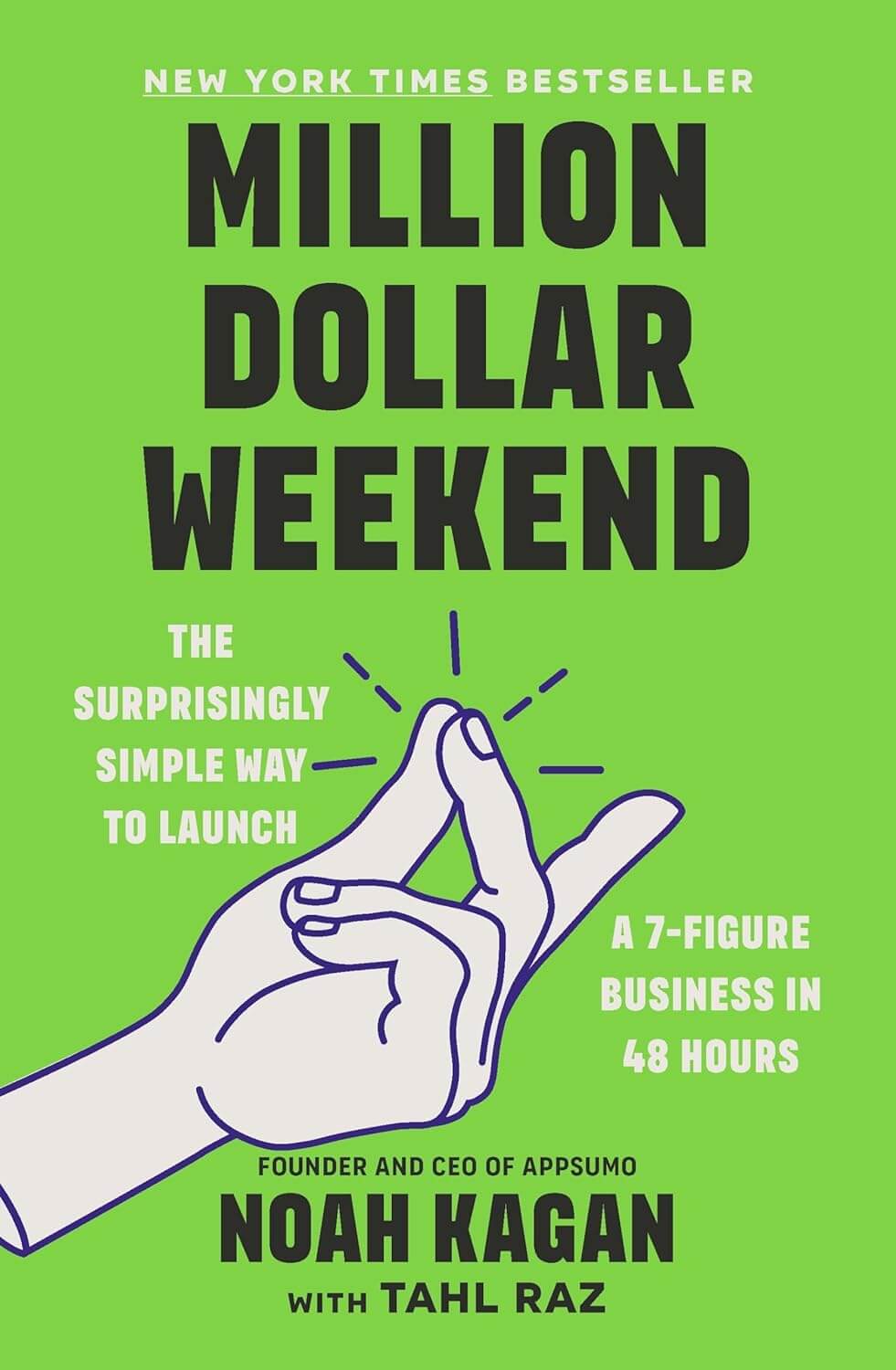
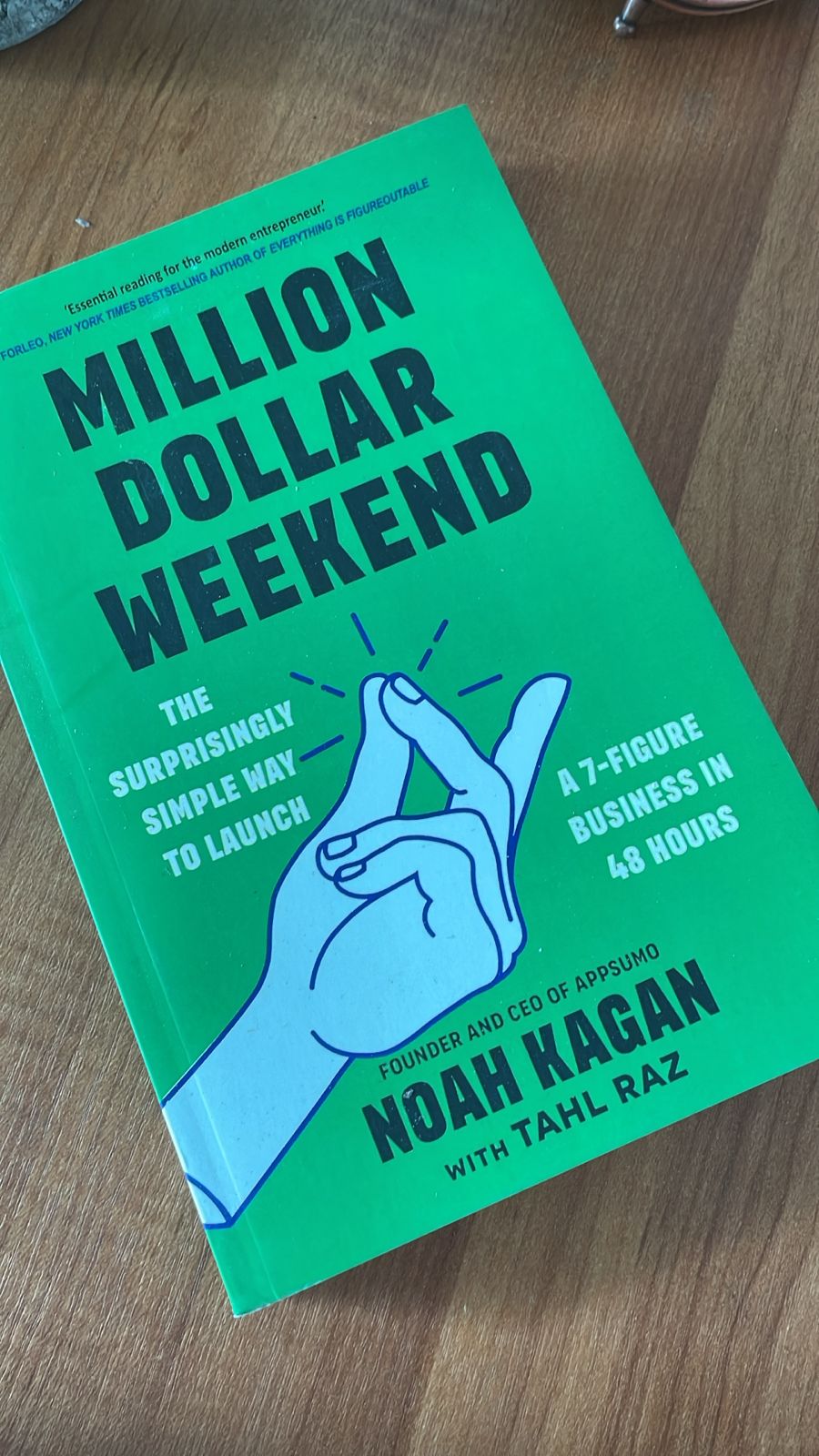
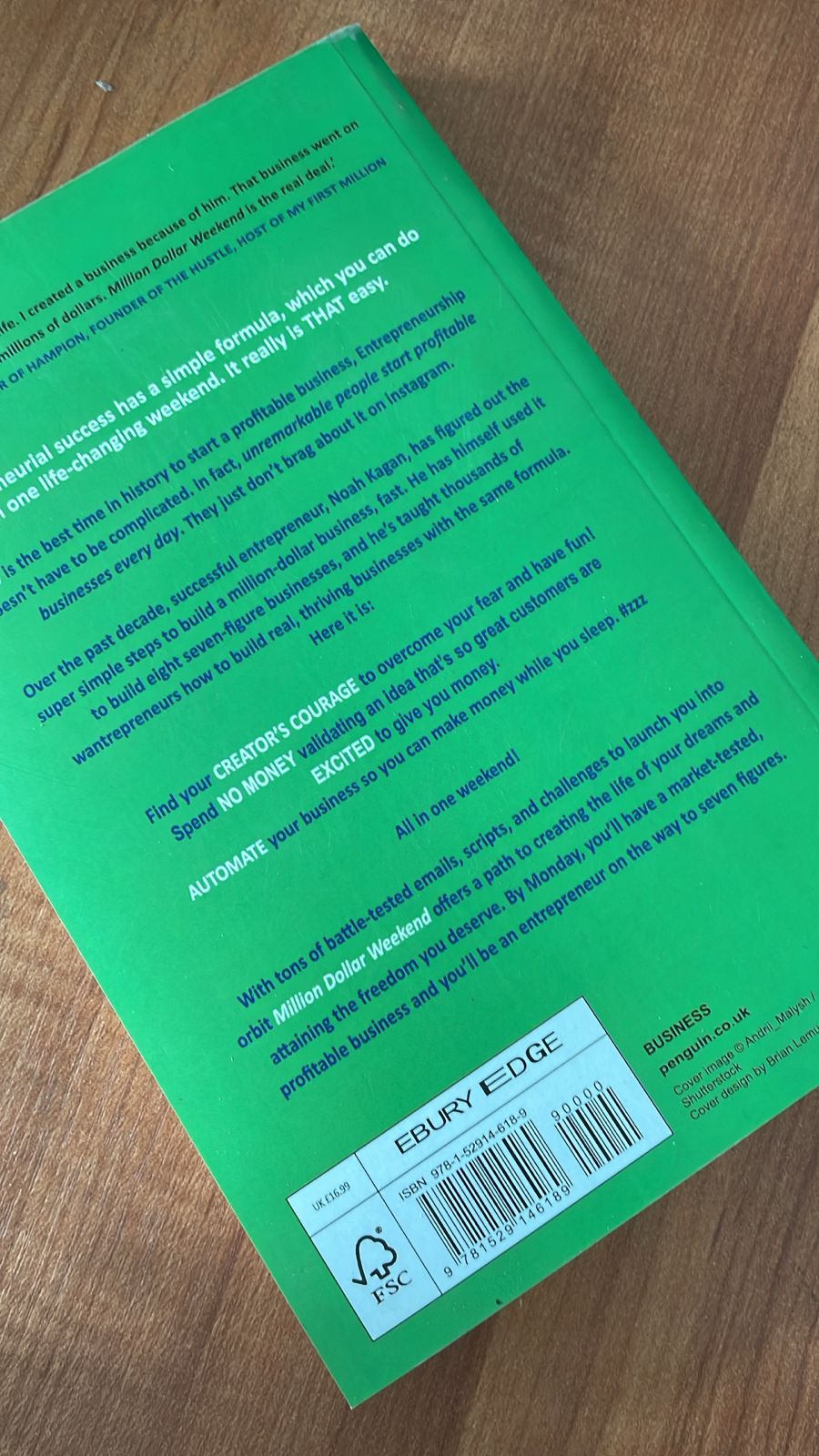


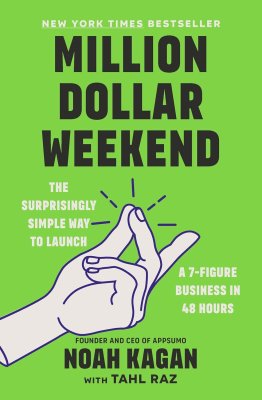
Million Dollar Weekend by by Noah Kagan
රු1,990.00
3 X Rs. 663.33 or 8% Cashback with


or 3 X රු663.33 with


or up to 4 X රු497.50 with


Million Dollar Weekend: The Surprisingly Simple Way to Launch a 7-Figure Business in 48 Hours by Noah Kagan is a practical guide for aspiring entrepreneurs looking to quickly build a profitable business. Kagan provides actionable strategies, proven techniques, and real-world insights that show how to create a 7-figure business in just a weekend, breaking down complex processes into simple, effective steps.
13 in stock
Million Dollar Weekend by Noah Kagan is a practical entrepreneurship guide for people who want to stop endlessly planning a business and start testing whether real customers will actually pay for their idea.
Many aspiring entrepreneurs spend months preparing.
They think they need:
The perfect business idea.
A professional logo.
A beautiful website.
Business cards.
A large social-media following.
Investors.
Complicated software.
A detailed business plan.
Noah Kagan argues that most of these things can wait.
The first question is much simpler:
Will someone pay you?
Instead of spending months building a business before knowing whether customers want it, Million Dollar Weekend encourages readers to move quickly.
Find a problem.
Talk to potential customers.
Ask for money.
Validate demand.
Then improve the idea based on real feedback.
Kagan presents entrepreneurship as something learned through action rather than endless preparation.
His approach challenges two common fears:
Fear of starting.
And:
Fear of asking.
The book includes practical challenges designed to make readers more comfortable with rejection, selling and taking immediate action.
Its central message is simple:
You do not need to know every step before beginning.
You need to take the next useful step.
For aspiring entrepreneurs, side-hustle builders, freelancers, creators and small-business owners, Million Dollar Weekend by Noah Kagan offers a fast-moving framework for turning ideas into experiments and experiments into paying customers.
Million Dollar Weekend by Noah Kagan – Book Overview
Million Dollar Weekend by Noah Kagan is built around action.
The problem Kagan sees is not necessarily that people lack ideas.
People have ideas constantly.
A restaurant concept.
An online service.
A product.
An app.
A consulting business.
A course.
A retail idea.
The problem is that many people never test them.
They wait.
Research.
Plan.
Watch videos.
Read more books.
Design logos.
Then months later, they still have no customer.
The book tries to break that cycle.
Start Before You Feel Ready
One of the biggest lessons in the book is that readiness is often an illusion.
You may think:
I’ll start when I know more.
When I have more money.
When I understand marketing.
When the website is finished.
When I have more confidence.
But every new stage creates another reason to wait.
Kagan encourages readers to begin before everything feels perfect.
NOW, Not How
A key mindset is essentially:
Focus on now before becoming trapped by how.
People often stop themselves by asking:
How will I build the entire company?
How will I hire employees?
How will I reach one million dollars?
How will I automate everything?
Those questions may matter eventually.
But they can prevent today’s action.
A better question is:
What can I do right now?
Take the Smallest Useful Action
Suppose you want to start a tutoring business.
You do not need to build a complete tutoring platform today.
You could message ten parents.
Suppose you want to start a marketing service.
You do not need an agency office.
You can contact one potential client.
Suppose you want to sell a product.
You do not need 1,000 units.
You can try to pre-sell the first few.
Action creates information.
Fear of Rejection
Entrepreneurship involves asking.
Ask customers to buy.
Ask partners to collaborate.
Ask people for feedback.
Ask suppliers for better terms.
Ask employees to join.
Ask investors for money.
Many people avoid entrepreneurship because asking creates the possibility of rejection.
Kagan deliberately encourages readers to practice being rejected.
The Dollar Challenge
One memorable exercise in Million Dollar Weekend by Noah Kagan is the Dollar Challenge.
The idea is intentionally small.
Ask someone for a very small amount of money.
The amount itself barely matters.
The real purpose is practicing the uncomfortable act of asking.
Once someone learns:
I can ask.
Someone may say no.
I will survive.
the fear begins losing power.
Rejection Is Data
A no is not always personal rejection.
It may mean:
Wrong customer.
Wrong offer.
Wrong timing.
Wrong price.
Wrong problem.
Weak explanation.
Every no can provide useful information.
Ask Why
If someone says no, ask respectfully:
What stopped you?
Their answer might reveal the real problem.
Too expensive.
Not urgent.
Already using something else.
Do not understand the value.
Need another feature.
Feedback improves the next offer.
The Coffee Challenge
The book also encourages small exercises designed to make rejection feel less frightening.
The goal is not receiving every yes.
The goal is becoming comfortable enough with asking that fear no longer controls your decisions.
For entrepreneurs, this matters because selling requires repeated asks.
Creator’s Courage
Kagan emphasizes developing what he describes as the courage to create.
A creator produces something and places it in front of the world.
That creates vulnerability.
People may:
Ignore it.
Criticize it.
Reject it.
But they may also:
Buy it.
Recommend it.
Love it.
You cannot receive the positive result without risking the negative one.
Stop Waiting for the Perfect Idea
A major misconception is believing successful entrepreneurs discover one magical idea.
In reality, many businesses begin with:
An ordinary problem.
A simple service.
A frustrating experience.
An inefficient process.
Something people already want improved.
The challenge is not necessarily originality.
It is usefulness.
Problems Create Business Ideas
Instead of asking:
What business should I start?
try asking:
What problems do people repeatedly experience?
What frustrates me?
What do friends complain about?
What do businesses waste time doing?
What would people happily pay to make easier?
Problems are often more useful starting points than brainstorming random ideas.
Customer First
Million Dollar Weekend by Noah Kagan strongly encourages beginning with customers.
Entrepreneurs sometimes fall in love with their own idea.
They build for months.
Then launch.
And discover nobody wants it.
A customer-first approach reverses the process.
Talk to people first.
Understand their problem.
Then create the solution.
Customers Do Not Pay for Your Effort
You may spend six months building something.
That does not automatically make it valuable.
Customers pay for:
Results.
Convenience.
Entertainment.
Savings.
Status.
Speed.
Relief.
Transformation.
The amount of effort you spent building something is not the same as the value customers receive.
Validate Before Building
Validation means gathering evidence that people actually want the offer.
The strongest evidence is not:
Likes.
Compliments.
Friends saying, “That’s a great idea.”
The strongest evidence is usually:
Payment.
Someone paying demonstrates stronger intent than someone saying they might buy later.
Get Paying Customers Early
The book pushes readers toward getting customers before building a complicated operation.
Why?
Because early customers prove demand.
They also teach you:
What people really want.
Which language resonates.
What they will pay.
Which features matter.
Which features do not.
The 48-Hour Mindset
The “weekend” concept is designed to create urgency.
A short deadline prevents endless overthinking.
When you give yourself six months, you may create six months of work.
When you have two days, you must identify what actually matters.
This encourages simplicity.
Constraints Can Help
Limited:
Time.
Money.
People.
can sometimes improve creativity.
You are forced to ask:
What is essential?
What can wait?
What is the fastest way to test this?
That can produce better decision-making than unlimited preparation.
Your Freedom Number
Another useful concept in Million Dollar Weekend by Noah Kagan is identifying a financial target connected with personal freedom.
Instead of beginning with:
I need to make a million dollars.
ask:
How much monthly income would meaningfully change my life?
Perhaps enough to:
Cover rent.
Pay bills.
Reduce work hours.
Leave a job.
Support family.
The number may be much smaller than one million dollars.
Specific Goals Beat Vague Goals
“I want to be rich” is vague.
“I want my business to generate Rs. 300,000 per month” is measurable.
Now you can ask:
How many customers do I need?
At what price?
What costs will I have?
Specific goals allow calculation.
The One-Minute Business Model
Business ideas can be tested with simple mathematics before huge amounts of money are invested.
Ask:
How many possible customers exist?
How much could each customer reasonably pay?
What does delivering the product cost?
What profit remains?
Could the model realistically reach the size you want?
Simple numbers can eliminate weak ideas quickly.
Revenue Is Not Profit
One of the most important basic business distinctions is:
Revenue is money coming in.
Profit is what remains after costs.
A business can generate impressive sales and still lose money.
Entrepreneurs should understand:
Product cost.
Delivery.
Advertising.
Payment fees.
Software.
Employees.
Returns.
Taxes.
Overheads.
Market Size Matters
Imagine making Rs. 100 profit per customer.
To earn Rs. 1,000,000 profit, you need 10,000 customers.
Can you realistically reach them?
If not, you may need to change:
Price.
Margin.
Target customer.
Business model.
Price Matters
Many beginners underprice because they are afraid customers will reject them.
But extremely low prices can create another problem.
You may need too many customers to create a sustainable business.
Pricing should reflect:
Customer value.
Competition.
Costs.
Positioning.
Market.
Sell Before You Build
This is one of the strongest principles in Million Dollar Weekend by Noah Kagan.
Instead of spending months creating something and hoping people purchase it later, try to validate demand first.
This could involve:
Pre-orders.
Deposits.
Paid pilot projects.
Consulting clients.
Early-access customers.
The exact method depends on the business.
The Dream Ten
When looking for early customers, start with people most likely to need the solution.
Rather than advertising to everyone, identify a small targeted group.
Think:
Who already has this problem?
Who do I know?
Who can introduce me?
Who is most likely to buy?
Focused outreach is often more effective than generic mass marketing.
Your First Customers Matter
The first customers are not only revenue.
They are teachers.
Ask them:
Why did you buy?
What did you expect?
What was confusing?
What would make this better?
Would you recommend it?
Their answers can shape the business.
Solve Before You Scale
Beginners sometimes ask:
How do I scale?
before they have one satisfied customer.
Scaling something people do not want only creates a larger failure.
First:
Solve the problem.
Then repeat.
Then scale.
Manual First, Automation Later
You do not need automation immediately.
At first, doing things manually can teach you how the process works.
For example:
Personally respond to customers.
Manually create invoices.
Pack orders yourself.
Handle support.
Then identify repeated tasks.
Only afterward automate.
Automation
Once demand is proven, automation can reduce repetitive work.
Possible areas include:
Email marketing.
Customer follow-up.
Payments.
Reporting.
Inventory alerts.
Scheduling.
Lead management.
Automation should improve a working process rather than hide a broken one.
Build Systems
A business becomes more scalable when it depends less on the founder personally handling every task.
Systems may include:
Documented processes.
Software.
Automation.
Employees.
Templates.
Standard operating procedures.
The goal is repeatability.
Business Versus Self-Employment
If the owner must personally perform every sale, delivery and customer interaction forever, they may have created a demanding job rather than a scalable business.
That is not necessarily bad.
But it is important to understand the distinction.
Start Small
Small beginnings reduce risk.
You do not necessarily need:
A large office.
Twenty employees.
Huge inventory.
Expensive equipment.
Start with the smallest version capable of proving demand.
Minimum Viable Offer
Before creating the perfect product, create enough value to solve the customer’s core problem.
Then improve it.
This prevents wasting time on features customers do not care about.
Get Feedback Fast
Fast feedback is an advantage.
Launch.
Observe.
Improve.
The shorter the feedback cycle, the faster you learn.
Do Not Hide Behind Branding
Branding matters eventually.
But people sometimes use branding as productive procrastination.
Weeks spent debating:
Logo colors.
Fonts.
Business cards.
Domain names.
may feel like work while avoiding the harder task:
Selling.
Customers Before Cosmetics
Before perfecting visual identity, prove people want the product.
A beautiful brand around an unwanted offer is still an unwanted offer.
Selling Is Helping
Many people dislike selling because they associate it with manipulation.
Healthy selling is different.
If you genuinely solve a problem, explaining that solution helps the customer decide whether it is useful.
The goal is not forcing someone to buy.
It is finding people who need what you provide.
Ask Clearly
Do not end every sales conversation with:
“Let me know what you think.”
Make a clear offer.
Explain:
What you provide.
How it helps.
What it costs.
What happens next.
Then ask whether they want it.
Learn to Hear No
You cannot build a business while requiring universal approval.
Some people will reject:
Your offer.
Your price.
Your idea.
That is normal.
The goal is finding enough right customers—not convincing everyone.
Side Hustles
Million Dollar Weekend by Noah Kagan is especially relevant to people who want to start while keeping their existing job.
A small experiment can reduce risk.
You can test:
Demand.
Pricing.
Customer acquisition.
Delivery.
before making a major career decision.
You Do Not Have to Quit Immediately
Entrepreneurship does not require dramatic resignation on day one.
A side business can provide useful evidence.
Grow until the numbers justify another decision.
Financial Runway
Before leaving stable employment, understand:
Monthly expenses.
Savings.
Business revenue.
Business costs.
Income consistency.
Risk.
Excitement should not replace financial planning.
Marketing
Once the business is validated, marketing becomes important.
Marketing helps the right people discover the offer.
Channels may include:
Social media.
Email.
Content.
Partnerships.
Referrals.
Direct outreach.
Advertising.
Different businesses require different mixes.
Start With People You Can Reach
Your first customers may come from:
Friends.
Former colleagues.
Existing communities.
Local businesses.
Professional networks.
You do not need millions of followers.
You need access to people with the problem.
Referrals
Satisfied customers can become a powerful acquisition channel.
Ask:
Who else might need this?
A recommendation from someone trusted can be more persuasive than advertising.
Email is valuable because it creates a direct communication channel.
Social platforms can change algorithms.
An email list provides a more direct connection with interested customers.
Social Media
Social media can help:
Demonstrate expertise.
Reach customers.
Share results.
Educate.
Build trust.
But followers are not automatically a business.
Revenue requires an offer.
Build an Audience With Purpose
Do not chase follower counts only for status.
Ask:
Are these the people who need what we sell?
A small targeted audience can be more valuable than a huge unrelated one.
Entrepreneurship Is Experimentation
Treat ideas like experiments.
Hypothesis:
These customers have this problem.
Experiment:
Offer this solution.
Result:
They buy or they do not.
Then adjust.
This removes some emotion from failure.
Failure Can Be Cheap
One advantage of testing quickly is that weak ideas can fail before you invest heavily.
A failed weekend experiment is cheaper than:
Six months of development.
A large inventory purchase.
Expensive office rent.
A Failed Idea Can Be a Success
If you quickly discover customers do not want something, you have gained useful knowledge.
That saves:
Time.
Money.
Energy.
Then you can test the next idea.
Do Not Fall in Love With One Solution
Stay committed to solving a useful problem.
But remain flexible about how.
Perhaps customers dislike:
Your product.
But love the service.
Or dislike the subscription.
But prefer one-time payment.
Listen.
Entrepreneurship for Introverts
Business does not require becoming the loudest person in the room.
Introverts can succeed through:
Preparation.
Listening.
Writing.
Expertise.
One-to-one communication.
Selling is a learnable skill.
Confidence Comes After Action
People often wait for confidence before acting.
But confidence frequently develops because you acted.
First sales call:
Terrifying.
Tenth:
Easier.
Hundredth:
Normal.
Repetition changes fear.
Speed
Kagan strongly favors speed.
Not careless speed.
Learning speed.
How quickly can you move from:
Idea.
To customer conversation.
To payment.
To feedback.
To improvement.
Fast learning creates an advantage.
Perfectionism
Perfectionism sounds admirable.
But it can become avoidance.
The founder says:
It is not ready.
Another month passes.
The customer still has nothing.
Aim for useful before perfect.
Ask Better Questions
Instead of:
What business will make me rich?
ask:
What problem can I solve?
Instead of:
How do I get millions of customers?
ask:
How do I get the first three?
Instead of:
How do I automate everything?
ask:
Does anyone want this?
Better questions create better priorities.
Simple Businesses Can Win
A business does not need to involve revolutionary technology.
Simple businesses can create significant value.
Cleaning.
Consulting.
Bookkeeping.
Delivery.
Tutoring.
Retail.
Maintenance.
Specialized services.
Customers care about solutions.
Entrepreneurship and Technology
Technology makes many businesses cheaper to test.
Today, entrepreneurs can access:
Payment platforms.
Website tools.
AI.
Email software.
Video calls.
E-commerce systems.
Social platforms.
Cloud software.
But tools do not replace customers.
AI and Million Dollar Weekend
AI can accelerate:
Brainstorming.
Research.
Copywriting.
Prototyping.
Design.
Customer analysis.
But AI can also make overbuilding easier.
You can create an impressive product quickly and still discover nobody wants it.
Customer validation remains essential.
Apply the Book to Retail
A retailer can use Million Dollar Weekend by Noah Kagan principles by testing demand before making a large stock commitment.
For example:
Post a product.
Collect pre-orders.
Measure enquiries.
Run a small campaign.
Test customer response.
Then order more based on evidence.
Apply the Book to Online Stores
An online store can test:
New categories.
Bundles.
Subscriptions.
Gift products.
Corporate packages.
Promotions.
before making major investments.
The principle is:
Small experiment.
Real customer response.
Then scale.
Apply the Book to Services
Suppose you want to start:
Website development.
Marketing consulting.
Accounting.
Design.
Tutoring.
You may not need a website first.
Contact potential customers directly.
Offer a clear result.
Ask for payment.
Deliver manually.
Improve.
AppSumo
Noah Kagan is best known as the founder of AppSumo, a business focused on software deals for entrepreneurs.
His entrepreneurial experience strongly shapes the book’s practical, experimental approach.
Early Career Experience
Before building AppSumo, Kagan worked in technology companies including Facebook and Mint.
His experiences with both employment and entrepreneurship contribute to the book’s emphasis on taking action rather than waiting for perfect conditions.
Is Million Dollar Weekend a Get-Rich-Quick Book?
The title may sound like one.
But the useful message is not:
“You will become a millionaire by Monday.”
The weekend is primarily a framework for quickly testing whether a business idea has real demand.
Building a seven-figure company still requires:
Customers.
Execution.
Growth.
Systems.
Persistence.
Seven Figures Are Not Guaranteed
No book can guarantee a million-dollar business.
Market conditions matter.
Execution matters.
Skills matter.
Capital may matter.
Timing matters.
The framework is best understood as a method for reducing wasted time and learning faster.
Is Million Dollar Weekend Good for Beginners?
Yes.
Million Dollar Weekend by Noah Kagan is particularly suitable for people who have thought about starting a business but feel overwhelmed by:
Risk.
Fear.
Lack of ideas.
Lack of experience.
The book deliberately focuses on small initial actions.
Is It Good for Existing Business Owners?
Yes.
Existing entrepreneurs can use the same principles to test:
New products.
New markets.
Pricing.
Services.
Sales channels.
Business ideas.
The validation framework can apply repeatedly.
Is It a Marketing Book?
Partly.
It covers customer acquisition and growth, but the core focus is broader:
Starting.
Validating.
Selling.
Building.
Growing.
Is It a Startup Book?
Yes, although its lessons are not limited to venture-backed technology startups.
They can apply to:
Side hustles.
Local businesses.
Freelancing.
Online businesses.
Retail.
Services.
Important Themes
Million Dollar Weekend by Noah Kagan explores:
- Entrepreneurship
- Starting a business
- Business ideas
- Side hustles
- Customer validation
- Selling
- Rejection
- Confidence
- Action
- Business growth
- Market testing
- Customer research
- Pricing
- Freedom Number
- Dollar Challenge
- NOW Not How
- First customers
- Automation
- Marketing
- Financial freedom
7 Powerful Business Lessons From Million Dollar Weekend by Noah Kagan
There are many lessons in Million Dollar Weekend by Noah Kagan, but seven stand out:
- Start before you feel completely ready – Waiting for perfect knowledge, confidence or circumstances can delay useful action indefinitely.
- Practice asking and become comfortable with rejection – Entrepreneurs need to ask customers to buy, so fear of hearing no must not control the business.
- Find problems before becoming obsessed with ideas – Useful businesses usually begin by solving something people genuinely care about.
- Validate with real money before overbuilding – Payment is much stronger evidence of demand than compliments, likes or expressions of interest.
- Get the first few customers before worrying about massive scale – A business begins by proving that one small group of people will pay for the solution.
- Use speed to learn faster – Short experiments reveal whether assumptions are correct before months of time and money are committed.
- Automate and scale only after proving what works – Systems are powerful, but they should multiply a validated business rather than automate something customers never wanted.
Why Read Million Dollar Weekend by Noah Kagan?
Million Dollar Weekend by Noah Kagan is an excellent choice for readers interested in:
- Entrepreneurship
- Starting a business
- Side hustles
- Business validation
- Noah Kagan
- AppSumo
- Business ideas
- Small business
- Online business
- Customer acquisition
- Selling
- Marketing
- Startup books
- Financial freedom
- Business growth
- Overcoming fear
- Taking action
- First customers
- Business experiments
- Scalable businesses
It is especially useful for people who have spent a long time thinking about starting something but have not yet tested whether customers will pay.
Who Should Read This Book?
Million Dollar Weekend by Noah Kagan may especially appeal to:
- Aspiring entrepreneurs
- Startup founders
- Small-business owners
- Freelancers
- Students interested in entrepreneurship
- Side-hustle builders
- Online sellers
- Creators
- Consultants
- Marketers
- Product managers
- People afraid of selling
- People with too many business ideas
- Existing business owners testing new products
- Anyone who needs a practical push from planning into action
Million Dollar Weekend by Noah Kagan – Stop Planning Forever and Test the Idea
Million Dollar Weekend by Noah Kagan challenges one of the most common habits among aspiring entrepreneurs:
Preparing without starting.
There will always be another thing you could do first.
Read another book.
Watch another video.
Research another competitor.
Redesign the logo.
Build another feature.
Eventually, preparation becomes a comfortable hiding place.
Real entrepreneurship begins when the idea touches the market.
You ask.
Someone responds.
They say yes.
Or they say no.
Either result teaches you more than endless speculation.
That is why speed matters.
Not because every business should be rushed.
But because learning should not be unnecessarily delayed.
Find a problem.
Identify potential customers.
Make an offer.
Ask for money.
If people buy:
Deliver.
Learn.
Improve.
Repeat.
If nobody buys:
Learn why.
Change the offer.
Or test another problem.
The first goal is not necessarily becoming a millionaire.
The first goal is proving that someone values your solution enough to pay for it.
Then you can build.
Then you can market.
Then you can automate.
Then you can scale.
That sequence can save enormous amounts of:
Time.
Money.
Frustration.
For readers interested in entrepreneurship, side hustles, customer validation and building businesses through real-world action, Million Dollar Weekend by Noah Kagan offers a direct and energetic framework for replacing “someday” with a practical experiment you can start now.
Learn more about Million Dollar Weekend by Noah Kagan on Noah Kagan’s official website.
Explore more business and entrepreneurship books at Bargain Books.
‘A lively read that provides a practical step-by-step guide to founding a business.’ The Financial Times
It’s time to leapfrog the only hurdle between you and a million-dollar company.
| Weight | 300 kg |
|---|---|
| Dimensions | 15.2 × 1.8 × 23.3 cm |
Be the first to review “Million Dollar Weekend by by Noah Kagan”
Related products
Business, Finance & Economics
රු1,950.00
3 X Rs. 650.00 or 8% Cashback with
or 3 X රු650.00 with
or up to 4 X රු487.50 with
Out of stock
Business, Finance & Economics
රු1,900.00
3 X Rs. 633.33 or 8% Cashback with
or 3 X රු633.33 with
or up to 4 X රු475.00 with
Out of stock
Entrepreneurship
රු1,700.00
3 X Rs. 566.67 or 8% Cashback with
or 3 X රු566.67 with
or up to 4 X රු425.00 with
Out of stock
රු1,500.00
3 X Rs. 500.00 or 8% Cashback with
or 3 X රු500.00 with
or up to 4 X රු375.00 with
Entrepreneurship
රු2,500.00
3 X Rs. 833.33 or 8% Cashback with
or 3 X රු833.33 with
or up to 4 X රු625.00 with
Entrepreneurship
රු1,600.00
3 X Rs. 533.33 or 8% Cashback with
or 3 X රු533.33 with
or up to 4 X රු400.00 with
Out of stock
Business
රු2,700.00
3 X Rs. 900.00 or 8% Cashback with
or 3 X රු900.00 with
or up to 4 X රු675.00 with
Reviews
There are no reviews yet.