
No products in the cart.
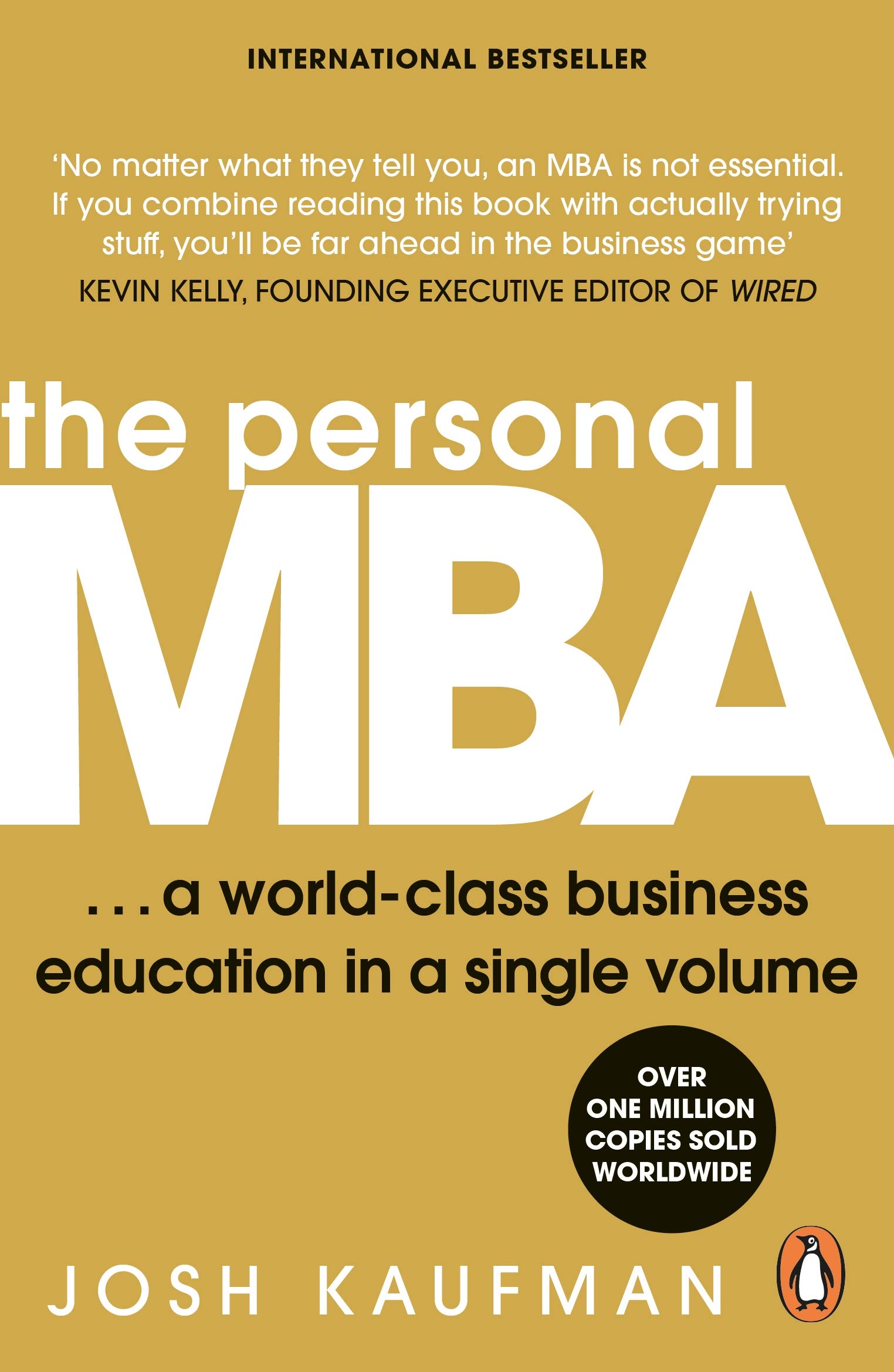



The Personal MBA by KAUFMAN JOSH

රු1,900.00
3 X Rs. 633.33 or 8% Cashback with


or 3 X රු633.33 with


or up to 4 X රු475.00 with


“The Personal MBA” by Josh Kaufman is a comprehensive guide that distills the core principles of business into practical, actionable insights. Ideal for aspiring entrepreneurs, business professionals, and lifelong learners, this book provides the essential knowledge you need to succeed in business without the time and cost of a traditional MBA program.
51 in stock
The Personal MBA by Josh Kaufman is a practical introduction to the essential principles of business, designed for entrepreneurs, managers, students and professionals who want to understand how successful businesses actually work without becoming buried in unnecessary jargon.
What does every successful business need?
A product or service people genuinely want.
A way to attract potential customers.
A method for turning interest into sales.
A system for delivering what was promised.
And enough financial discipline to remain profitable.
Josh Kaufman argues that these fundamental ideas can be understood without spending years learning complicated business terminology.
Instead, the reader can study the most useful principles directly.
The Personal MBA by Josh Kaufman explores value creation, marketing, sales, value delivery and finance before moving into human psychology, productivity, working with others and systems thinking. Kaufman’s official book site describes the book as an introductory business primer covering the universal principles behind successful businesses.
The result is a broad, accessible business education for anyone who wants to understand how companies create value, make money, serve customers and improve their operations.
The Personal MBA by Josh Kaufman – Book Overview
The Personal MBA by Josh Kaufman begins from a simple idea:
Business does not need to feel mysterious.
Behind complex corporate language are several basic processes.
A business identifies something people want.
It creates that value.
It tells potential customers about it.
It persuades some of them to buy.
It delivers what was promised.
It manages the money generated by those transactions.
Everything else builds on those fundamentals.
Kaufman organizes the early chapters around five core business areas: Value Creation, Marketing, Sales, Value Delivery and Finance. He then expands into how the human mind works, how individuals manage themselves, how people work together and how systems can be understood and improved.
Value Creation Comes First
A business cannot survive simply because its founder is passionate about an idea.
Customers must care too.
Kaufman begins with value creation because every successful business must provide something useful enough that another person is willing to exchange money, time or attention for it.
His official chapter description explains value creation as identifying something people need or want and finding a way to provide it.
This sounds obvious, but many businesses reverse the process.
They create a product first.
Spend money building it.
Then ask:
“Who can we sell this to?”
A stronger approach begins with:
“What problem already exists?”
“Who experiences it?”
“How important is solving it?”
“What are people already doing about it?”
Start With the Market, Not the Idea
One of Kaufman’s best-known concepts is the Iron Law of the Market.
Even a well-designed offer struggles if too few people want it.
A mediocre offer entering a strong market can sometimes perform better than an excellent offer entering a market with almost no demand.
That makes market selection extremely important.
Before investing heavily, entrepreneurs should evaluate whether enough people genuinely want the outcome being offered.
The 12 Standard Forms of Value
Kaufman also argues that businesses can create value in more ways than simply selling physical products.
A business may provide products, services, shared resources, subscriptions, resale, leasing, agency arrangements and other forms of value.
The point is not memorizing terminology.
It is realizing that one customer need can often be served through several different business models.
A bookstore, for example, may sell books directly, offer memberships, organize events, provide corporate gifting services or build subscription-style reading programs.
The underlying customer need may stay similar while the form of value changes.
Marketing Is About Attention
Creating something useful is not enough.
People must know it exists.
The official Personal MBA material defines marketing as attracting the attention of people who are likely to be interested in what a business offers. Kaufman also distinguishes marketing from sales: marketing creates awareness and interest, while sales turns qualified interest into a transaction.
This distinction is important.
A business can have excellent marketing and poor sales.
Thousands of people may view a product.
Very few buy.
Alternatively, a business may have a strong sales process but almost no marketing.
The team converts prospects well, but there are not enough prospects.
Both systems need to work.
Attention Is Valuable
Modern customers have almost unlimited choices competing for attention.
Books.
Videos.
Advertisements.
Social media.
Messages.
Streaming services.
Online stores.
A business therefore cannot assume customers will simply notice it.
Marketing requires communicating why the offer matters.
Focus on the End Result
Customers usually care less about technical features than businesses think.
They care about the result.
A reader does not necessarily buy a business book because it has 496 pages.
They buy because they want knowledge that may help them:
Understand business.
Make better decisions.
Increase revenue.
Build a company.
Improve a career.
Kaufman calls attention to the importance of communicating the end result customers want rather than only describing product features.
Marketing Is Not Manipulation
Good marketing should help the right people understand why an offer may be useful.
It should not depend on deceiving customers.
The strongest businesses try to match genuine customer needs with genuine value.
That produces something much healthier than forcing unsuitable products onto uninterested people.
Sales Turns Interest Into Revenue
Kaufman’s third major business area is sales.
A company can have:
Excellent products.
Beautiful branding.
Thousands of followers.
High website traffic.
But if nobody completes a transaction, the company does not have a sustainable business.
The official sales chapter describes the process as moving from a prospect to a paying customer while building enough trust for the buyer to believe the business can deliver what it promises.
Good Sales Reduces Uncertainty
Why do people hesitate before purchasing?
They may wonder:
Is this worth the price?
Will it work?
Can I trust this company?
Is there a better alternative?
Do I really need it now?
A good sales process helps customers answer those questions.
This can involve:
Clear product information.
Reviews.
Demonstrations.
Guarantees.
Helpful staff.
Transparent pricing.
Trust reduces uncertainty.
Sales Is Not Pressure
Aggressive pressure may produce occasional transactions.
But long-term business success depends more heavily on:
Trust.
Repeat customers.
Referrals.
Reputation.
A customer who feels manipulated may buy once and never return.
A customer who feels understood may remain for years.
Value Delivery
Once the sale happens, another responsibility begins.
The business must actually deliver what was promised.
This is the fourth major area in The Personal MBA by Josh Kaufman.
A strong marketing campaign may create demand.
A good sales process may generate orders.
But poor delivery destroys trust.
Late orders.
Incorrect items.
Poor customer support.
Broken products.
Confusing processes.
All reduce the value created earlier.
Operations Matter
Customers usually see the final result.
Behind that result are operational systems.
Inventory.
Staff.
Software.
Suppliers.
Packaging.
Payment processing.
Delivery.
Customer service.
Returns.
An efficient business designs these processes so value reaches the customer reliably.
Customer Expectations
Customer satisfaction often depends on the gap between what was expected and what was received.
Overpromising creates dangerous expectations.
A company that promises perfection and delivers something merely good may disappoint.
A company that sets accurate expectations and then slightly exceeds them may create loyalty.
Finance Without Fear
Finance is the fifth core business area.
Kaufman deliberately presents it in practical terms.
His official finance chapter describes finance as tracking money flowing into and out of a business and determining whether enough remains for the company to continue operating.
Business finance therefore does not need to begin with advanced mathematics.
Start with basic questions.
How much money came in?
How much went out?
What did it cost to make the sale?
What remains?
Is the business generating enough cash?
Revenue Is Not Profit
This is a crucial distinction for entrepreneurs.
Imagine a company generates Rs. 10 million in sales.
That sounds impressive.
But if running the business costs Rs. 11 million, revenue alone does not indicate success.
Profit depends on what remains after relevant expenses.
A growing business can even have strong reported sales while experiencing serious cash-flow problems.
Cash Flow Matters
Cash gives businesses flexibility.
Cash pays:
Employees.
Suppliers.
Rent.
Marketing.
Software.
Taxes.
Inventory.
Equipment.
Growth investments.
Kaufman’s finance material emphasizes cash-flow awareness because a profitable-looking business can still run into trouble if cash is unavailable when bills need to be paid.
Profit Margin
Two businesses can generate the same revenue but operate very differently.
If Business A earns Rs. 1,000,000 in sales and retains Rs. 300,000 after costs, while Business B retains only Rs. 50,000, their financial positions are very different.
Understanding margin helps owners avoid becoming impressed by sales numbers without understanding profitability.
Pricing Power
Price is one of the strongest business levers.
Pricing too low can create:
Weak margins.
Cash-flow pressure.
Difficulty hiring.
Poor service.
Limited growth.
Pricing too high without sufficient perceived value creates another problem.
The goal is to create enough value that customers can reasonably justify the price while leaving enough margin for the company to operate sustainably.
The Four Ways to Increase Revenue
Kaufman also highlights four broad ways businesses can improve revenue: increase the number of customers, increase the average transaction size, increase how often customers purchase, or raise prices where justified. His official materials present these as core finance concepts.
This framework is useful because it simplifies a vague goal such as:
“We need more revenue.”
Instead, the business can identify which lever needs attention.
Customer Lifetime Value
A customer should not always be evaluated by one purchase.
Suppose someone buys from a business every month for five years.
That relationship may be worth far more than the first order suggests.
Understanding lifetime value can influence how much a company can reasonably spend to acquire and retain customers.
Acquisition Cost
Marketing is not free.
A business may spend money on:
Advertising.
Influencers.
Sales teams.
SEO.
Events.
Discounts.
Promotions.
The key question is whether acquiring the customer produces enough value to justify the cost.
The Human Mind
After explaining the basic mechanics of business, The Personal MBA by Josh Kaufman moves into psychology.
Businesses are created by people for people.
Understanding customer behavior requires understanding:
Motivation.
Attention.
Fear.
Habit.
Status.
Decision-making.
Bias.
The official chapter on the human mind explores how people interpret information, make decisions and choose whether to act.
People Are Not Perfectly Rational
Traditional business thinking can sometimes assume that customers simply compare all options and choose the objectively best one.
Real people do not operate that way.
They are influenced by:
Emotion.
Habit.
Social proof.
Fear.
Loss aversion.
Convenience.
Attention.
Previous experience.
Good business decisions therefore require understanding human behavior, not only spreadsheets.
Loss Aversion
People often feel losses more strongly than equivalent gains.
Losing Rs. 5,000 may feel more painful than gaining Rs. 5,000 feels pleasurable.
This can influence:
Purchasing.
Investing.
Negotiations.
Pricing.
Decision-making.
Understanding the principle can help leaders recognize when fear of losing something prevents rational decisions.
Working With Yourself
Business performance depends partly on personal performance.
Kaufman therefore dedicates a major section to productivity.
His official chapter discusses goal-setting, task management, overcoming resistance and getting useful work completed without burning out.
This makes The Personal MBA by Josh Kaufman broader than a traditional entrepreneurship manual.
It also asks:
How do you manage your own attention?
The Cost of Switching Tasks
Constantly switching between:
Email.
WhatsApp.
Meetings.
Coding.
Reports.
Social media.
calls.
creates a cognitive cost.
A busy day can feel productive while producing very little deep work.
Protecting focused time can dramatically improve output.
Most Important Tasks
A long to-do list can create the illusion that everything matters equally.
Usually it does not.
Some tasks create disproportionate value.
A useful productivity habit is asking:
What is the most important thing I can complete today?
Stress and Recovery
Productivity should not mean endless work.
Kaufman’s official material explicitly discusses the importance of stress and recovery, arguing that deliberate recovery can make work both more enjoyable and more sustainable.
Burnout is not a sign that someone has mastered productivity.
Sustainable performance requires recovery.
Working With Others
No business operates entirely alone.
Even solo entrepreneurs depend on:
Customers.
Suppliers.
Contractors.
Platforms.
Partners.
Advisers.
Employees.
Kaufman’s chapter on working with others focuses on communication, trust, collaboration, leadership and management.
Communication Is a Business Skill
Many organizational problems are not technical problems.
They are communication problems.
Someone assumed another person understood.
Someone failed to communicate a deadline.
Someone changed priorities but did not tell the team.
The result becomes:
Rework.
Delay.
Frustration.
Good communication reduces unnecessary friction.
Do Not Expect People to Read Your Mind
Managers sometimes say:
“They should know what I want.”
Employees say:
“Management should know what we need.”
Customers say:
“The company should understand.”
But people cannot reliably read one another’s minds.
Kaufman’s materials emphasize the importance of expressing needs, expectations and priorities clearly rather than assuming others already understand them.
Management Is Not Micromanagement
Strong management does not require controlling every action.
It involves making sure people have:
Clear goals.
Resources.
Information.
Authority.
Support.
Then removing unnecessary obstacles.
Kaufman describes management as helping teams work together effectively without unnecessary friction.
Systems Thinking
Businesses are systems.
Change one part and another may change.
Lower prices may increase demand.
Higher demand may overload fulfillment.
Fulfillment problems may increase complaints.
Complaints may damage reviews.
Poor reviews may reduce future demand.
Looking at isolated events is not enough.
Leaders need to understand relationships between parts of the system.
Bottlenecks
A system is often limited by its weakest important constraint.
Suppose marketing generates 1,000 orders daily but the warehouse can pack only 500.
Buying more advertising may make the problem worse.
The bottleneck is delivery capacity.
Improving the constraint often creates more value than optimizing an area already performing well.
Feedback Loops
Systems respond to feedback.
Positive customer reviews may generate more customers.
More customers generate more reviews.
That can form a reinforcing loop.
But negative loops exist too.
Poor service creates bad reviews.
Bad reviews reduce sales.
Falling revenue reduces resources.
Service becomes worse.
Managers should identify these patterns early.
Entrepreneurship Without Business-School Jargon
One major appeal of The Personal MBA by Josh Kaufman is accessibility.
Kaufman does not attempt to reproduce every subject taught inside a formal MBA.
Instead, he focuses on practical mental models that help people understand how businesses function.
The official author site describes the book as an introductory business primer and a self-directed alternative for learning core business principles.
Does It Replace a Real MBA?
Not completely.
This distinction is important.
A formal MBA may provide:
Accreditation.
Recruiting access.
Professors.
Structured coursework.
Alumni networks.
Internships.
Peer relationships.
Specialized finance and strategy training.
The Personal MBA by Josh Kaufman does not replicate all of those benefits.
Instead, it aims to provide practical business understanding at a much lower financial and time cost.
For entrepreneurs or professionals who mainly want foundational knowledge, that can be extremely useful.
For someone seeking a credential required by a specific employer or career path, a book obviously cannot replace the degree.
Is It Good for Beginners?
Yes.
That is one of its strongest uses.
The book covers many business concepts without assuming the reader already has a business degree.
A beginner can use it to understand the language of:
Marketing.
Sales.
Finance.
Operations.
Management.
Entrepreneurship.
Systems.
Is It Useful for Business Owners?
Yes.
Existing business owners may find it especially helpful because they can immediately connect concepts to real situations.
For example:
Is the market strong enough?
Where is the sales bottleneck?
Are margins healthy?
Which customers have the highest lifetime value?
What is causing operational friction?
Which processes need improvement?
Is It Good for Students?
Yes.
Students interested in entrepreneurship or management can use the book to build a broad foundation before studying individual subjects more deeply.
It can also help them understand how subjects such as accounting, marketing, psychology and operations connect inside one business.
Is It Useful for Employees?
Yes.
Business knowledge is not only for founders.
Employees who understand how companies create value can make better decisions.
A software engineer benefits from understanding customers.
A marketer benefits from understanding finance.
A salesperson benefits from understanding operations.
A manager benefits from understanding psychology.
Business becomes easier to navigate when you understand the entire system rather than only your own department.
Official Edition Details
Your inventory lists Personal MBA – Josh Kaufman – ISBN 9780670919536. Penguin confirms that ISBN for the paperback edition of The Personal MBA, published September 3, 2020, with 496 pages.
For WooCommerce, I recommend using:
Display Title: The Personal MBA by Josh Kaufman
Author: Josh Kaufman
ISBN: 9780670919536
Format: Paperback
Pages: 496
Category: Non-Fiction > Business, Leadership & Marketing
7 Powerful Lessons From The Personal MBA by Josh Kaufman
- Create something people actually want. A business idea is only valuable when it solves a meaningful problem or satisfies real demand.
- Marketing and sales are different. Marketing earns attention and interest; sales helps interested prospects confidently complete a transaction.
- Delivering value matters as much as promising it. Sustainable businesses build trust by consistently providing what customers paid for.
- Understand the numbers. Revenue alone does not equal success; cash flow, profit margin, customer acquisition cost and lifetime value matter.
- Learn how people actually make decisions. Customers, employees and managers are human beings influenced by psychology, emotion, incentives and cognitive limitations.
- Manage yourself before trying to manage everyone else. Focus, prioritization, energy and recovery strongly affect professional performance.
- Think in systems. Business problems are interconnected, so leaders should identify constraints, feedback loops and root causes rather than treating every symptom separately.
Why Read The Personal MBA by Josh Kaufman?
The Personal MBA by Josh Kaufman is ideal for readers who want a broad understanding of business without beginning with highly specialized textbooks.
It is especially relevant to entrepreneurs, small-business owners, managers, freelancers, startup founders, university students and professionals moving into leadership roles.
The book can help readers understand why a company with a great product can still fail because of poor marketing, why strong sales can become useless when fulfillment breaks, why rapid growth can create cash-flow problems and why management problems often begin with communication rather than strategy.
That systems-level understanding is what makes the book valuable.
Who Should Read This Book?
The Personal MBA by Josh Kaufman is particularly suitable for entrepreneurs, aspiring founders, business students, managers, marketers, sales professionals, freelancers, startup employees and anyone who wants to understand the fundamentals of modern business before specializing in a particular area.
It is also useful for people considering business school who want to build foundational knowledge first.
The Personal MBA by Josh Kaufman – Understand How Business Really Works
The Personal MBA by Josh Kaufman is ultimately about replacing business confusion with clear mental models.
Business can appear intimidating from the outside.
Finance has unfamiliar terminology.
Marketing seems complicated.
Sales makes some people uncomfortable.
Management involves unpredictable human behavior.
Strategy can sound abstract.
But underneath those complexities are understandable principles.
Create value.
Find people who want it.
Help them understand why it matters.
Make the sale.
Deliver what was promised.
Watch the money.
Improve the system.
Take care of the people doing the work.
Those principles sound simple.
Using them well is the difficult part.
That is why the book is best treated not as something to read once and forget, but as a practical reference.
A founder can return to the value-creation section when considering a new product.
A marketer can revisit customer attention and positioning.
A manager can return to the chapters on working with others.
An owner facing cash problems can revisit finance.
A professional overwhelmed by work can return to productivity and recovery.
The strength of The Personal MBA by Josh Kaufman is that it helps readers see business as one connected system rather than a collection of unrelated departments.
For anyone who wants a practical foundation in entrepreneurship, marketing, sales, finance, management, psychology and business systems, it is a comprehensive and accessible place to begin.
Learn more about The Personal MBA by Josh Kaufman on the official Personal MBA website.
Explore more business and entrepreneurship books at Bargain Books.
| Weight | 0.34 kg |
|---|---|
| Dimensions | 19.8 × 12.9 × 2.96 cm |
| Author | Josh Kaufman |
| Language | English |
| Type | Paperback Printed Book (Second Quality Copy) |
| ISBN/ISSN | 0670919535 |
| Pages | 496 |
Be the first to review “The Personal MBA by KAUFMAN JOSH”
Related products
-16%

Business, Finance & Economics
Original price was: රු3,150.00.රු2,650.00Current price is: රු2,650.00.
3 X Rs. 883.33 or 8% Cashback with
or 3 X රු883.33 with
or up to 4 X රු662.50 with
-21%

Non-Fiction & Knowledge
7 Secrets to Investing Like Warren Buffett by Mary Buffett & Sean Seah
Original price was: රු1,900.00.රු1,500.00Current price is: රු1,500.00.
3 X Rs. 500.00 or 8% Cashback with
or 3 X රු500.00 with
or up to 4 X රු375.00 with
-33%

Business, Finance & Economics
Original price was: රු2,300.00.රු1,550.00Current price is: රු1,550.00.
3 X Rs. 516.67 or 8% Cashback with
or 3 X රු516.67 with
or up to 4 X රු387.50 with
-14%

Out of stock
Non-Fiction & Knowledge
Original price was: රු3,500.00.රු3,000.00Current price is: රු3,000.00.
3 X Rs. 1,000.00 or 8% Cashback with
or 3 X රු1,000.00 with
or up to 4 X රු750.00 with

රු1,500.00
3 X Rs. 500.00 or 8% Cashback with
or 3 X රු500.00 with
or up to 4 X රු375.00 with
-31%

Business, Finance & Economics
Original price was: රු1,600.00.රු1,100.00Current price is: රු1,100.00.
3 X Rs. 366.67 or 8% Cashback with
or 3 X රු366.67 with
or up to 4 X රු275.00 with
![Stories of bible [hardcover]](https://bargainbooks.lk/wp-content/uploads/Stories-of-bible-hardcover-3-3-300x450.jpeg)
Damaged & Imperfect Books
රු1,750.00
3 X Rs. 583.33 or 8% Cashback with
or 3 X රු583.33 with
or up to 4 X රු437.50 with

Damaged & Imperfect Books
රු1,200.00
3 X Rs. 400.00 or 8% Cashback with
or 3 X රු400.00 with
or up to 4 X රු300.00 with
Reviews
There are no reviews yet.