
No products in the cart.
-23%
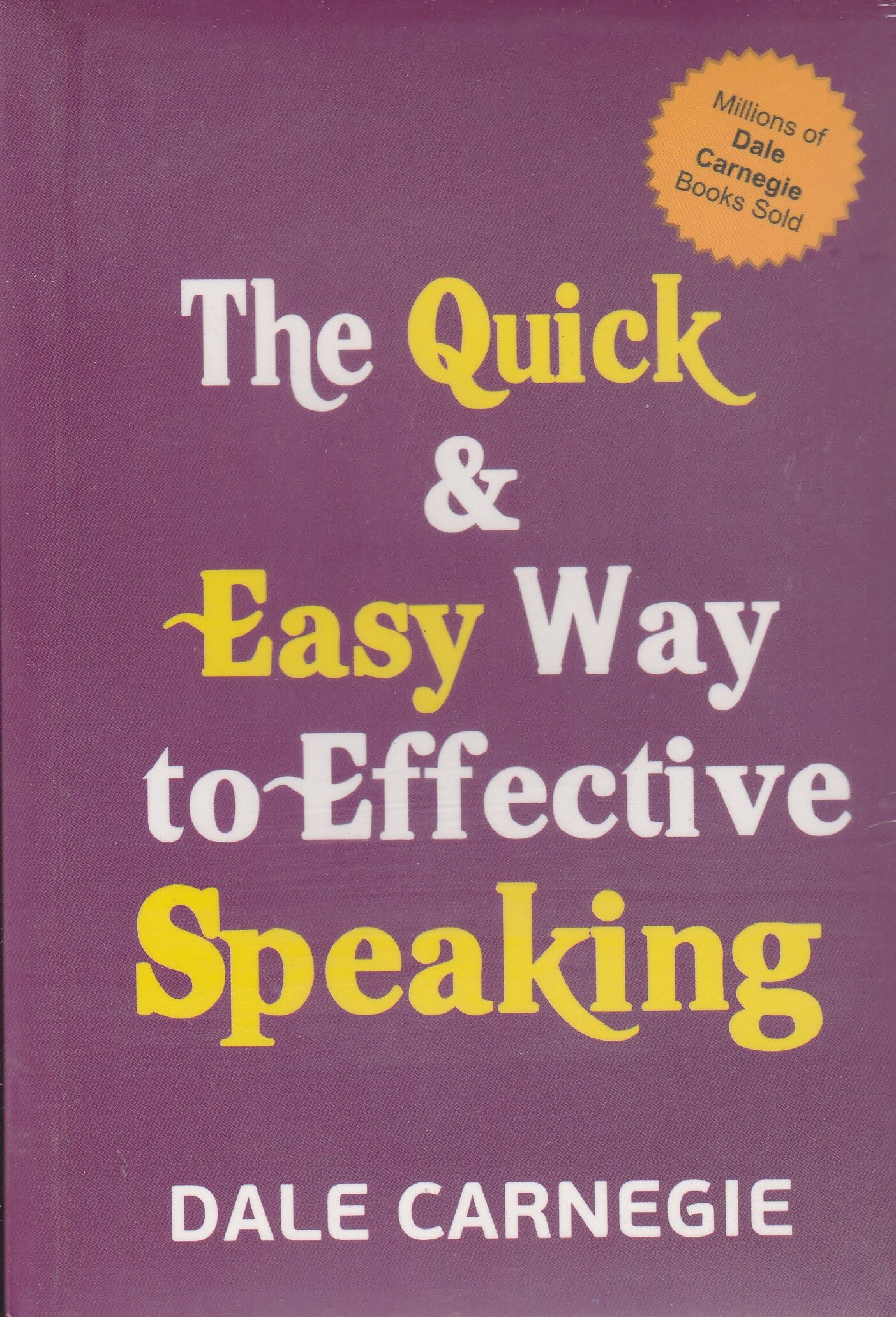
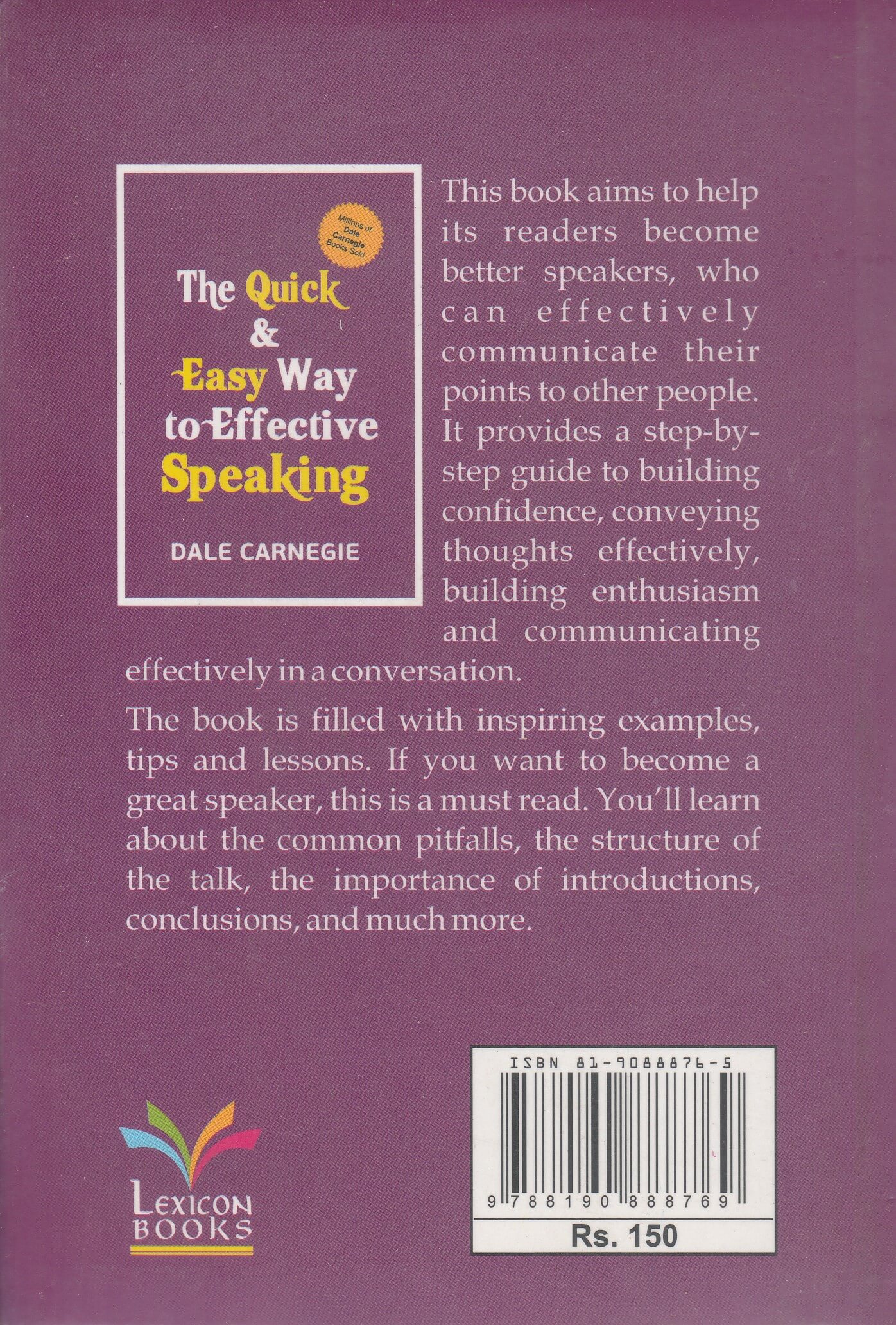
Quick and Easy Way to Effective Speaking by Dale Carnegie


Original price was: රු2,200.00.රු1,700.00Current price is: රු1,700.00.
3 X Rs. 566.67 or 8% Cashback with


or 3 X රු566.67 with


or up to 4 X රු425.00 with


Master the art of effective communication with ‘The Quick and Easy Way to Effective Speaking’ by Dale Carnegie. This timeless guide offers practical tips and techniques to enhance your public speaking skills, build confidence, and captivate any audience. Carnegie’s insights, drawn from years of experience, make this book an essential resource for anyone seeking to communicate with impact.
Out of stock
Email when stock available
The Quick and Easy Way to Effective Speaking by Dale Carnegie is a practical guide to overcoming fear, building confidence and learning how to communicate clearly and persuasively in front of other people.
Speaking effectively is not only useful for professional speakers.
It matters when you:
Give a presentation.
Attend an interview.
Lead a meeting.
Pitch an idea.
Teach a class.
Speak with customers.
Manage employees.
Give a speech.
Explain a project.
Try to persuade someone.
Many people know exactly what they want to say when thinking quietly.
Then they stand in front of an audience.
Their mind goes blank.
Their voice becomes uncertain.
They rush.
They forget important points.
Or they become so focused on remembering every sentence that they stop connecting with the people listening.
Dale Carnegie’s central message is encouraging:
Good speakers can be developed.
Effective speaking is not a mysterious talent that only naturally confident people possess.
It is a skill.
And skills improve through:
Practice.
Preparation.
Experience.
Knowledge.
Confidence.
And learning how to connect with an audience.
The Quick and Easy Way to Effective Speaking provides practical guidance for becoming more comfortable when speaking, organizing material, making ideas memorable and communicating in a natural rather than mechanical way.
The Quick and Easy Way to Effective Speaking – Book Overview
The Quick and Easy Way to Effective Speaking focuses on one of Dale Carnegie’s most important areas of teaching:
How ordinary people can become confident communicators.
The official Simon & Schuster description emphasizes that good public speakers are made rather than born and that the book provides step-by-step methods for developing confidence, courage and enthusiasm in situations where speakers need to convince others of their point of view.
This makes the book relevant far beyond formal public speaking.
Its principles can help in:
Business.
Leadership.
Sales.
University.
Teaching.
Networking.
Management.
Entrepreneurship.
Everyday conversation.
Public Speaking Is a Skill
One of the most useful ideas in The Quick and Easy Way to Effective Speaking is that speaking ability can improve.
People often say:
“I am just not a speaker.”
That statement treats communication as a fixed personality trait.
Carnegie takes a different view.
Someone who is nervous today can become more confident.
Someone who struggles to organize ideas can learn structure.
Someone who speaks too quietly can improve delivery.
Someone who avoids presentations can become more comfortable through experience.
Confidence Comes Through Doing
You cannot become a strong speaker only by reading about speaking.
Eventually, you must speak.
This is similar to:
Swimming.
Driving.
Playing music.
Writing code.
You can study the principles.
But skill develops through practice.
Carnegie repeatedly emphasizes action.
The first speech may feel uncomfortable.
The next may still be difficult.
But each experience provides evidence that you can survive the situation and improve.
Fear of Public Speaking
Many people feel nervous before speaking.
Their symptoms may include:
Fast heartbeat.
Dry mouth.
Shaking hands.
Forgetfulness.
Racing thoughts.
A desire to escape.
The goal is not necessarily to eliminate every sign of nervousness.
A better goal is learning how to function effectively despite it.
Nervousness Does Not Mean You Cannot Speak
People often interpret nervousness as proof that they are unprepared.
Not necessarily.
A person can be:
Prepared
and
nervous.
Experienced speakers may still feel adrenaline before an important presentation.
What changes is their relationship with that feeling.
They learn:
I have felt this before.
I can still perform.
Preparation Builds Confidence
One of the strongest ways to reduce speaking anxiety is knowing your subject.
If you are presenting something you genuinely understand, you have more confidence than if you are trying to memorize unfamiliar material.
Carnegie encourages speakers to talk about subjects they have earned the right to discuss through:
Experience.
Study.
Observation.
Personal involvement.
Speak About Something You Know
Imagine two presentations.
In the first, you memorized ten paragraphs about something you barely understand.
In the second, you explain a project you personally worked on for six months.
Which feels easier?
Usually the second.
Knowledge creates flexibility.
If you forget one sentence, you can explain the idea differently.
You are not trapped by memorization.
Do Not Memorize Every Word
One common speaking mistake is memorizing a speech word for word.
This can create several problems.
If one sentence disappears from memory, the entire speech may collapse.
The delivery may sound unnatural.
The speaker may focus more on remembering text than communicating with people.
A better approach is often to understand:
The main idea.
Key points.
Important examples.
The conclusion.
Then speak naturally around that structure.
Know Your Message
Before giving a speech, ask:
What is the main thing I want this audience to remember?
Not twenty things.
One central message.
If you cannot explain the purpose of your speech in one sentence, the audience may also struggle to understand it.
Organize Your Ideas
Effective speaking requires structure.
A speech does not need to be complicated.
A useful basic structure might be:
Problem.
Example.
Lesson.
Action.
Or:
Introduction.
Main idea one.
Main idea two.
Main idea three.
Conclusion.
Structure helps both the speaker and the audience.
Opening Matters
The first moments influence audience attention.
A weak beginning may sound like:
“Today I am going to give a presentation about…”
A stronger beginning might use:
A question.
A short story.
A surprising fact.
A relevant experience.
A problem the audience understands.
The goal is not to become theatrical.
The goal is to give people a reason to listen.
Stories Are Powerful
People often forget abstract information.
They remember stories.
Suppose a manager says:
“Customer response time should improve.”
That is information.
Now suppose the manager tells the story of a customer who waited two days for a simple answer and then purchased from a competitor.
The principle becomes concrete.
Personal Experience Creates Authenticity
Carnegie strongly valued personal examples.
When you speak about something that genuinely happened to you, your delivery often becomes:
More natural.
More detailed.
More emotional.
More believable.
You are not reciting.
You are remembering.
Specific Details Make Stories Real
Compare:
“I had a difficult customer.”
with:
“Last Friday, a customer called at 4:45 PM because his order had not arrived.”
The second creates a clearer picture.
Specificity makes communication more memorable.
Enthusiasm
An audience is influenced not only by words but by the speaker’s relationship with those words.
If the speaker appears completely uninterested, the audience may become uninterested too.
Enthusiasm does not require shouting.
It can appear through:
Energy.
Voice.
Expression.
Interest.
Conviction.
Care About What You Say
One of the easiest ways to sound passionate is to actually care about the subject.
Artificial enthusiasm is difficult to maintain.
Genuine interest naturally changes:
Tone.
Pace.
Body language.
Word choice.
Speak Naturally
The Quick and Easy Way to Effective Speaking does not encourage becoming an artificial “professional speaker.”
The goal is to communicate naturally.
Think about how you speak when telling a close friend an interesting story.
You do not normally think:
Now I will perform Gesture Number Three.
You simply communicate.
Public speaking should retain some of that natural quality.
Conversation Versus Performance
Many nervous speakers imagine:
Everyone is judging me.
A healthier mindset is:
I am communicating something useful to these people.
The focus changes from:
How do I look?
to:
How can I help them understand?
That shift can reduce self-consciousness.
Focus on the Audience
Effective speaking is audience-centered.
Before preparing, ask:
Who are these people?
What do they already know?
What do they care about?
What problem are they trying to solve?
Why should they listen?
The same presentation should not necessarily be delivered identically to every audience.
Understand What Your Audience Wants
Imagine presenting a new software system.
The development team may want:
Architecture.
APIs.
Security.
Technical limitations.
Management may want:
Cost.
Timeline.
Productivity.
Risk.
The same project requires different communication.
Communication Is About Understanding
Speaking is not successful simply because words left your mouth.
Communication succeeds when the listener understands the intended message.
That means a speaker must pay attention to:
Clarity.
Examples.
Audience knowledge.
Vocabulary.
Structure.
Avoid Unnecessary Complexity
People sometimes use complicated language because they think it sounds intelligent.
Usually it makes communication harder.
Simple language is powerful.
Especially when explaining complicated ideas.
The objective is not:
Make yourself sound intelligent.
The objective is:
Make the idea easy to understand.
Use Familiar Language
Instead of trying to impress an audience with specialized terminology, translate ideas into language appropriate for listeners.
Technical terms are useful when everyone understands them.
Otherwise, explain them.
Make Ideas Visual
Abstract concepts become easier when the audience can imagine them.
Use:
Examples.
Comparisons.
Numbers.
Scenes.
Objects.
Stories.
A speaker should help listeners create mental pictures.
Use Comparisons
Suppose you need to explain a huge number.
Saying:
“The database contains 500 million records”
may be technically correct.
But many listeners cannot intuitively understand that scale.
A comparison can help.
Good communicators translate unfamiliar information into something familiar.
Persuasion
Speaking effectively often involves persuasion.
A manager wants employees to adopt a process.
A salesperson wants a customer to consider a product.
A student argues for a position.
An entrepreneur pitches investors.
Carnegie’s approach suggests that persuasion works better when speakers connect ideas with the audience’s interests.
Start From the Audience’s Perspective
Instead of saying:
“I want you to approve my project,”
think:
Why would this project matter to them?
Maybe it:
Reduces costs.
Saves time.
Improves customer satisfaction.
Reduces risk.
The audience wants to know:
What does this mean for us?
Earn the Right to Speak
Authority does not always come from a job title.
It can come from:
Experience.
Study.
Evidence.
Results.
If you are explaining something, demonstrate why your perspective deserves attention.
Not through boasting.
Through substance.
Credibility
A persuasive speaker needs credibility.
Credibility can come from:
Accuracy.
Preparation.
Honesty.
Experience.
Admitting uncertainty when appropriate.
Pretending to know everything usually damages trust eventually.
Do Not Bluff
If someone asks a question you cannot answer, saying:
“I don’t know, but I will check”
can be stronger than inventing an answer.
Confidence and honesty are compatible.
Audience Attention
Attention is limited.
Modern audiences are especially distracted.
Phones.
Notifications.
Email.
Thoughts.
Other responsibilities.
A speaker therefore needs to continually earn attention.
Variety Helps
A presentation becomes difficult to follow when every sentence has identical rhythm.
Effective speakers naturally vary:
Pace.
Volume.
Pauses.
Examples.
Stories.
Questions.
This keeps delivery alive.
The Power of the Pause
Nervous speakers often rush.
Silence feels uncomfortable.
But a short pause can:
Emphasize an important idea.
Give listeners time to think.
Help the speaker breathe.
Create confidence.
A pause that feels long to the speaker may feel completely natural to the audience.
Slow Down
When nervous, people often speak faster than usual.
A simple improvement is deliberately reducing speed.
This gives you time to:
Think.
Breathe.
Observe.
It gives your audience time to process information too.
Voice
You do not need a dramatic radio voice to speak effectively.
Clarity matters more.
Aim for:
Audible volume.
Natural tone.
Clear pronunciation.
Variation.
Avoid speaking so quietly that listeners must struggle.
Body Language
Communication includes more than words.
Audience perception is influenced by:
Posture.
Facial expression.
Eye contact.
Movement.
The goal is not to memorize artificial gestures.
Natural body language usually improves as confidence grows.
Eye Contact
Reading every sentence from slides disconnects the speaker from the audience.
Look at people.
You do not need to stare at one person continuously.
Move naturally across the room.
Eye contact makes communication feel direct.
Slides Are Support, Not the Speech
Modern presentations often include PowerPoint.
Carnegie wrote before today’s slide-heavy corporate culture, but his principles apply strongly.
A common mistake is putting the entire speech on slides.
Then reading it.
If the audience can read everything themselves, they begin wondering why the speaker is needed.
Slides should support communication.
Not replace it.
Avoid Text-Heavy Slides
Use slides for:
Key points.
Images.
Charts.
Important numbers.
Short quotations.
Not paragraphs the audience must read while simultaneously listening.
Public Speaking for Students
The Quick and Easy Way to Effective Speaking can be especially useful for students.
University life may require:
Presentations.
Viva examinations.
Group projects.
Interviews.
Class discussions.
Research defenses.
Students who learn speaking early gain an advantage that can continue throughout their careers.
Speaking in Interviews
A job interview is a form of speaking under pressure.
You need to:
Explain experiences.
Give examples.
Communicate confidence.
Answer unexpected questions.
The same principles apply.
Know your material.
In this case, your material is your own experience.
Use Specific Examples in Interviews
Instead of:
“I am good at solving problems.”
say:
“During my internship, our checkout integration was leaving successful payments in pending status. I traced the webhook flow, identified the issue and helped correct the order update process.”
Specific stories are more persuasive than generic claims.
Speaking for Software Professionals
Developers sometimes underestimate communication.
You can write excellent code and still need to:
Explain architecture.
Defend a technical decision.
Report a bug.
Present a demo.
Communicate with nontechnical managers.
Write documentation.
Lead stand-ups.
Technical skill becomes more valuable when other people understand it.
Speaking for Entrepreneurs
Entrepreneurs constantly speak.
To:
Customers.
Employees.
Investors.
Suppliers.
Partners.
Banks.
The media.
A brilliant business idea that cannot be explained clearly may struggle to gain support.
Speaking for Sales Professionals
Sales is communication.
Strong salespeople learn to:
Ask questions.
Listen.
Explain benefits.
Handle objections.
Build trust.
Effective speaking therefore involves more than talking.
It requires understanding the listener.
Listening Matters Too
A powerful communicator is not someone who talks continuously.
Listening reveals:
Concerns.
Questions.
Priorities.
Objections.
Without listening, a speaker may answer questions nobody asked.
Leadership and Speaking
Leaders communicate direction.
During uncertainty, people want to understand:
What is happening?
What matters?
What should we do?
Strong leadership communication is:
Clear.
Calm.
Specific.
Credible.
Explain the Why
People are more likely to support a change when they understand why it matters.
Instead of:
“We are changing this process.”
explain:
“We are changing this process because customers currently wait two days for confirmation, and the new workflow should reduce that delay.”
Meaning creates motivation.
Impromptu Speaking
Sometimes you have no time for a prepared speech.
A manager suddenly asks:
“Can you explain the project?”
Someone at a meeting asks:
“What do you think?”
A simple structure helps.
Point.
Reason.
Example.
Conclusion.
Structure creates clarity even when preparation time is short.
Think Before You Speak
A short pause before answering is not weakness.
It can make the answer stronger.
You do not need to immediately fill every silence.
Practice Out Loud
Reading notes silently is not enough.
Speak them.
Your brain experiences language differently when you hear it.
You may discover:
Sentences are too long.
Transitions sound awkward.
A point is unclear.
A section takes much longer than expected.
Record Yourself
Modern technology makes public-speaking practice easier than ever.
Use your phone.
Record two minutes.
Watch it.
Notice:
Pace.
Clarity.
Filler words.
Posture.
Eye contact.
Do not judge yourself harshly.
Look for one thing to improve.
Improve One Element at a Time
Trying to fix ten problems simultaneously can make speaking feel impossible.
Choose one.
Maybe:
Slow down.
Next time:
Improve eye contact.
Then:
Reduce filler words.
Small improvements compound.
Filler Words
Words such as:
Um.
Ah.
Like.
Basically.
You know.
may become repetitive.
The solution is often not forcing yourself to eliminate them consciously.
Instead, become comfortable with pauses.
Silence is usually better than a stream of fillers.
Learn From Strong Speakers
Watch speakers you admire.
Do not simply think:
They are naturally talented.
Analyze them.
How do they open?
How do they structure ideas?
How often do they use stories?
How do they pause?
How do they conclude?
Turn admiration into observation.
Do Not Copy Personality
You can learn techniques without imitating another person’s personality.
A quiet speaker can be excellent.
An energetic speaker can be excellent.
An analytical speaker can be excellent.
Authenticity matters.
Humor
Humor can strengthen communication when used naturally.
But you do not need to become a comedian.
Forced jokes can create more anxiety than value.
A genuine funny experience often works better than a memorized joke.
Do Not Make the Audience the Joke
Humor that embarrasses or humiliates listeners may damage trust.
Good humor should support connection rather than superiority.
Use Examples
Abstract principles become more useful when connected with examples.
This is one reason Dale Carnegie’s books often rely heavily on stories and examples.
A principle becomes easier to remember when connected to a person or event.
Conclusions Matter
Do not end with:
“Yeah… that’s basically it.”
A strong conclusion tells the audience that the message is complete.
You might:
Summarize.
Return to the opening story.
Make a recommendation.
Ask for action.
State the central message.
Call to Action
If the purpose of the speech is action, make that action clear.
What exactly should listeners do next?
Visit a page?
Approve a proposal?
Change a process?
Practice a technique?
Ambiguous endings create ambiguous results.
Practice Builds Courage
One important message throughout The Quick and Easy Way to Effective Speaking is that courage grows through experience.
The person waiting to become completely confident before speaking may wait forever.
Action often comes first.
Confidence follows.
Small Audiences Count
You do not need to begin with 1,000 people.
Practice in:
A team meeting.
A class.
A small group.
A video recording.
A discussion.
Each experience helps normalize speaking.
Mistakes Are Normal
You may:
Forget a point.
Mispronounce a word.
Lose your place.
Answer a question imperfectly.
The audience usually forgets small mistakes much faster than the speaker does.
Continue.
Do Not Apologize for Every Small Error
If you say the wrong word and immediately correct it, continue.
Repeatedly saying:
“Sorry, I’m so nervous”
directs attention toward nervousness.
Keep focus on the message.
Perfection Is the Wrong Goal
Effective communication is more important than flawless performance.
A perfectly polished speech that nobody remembers is less useful than a slightly imperfect speech that genuinely helps people.
Communication and Career Success
The ability to explain ideas can influence:
Leadership opportunities.
Sales.
Interviews.
Promotions.
Teaching.
Entrepreneurship.
Networking.
People often need to understand your work before they can value it.
That is why The Quick and Easy Way to Effective Speaking remains relevant decades after its original publication.
Some Examples Reflect an Earlier Era
This is a classic communication book, so some examples, names and business situations naturally reflect the period in which Carnegie’s material was developed.
Modern readers should adapt those examples to:
Video meetings.
Zoom presentations.
LinkedIn communication.
Digital sales.
Remote teams.
Modern workplaces.
The technology changed.
The communication principles remain recognizable.
Speaking on Video Calls
Carnegie never needed to present through Zoom or Microsoft Teams.
But the principles still apply.
On video:
Look at the camera periodically.
Speak clearly.
Avoid reading continuously.
Use concise points.
Reduce distractions.
Check audio beforehand.
Audience-centered communication remains audience-centered whether listeners are in the room or on a screen.
Is The Quick and Easy Way to Effective Speaking a Public Speaking Book?
Yes.
It is primarily a practical guide to developing speaking and communication ability.
It is especially useful for readers interested in:
Public speaking.
Presentations.
Confidence.
Persuasion.
Leadership communication.
Business communication.
Is It a Self-Help Book?
Yes.
Simon & Schuster categorizes the current edition within self-help and personal growth.
For BookLounge, Non-Fiction > Self-Help & Personal Development would therefore be a suitable category.
Is It Good for Beginners?
Yes.
The book is designed around developing basic confidence and practical speaking ability rather than assuming the reader is already an experienced professional speaker.
Beginners who fear presentations may find the straightforward approach particularly useful.
Is It Only for Professional Speakers?
No.
The principles apply to anyone who needs to communicate ideas effectively.
That includes:
Students.
Managers.
Teachers.
Entrepreneurs.
Salespeople.
Employees.
Job seekers.
Team leaders.
Is It Still Relevant?
Yes, although readers should adapt older examples to modern communication environments.
Fundamental problems remain surprisingly similar:
Fear.
Lack of preparation.
Weak structure.
Low confidence.
Audience disengagement.
Over-memorization.
Unclear messages.
Those issues exist today just as they did decades ago.
Dale Carnegie
Dale Carnegie was one of the major early figures in modern self-improvement and professional communication training.
He is best known for How to Win Friends and Influence People and for teaching communication, confidence and interpersonal skills.
His work continues to be published internationally decades after his death.
Dorothy Carnegie
The official Pocket Books edition credits Dorothy Carnegie and Dale Carnegie.
Therefore, if your website has a separate author field and you want to follow the exact publisher metadata, you may enter:
Dale Carnegie, Dorothy Carnegie
However, for customer-facing search recognition, Dale Carnegie is the name most readers associate with the title.
Official Edition Details
For the official Pocket Books mass-market paperback:
Title: The Quick and Easy Way to Effective Speaking
Authors: Dorothy Carnegie and Dale Carnegie
Publisher: Pocket Books
Publication Date: March 1, 1990 for this edition
Pages: 224
ISBN-13: 9780671724009
Your consolidated stock record also associates the title with Dale Carnegie and ISBN 978-0671724009.
ISBN Check for Your Stock
One of your later order files records 9780671724001, while the official Simon & Schuster ISBN is 9780671724009.
So before publishing the WooCommerce ISBN field, check the barcode on your actual book.
If your physical copy shows:
9780671724009 → use it.
If it is a completely different edition → use the ISBN printed on that copy.
Do not copy 9780671724001 unless that exact number is genuinely printed on your physical edition.
Important Themes
The Quick and Easy Way to Effective Speaking explores public speaking, confidence, communication, persuasion, preparation, audience engagement, storytelling, leadership, courage, presentations, clarity, voice, speaking naturally, self-expression, professional communication and personal development.
7 Powerful Lessons From The Quick and Easy Way to Effective Speaking
- Effective speakers are developed, not simply born. Speaking ability improves through practice, preparation and repeated experience rather than depending only on natural personality.
- Know what you are talking about. Confidence grows when you speak from genuine knowledge, experience and conviction instead of trying to memorize unfamiliar material.
- Do not memorize every sentence. Understand your main ideas and communicate them naturally so that forgetting one phrase does not destroy the entire presentation.
- Use stories and concrete examples. Audiences usually remember specific experiences and vivid illustrations better than abstract statements alone.
- Focus on your audience rather than yourself. Asking what listeners need to understand reduces self-consciousness and makes communication more useful.
- Enthusiasm strengthens communication. When a speaker genuinely cares about a subject, that interest often appears naturally through voice, expression and energy.
- Confidence grows through action. Waiting until all nervousness disappears is rarely effective. Speak, learn, improve and gradually become more comfortable.
Why Read The Quick and Easy Way to Effective Speaking?
The Quick and Easy Way to Effective Speaking is an excellent choice for readers who want to become better at:
Public speaking.
Presentations.
Interviews.
Meetings.
Leadership.
Teaching.
Sales.
Networking.
Explaining ideas.
Persuasion.
Confidence.
Business communication.
The book can be particularly valuable to anyone who knows their subject but struggles to communicate that knowledge confidently in front of other people.
It teaches a practical lesson:
A brilliant idea has limited influence if nobody can understand it.
Communication transforms knowledge into impact.
Who Should Read This Book?
The Quick and Easy Way to Effective Speaking may especially appeal to students, business professionals, entrepreneurs, managers, salespeople, teachers, team leaders, job seekers, software professionals, university students and anyone who becomes nervous before presentations or important conversations.
It is also a natural companion for readers who enjoyed How to Win Friends and Influence People but want more direct guidance on speaking and presenting.
The Quick and Easy Way to Effective Speaking – Turn Nervousness Into Communication
The Quick and Easy Way to Effective Speaking is ultimately based on an encouraging idea:
You do not need to become someone else to become a better speaker.
You do not need the loudest voice.
You do not need perfect English.
You do not need a dramatic personality.
You do not need to eliminate every nervous feeling.
You need:
Something worth saying.
Enough knowledge to say it confidently.
A clear structure.
Practice.
And genuine interest in helping your audience understand.
Public speaking becomes frightening when all attention turns inward.
What if I forget?
What if they judge me?
What if my voice shakes?
What if I make a mistake?
Carnegie’s approach gradually redirects attention outward.
What does the audience need?
What story will help them understand?
What example will make this clear?
What is the one idea I want them to remember?
That shift changes public speaking from a performance into communication.
And communication is something almost everyone already does every day.
The goal is simply to do it more intentionally.
Practice.
Speak from experience.
Use stories.
Organize your ideas.
Slow down.
Look at people.
Care about what you say.
Then do it again.
Confidence is rarely created by waiting.
It is created by evidence.
Every presentation you complete becomes another piece of evidence that you can speak.
For readers who want to improve presentations, interviews, meetings, leadership communication or everyday confidence, The Quick and Easy Way to Effective Speaking remains a practical classic for learning how to turn ideas into clear, persuasive and memorable communication.
Learn more about The Quick and Easy Way to Effective Speaking by Dale Carnegie and Dorothy Carnegie on the official Simon & Schuster website.
Explore more communication and personal development books at Bargain Books.
| Author | Dale Carnegie |
|---|---|
| Type | Paperback Printed Book |
| ISBN/ISSN | 8129140209, 978-8129140203 |
| Language | English |
| Pages | 244 |
Be the first to review “Quick and Easy Way to Effective Speaking by Dale Carnegie ”
Related products
Out of stock
Non-Fiction & Knowledge
රු1,600.00
3 X Rs. 533.33 or 8% Cashback with
or 3 X රු533.33 with
or up to 4 X රු400.00 with
-39%

Out of stock
Self-Help & Psychology
Original price was: රු2,450.00.රු1,500.00Current price is: රු1,500.00.
3 X Rs. 500.00 or 8% Cashback with
or 3 X රු500.00 with
or up to 4 X රු375.00 with
-10%
Communication & Social Skills
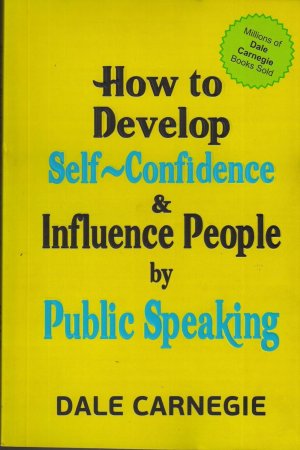
How to Develop Self-Confidence & Influence People By Public Speaking [Paperback] by Dale Carnegie
Original price was: රු2,000.00.රු1,800.00Current price is: රු1,800.00.
3 X Rs. 600.00 or 8% Cashback with
or 3 X රු600.00 with
or up to 4 X රු450.00 with
-34%

Self-Help & Psychology
Original price was: රු2,350.00.රු1,550.00Current price is: රු1,550.00.
3 X Rs. 516.67 or 8% Cashback with
or 3 X රු516.67 with
or up to 4 X රු387.50 with
-13%

Out of stock
Non-Fiction & Knowledge
Original price was: රු3,900.00.රු3,400.00Current price is: රු3,400.00.
3 X Rs. 1,133.33 or 8% Cashback with
or 3 X රු1,133.33 with
or up to 4 X රු850.00 with
-23%

Non-Fiction & Knowledge
Original price was: රු2,200.00.රු1,700.00Current price is: රු1,700.00.
3 X Rs. 566.67 or 8% Cashback with
or 3 X රු566.67 with
or up to 4 X රු425.00 with

Out of stock
Self-Help & Psychology
රු1,500.00
3 X Rs. 500.00 or 8% Cashback with
or 3 X රු500.00 with
or up to 4 X රු375.00 with
-24%

Out of stock
Non-Fiction & Knowledge
Original price was: රු2,100.00.රු1,600.00Current price is: රු1,600.00.
3 X Rs. 533.33 or 8% Cashback with
or 3 X රු533.33 with
or up to 4 X රු400.00 with
Reviews
There are no reviews yet.