
No products in the cart.
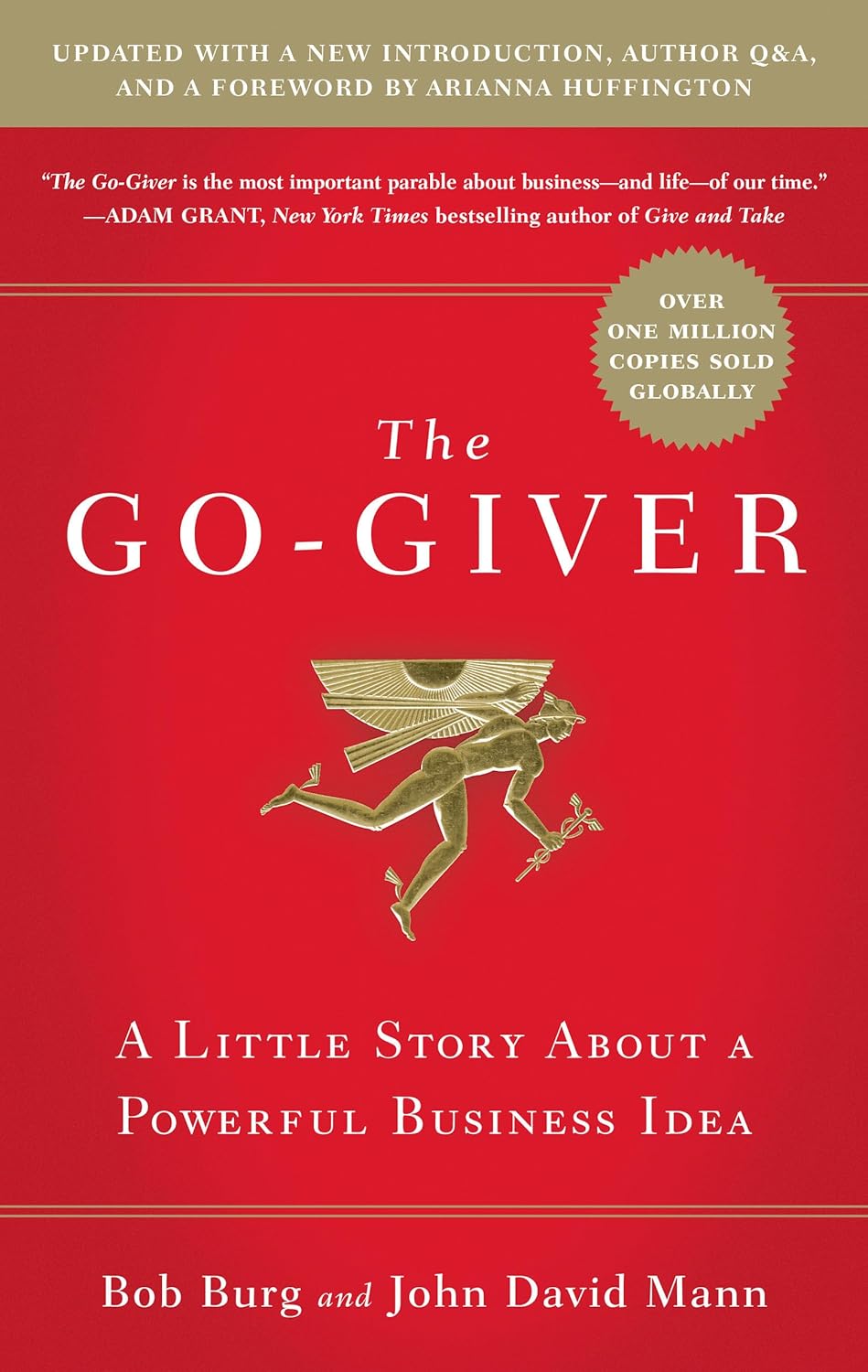












The Go-Giver by Bob Burg and John David Mann
The Go-Giver by Bob Burg and John David Mann is an inspiring business parable that challenges the traditional idea that success comes mainly from working harder, competing more aggressively or focusing entirely on personal gain.
Instead, the book presents a surprisingly simple philosophy: one of the most effective ways to achieve greater success is to focus on creating genuine value for other people.
The story follows Joe, an ambitious young professional who desperately wants to succeed. Joe considers himself a determined go-getter, but despite working harder and pushing himself further, his goals seem to keep moving away from him.
When he needs to secure an important business deal, Joe seeks advice from a mysterious and highly respected consultant named Pindar.
What follows changes the way Joe thinks about business, relationships and success.
Why Read The Go-Giver?
One of the greatest strengths of The Go-Giver is the simplicity of its message.
Instead of presenting readers with hundreds of pages of business theories, complicated financial models or management terminology, Bob Burg and John David Mann communicate their ideas through an easy-to-follow story.
Over the course of several meetings, Pindar introduces Joe to successful people who each teach him an important principle.
Together, these principles form the Five Laws of Stratospheric Success.
The five laws focus on value, compensation, influence, authenticity and receptivity. The official Go-Giver materials describe them as the central principles of the book.
Although these lessons are presented in a business setting, they can also be applied to leadership, customer service, relationships, networking and everyday life.
Success Begins With Creating Value
The first major lesson is the Law of Value.
The basic idea is that successful businesses should focus on providing customers with more value than they expect.
Price and value are not necessarily the same thing.
A customer may pay a certain amount for a product or service, but the experience, convenience, support, quality or result they receive can make it feel much more valuable.
This principle is particularly important for entrepreneurs.
Instead of constantly asking:
“How much money can I make from this customer?”
The book encourages a different question:
“How much value can I create for this customer?”
That small change in perspective can completely alter the way a business approaches sales, customer service and long-term relationships.
Serve More People and Serve Them Well
Another important principle in The Go-Giver is the Law of Compensation.
The authors connect financial success with the number of people you serve and the quality of the value you provide.
This is a useful concept for business owners.
Imagine two businesses selling similar products.
One focuses only on completing transactions.
The other focuses on providing an excellent experience, solving customer problems and building trust.
Over time, satisfied customers may return, recommend the company and introduce new customers.
The lesson is not simply to sell more.
It is to help more people effectively.
A company grows when it discovers how to create value repeatedly and deliver that value to a larger audience.
Put Other People’s Interests First
The Law of Influence is another central lesson.
Influence does not necessarily come from authority, job titles or aggressive persuasion.
Instead, the book suggests that genuine influence can grow when people know that you care about their interests.
This principle can be particularly useful in sales.
Customers usually recognize when someone is focused only on closing a sale.
A salesperson who takes time to understand what the customer actually needs can build much stronger trust.
Sometimes this may even mean recommending a less expensive product or telling a customer that a particular solution is not right for them.
That decision may reduce short-term revenue.
But it can create something much more valuable: trust.
Customers who trust a business are more likely to return and recommend it to others.
Authenticity Matters
The Go-Giver also emphasizes authenticity.
Many people believe that success requires becoming someone different.
They may imitate successful entrepreneurs, copy another salesperson’s personality or try to behave how they think a leader should behave.
The book presents a different idea.
Your own personality, experiences and ability to connect genuinely with other people can be among your greatest strengths.
Customers and employees often respond better to people who communicate honestly than to someone who appears to be performing a role.
This lesson is particularly relevant to leadership.
A manager does not need to pretend to know everything.
Being able to admit mistakes, listen to employees and communicate honestly can often build stronger relationships than trying to appear perfect.
Learn to Receive as Well as Give
The final principle is the Law of Receptivity.
Giving is important, but successful relationships also require the ability to receive.
Someone who refuses every compliment, opportunity, referral or offer of assistance may unintentionally prevent others from contributing.
The book therefore presents giving and receiving as connected ideas.
Business relationships work best when value can move in both directions.
You help someone.
Someone helps you.
You recommend another business.
Someone recommends yours.
This creates relationships built around mutual value rather than one-sided transactions.
A Different Approach to Selling
Sales is one of the areas where The Go-Giver can be especially useful.
Traditional selling is sometimes associated with pressure.
The seller wants the customer to buy.
The customer tries to avoid being persuaded.
The Go-Giver philosophy changes this relationship.
Instead of asking:
“How can I convince this person to buy?”
A salesperson can ask:
“How can I help this person make the best decision?”
That approach can make selling feel more like problem-solving.
The salesperson understands the customer’s situation, identifies what they need and then recommends an appropriate solution.
Even when the customer does not buy immediately, the interaction can create trust.
For businesses that depend on repeat customers and referrals, that trust can become extremely valuable.
Building Better Customer Relationships
Customer relationships are another area where the book’s lessons can be applied.
A business transaction should not necessarily end when the payment is completed.
Companies can continue creating value through:
- Helpful customer support
- Fast responses
- Honest recommendations
- Easy return processes
- Useful information
- Reliable service
- Personalized communication
- After-sales support
Small improvements can make customers feel appreciated.
And satisfied customers can become loyal customers.
That is one of the most practical business lessons behind the Go-Giver philosophy.
The Five Laws of Stratospheric Success
The book organizes its central philosophy around five principles:
- The Law of Value – focus on creating exceptional value.
- The Law of Compensation – increase your impact by serving more people well.
- The Law of Influence – build influence by genuinely considering the interests of others.
- The Law of Authenticity – bring your genuine self to your relationships and work.
- The Law of Receptivity – remain open to receiving value as well as giving it.
These principles are presented through Joe’s meetings with Pindar and a group of successful people rather than as traditional textbook chapters.
This storytelling approach makes the lessons memorable and easy to understand.
A Short Business Book With a Big Message
One reason The Go-Giver has become so popular is its accessibility.
The Expanded Edition published by Portfolio contains 176 pages, making it much shorter than many traditional business books.
The expanded version also includes additional material such as a foreword, introduction, discussion guide and Q&A with the authors.
This makes it a good choice for busy entrepreneurs and professionals who want a book that can be read relatively quickly while still providing ideas worth considering long after finishing it.
More Than One Million Copies Sold
The Go-Giver has grown far beyond its original publication.
The authors’ official website states that the book has sold well over one million copies, and it has appeared on bestseller lists including the Wall Street Journal and BusinessWeek.
Its popularity has also resulted in additional books that expand the Go-Giver philosophy into areas such as selling, leadership and influence.
The original book remains the best starting point for understanding the core philosophy.
Who Should Read The Go-Giver?
This book is an excellent choice for readers interested in:
- Entrepreneurship
- Business growth
- Sales
- Leadership
- Customer service
- Networking
- Personal development
- Relationship building
- Communication
- Business mindset
- Creating customer value
- Building trust
- Long-term success
It is particularly useful for entrepreneurs, salespeople, managers, business owners and professionals who work directly with customers.
However, the principles are broad enough to apply outside business as well.
Is The Go-Giver Worth Reading?
If you enjoy short business books with simple but memorable lessons, The Go-Giver is an excellent choice.
Its most important idea is not that people should give everything away for free.
Instead, it encourages readers to shift their attention away from constantly asking what they can get and toward understanding what value they can provide.
That shift can influence the way someone approaches customers, employees, business partners and personal relationships.
For entrepreneurs, it offers an especially useful reminder that sustainable business success is often built on satisfied customers, trust and strong relationships.
Buy The Go-Giver in Sri Lanka
If you are searching for The Go-Giver in Sri Lanka, this bestselling business parable is a valuable addition to any entrepreneurship, leadership or personal-development collection.
Bob Burg and John David Mann turn important business principles into an engaging story about Joe, Pindar and the Five Laws of Stratospheric Success.
Whether you are starting a new business, working in sales, managing employees or simply looking for a different perspective on success, The Go-Giver provides practical lessons about creating value, serving others, building trust and developing meaningful professional relationships.
It is a small book with an important message: lasting success can begin when you stop focusing only on what you can get and start thinking about how much value you can give.
Learn more about The Go-Giver by Bob Burg and John David Mann on the official Penguin Random House website.
Explore more business and personal development books at Bargain Books.
Be the first to review “Go-Giver by Bob Burg & John David Mann”
Related products

Out of stock
Self-Help & Psychology
රු2,200.00
3 X Rs. 733.33 or 8% Cashback with


or 3 X රු733.33 with


or up to 4 X රු550.00 with


Out of stock
Self-Help & Psychology
රු1,900.00
3 X Rs. 633.33 or 8% Cashback with
or 3 X රු633.33 with
or up to 4 X රු475.00 with
Non-Fiction & Knowledge
රු2,250.00
3 X Rs. 750.00 or 8% Cashback with
or 3 X රු750.00 with
or up to 4 X රු562.50 with

Out of stock
Autobiography
රු2,750.00
3 X Rs. 916.67 or 8% Cashback with
or 3 X රු916.67 with
or up to 4 X රු687.50 with
-26%
Non-Fiction & Knowledge
The 7 Habits of Highly Effective People by Stephen R. Covey – Blue Cover
Original price was: රු2,300.00.රු1,700.00Current price is: රු1,700.00.
3 X Rs. 566.67 or 8% Cashback with
or 3 X රු566.67 with
or up to 4 X රු425.00 with

Non-Fiction & Knowledge
රු1,550.00
3 X Rs. 516.67 or 8% Cashback with
or 3 X රු516.67 with
or up to 4 X රු387.50 with
-24%

Out of stock
Non-Fiction & Knowledge
Original price was: රු2,500.00.රු1,900.00Current price is: රු1,900.00.
3 X Rs. 633.33 or 8% Cashback with
or 3 X රු633.33 with
or up to 4 X රු475.00 with

Out of stock
Non-Fiction & Knowledge
රු1,500.00
3 X Rs. 500.00 or 8% Cashback with
or 3 X රු500.00 with
or up to 4 X රු375.00 with
Reviews
There are no reviews yet.