
No products in the cart.
-22%
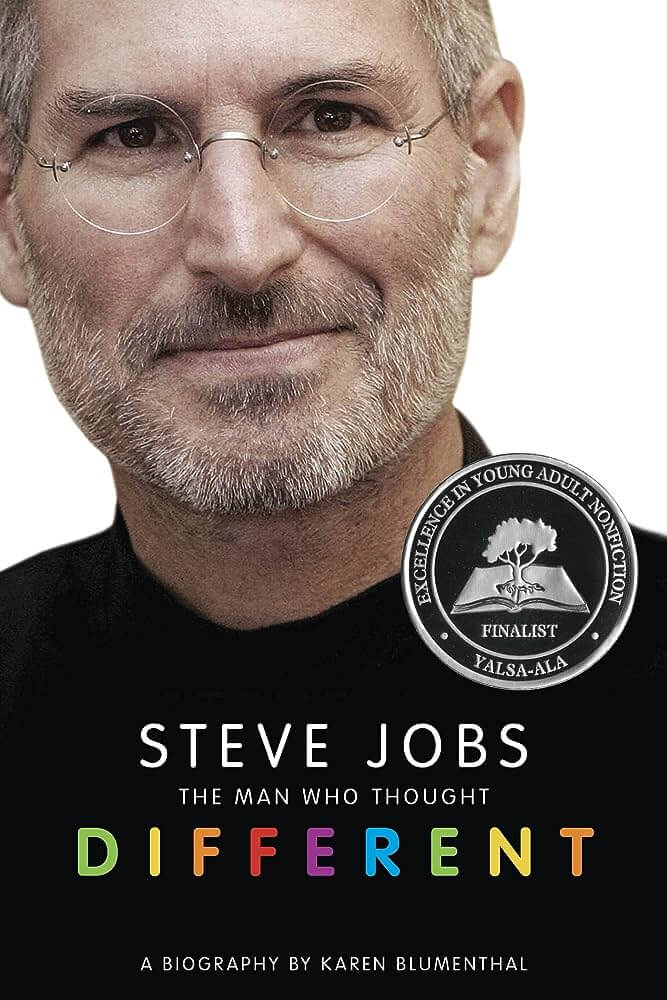
Steve Jobs by Karen Blumenthal
Original price was: රු2,300.00.රු1,800.00Current price is: රු1,800.00.
3 X Rs. 600.00 or 8% Cashback with


or 3 X රු600.00 with


or up to 4 X රු450.00 with


Explore the life and legacy of Steve Jobs, the visionary co-founder of Apple Inc., with “Steve Jobs: The Man Who Thought Different” by Karen Blumenthal. This captivating biography delves into Jobs’ relentless pursuit of perfection and his transformative impact on technology, design, and business. Order now to discover the story of a true tech pioneer.
1 in stock
Steve Jobs: The Man Who Thought Different by Karen Blumenthal
Steve Jobs The Man Who Thought Different by Karen Blumenthal is an engaging biography of one of the most influential figures in modern technology.
The book explores Steve Jobs as an inventor, entrepreneur, perfectionist, leader, and complicated human being.
It follows his life from childhood and adoption through the early days of Apple, his departure from the company, his work with Pixar, and his eventual return.
Rather than presenting Jobs as a perfect hero, Karen Blumenthal examines both his remarkable achievements and his difficult personality.
About Steve Jobs The Man Who Thought Different
Steve Jobs helped change how people interact with computers, music, phones, movies, and digital technology.
But his journey was far from predictable.
He was adopted shortly after birth.
He later attended college but dropped out.
He became deeply interested in electronics, design, creativity, and alternative ways of thinking.
Eventually, his friendship with Steve Wozniak helped lead to the creation of Apple.
The company began on a small scale.
What followed transformed the technology industry.
Growing Up Differently
Jobs did not follow a conventional path.
He was curious, rebellious, and often unwilling to accept things simply because they had always been done a certain way.
Those qualities sometimes created problems.
They also became part of what made him successful.
The biography shows how his early environment, education, friendships, and interests influenced his future.
He was not simply someone who woke up one day with a billion-dollar idea.
His success developed through years of experimentation, failure, obsession, and risk.
7 Powerful Lessons from Steve Jobs The Man Who Thought Different
1. Think Differently
One of the strongest themes of the book is refusing to accept ordinary limitations.
Jobs often questioned assumptions.
He wanted products to feel simpler, more elegant, and more intuitive.
That mindset helped Apple stand out in industries where many companies focused primarily on technical specifications.
The lesson is not to reject every convention.
It is to ask whether there is a better way.
2. Design Matters
Jobs believed technology should not only work well.
It should also look and feel right.
He cared intensely about design.
That attention extended from the appearance of a device to the way a user interacted with it.
This philosophy became central to Apple products.
The book shows how design can become part of the overall experience rather than simply decoration.
3. Failure Is Not the End
Jobs experienced major setbacks.
One of the biggest came when he was pushed out of Apple.
For many people, losing control of the company they helped create would have been devastating.
Jobs used the period to build new projects.
He became involved with NeXT and Pixar.
Those experiences eventually influenced what happened when he returned to Apple.
4. Creativity Often Comes from Combining Ideas
Jobs was interested in more than computers.
He cared about art, typography, music, animation, philosophy, and design.
Those interests influenced how he thought about technology.
Innovation often came from combining ideas from different fields.
This is one reason his products frequently felt different from competing devices.
5. High Standards Can Produce Great Work
Jobs was famous for demanding extremely high standards.
He wanted products to meet his expectations.
This sometimes pushed teams to achieve extraordinary results.
However, the biography also shows the difficult side of that personality.
His intensity could make him challenging to work with.
This makes the book more balanced than a simple success story.
6. Build Things People Truly Want
Technology is useful only when people can actually understand and use it.
Jobs focused heavily on the user experience.
He wanted computers and devices to become accessible to ordinary people.
This approach influenced the Macintosh, iPod, iPhone, and other Apple products.
The lesson is simple.
A great product must solve a real problem or create genuine value for the user.
7. Time Is Limited
Jobs’s famous Stanford commencement speech plays an important role in the book.
He spoke about mortality, purpose, and making meaningful choices.
The biography frames parts of his life through these ideas.
His story encourages readers to think carefully about what they want to build and how they use their time.
Steve Jobs and Steve Wozniak
The relationship between Steve Jobs and Steve Wozniak was crucial to Apple’s beginning.
Wozniak was technically brilliant.
Jobs recognized the commercial potential of what they were building.
Their strengths were different.
That difference helped create a powerful partnership.
Apple began as a small operation.
But the combination of engineering talent, ambition, and business vision allowed the company to grow rapidly.
The Birth of Apple
Apple was founded during the early years of personal computing.
Computers were still unfamiliar to most people.
Jobs believed they could become far more accessible.
The Apple II became an important early success.
Later, the Macintosh introduced new ideas about graphical interfaces and user interaction.
The company helped move computers away from specialist environments and closer to everyday users.
Leaving Apple
One of the most dramatic parts of Steve Jobs’s career was his departure from Apple.
Internal disagreements eventually pushed him out.
The experience was painful.
But it also created a new chapter.
Jobs founded NeXT.
He also became deeply involved with Pixar.
These ventures gave him new experience in software, design, animation, and business leadership.
Pixar and a New Kind of Success
Jobs’s connection to Pixar became extremely important.
The company eventually produced groundbreaking computer-animated films.
Movies such as Toy Story helped transform animation.
This part of the story demonstrates that Jobs’s influence extended far beyond personal computers.
His career touched technology, entertainment, music, and digital media.
Returning to Apple
Jobs eventually returned to Apple.
At that point, the company was struggling.
His return marked the beginning of a major transformation.
Apple introduced products that would become extremely influential.
These included the iMac, iPod, iTunes, iPhone, and later the iPad.
The company’s design-focused approach helped redefine consumer technology.
A Complicated Personality
Steve Jobs The Man Who Thought Different does not ignore Jobs’s difficult qualities.
He could be demanding.
He could be impatient.
He could also be harsh with people around him.
That complexity is important.
The book does not suggest that success automatically makes someone admirable in every area of life.
Instead, readers see how strengths and weaknesses can exist in the same person.
Innovation and Perfectionism
Jobs believed strongly in creating products that felt complete.
He cared about details that many customers would never see.
That perfectionism became part of Apple’s identity.
But perfectionism can also have a cost.
The biography shows how high standards may produce excellent work while also creating pressure on teams and relationships.
This makes his leadership style worth studying rather than simply copying.
Who Should Read This Book?
This biography is ideal for readers interested in technology, business, entrepreneurship, innovation, design, and leadership.
It is especially accessible for teenagers and young adults.
Students may appreciate how clearly the book explains the development of personal computing.
Entrepreneurs can learn from the risks and decisions that shaped Apple.
Technology fans can also discover more about the person behind some of the world’s most influential products.
About Karen Blumenthal
Karen Blumenthal was an award-winning journalist and nonfiction author.
She spent many years at The Wall Street Journal.
Her books often explained major historical, business, and social subjects in a way that was accessible to younger readers.
Her other works include Bootleg, Six Days in October, and Let Me Play.
Readers can learn more about this biography on the official Macmillan page for Steve Jobs: The Man Who Thought Different.
Product Details
Title: Steve Jobs: The Man Who Thought Different
Author: Karen Blumenthal
Genre: Biography / Technology / Business / Young Adult Nonfiction
Language: English
Publisher: Square Fish
Publication Year: 2012
ISBN-13: 9781250014450
Pages: 320
Some international editions use different ISBNs and page counts.
For example, an A&C Black edition is listed with ISBN 9781408832073 and 320 pages.
Always check your physical copy before entering final product specifications.
Explore More Biography Books
Steve Jobs The Man Who Thought Different gives readers a clear and balanced introduction to the life of one of modern technology’s most important figures.
His story includes success, failure, creativity, conflict, risk, and reinvention.
He helped build Apple.
He influenced Pixar.
And his ideas changed the way millions of people interact with technology.
Readers can explore more Biography Books at Bargain Books.
For readers interested in innovation, entrepreneurship, technology, design, and unconventional thinking, this biography offers an engaging look at the life and legacy of Steve Jobs.
| Author | Karen Blumenthal |
|---|---|
| Type | Paperback Printed Book |
| ISBN/ISSN | 1408853302, 978-1408853306 |
| Language | English |
| Pages | 320 |
Be the first to review “Steve Jobs by Karen Blumenthal”
Related products
රු1,800.00
3 X Rs. 600.00 or 8% Cashback with
or 3 X රු600.00 with
or up to 4 X රු450.00 with
-17%

Biography
Original price was: රු3,000.00.රු2,500.00Current price is: රු2,500.00.
3 X Rs. 833.33 or 8% Cashback with
or 3 X රු833.33 with
or up to 4 X රු625.00 with

Autobiography
රු1,900.00
3 X Rs. 633.33 or 8% Cashback with
or 3 X රු633.33 with
or up to 4 X රු475.00 with
-11%

Out of stock
Autobiography
Original price was: රු4,450.00.රු3,950.00Current price is: රු3,950.00.
3 X Rs. 1,316.67 or 8% Cashback with
or 3 X රු1,316.67 with
or up to 4 X රු987.50 with
-24%

Original price was: රු2,100.00.රු1,600.00Current price is: රු1,600.00.
3 X Rs. 533.33 or 8% Cashback with
or 3 X රු533.33 with
or up to 4 X රු400.00 with
Autobiography
රු1,950.00
3 X Rs. 650.00 or 8% Cashback with
or 3 X රු650.00 with
or up to 4 X රු487.50 with
-17%

Out of stock
Biography
Original price was: රු3,000.00.රු2,500.00Current price is: රු2,500.00.
3 X Rs. 833.33 or 8% Cashback with
or 3 X රු833.33 with
or up to 4 X රු625.00 with
-19%

Out of stock
Biography
Original price was: රු2,400.00.රු1,950.00Current price is: රු1,950.00.
3 X Rs. 650.00 or 8% Cashback with
or 3 X රු650.00 with
or up to 4 X රු487.50 with
Reviews
There are no reviews yet.