
No products in the cart.



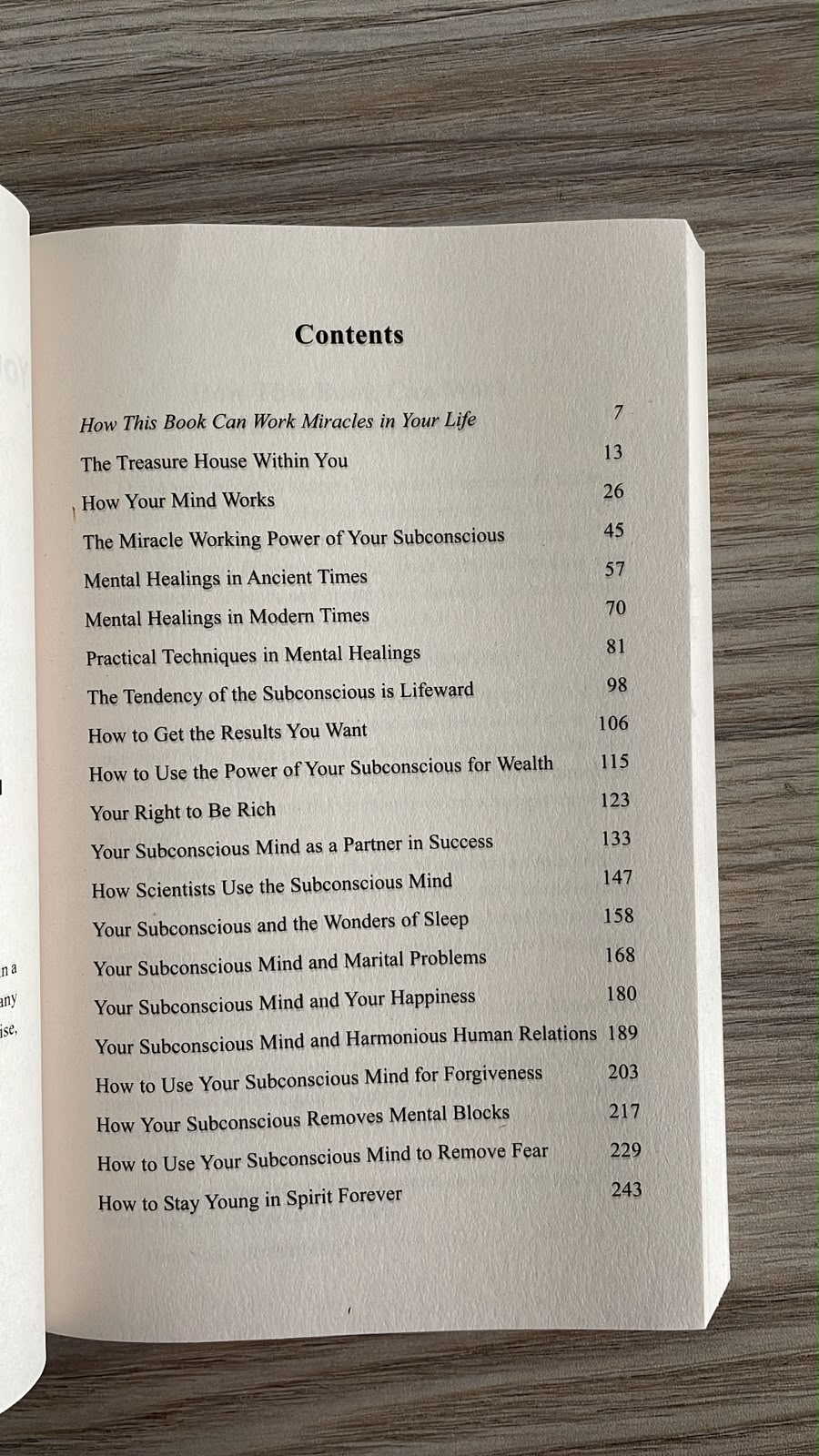





Power of Your Subconscious Mind by Dr. Joseph Murphy

රු1,450.00
3 X Rs. 483.33 or 8% Cashback with


or 3 X රු483.33 with


or up to 4 X රු362.50 with


Out of stock
Email when stock available
Power of Your Subconscious Mind by Joseph Murphy is a classic self-help book about the influence of thoughts, beliefs, habits and mental patterns on the way people experience life and pursue their goals.
Joseph Murphy argues that much of human behavior operates beneath conscious awareness. Habits, expectations, emotional reactions and deeply held beliefs can influence the choices people make every day.
The book encourages readers to become more conscious of those patterns and deliberately replace destructive thinking with more constructive mental habits.
Murphy discusses ideas such as positive self-talk, visualization, repetition, confidence, goal setting, sleep, relationships, forgiveness and overcoming fear. He presents the subconscious mind as an enormously powerful influence that can either support or interfere with a person’s goals depending on the beliefs repeatedly impressed upon it.
First published in the twentieth century and still widely read today, Power of Your Subconscious Mind by Joseph Murphy has become one of the best-known books in the positive-thinking and personal-development tradition.
However, modern readers should approach some of Murphy’s stronger claims carefully. The book often blends psychology, spirituality and New Thought philosophy, and some claims about healing, wealth or the subconscious are not established scientific facts. Its greatest practical value is in encouraging constructive habits, self-reflection, optimism and intentional behavior rather than treating thought alone as a guaranteed way to change external reality.
Power of Your Subconscious Mind by Joseph Murphy – Book Overview
Power of Your Subconscious Mind by Joseph Murphy begins with the idea that human beings operate through both conscious and subconscious mental processes.
The conscious mind is associated with deliberate thinking. It evaluates information, makes decisions and directs attention.
The subconscious, in Murphy’s framework, contains deeper habits, assumptions and beliefs that continue influencing behavior even when we are not consciously thinking about them.
His central argument is that repeated thoughts can gradually become powerful mental patterns.
If someone continually thinks:
“I cannot do this.”
“I always fail.”
“I am terrible at speaking.”
“I will never improve.”
those beliefs may influence behavior in ways that make improvement harder.
Murphy therefore encourages readers to pay attention to the messages they repeatedly give themselves.
Conscious and Subconscious Thinking
The distinction between conscious and automatic mental processes remains useful, even though modern psychology describes them differently from Murphy’s terminology.
Many everyday behaviors happen with little deliberate thought.
Driving a familiar route.
Typing.
Reacting emotionally.
Following routines.
Thinking automatically about ourselves.
The more frequently a behavior or thought pattern is repeated, the easier it can become to perform automatically.
This is one reason habits matter.
Thoughts Can Influence Behavior
A useful interpretation of Power of Your Subconscious Mind by Joseph Murphy is not that every thought magically becomes reality.
Instead, thoughts can influence:
Attention.
Confidence.
Motivation.
Decision-making.
Persistence.
Behavior.
Suppose two people approach the same difficult task.
One thinks:
“I probably cannot do this, so there is no point trying.”
The other thinks:
“This will be difficult, but I can learn.”
Neither thought guarantees an outcome.
But those beliefs may influence how much effort each person invests.
Self-Talk
The language people use internally matters.
Self-talk can become extremely negative without someone realizing it.
A mistake becomes:
“I am stupid.”
A failed project becomes:
“I always ruin everything.”
A rejection becomes:
“Nobody will ever choose me.”
Murphy encourages replacing these absolute statements with more constructive mental language.
A healthier alternative might be:
“I made a mistake, and I can understand what caused it.”
That does not deny reality.
It simply prevents one event from becoming an entire identity.
Positive Thinking
Positive thinking is one of the book’s most recognizable themes.
But useful positive thinking should not mean pretending everything is perfect.
If a business is losing money, saying:
“Everything is wonderful”
does not fix the problem.
Constructive thinking would sound more like:
“The current strategy is not working. I can analyze why, make changes and test another approach.”
Optimism works best when it supports action.
Belief and Expectation
Expectations can affect behavior.
If you strongly believe improvement is impossible, you may stop practicing.
If you believe improvement is possible, you are more likely to continue.
This creates an important distinction.
Belief does not guarantee success.
But belief can influence whether you take the actions required for success.
Visualization
Power of Your Subconscious Mind by Joseph Murphy frequently recommends mentally imagining desired outcomes.
Visualization is widely used in areas such as sport and performance preparation, but it should be combined with real-world practice.
A student might imagine confidently completing an exam.
Useful.
Then the student must still study.
A salesperson might mentally rehearse a presentation.
Useful.
Then the salesperson must still understand the product and customer.
Visualization can prepare the mind.
It cannot replace execution.
Mental Rehearsal
One practical way to use visualization is as rehearsal.
Before a presentation, imagine:
Walking into the room.
Opening confidently.
Explaining your main points.
Answering questions calmly.
This can make the situation feel more familiar.
Athletes frequently use forms of mental rehearsal alongside physical training.
The important phrase is alongside physical training, not instead of it.
Repetition
Murphy emphasizes repetition because repeated thoughts may become more familiar and automatic.
This idea connects naturally with habit formation.
A behavior repeated consistently becomes easier.
The same can happen with mental patterns.
If someone constantly rehearses worry, worry becomes familiar.
If someone repeatedly practices responding calmly, calm behavior may become easier.
Affirmations
The book is famous for encouraging affirmative statements.
Affirmations are short statements repeated to reinforce a desired belief or mindset.
Examples might include:
“I can improve through practice.”
“I can handle this conversation calmly.”
“I am capable of learning.”
The strongest affirmations tend to be believable and connected to action.
For someone experiencing severe anxiety, repeating “I have absolutely no anxiety” may feel obviously false.
A more grounded statement could be:
“I can feel anxious and still take the next step.”
Habit Formation
Habits are one of the most practical ways to interpret Murphy’s ideas.
Your life is partly shaped by actions you repeat.
Reading twenty minutes each day.
Saving a small amount regularly.
Walking every morning.
Practicing a language.
Checking your phone every five minutes.
Small repeated actions accumulate.
That means changing a life often begins with changing repeated behavior rather than waiting for one enormous motivational moment.
Goals
Power of Your Subconscious Mind by Joseph Murphy encourages readers to identify what they actually want.
Vague goals create vague action.
“I want a better career” is difficult to act upon.
“I want to qualify for a junior software engineering role within twelve months” creates clearer next steps.
Now you can ask:
Which skills are missing?
Which projects should I build?
How many applications should I send?
What feedback do I need?
Mental clarity becomes useful when converted into practical behavior.
Success
Murphy frequently connects mental attitude with success.
A modern reader should interpret this carefully.
Success depends on many factors beyond mindset, including opportunity, economic conditions, health, education, resources, social support and luck.
Mindset still matters because it influences how someone uses the opportunities available to them.
It is one factor, not the only factor.
The Subconscious and Fear
Fear can become self-reinforcing.
Suppose someone fears public speaking.
They avoid presentations.
Avoidance prevents practice.
Lack of practice preserves fear.
Eventually they think:
“See? I knew I couldn’t do it.”
The cycle continues.
Breaking the cycle may involve gradual exposure, preparation and repeated experience.
For serious anxiety disorders, professional mental-health support may also be appropriate.
Confidence
Confidence is another recurring subject.
True confidence does not require believing you are already excellent.
A healthier foundation is:
“I can handle learning.”
This allows mistakes.
Beginners need permission to be beginners.
Otherwise every failure feels like proof they should stop.
Sleep and the Mind
Murphy also discusses the period before sleep and recommends focusing the mind on constructive ideas rather than ending every day with fear and worry.
There is practical value in protecting sleep routines and reducing unnecessary stimulation before bed.
However, readers should avoid treating sleep-time suggestions as guaranteed cures for medical or psychological problems.
Persistent sleep difficulties may require professional advice.
Problem-Solving
Sometimes people solve problems after temporarily stepping away from them.
You work on a problem for hours.
Nothing works.
You take a walk.
Later, an idea appears.
This does not require a mystical explanation.
The brain continues organizing information in complex ways even when deliberate attention changes.
Murphy encourages readers to trust that not every problem must be solved through constant conscious forcing.
Creativity
Creative work frequently benefits from alternating between focused effort and mental space.
Writers.
Designers.
Engineers.
Programmers.
Entrepreneurs.
All may experience moments when an idea appears after leaving the problem temporarily.
The practical lesson is not to stop working.
It is to recognize that creativity sometimes needs both concentration and distance.
Worry
Murphy strongly discourages repetitive negative thinking.
There is an important difference between:
Planning for a problem
and
rehearsing disaster repeatedly.
Planning asks:
“What can I do?”
Worry often asks:
“What if everything goes wrong?”
again and again without producing action.
When worry becomes overwhelming or persistent, psychological support can be more useful than simply trying to think positively.
Forgiveness
Forgiveness appears frequently in Power of Your Subconscious Mind by Joseph Murphy.
Holding resentment can keep attention tied to old events.
Forgiveness, however, does not necessarily mean:
Approving what happened.
Rebuilding the relationship.
Removing boundaries.
Forgetting abuse.
It can mean choosing not to let the event control your emotional life indefinitely.
Relationships
Murphy encourages constructive thinking about other people.
Relationships often deteriorate when someone repeatedly assumes the worst possible motive.
“They did that because they do not respect me.”
Maybe.
Or maybe there is another explanation.
Healthy communication involves checking assumptions before treating them as facts.
Anger
Anger can provide information.
It may indicate:
A boundary was crossed.
Something feels unjust.
You feel threatened.
The goal should not necessarily be eliminating anger.
It is learning how to respond without allowing anger to make every decision.
Gratitude
Gratitude can redirect attention toward things that are already working.
This does not mean ignoring difficulties.
Someone can simultaneously say:
“This situation is difficult”
and
“I still appreciate the support I have.”
Both can be true.
Wealth
Murphy frequently discusses prosperity and financial abundance.
This is one area where modern readers should be particularly careful.
Thinking positively about money does not automatically create wealth.
Financial outcomes depend on real-world factors such as:
Income.
Spending.
Saving.
Investment.
Business execution.
Risk.
Economic conditions.
Financial education.
A positive money mindset may support constructive action, but it should not replace practical financial planning.
Career Success
The book’s mindset principles can be applied more realistically to career development.
Instead of believing:
“I will become successful because I visualize success,”
use visualization to support a system.
Clarify the role you want.
Build relevant skills.
Create projects.
Improve your CV.
Network.
Apply.
Practice interviews.
Review feedback.
Then repeat.
Mindset supports the process.
The process creates the opportunity.
Business and Entrepreneurship
Entrepreneurs may find the book motivating because starting a business requires acting despite uncertainty.
A founder needs enough belief to begin.
But optimism must be balanced with evidence.
Customer demand.
Cash flow.
Margins.
Competition.
Operational capacity.
Positive thinking should help entrepreneurs face facts confidently, not avoid facts.
The Placebo Effect and Expectations
Modern medicine has shown that expectations can sometimes influence subjective experiences and some physiological responses, but this does not mean belief can cure every illness.
Murphy’s stronger healing claims should therefore not be treated as medical guidance.
Medical conditions should be evaluated and treated using qualified healthcare professionals and evidence-based care.
Spirituality
Joseph Murphy’s writing is influenced strongly by spirituality and the New Thought tradition.
He frequently combines psychological language with religious or metaphysical ideas.
Readers who enjoy spiritual self-help may appreciate this.
Readers looking for a modern academic psychology textbook should know that this book is something different.
Science Versus Philosophy
Power of Your Subconscious Mind by Joseph Murphy is best categorized as classic self-help and spiritual personal development rather than contemporary scientific psychology.
Some broad ideas—such as habits, expectations, mental rehearsal and automatic thinking—overlap with concepts studied scientifically.
Other claims go much further than current evidence supports.
Readers can benefit from distinguishing between the two.
You Cannot Control Everything With Your Thoughts
This is perhaps the most important modern caveat.
People do not cause every bad event through negative thinking.
Illness.
Accidents.
Natural disasters.
Abuse.
Poverty.
Other people’s decisions.
These cannot fairly be blamed on someone’s mindset.
A self-help philosophy becomes harmful if it tells people that every tragedy occurred because they “thought incorrectly.”
That is not a responsible interpretation.
What You Can Influence
A more balanced lesson is to focus on what you can influence.
Your routines.
Your preparation.
Your response.
Your self-talk.
Your habits.
Your willingness to seek help.
Your next decision.
This gives the reader agency without pretending they control the entire universe.
Self-Image
How someone thinks about themselves can influence behavior.
If your identity is:
“I am terrible with money,”
you may avoid learning about finances.
If the identity becomes:
“I am learning to manage money better,”
there is room for progress.
Language can create psychological space for change.
Identity-Based Habits
Instead of only focusing on outcomes, consider identity.
Rather than:
“I want to read 20 books.”
think:
“I am becoming someone who reads regularly.”
Then reinforce that identity through action.
Read ten pages.
Then do it again tomorrow.
Actions provide evidence for the identity.
Discipline Versus Motivation
Motivation changes.
Some days you feel inspired.
Other days you do not.
Habits reduce dependence on motivation.
This connects naturally with Murphy’s emphasis on repetition.
Repeated behavior eventually becomes more automatic.
The Importance of Environment
Mindset matters, but environment matters too.
If you want to reduce phone use but keep the phone beside you all day, willpower must constantly fight temptation.
Change the environment.
Move the phone.
Disable unnecessary notifications.
Create friction around unwanted behavior.
Mental change works better when supported by practical design.
Avoid Toxic Positivity
Positive thinking becomes unhealthy when it refuses to acknowledge real pain.
Someone grieving does not need to be told:
“Just think positively.”
Someone experiencing depression may need professional care.
Someone in an abusive relationship may need safety and support, not affirmations telling them the situation is fine.
Constructive optimism acknowledges reality while still looking for useful action.
Why the Book Became Popular
The appeal of Power of Your Subconscious Mind by Joseph Murphy is easy to understand.
It gives readers a hopeful idea:
The patterns inside your mind are not necessarily permanent.
You can notice them.
Question them.
Practice alternatives.
Develop new habits.
That message can feel empowering.
Timeless Ideas and Dated Claims
Because the book comes from an earlier era of self-help writing, some language and explanations may feel dated.
Modern readers can still extract useful principles while evaluating extraordinary claims critically.
A book does not need to be scientifically perfect in every claim for parts of it to stimulate useful self-reflection.
Is Power of Your Subconscious Mind a Self-Help Book?
Yes.
Your BookLounge categorization under Self-Help & Personal Development is appropriate.
Its central subjects include mental habits, positive thinking, confidence, goals, relationships and personal change.
Is It a Psychology Book?
It uses psychological terminology, but it should not be treated as a modern academic psychology textbook.
Murphy’s framework incorporates spiritual and New Thought ideas alongside observations about habits and belief.
Readers seeking evidence-based psychology should supplement it with contemporary psychological research.
Is It a Religious Book?
It contains frequent spiritual and biblical references, but it is generally marketed as self-help rather than as a conventional theology book.
Murphy uses religious language to explain many of his ideas about faith, belief and the subconscious.
Is It Easy to Read?
Yes.
The writing is generally direct and accessible.
Murphy uses:
Short explanations.
Examples.
Stories.
Repeated principles.
This makes the book approachable for readers new to self-development literature.
Is It Good for Beginners?
Yes.
Readers interested in:
Positive thinking.
Mindset.
Habits.
Goal setting.
Self-confidence.
Visualization.
may find it an accessible starting point.
Just remember to separate motivational ideas from claims that require scientific or medical evidence.
Joseph Murphy
Joseph Murphy was an influential twentieth-century writer and minister associated with the New Thought movement.
His work focused heavily on belief, spirituality, mental habits and what he described as the power of the subconscious mind.
The Power of Your Subconscious Mind became his best-known work and remains widely available in numerous editions worldwide.
Edition Note
There are many editions of this classic, so ISBN, page count, publisher and cover design can differ substantially.
Your BookLounge catalogue identifies the title as Power of Your Subconscious Mind by Joseph Murphy, product code 2078, currently listed in the digital catalogue at Rs. 1,750.
For WooCommerce, use the ISBN, page count and publisher printed on the exact physical copy you are selling rather than copying specifications from another edition.
Important Themes
Power of Your Subconscious Mind by Joseph Murphy explores the subconscious mind, positive thinking, self-talk, belief, visualization, habits, confidence, fear, goals, relationships, forgiveness, prosperity, creativity, sleep, mental rehearsal, spirituality, personal growth and changing destructive thought patterns.
7 Powerful Lessons From Power of Your Subconscious Mind by Joseph Murphy
- Pay attention to repeated self-talk. Thoughts repeated constantly can influence expectations, confidence and behavior, so destructive inner language deserves to be challenged.
- Visualization works best when combined with action. Mentally rehearsing success may improve preparation, but real progress still requires practice, learning and execution.
- Habits shape more of life than occasional motivation. Repeated constructive behavior can gradually become easier and more automatic.
- Fear does not need to make every decision. Confidence can grow by preparing well, taking manageable steps and gaining evidence that difficult situations can be handled.
- Replace absolute negative beliefs with growth-oriented ones. “I cannot do this” closes the door, while “I have not learned this yet” leaves room for improvement.
- Focus attention on what you can influence. You cannot control every external event, but you can often influence preparation, habits, responses and the next decision you make.
- Use positive thinking as support for practical action, not as a substitute for reality. The strongest modern interpretation of Murphy’s message is to combine constructive thinking with evidence, work, healthy habits and appropriate professional help.
Why Read Power of Your Subconscious Mind by Joseph Murphy?
Power of Your Subconscious Mind by Joseph Murphy is an excellent choice for readers interested in classic self-help, personal development, mindset, positive thinking, visualization, confidence, habits, motivation and spiritual approaches to personal growth.
Its greatest strength is the reminder that many thought patterns operate automatically.
Sometimes we repeat beliefs for years without stopping to ask whether they are useful or even accurate.
“I always fail.”
“People like me cannot succeed.”
“I am too old.”
“I am not confident.”
“I cannot change.”
Murphy encourages readers to interrupt these patterns.
That process alone can be valuable.
But the most useful modern interpretation adds another step:
change the thought, then change the behavior.
If you want confidence, practice.
If you want financial stability, create a plan.
If you want career growth, develop skills.
If you want better relationships, communicate.
If you want better health, follow evidence-based medical and lifestyle guidance.
The mind can help direct action.
Action connects thought with reality.
Who Should Read This Book?
Power of Your Subconscious Mind by Joseph Murphy may especially appeal to self-help readers, students, entrepreneurs, professionals, people working on confidence, readers interested in positive thinking, readers exploring spiritual personal development and anyone curious about how repeated beliefs and mental habits may influence everyday behavior.
It is also a useful historical example of the positive-thinking tradition that influenced many later personal-development books.
Readers wanting strictly evidence-based psychology should read it critically and supplement it with modern psychological sources.
Power of Your Subconscious Mind by Joseph Murphy – Change the Pattern, Then Change the Action
Power of Your Subconscious Mind by Joseph Murphy is ultimately built around an encouraging idea:
What you repeatedly think does not have to remain unchanged forever.
Many people carry beliefs that began years earlier.
A teacher criticized them.
A business failed.
A relationship ended.
An examination went badly.
Someone told them they were not talented.
The event ends.
The belief continues.
Eventually, that belief can sound like objective truth.
“I am not good enough.”
Murphy asks readers to question those internal messages.
But the most practical version of his philosophy goes one step further.
Do not simply repeat:
“I am confident.”
Build confidence.
Prepare.
Practice.
Take small risks.
Learn from mistakes.
Collect evidence that you can improve.
Do not simply think:
“I will be successful.”
Develop the abilities and habits that make success more likely.
That balance keeps the hopeful message of the book without turning positive thinking into magical thinking.
The mind matters.
Beliefs matter.
Expectations matter.
But so do behavior, evidence, opportunity, skill and circumstance.
For readers who enjoy classic self-help and want to examine the mental patterns influencing their everyday choices, Power of Your Subconscious Mind by Joseph Murphy remains a famous and accessible introduction to the idea that changing your inner dialogue can be one important part of changing how you act in the world.
Learn more about The Power of Your Subconscious Mind by Joseph Murphy on Penguin Random House.
Explore more personal development and self-help books at Bargain Books.
| Author | Dr. Joseph Murphy |
|---|---|
| Language | English |
| Type | Paperback Printed Book (Second Quality Copy) |
Be the first to review “Power of Your Subconscious Mind by Dr. Joseph Murphy”
Related products
-28%

Self-Help & Psychology
Original price was: රු1,800.00.රු1,300.00Current price is: රු1,300.00.
3 X Rs. 433.33 or 8% Cashback with
or 3 X රු433.33 with
or up to 4 X රු325.00 with
-19%

Out of stock
Non-Fiction & Knowledge
Original price was: රු2,650.00.රු2,150.00Current price is: රු2,150.00.
3 X Rs. 716.67 or 8% Cashback with
or 3 X රු716.67 with
or up to 4 X රු537.50 with
-24%

Out of stock
Non-Fiction & Knowledge
Original price was: රු2,100.00.රු1,600.00Current price is: රු1,600.00.
3 X Rs. 533.33 or 8% Cashback with
or 3 X රු533.33 with
or up to 4 X රු400.00 with

Non-Fiction & Knowledge
රු1,700.00
3 X Rs. 566.67 or 8% Cashback with
or 3 X රු566.67 with
or up to 4 X රු425.00 with
-24%

Out of stock
Non-Fiction & Knowledge
Original price was: රු2,500.00.රු1,900.00Current price is: රු1,900.00.
3 X Rs. 633.33 or 8% Cashback with
or 3 X රු633.33 with
or up to 4 X රු475.00 with
-17%

Non-Fiction & Knowledge
Original price was: රු2,900.00.රු2,400.00Current price is: රු2,400.00.
3 X Rs. 800.00 or 8% Cashback with
or 3 X රු800.00 with
or up to 4 X රු600.00 with

Non-Fiction & Knowledge
රු1,500.00
3 X Rs. 500.00 or 8% Cashback with
or 3 X රු500.00 with
or up to 4 X රු375.00 with

Non-Fiction & Knowledge
රු1,600.00
3 X Rs. 533.33 or 8% Cashback with
or 3 X රු533.33 with
or up to 4 X රු400.00 with
Reviews
There are no reviews yet.