
No products in the cart.
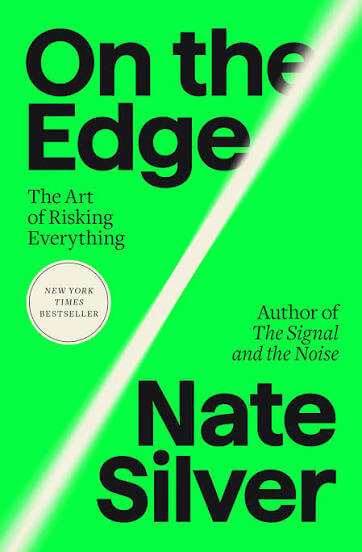
On the Edge: The Art of Risking Everything by Nate Silver


රු2,900.00
3 X Rs. 966.67 or 8% Cashback with


or 3 X රු966.67 with


or up to 4 X රු725.00 with


On the Edge: The Art of Risking Everything by Nate Silver explores the world of professional risk-takers—from poker players and investors to crypto entrepreneurs and AI thinkers.
A fascinating nonfiction book about probability, uncertainty, decision-making and the people shaping finance and technology.
Format: Paperback
Pages: 576
Publisher: Penguin Books
ISBN: 9780593491645
5 in stock
On the Edge by Nate Silver
On the Edge: The Art of Risking Everything by Nate Silver is a wide-ranging nonfiction book about risk, probability, gambling, technology, finance and the people who make high-stakes decisions under uncertainty.
Silver is best known for his work in statistics and forecasting and as the founder of FiveThirtyEight.
In On the Edge, he turns his attention toward a group of people he describes as “the River.”
This group includes people such as:
- Professional poker players
- Sports bettors
- Hedge-fund managers
- Venture capitalists
- Crypto investors
- Technology entrepreneurs
- Artificial-intelligence researchers
- Quantitative thinkers
What connects them is not one profession.
It is a particular relationship with risk and uncertainty.
Penguin Random House describes the book as an investigation into people who use probability, numbers and risk-taking to gain an advantage in areas ranging from poker and finance to technology and artificial intelligence.
Understanding “The River”
One of Silver’s central ideas is a community he calls the River.
People in the River tend to share characteristics such as:
- High tolerance for risk
- Comfort with uncertainty
- Strong interest in numbers
- Probabilistic thinking
- Distrust of conventional wisdom
- Competitive behaviour
- Willingness to update beliefs when new information appears
Silver contrasts this mindset with more conventional approaches to decision-making.
The book explores both the advantages and dangers of thinking this way.
Risk-taking can create extraordinary opportunities.
It can also produce enormous failures.
Poker and Decision-Making
Poker plays an important role in the book.
Silver has extensive experience playing poker himself, and he uses the game as a model for understanding decisions made with incomplete information.
Poker requires players to think about:
- Probability
- Opponents
- Expected value
- Uncertainty
- Risk versus reward
- Incomplete information
The important question is often not:
“Do I know what will happen?”
Instead, it is:
“Given what I know, what decision has the best expected outcome?”
That idea appears throughout the book.
Expected Value
Expected value is one of the fundamental concepts behind many forms of decision-making discussed in On the Edge.
A decision may have several possible outcomes.
Some outcomes are likely but small.
Others may be unlikely but extremely valuable.
Thinking in expected-value terms requires considering both:
- Probability
- Size of the possible outcome
This approach is common in gambling and investing but can also influence business strategy and technology decisions.
Gambling and Sports Betting
Silver spends significant time inside gambling communities.
These environments provide a clear demonstration of how people react when:
- Real money is at stake
- Probabilities are uncertain
- Outcomes can change quickly
- Emotional discipline matters
Professional gamblers attempt to find an edge—a small advantage that becomes meaningful over many decisions.
The same idea appears in other industries.
Finance and Investing
Financial markets are another major area explored in the book.
Traders and investors constantly make decisions without knowing exactly what will happen next.
They need to estimate:
- Risk
- Expected returns
- Market behaviour
- Probability
- Downside
- Opportunity
Silver examines how highly quantitative thinkers approach these problems.
The book does not present investing as predictable.
Instead, it focuses on how people make decisions when outcomes are uncertain.
Cryptocurrency and FTX
The book also examines the cryptocurrency boom and the collapse of FTX.
Silver visited the world surrounding Sam Bankman-Fried and examines how extreme confidence in probability, expected value and unconventional thinking can sometimes become dangerous.
Google Books describes the book as taking readers into environments including the FTX world, professional gambling and other high-risk communities.
The FTX story becomes an example of how rational-sounding frameworks do not automatically protect people from:
- Overconfidence
- Poor judgment
- Ethical failures
- Excessive risk
Artificial Intelligence
Artificial intelligence is another major theme.
AI development involves uncertainty on an enormous scale.
Researchers, founders and investors make decisions about:
- Future capabilities
- Potential benefits
- Economic impact
- Safety
- Competition
- Long-term risk
Silver examines the people who attempt to put probabilities on events that have never happened before.
Venture Capital and Technology
Venture capital also fits naturally into Silver’s framework.
Most startup investments fail.
A small number can generate extraordinary returns.
This means investors may accept many losses if one successful investment has enormous upside.
The same logic appears in:
- Startups
- Technology
- Research
- Innovation
Silver explores how this environment attracts people who are unusually comfortable with uncertainty.
Bayesian Thinking
Another important concept connected to the book is updating beliefs.
A person begins with an estimate based on available evidence.
When new information appears, that estimate should change.
This is closely related to Bayesian reasoning.
Instead of treating beliefs as permanent, probabilistic thinkers repeatedly ask:
What does this new evidence tell me?
This approach can be useful in forecasting, investing, science and everyday decision-making.
Risk Versus Recklessness
One of the important distinctions in On the Edge is the difference between intelligent risk-taking and recklessness.
Taking risk does not automatically make someone sophisticated.
A good risk decision requires understanding:
- Potential upside
- Potential downside
- Probability
- Uncertainty
- What happens if you are wrong
The book examines cases where confidence and risk-taking produce success as well as cases where they go too far.
Politics and Forecasting
Silver became widely known through election forecasting, and probabilistic political thinking also forms part of the broader intellectual background of the book.
However, On the Edge is not primarily a book about elections.
Its focus is broader:
How do people make decisions when the future is uncertain?
That question applies to politics, markets, games, technology and business.
A Book About Modern Power
Another major theme is that people comfortable with risk increasingly hold significant influence.
Silver examines communities connected to:
- Silicon Valley
- Finance
- Crypto
- AI
- Venture capital
These industries have the ability to shape markets, technology and society.
Understanding how their decision-makers think can therefore help readers understand some of the forces affecting the modern economy.
Important Evidence Note
On the Edge combines:
- Reporting
- Interviews
- Statistics
- Personal observations
- Case studies
- Nate Silver’s interpretations
Some arguments in the book are Silver’s own analytical framework rather than universally accepted scientific classifications.
Readers should therefore distinguish between documented events, statistical concepts and the author’s broader interpretation of “the River.”
Who May Enjoy This Book?
On the Edge may appeal to readers interested in:
- Probability
- Risk
- Statistics
- Investing
- Poker
- Gambling
- Artificial intelligence
- Cryptocurrency
- Technology
- Decision-making
- Forecasting
- Business
- Economics
It may especially appeal to readers who enjoyed:
- The Signal and the Noise
- Thinking, Fast and Slow
- Fooled by Randomness
- The Black Swan
- Superforecasting
- The Psychology of Money
About Nate Silver
Nate Silver is a statistician, writer and forecaster.
He founded FiveThirtyEight and later launched the newsletter Silver Bulletin.
His books include:
- The Signal and the Noise
- On the Edge: The Art of Risking Everything
Penguin Random House identifies him as the bestselling author of both titles and confirms his role as founder of FiveThirtyEight.
For readers looking to buy On the Edge by Nate Silver in Sri Lanka, ISBN 9780593491645 is the current Penguin Books paperback edition used for this listing.
Be the first to review “On the Edge: The Art of Risking Everything by Nate Silver”
Related products
-20%
Out of stock
Original price was: රු2,500.00.රු2,000.00Current price is: රු2,000.00.
3 X Rs. 666.67 or 8% Cashback with
or 3 X රු666.67 with
or up to 4 X රු500.00 with
Out of stock
රු1,750.00
3 X Rs. 583.33 or 8% Cashback with
or 3 X රු583.33 with
or up to 4 X රු437.50 with
Business
රු1,400.00
3 X Rs. 466.67 or 8% Cashback with
or 3 X රු466.67 with
or up to 4 X රු350.00 with
-12%
Out of stock
Biography
Original price was: රු2,600.00.රු2,300.00Current price is: රු2,300.00.
3 X Rs. 766.67 or 8% Cashback with
or 3 X රු766.67 with
or up to 4 X රු575.00 with
රු3,200.00
3 X Rs. 1,066.67 or 8% Cashback with
or 3 X රු1,066.67 with
or up to 4 X රු800.00 with
-13%
Out of stock
Original price was: රු4,000.00.රු3,500.00Current price is: රු3,500.00.
3 X Rs. 1,166.67 or 8% Cashback with
or 3 X රු1,166.67 with
or up to 4 X රු875.00 with
Business
Coffee Can Investing by Sanjay Bakshi – A Simple, High-Reward Strategy for Building Long-Term Wealth
රු1,750.00
3 X Rs. 583.33 or 8% Cashback with
or 3 X රු583.33 with
or up to 4 X රු437.50 with
-33%
Original price was: රු2,900.00.රු1,950.00Current price is: රු1,950.00.
3 X Rs. 650.00 or 8% Cashback with
or 3 X රු650.00 with
or up to 4 X රු487.50 with
Reviews
There are no reviews yet.