
No products in the cart.
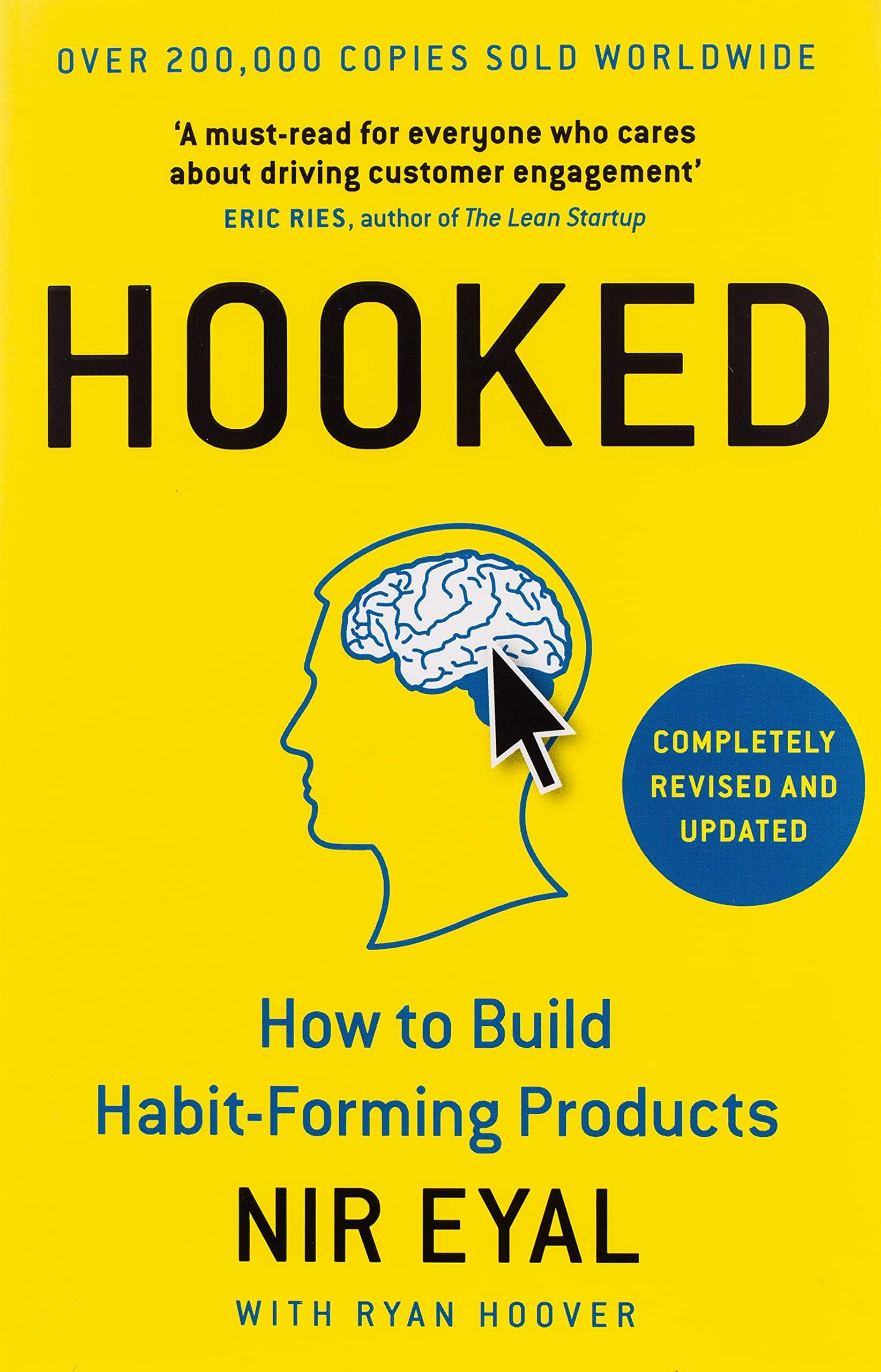
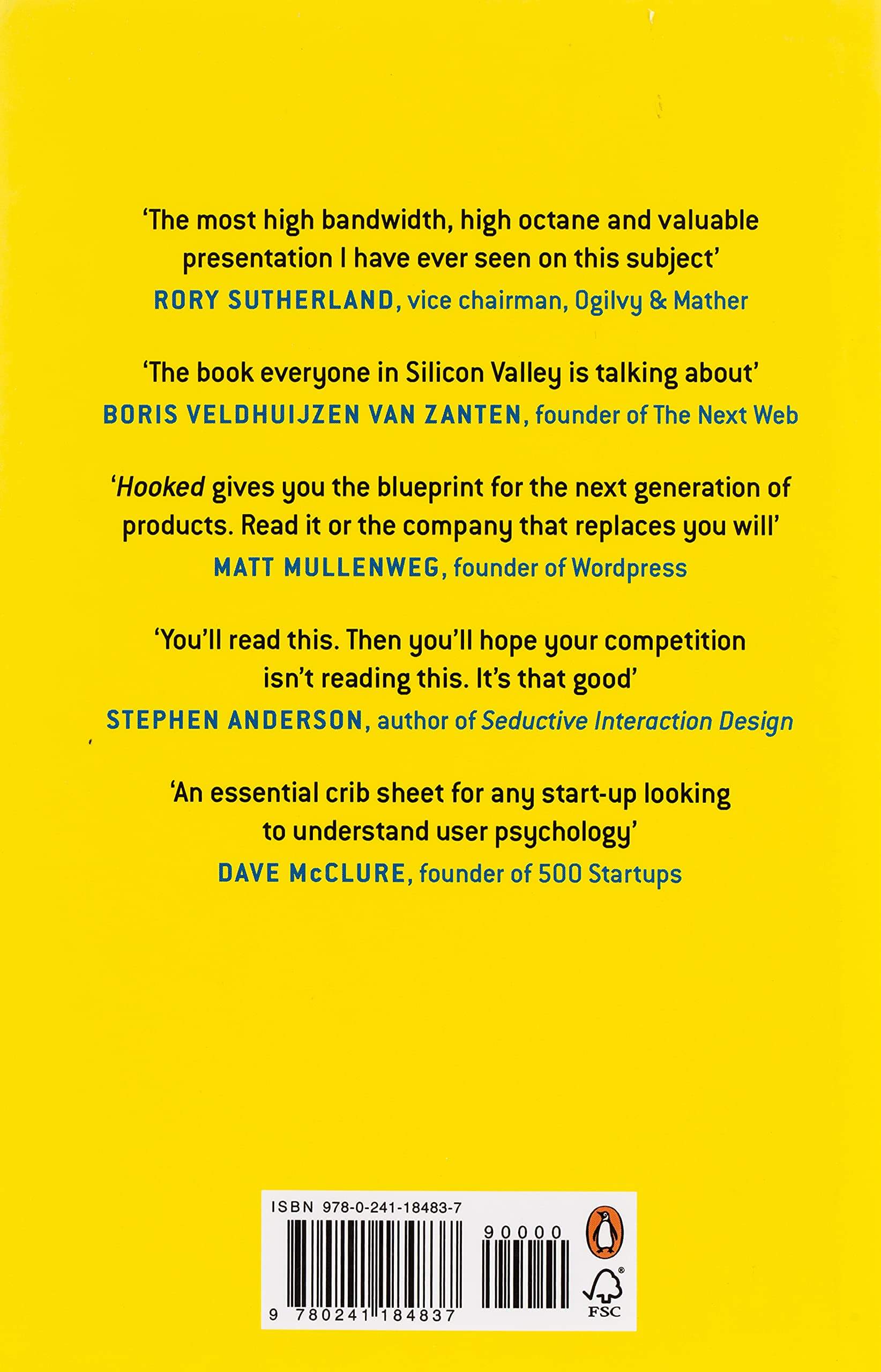


Hooked by Nir Eyal


රු1,550.00
3 X Rs. 516.67 or 8% Cashback with


or 3 X රු516.67 with


or up to 4 X රු387.50 with


| Detail | Information |
|---|---|
| Title | Hooked: How to Build Habit-Forming Products |
| Author | Nir Eyal |
| Genre | Business / Product Design / Psychology |
| Published | 2014 |
| Publisher | Penguin |
| Pages | 256 |
| Language | English |
| ISBN | 9781591847786 |
| Formats | Paperback |
| Target Audience | Entrepreneurs, Product Teams, Designers, Marketers |
Out of stock
Email when stock available
Hooked by Nir Eyal is a practical business, psychology, marketing, and product-design book that explains why some products become part of people’s everyday routines while others are quickly forgotten. Through research, real-world examples, and a clear four-step framework known as the Hook Model, Nir Eyal explores how companies can build products that encourage repeated use.
The central idea is simple.
Many successful products do not rely only on advertising to bring customers back.
Instead, they become connected to habits.
People begin opening an app, checking a service, or using a product almost automatically because a repeated behavioural cycle has formed.
Eyal explains that this cycle can often be understood through four stages:
Trigger → Action → Variable Reward → Investment
Together, these four stages form the Hook Model.
Hooked by Nir Eyal – Book Overview
Hooked by Nir Eyal is designed for product managers, entrepreneurs, marketers, designers, startup founders, developers, and anyone interested in understanding how technology influences behaviour.
Rather than focusing only on theory, the book presents a practical framework that can be applied when developing products and services.
Eyal asks several important questions.
Why do people check certain apps repeatedly?
Why do some products become part of daily routines?
Why do customers return to one service while abandoning another?
And how can businesses encourage useful habits without depending entirely on expensive advertising?
The Hook Model is Eyal’s answer to these questions.
Step 1 – Trigger
The first stage in Hooked by Nir Eyal is the trigger.
A trigger encourages a person to take action.
Triggers can be external or internal.
External triggers come from something outside the user.
Examples may include:
- Notifications
- Emails
- Advertising
- Recommendations
- Buttons
- Messages
- Reminders
These prompts tell users what to do next.
Internal triggers work differently.
They are connected to emotions, thoughts, routines, or situations.
For example, boredom may encourage someone to open a social media app.
Uncertainty may cause someone to search online.
Loneliness may encourage someone to open a messaging platform.
When a product becomes connected to an internal trigger, users may begin returning without needing external reminders.
Step 2 – Action
The second stage in Hooked by Nir Eyal is action.
After a trigger appears, the user must perform some behaviour.
The easier that behaviour feels, the more likely the person may be to complete it.
This makes simplicity extremely important in product design.
If a user wants to complete a task but encounters too many steps, they may leave.
Successful products often reduce unnecessary friction.
A button may make purchasing easier.
A simple interface may make navigation faster.
A well-designed sign-up process may reduce frustration.
The book encourages product teams to ask whether they are making the desired action easy enough.
Step 3 – Variable Reward
Variable rewards are one of the most interesting concepts in Hooked by Nir Eyal.
People are often motivated by uncertainty.
If the outcome of an action is always completely predictable, interest may decrease.
But when the reward contains some variation, curiosity can increase.
This does not mean every product should feel like gambling.
Rather, it means products can provide changing forms of value.
For example, a social platform may show different updates every time someone opens it.
A news app may present new stories.
A marketplace may contain different products.
A messaging app may provide different conversations.
The user knows that something useful or interesting may appear, but they do not know exactly what it will be.
That uncertainty can encourage repeated engagement.
Step 4 – Investment
The fourth stage in Hooked by Nir Eyal is investment.
Investment occurs when users put something into a product that can make future use more valuable.
This investment does not necessarily mean money.
Users may invest:
- Time
- Information
- Preferences
- Photos
- Followers
- Content
- Reputation
- Contacts
- Personal data
- Learning
For example, someone who builds a large playlist on a music platform may be less willing to move to another service.
A user who creates a professional network may become more invested in that platform.
The more valuable the user’s stored experience becomes, the stronger the relationship with the product may become.
How the Hook Model Works Together
The power of Hooked by Nir Eyal comes from understanding how the four stages connect.
A trigger leads to an action.
The action creates a reward.
The user then makes an investment.
That investment can help create another future trigger.
This creates a repeating cycle.
Over time, repeated cycles may turn deliberate behaviour into habit.
Eventually, the user may begin returning automatically.
This is why habit formation can be so valuable for businesses.
A product that becomes part of a routine may need less advertising to encourage repeat use.
Building Products People Return To
One of the key lessons in Hooked by Nir Eyal is that customer acquisition is only one part of business success.
Getting someone to try a product once is not enough.
Companies also need to consider retention.
Do users return?
Do they receive enough value to continue?
Does the product become easier or more useful over time?
Retention can be especially important for apps, subscription businesses, online platforms, software products, marketplaces, and digital services.
A product with strong retention may become more valuable because existing users keep returning.
Understanding User Psychology
Psychology is central to Hooked by Nir Eyal.
Products are designed for people.
Understanding why people behave in certain ways can therefore improve product design.
Users may respond to convenience.
They may seek social connection.
They may want entertainment.
They may want information.
They may want recognition.
They may want relief from boredom or uncertainty.
A strong product attempts to understand the underlying need rather than simply adding more features.
This is an important lesson for product teams.
More features do not automatically create a better product.
The product must solve a meaningful problem.
Customer Engagement
Hooked by Nir Eyal is particularly useful for understanding customer engagement.
Engagement describes how frequently and meaningfully customers interact with a product.
A product may attract thousands of downloads and still fail if most users never return.
Businesses therefore need to look beyond initial attention.
The real question is whether the product continues providing enough value for users to keep coming back.
The Hook Model offers one way to analyse that behaviour.
Teams can examine whether the trigger is effective, whether the action is simple enough, whether the reward provides value, and whether users have opportunities to invest in future use.
Habit-Forming Technology
Technology makes habit formation especially important because digital products can be accessed repeatedly throughout the day.
Phones, apps, websites, and online services are always available.
This creates opportunities for businesses but also responsibilities.
A product that becomes too effective at capturing attention may create problems for users.
This raises ethical questions.
When does engagement become manipulation?
When does convenience become dependence?
When should designers avoid creating unnecessary habits?
These questions make Hooked by Nir Eyal relevant not only for business but also for discussions about responsible technology.
Ethics and Responsible Product Design
The ability to influence behaviour creates responsibility.
Hooked by Nir Eyal encourages readers to think about whether the habits they are creating actually improve users’ lives.
A product can be engaging and still be harmful.
Businesses should therefore consider whether users genuinely benefit from repeated use.
Ethical product design should focus on creating value rather than simply maximizing time spent.
This distinction becomes increasingly important as digital platforms compete for attention.
Companies that understand behavioural psychology have powerful tools.
The question is how those tools should be used.
Product Design and User Experience
User experience is closely connected to habit formation.
If a product is confusing, slow, or frustrating, users may stop using it before a habit has time to develop.
Hooked by Nir Eyal therefore encourages teams to reduce unnecessary friction.
The product should help users accomplish the behaviour that provides value.
This may involve simplifying navigation, reducing unnecessary steps, providing clear feedback, and understanding exactly what users are trying to achieve.
Good user experience makes the desired action easier.
Marketing Without Constant Advertising
Another interesting lesson in Hooked by Nir Eyal is that strong habits can reduce dependence on repeated advertising.
Advertising can attract initial users.
But companies that depend entirely on advertising must constantly spend money to bring people back.
Habit-forming products work differently.
When users associate the product with a regular need or internal trigger, they may return naturally.
This can improve customer retention and long-term value.
However, the product must genuinely provide enough value for the habit to continue.
Why Read Hooked by Nir Eyal?
Hooked by Nir Eyal is a valuable choice for readers interested in:
- Product design
- Consumer psychology
- Marketing
- Customer retention
- Behavioural science
- User experience
- Business strategy
- Startups
- Digital products
- Customer engagement
- Habit formation
- Technology
- Entrepreneurship
- App development
The book offers a simple framework that readers can apply to real products and services.
Who Should Read This Book?
Hooked by Nir Eyal may especially appeal to:
- Startup founders
- Entrepreneurs
- Product managers
- UX designers
- UI designers
- Digital marketers
- Software developers
- Business owners
- Growth marketers
- Marketing students
- Business students
- Product designers
- Technology professionals
It is also useful for ordinary technology users who want to better understand why certain apps and services become difficult to stop checking.
A Powerful Guide to Habit-Forming Products
Hooked by Nir Eyal provides a practical framework for understanding how products become part of everyday behaviour.
The Trigger creates the opportunity for action.
The Action moves the user forward.
The Variable Reward provides value and curiosity.
The Investment increases the likelihood that the user will return.
Together, these stages create the Hook Model.
For entrepreneurs, marketers, product designers, developers, and business leaders, understanding this cycle can help improve customer retention and product engagement.
At the same time, the book encourages readers to think carefully about the ethical responsibility that comes with influencing behaviour.
For anyone interested in product psychology, customer engagement, digital business, startups, UX design, and understanding why certain technologies become habits, Hooked by Nir Eyal is a practical and thought-provoking guide.
Learn more about Hooked: How to Build Habit-Forming Products by Nir Eyal on Nir Eyal’s official website.
Explore more business and marketing books at Bargain Books.
| Author | Nir Eyal |
|---|---|
| Language | English |
| Type | Hardcover |
Be the first to review “Hooked by Nir Eyal”
Related products
-24%
Out of stock
Non-Fiction & Knowledge
Original price was: රු2,500.00.රු1,900.00Current price is: රු1,900.00.
3 X Rs. 633.33 or 8% Cashback with
or 3 X රු633.33 with
or up to 4 X රු475.00 with
Non-Fiction & Knowledge
රු2,250.00
3 X Rs. 750.00 or 8% Cashback with
or 3 X රු750.00 with
or up to 4 X රු562.50 with
Non-Fiction & Knowledge
රු1,550.00
3 X Rs. 516.67 or 8% Cashback with
or 3 X රු516.67 with
or up to 4 X රු387.50 with
Out of stock
Non-Fiction & Knowledge
රු1,500.00
3 X Rs. 500.00 or 8% Cashback with
or 3 X රු500.00 with
or up to 4 X රු375.00 with

Non-Fiction & Knowledge
රු1,950.00
3 X Rs. 650.00 or 8% Cashback with
or 3 X රු650.00 with
or up to 4 X රු487.50 with
-19%

Out of stock
Biography
Original price was: රු2,400.00.රු1,950.00Current price is: රු1,950.00.
3 X Rs. 650.00 or 8% Cashback with
or 3 X රු650.00 with
or up to 4 X රු487.50 with
-33%

Self-Help & Psychology
Original price was: රු2,300.00.රු1,550.00Current price is: රු1,550.00.
3 X Rs. 516.67 or 8% Cashback with
or 3 X රු516.67 with
or up to 4 X රු387.50 with
-14%
Out of stock
Self-Help & Psychology
Original price was: රු2,900.00.රු2,500.00Current price is: රු2,500.00.
3 X Rs. 833.33 or 8% Cashback with
or 3 X රු833.33 with
or up to 4 X රු625.00 with
Reviews
There are no reviews yet.