
No products in the cart.
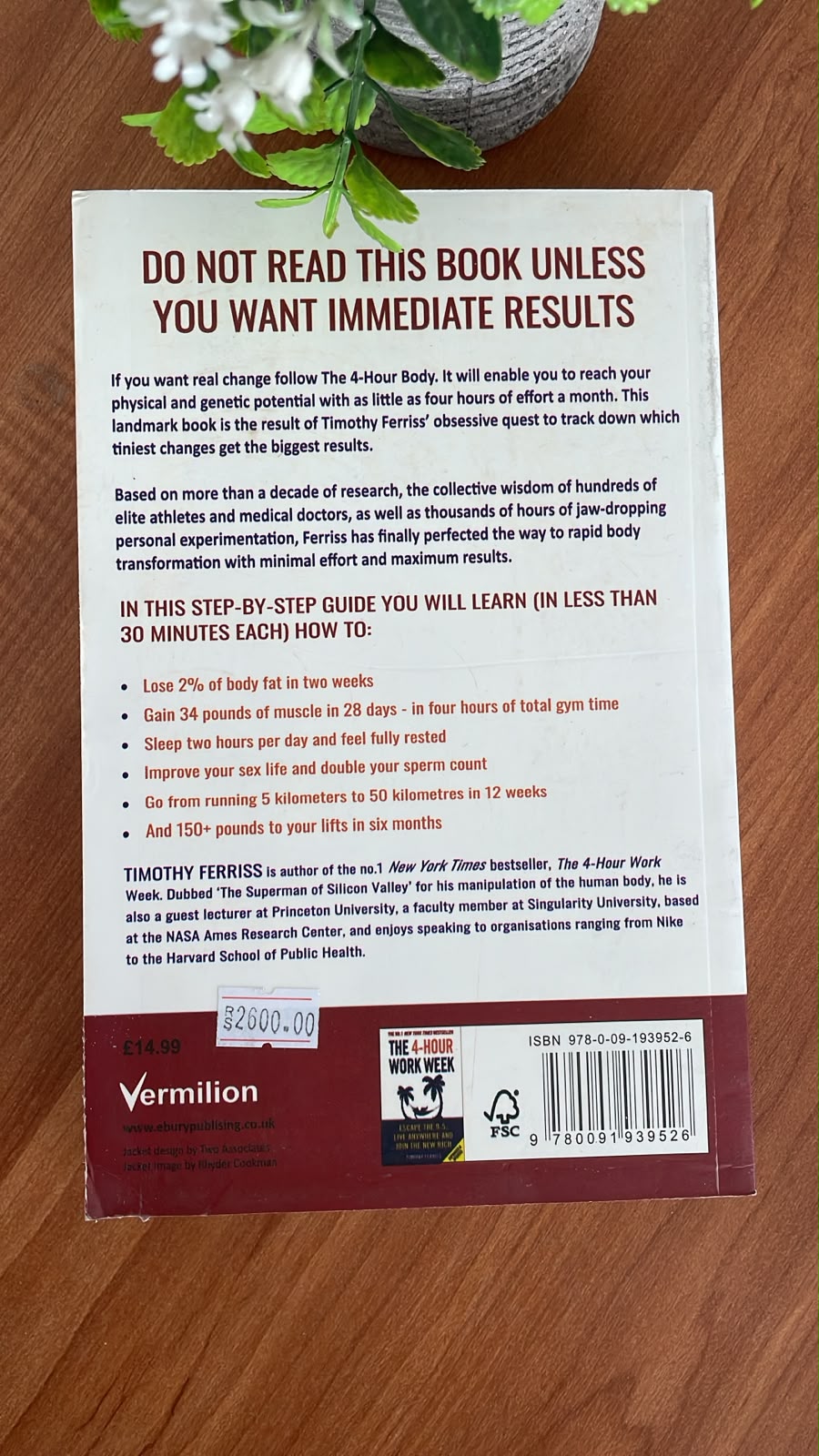

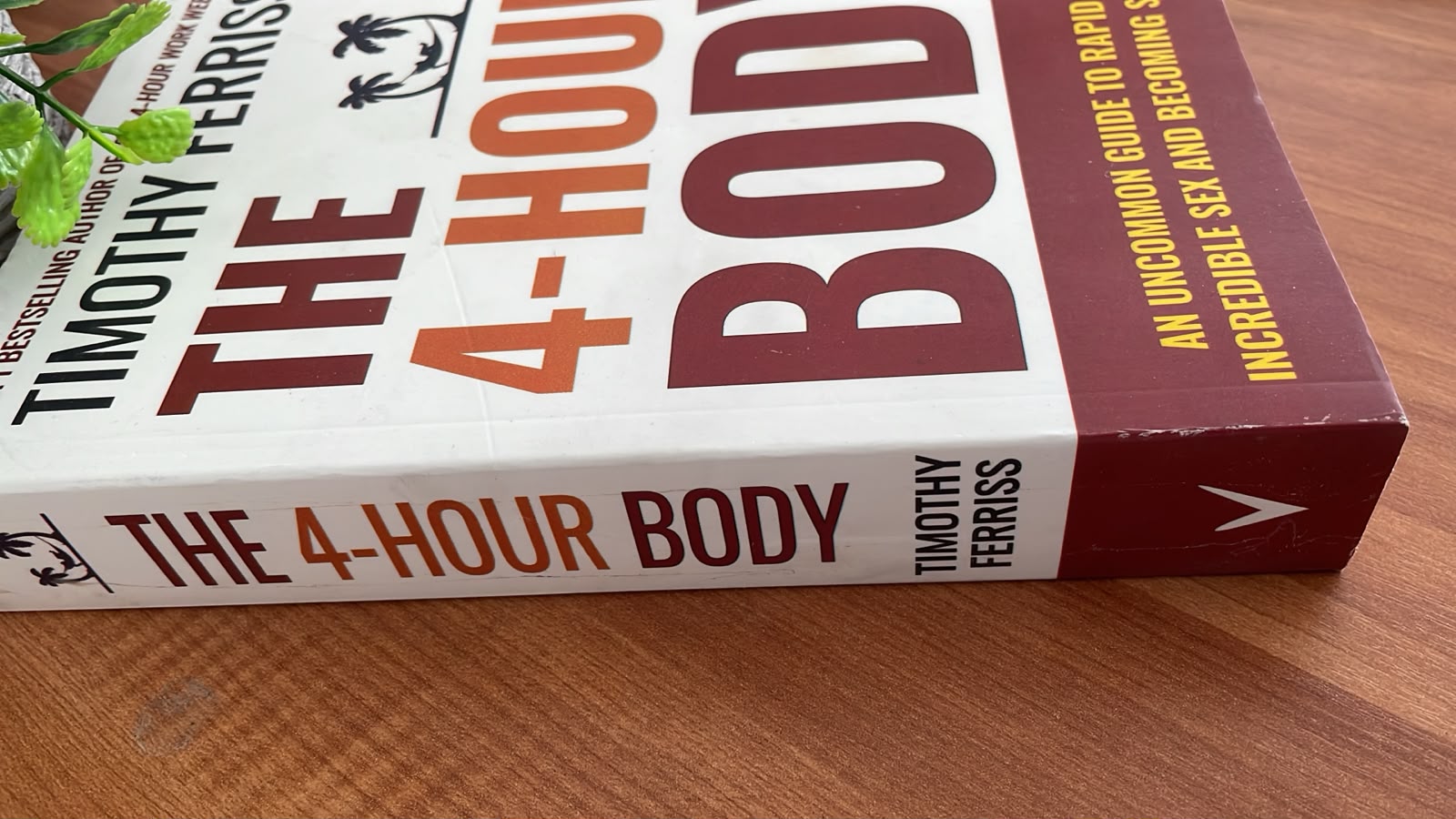


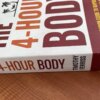
The 4-Hour Body by Timothy Ferriss

රු2,600.00
3 X Rs. 866.67 or 8% Cashback with


or 3 X රු866.67 with


or up to 4 X රු650.00 with


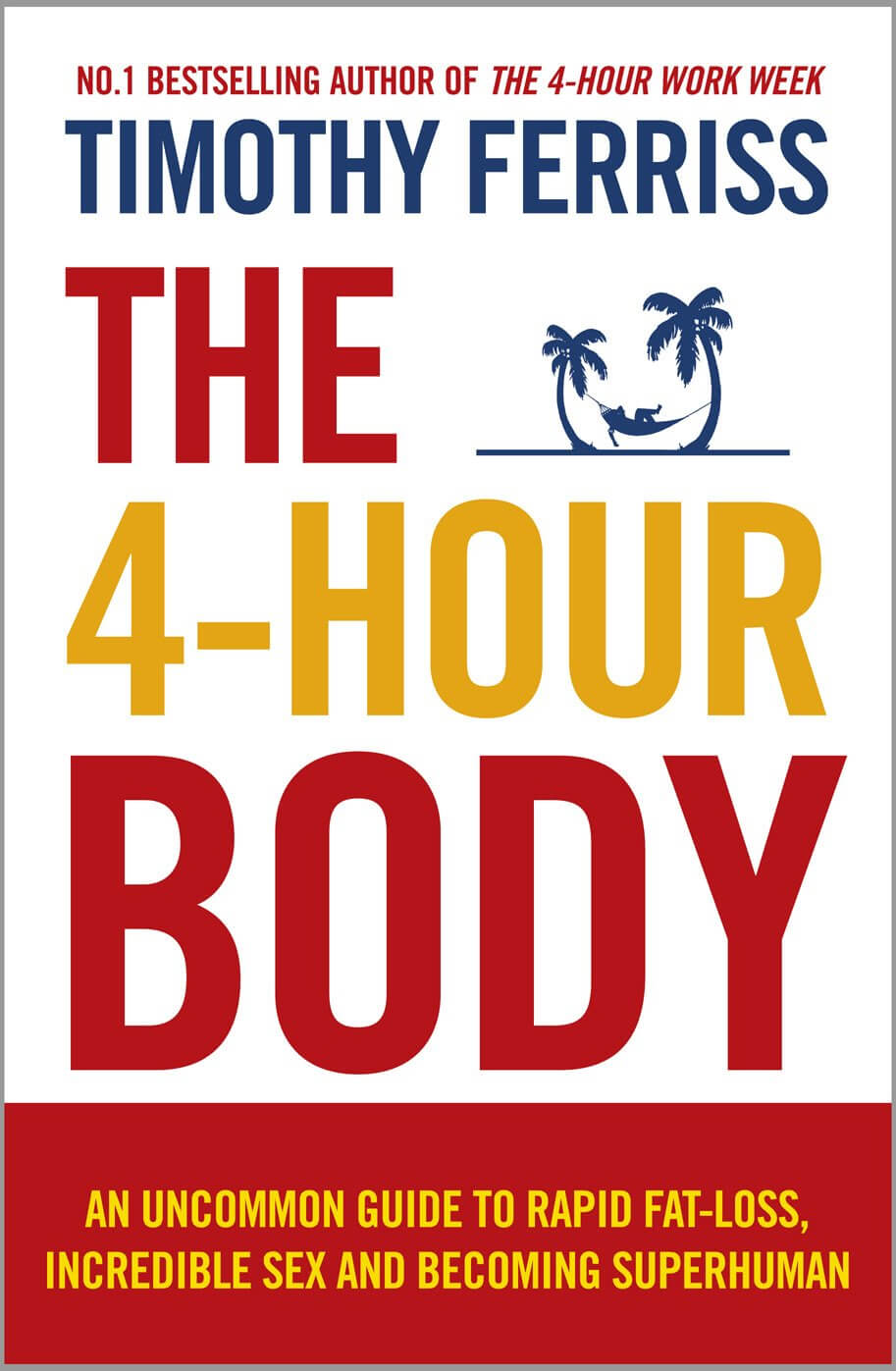
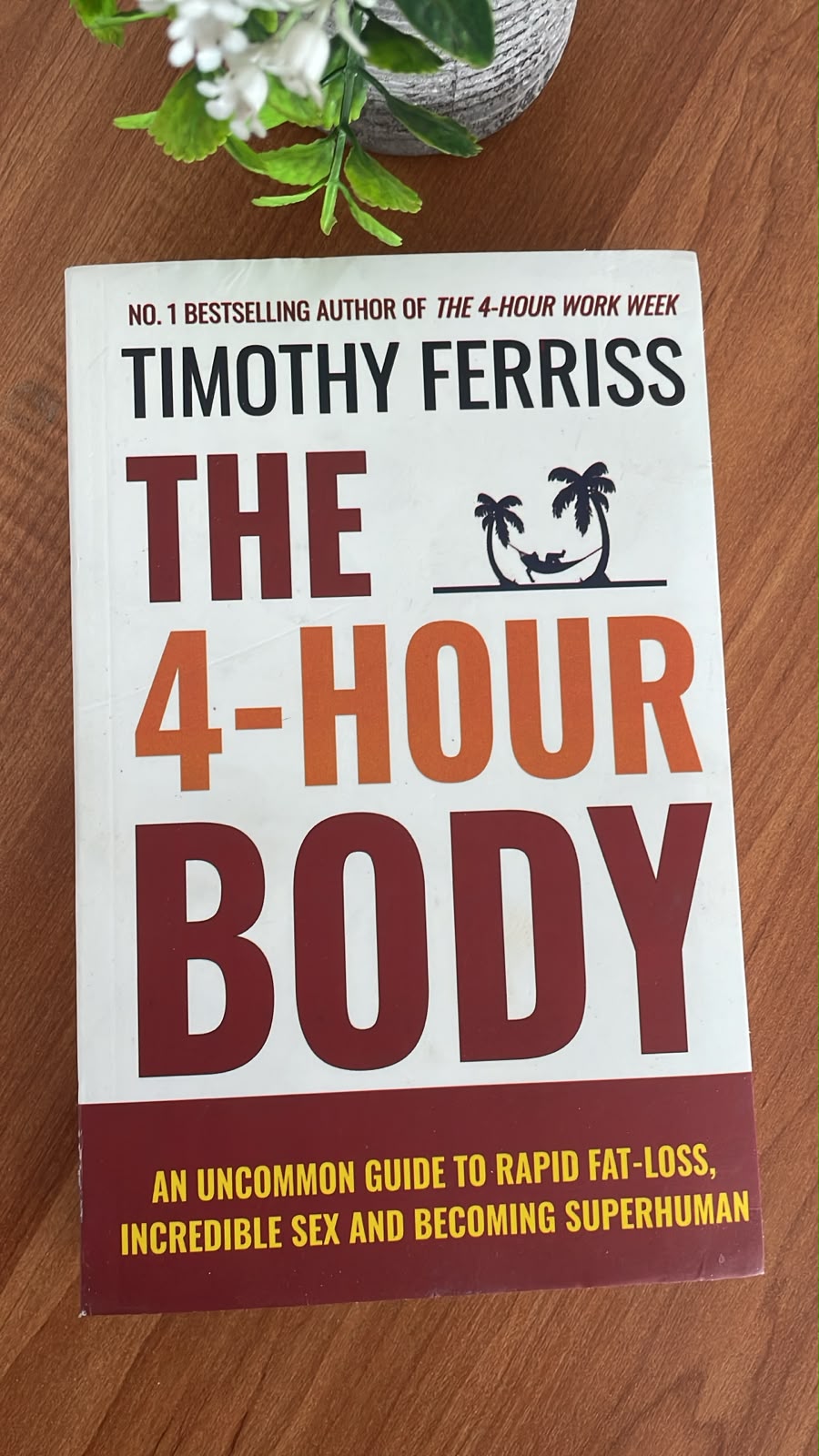
4 Hour Body by Timothy Ferriss is an unconventional health and fitness book built around experimentation, measurement and finding the smallest changes that may produce meaningful results.
Ferriss draws on years of personal experimentation, interviews and case studies while exploring topics including nutrition, body composition, strength, endurance, sleep and physical performance.
A central idea throughout the book is the Minimum Effective Dose: identifying the smallest amount of effort needed to produce a desired result instead of automatically assuming that more is always better.
Readers can explore individual sections according to their interests rather than reading the entire book as one continuous programme.
Product details:
- Full title: The 4-Hour Body
- Author: Timothy Ferriss
- Publisher: Ebury Publishing
- Imprint: Vermilion
- Format: Trade Paperback
- Pages: 592
- Language: English
- ISBN-13: 9780091939526
- ISBN-10: 0091939526
- Publication date: 27 January 2011
- Dimensions: 22.3 × 15.4 × 4.4 cm
- Weight: 714 g
- Categories: Health, Fitness, Nutrition and Personal Development
- Key themes: Self-experimentation, fitness, nutrition, recovery and performance
Note: The book discusses experimental approaches to diet, supplements, sleep and exercise. These are the author’s approaches and should not be treated as personalised medical advice.
4 in stock

The 4-Hour Body by Timothy Ferriss
4 Hour Body by Timothy Ferriss is an unconventional exploration of fitness, nutrition, recovery and human performance.
Rather than presenting one traditional fitness programme, Ferriss approaches the human body as something that can be studied through experimentation, measurement and careful adjustment.
The book contains numerous sections covering different physical goals, allowing readers to focus on the areas most relevant to them.
4 Hour Body by Timothy Ferriss
4 Hour Body is built around Timothy Ferriss’s interest in testing commonly accepted ideas about health and performance.
Ferriss describes experiments involving his own body and discusses information gathered from athletes, researchers, coaches and other specialists.
His objective is to search for approaches that may produce significant changes without automatically requiring enormous amounts of time.
This leads to one of the book’s central concepts: the Minimum Effective Dose.
The Minimum Effective Dose
The Minimum Effective Dose is the smallest amount of input needed to create the desired result.
Ferriss uses this idea throughout the book when discussing exercise, nutrition and other areas of physical performance.
The principle asks readers to think about efficiency.
Instead of asking:
“How much can I do?”
the question becomes:
“What is the smallest effective amount required to produce a meaningful result?”
This way of thinking is similar to optimisation principles often used in business and productivity.
A Book Designed for Selective Reading
The 4-Hour Body does not necessarily need to be read from beginning to end.
It is structured more like a large reference manual.
Readers can select chapters depending on the goal they want to explore.
Topics include areas such as:
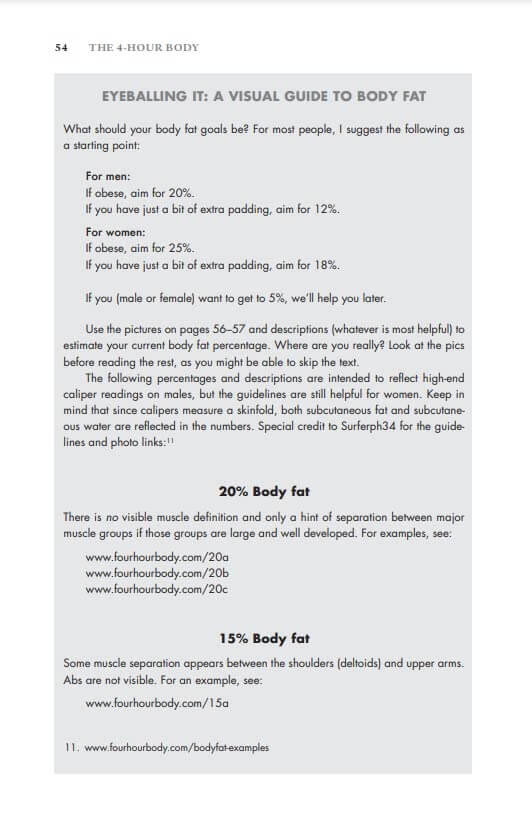
- Body composition
- Nutrition
- Strength
- Endurance
- Exercise
- Recovery
- Sleep
- Measurement
- Physical performance
This structure makes the book suitable for readers who prefer practical reference material rather than a single continuous argument.
Measurement Before Guesswork
A recurring idea in 4 Hour Body is the value of measurement.
People often make decisions about fitness based primarily on how they feel.
Ferriss encourages collecting measurable information where practical.
Depending on the goal, this might involve tracking:
- Body measurements
- Weight
- Exercise performance
- Training frequency
- Sleep
- Food intake
- Progress over time
Measurement can help separate genuine progress from assumptions.
It can also help identify whether a particular approach appears to be producing the desired outcome.
Experiment with One Variable at a Time
When too many things are changed simultaneously, it becomes difficult to determine what produced the result.
A more structured experiment changes fewer variables.
For example, someone interested in improving a routine might first establish a baseline.
They can then change one behaviour and observe what happens.
The basic process can be:
- Define the desired result.
- Record the current starting point.
- Change one important variable.
- Track the outcome.
- Review the evidence.
- Keep, adjust or stop the experiment.
This mindset is one of the most useful general lessons in 4 Hour Body.
Nutrition and the Slow-Carb Approach
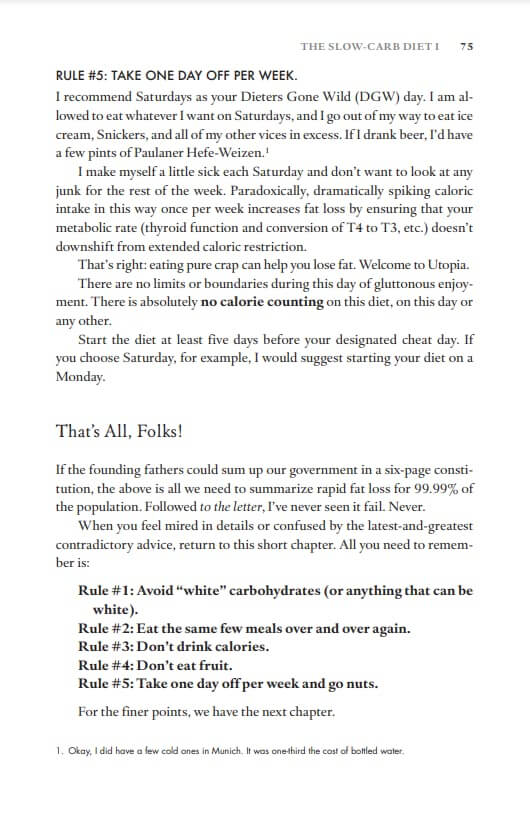
One of the best-known sections of the book discusses Ferriss’s Slow-Carb Diet framework.
The approach is presented as one of his methods for managing body composition.
Rather than treating the book’s nutrition ideas as universal rules, readers should remember that nutritional needs vary considerably between individuals.
Factors such as health conditions, medication, age, training demands and personal dietary needs can affect what is appropriate.
The broader lesson is to examine how food choices affect measurable outcomes instead of relying entirely on assumptions.
Exercise and Efficiency
4 Hour Body also examines exercise through the lens of efficiency.
Ferriss questions whether longer workouts are always necessary for every physical objective.
Different goals require different training.
Someone preparing for endurance activity will need a different approach from someone focused on strength or general fitness.
The book encourages readers to identify the actual objective first.
Then the training method can be selected according to that objective rather than simply doing more exercise without a clear reason.
Strength and Physical Performance
Strength training is another major area covered in the book.
Ferriss explores training methods and examples from people who specialise in different areas of physical performance.
For readers, the useful principle is progressive measurement.
A training programme becomes easier to evaluate when performance can be recorded.
Examples might include:
- Repetitions
- Resistance used
- Distance
- Time
- Recovery
- Technique
Progress can then be compared over time.
Recovery Matters
Exercise receives significant attention in most fitness discussions.
Recovery sometimes receives much less.
4 Hour Body explores the idea that improvement does not occur only while someone is training.
Rest and recovery can also influence performance.
Readers interested in fitness should therefore consider the balance between training and recovery rather than measuring commitment only by how much exercise they perform.
More activity is not automatically better if the body cannot recover adequately.
Sleep and Performance
Sleep is another topic Ferriss examines experimentally.
The book contains unconventional discussions about sleep patterns and optimisation.
Some of these ideas are intentionally experimental and should not be interpreted as standard medical recommendations.
The more broadly applicable lesson is that sleep affects performance.
Energy, concentration, mood and physical recovery can all be influenced by sleep quality.
Readers considering significant changes to normal sleep patterns should use appropriate professional guidance.
Question Conventional Assumptions
A defining characteristic of 4 Hour Body is Ferriss’s willingness to question commonly repeated advice.
This does not mean that conventional advice is automatically wrong.
It means the reader is encouraged to ask for evidence.
Useful questions include:
- What evidence supports this recommendation?
- Is the evidence relevant to my goal?
- How was the result measured?
- Could another explanation exist?
- Does this approach apply to everyone?
- What are the risks?
Critical thinking is especially important when reading about health.
Personal Experiments and Case Studies
Timothy Ferriss is well known for using himself as a test subject.
4 Hour Body contains many accounts of experimentation and examples involving other participants.
This makes the book different from a conventional academic health textbook.
It combines research references with personal trials, anecdotes and case studies.
Readers should distinguish between those different kinds of evidence.
A personal experiment may generate an interesting idea.
It does not necessarily prove that the same outcome will occur for everyone.
Set a Clear Physical Goal
One practical lesson from 4 Hour Body is to define the outcome before selecting the method.
“Get healthier” is difficult to measure.
A more specific objective might involve improving a particular fitness measurement or building a consistent exercise routine.
Clear goals make experiments easier to evaluate.
Ask:
- What exactly do I want to improve?
- How will I measure progress?
- How long will I test the approach?
- What result would count as success?
- What would make me stop?
These questions help create structure.
Avoid Changing Everything at Once
Motivation can sometimes encourage people to completely redesign their routines overnight.
That can make consistency difficult.
A more controlled approach is to identify a small number of meaningful changes.
Track them.
Then decide whether additional changes are necessary.
This is particularly useful when trying to understand which behaviour is actually producing an effect.
A Different Kind of Fitness Book
4 Hour Body is not written like a conventional exercise textbook.
It combines:
- Personal experiments
- Interviews
- Research references
- Case studies
- Recipes
- Fitness techniques
- Measurement tools
- Unconventional ideas
This variety is one reason the book is substantial at nearly six hundred pages.
Readers can use it as a source of ideas rather than attempting to implement every section.
Think Like an Experimenter
One of the strongest non-medical lessons in the book is experimentation.
An experimenter does not simply assume an idea works.
They define a hypothesis.
They measure a starting point.
They test.
They observe.
They adjust.
This approach can apply beyond fitness.
People can use similar thinking for productivity, learning and other measurable goals.
About Timothy Ferriss
Timothy Ferriss is an author, entrepreneur, investor and podcast host.
His books include The 4-Hour Workweek, The 4-Hour Body, The 4-Hour Chef, Tools of Titans and Tribe of Mentors.
His writing frequently focuses on experimentation, rapid learning, productivity and finding unconventional methods for improving performance.
Who Should Read This Book?
4 Hour Body may appeal to readers interested in:
- Health and fitness
- Exercise
- Nutrition
- Physical performance
- Self-experimentation
- Strength
- Endurance
- Recovery
- Measurement
- Timothy Ferriss’s other books
It may particularly appeal to readers who enjoy large reference-style books that allow them to explore individual topics selectively.
Read Health Claims Critically
Because 4 Hour Body includes unconventional experiments and strong claims about physical results, readers should approach health-related recommendations critically.
A method that worked for the author or a case-study participant may not be appropriate for everyone.
Individual medical history, existing conditions, medications and physical limitations can significantly affect what is safe.
Readers should seek appropriate professional advice before making substantial changes involving diet, supplements, sleep or exercise, particularly where they have existing health concerns.
Product Details
Product title: The 4-Hour Body
Subtitle: An Uncommon Guide to Rapid Fat-Loss, Incredible Sex and Becoming Superhuman
Author: Timothy Ferriss
Publisher: Ebury Publishing
Imprint: Vermilion
Format: Trade Paperback
Language: English
Page count: 592 pages
ISBN-13: 9780091939526
ISBN-10: 0091939526
Publication date: 27 January 2011
Dimensions: 223 × 44 × 154 mm
Weight: 714 grams
Categories: Health, Fitness, Nutrition and Personal Development
Key themes: Self-experimentation, measurement, exercise, nutrition, recovery and physical performance
Why Choose 4 Hour Body?
4 Hour Body offers a very different approach to traditional health and fitness writing.
Timothy Ferriss combines personal experimentation, interviews, case studies and research while asking readers to think in terms of measurement and efficiency.
The Minimum Effective Dose concept encourages readers to look for the smallest input capable of creating a meaningful outcome.
The book’s reference-style structure also allows readers to explore individual areas without needing to apply every experiment.
For readers interested in Timothy Ferriss, fitness experimentation, performance and unconventional approaches to self-improvement, 4 Hour Body is a substantial addition to a nonfiction collection.
Explore our complete health, fitness and personal development books collection to discover more titles about exercise, nutrition, habits and performance.
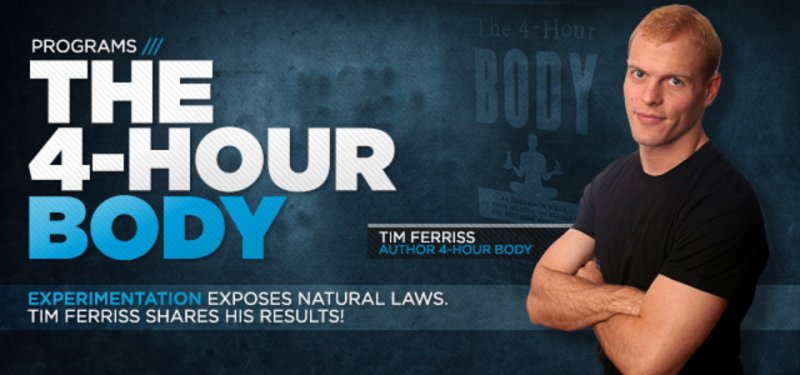
View the official publication details for
The 4-Hour Body by Timothy Ferriss
.
| Author | Tim Ferriss |
|---|---|
| Type | Paperback Printed Book |
| ISBN/ISSN | 0091939526, 978-0091939526 |
| Language | English |
| Pages | 592 |
Be the first to review “The 4-Hour Body by Timothy Ferriss”
Related products
Out of stock
Non-Fiction & Knowledge
රු1,800.00
3 X Rs. 600.00 or 8% Cashback with
or 3 X රු600.00 with
or up to 4 X රු450.00 with
-34%

Self-Help & Psychology
Original price was: රු2,350.00.රු1,550.00Current price is: රු1,550.00.
3 X Rs. 516.67 or 8% Cashback with
or 3 X රු516.67 with
or up to 4 X රු387.50 with
-24%
Out of stock
Non-Fiction & Knowledge
Original price was: රු2,100.00.රු1,600.00Current price is: රු1,600.00.
3 X Rs. 533.33 or 8% Cashback with
or 3 X රු533.33 with
or up to 4 X රු400.00 with
-24%
Non-Fiction & Knowledge
Original price was: රු2,300.00.රු1,750.00Current price is: රු1,750.00.
3 X Rs. 583.33 or 8% Cashback with
or 3 X රු583.33 with
or up to 4 X රු437.50 with
-23%
Non-Fiction & Knowledge
Original price was: රු2,200.00.රු1,700.00Current price is: රු1,700.00.
3 X Rs. 566.67 or 8% Cashback with
or 3 X රු566.67 with
or up to 4 X රු425.00 with
Out of stock
Autobiography
රු2,750.00
3 X Rs. 916.67 or 8% Cashback with
or 3 X රු916.67 with
or up to 4 X රු687.50 with
-26%
Out of stock
Non-Fiction & Knowledge
Original price was: රු2,000.00.රු1,490.00Current price is: රු1,490.00.
3 X Rs. 496.67 or 8% Cashback with
or 3 X රු496.67 with
or up to 4 X රු372.50 with
Out of stock
Non-Fiction & Knowledge
රු1,600.00
3 X Rs. 533.33 or 8% Cashback with
or 3 X රු533.33 with
or up to 4 X රු400.00 with
Reviews
There are no reviews yet.