
No products in the cart.
-14%
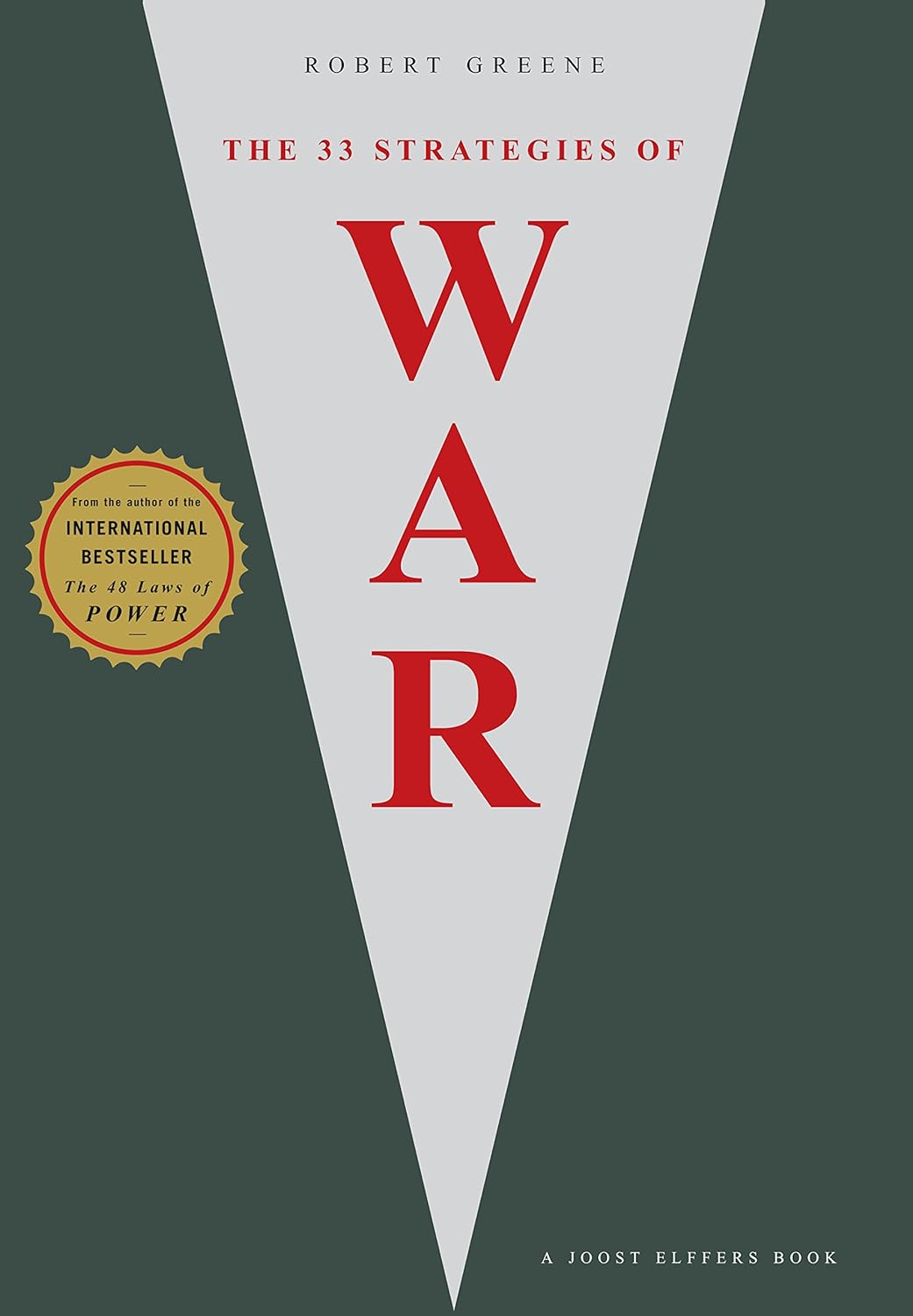
The 33 Strategies of War by Robert Greene

Original price was: රු3,500.00.රු3,000.00Current price is: රු3,000.00.
3 X Rs. 1,000.00 or 8% Cashback with


or 3 X රු1,000.00 with


or up to 4 X රු750.00 with


33 Strategies of War by Robert Greene is a thought-provoking guide to strategy, conflict, leadership and human behaviour.
Drawing lessons from military history, politics, business and famous historical figures, Greene presents thirty-three strategies designed to help readers think more clearly during competition and conflict.
The book is organised into five broad areas: Self-Directed Warfare, Organizational Warfare, Defensive Warfare, Offensive Warfare and Unconventional Warfare.
Rather than focusing only on literal warfare, Greene applies historical strategic principles to everyday challenges involving work, negotiation, competition, leadership and difficult relationships.
Product details:
- Full title: The 33 Strategies of War
- Author: Robert Greene
- Producer/Designer: Joost Elffers
- Publisher: Penguin Books
- Format: Paperback
- Edition: Authorized U.S. Paperback
- Pages: 512
- Language: English
- ISBN-13: 9780143112785
- ISBN-10: 0143112783
- Publication date: 14 December 2007
- Dimensions: Approximately 23.1 × 16.6 × 2.6 cm
- Weight: Approximately 0.72 kg
- Categories: Psychology, Strategy, Personal Development and Business
- Key themes: Strategy, conflict, self-control, leadership, negotiation and decision-making
Out of stock
Email when stock available

The 33 Strategies of War by Robert Greene
33 Strategies of War by Robert Greene is an extensive exploration of strategy, conflict, psychology and the ways people respond when their interests collide.
Rather than treating warfare only as military history, Greene uses historical examples to examine strategic thinking that can also be applied to competition, negotiation, leadership, business and everyday social conflict.
The book presents thirty-three strategies organised into five major forms of warfare.
33 Strategies of War
33 Strategies of War draws lessons from thousands of years of history and examines how successful strategists approached difficult situations.
Robert Greene studies leaders, generals, politicians and thinkers from different periods and cultures.
The examples are used to show how preparation, patience, timing, adaptability and emotional control can influence outcomes.
The book encourages readers to think strategically instead of reacting impulsively.
Five Major Forms of Strategy
The thirty-three chapters are organised into five broad sections:
- Self-Directed Warfare
- Organizational or Team Warfare
- Defensive Warfare
- Offensive Warfare
- Unconventional Warfare
Each section looks at a different aspect of strategic behaviour.
The first begins with the individual.
Later sections expand into teams, defence, initiative and less conventional approaches to difficult situations.
Self-Directed Warfare
Before managing external conflict, Greene argues that people need to manage themselves.
Emotion can interfere with good judgement.
Fear, anger, pride and attachment to past experiences can make people react before they fully understand a situation.
Self-directed strategy therefore begins with awareness.
Readers are encouraged to recognise patterns in their own thinking.
Useful questions include:
- Am I reacting emotionally?
- Am I repeating an old strategy?
- What facts am I overlooking?
- What result do I actually want?
- Am I creating unnecessary conflict?
Strategic thinking becomes stronger when decisions are made with greater clarity.
Do Not Fight the Last War
One memorable idea in 33 Strategies of War is the danger of relying too heavily on previous success.
A strategy that worked once may not work again.
Circumstances change.
Competitors learn.
Customers change.
Technology develops.
New information becomes available.
Good strategists adapt rather than automatically repeating familiar methods.
This lesson can apply strongly in business.
A marketing campaign that succeeded last year may perform differently today.
A management style that worked with one team may fail with another.
Adaptability is therefore a central part of strategy.
Maintain Presence of Mind
Difficult situations often create pressure.
People may make poor decisions because they feel rushed, threatened or angry.
33 Strategies of War repeatedly emphasizes the importance of maintaining mental balance.
A calmer person can observe more information.
They can also consider alternatives that someone acting from panic may miss.
This does not mean becoming passive.
It means separating urgency from emotional confusion.
Organizational and Team Warfare
Strategy becomes more complicated when groups are involved.
Teams need clear direction.
Poor communication can create duplication, confusion and conflict.
Greene examines how effective organizations coordinate people while still allowing flexibility.
Team leaders may consider:
- Is responsibility clear?
- Does everyone understand the objective?
- Are decisions being made at the correct level?
- Is the team affected by groupthink?
- Can people communicate problems honestly?
Strong organization can make execution faster and more reliable.
Avoid Groupthink
Groups sometimes make poor decisions because individuals are afraid to disagree.
Everyone may appear to support an idea even when several people privately believe it is wrong.
33 Strategies of War encourages leaders to remain aware of this problem.
Healthy teams need enough trust for members to question assumptions.
Different perspectives can expose weaknesses before they become costly mistakes.
Leadership therefore involves creating both unity and room for useful disagreement.
Build Morale
People perform differently when they believe their work has meaning.
Greene examines the role of morale in collective action.
A team that understands why a goal matters may show greater commitment than one simply following instructions.
Leaders can strengthen morale by:
- Communicating clearly
- Connecting tasks with purpose
- Recognising good performance
- Sharing responsibility
- Setting understandable goals
- Demonstrating commitment personally
Motivation becomes stronger when people understand what they are working toward.
Defensive Strategy
Not every conflict should be pursued aggressively.
Some situations require defence, patience or withdrawal.
33 Strategies of War encourages readers to choose battles carefully.
Time, money, attention and energy are limited resources.
Engaging in every disagreement can waste them.
A strategic person asks:
Is this conflict worth the cost?
Sometimes the strongest decision is to avoid an unnecessary battle.
Pick Your Battles Carefully
A minor disagreement can become extremely expensive when ego takes control.
This can happen in business, workplace relationships and personal life.
Before escalating a conflict, readers can consider:
- What can I realistically gain?
- What could I lose?
- Is this issue important?
- Is there another solution?
- Will winning create a larger problem?
Choosing where not to compete can be as important as deciding where to act.
Turn Pressure into Opportunity
Defensive situations do not always require remaining passive.
Sometimes an opponent’s action creates an opportunity.
A competitor may become overconfident.
A negotiation partner may reveal too much.
A rushed decision by someone else may expose a weakness.
Strategic thinking involves looking beyond the immediate pressure.
The question becomes:
What does this situation make possible?
Offensive Strategy
The offensive section examines initiative.
When action is necessary, constantly waiting for someone else to move can create disadvantages.
Greene discusses ideas involving planning, speed, understanding competitors and focusing resources.
The purpose is not random aggression.
Strategic initiative means acting with a clear objective.
Think Beyond Individual Battles
One important distinction is between winning a small battle and achieving the larger objective.
People sometimes become so focused on proving they are right that they lose sight of what they actually wanted.
A business may win an argument with a customer and lose the customer.
A manager may force compliance while damaging team trust.
A negotiator may gain one concession but destroy a valuable relationship.
33 Strategies of War encourages readers to think beyond immediate victories.
Ask:
What is the larger goal?
That question helps keep tactics connected to strategy.
Understand the Other Side
Good strategy requires information.
It is difficult to make strong decisions without understanding the people, organization or market involved.
In business, this might involve learning about:
- Customer needs
- Competitors
- Pricing
- Market trends
- Buying behaviour
- Strengths and weaknesses
- Available alternatives
The goal is to replace assumptions with better information.
Understanding another person’s incentives can also improve negotiation.
Use Resources Where They Matter Most
Resources become less effective when spread too thinly.
Time, employees, money and management attention should be concentrated where they can create meaningful results.
For example, a company trying to improve ten major areas simultaneously may make little progress in any of them.
A more strategic approach may be to identify the highest-impact problem first.
Concentrated effort can create stronger momentum.
Timing Matters
An excellent idea introduced at the wrong moment may still fail.
Timing affects negotiations, product launches, hiring, investment and communication.
Sometimes action should be fast.
Other situations benefit from patience.
The difficult skill is knowing the difference.
33 Strategies of War uses historical examples to show how timing can change outcomes dramatically.
Know How to End Things
Starting a project or conflict often receives more attention than ending one.
Yet exit strategy matters.
Before entering a difficult situation, consider what successful completion actually looks like.
Ask:
- What outcome is enough?
- When should we stop?
- What resources are we willing to spend?
- What happens after success?
- What happens after failure?
Without an exit plan, people may continue investing time and resources long after the original goal no longer makes sense.
Unconventional Strategy
The final major section examines unconventional situations.
Standard methods are useful when circumstances are predictable.
They become less effective when conditions change rapidly.
Adaptability becomes increasingly important.
The larger lesson is to avoid becoming so attached to rules and routines that you cannot respond creatively.
Strategy in Business
33 Strategies of War can be particularly interesting for business readers.
Many of its ideas can be interpreted through situations involving:
- Competition
- Negotiation
- Marketing
- Leadership
- Team management
- Business planning
- Crisis response
- Decision-making
The language of warfare should not be taken literally in every situation.
Its value for business readers lies mainly in examining preparation, incentives, positioning, timing and human behaviour.
Strategy in Everyday Life
Conflict does not always involve dramatic confrontation.
People regularly face competing priorities and interests.
A colleague may disagree with a proposal.
A customer may negotiate.
A team may resist change.
A personal relationship may involve misunderstanding.
Strategic thinking can help people respond deliberately rather than automatically.
In many situations, the best strategy may involve communication, compromise or avoiding unnecessary conflict.
Learn from Historical Examples
Robert Greene’s books are known for using historical stories to illustrate broader principles.
33 Strategies of War includes examples from military leaders, political figures, diplomats and other historical personalities.
Readers encounter figures from different civilizations and periods.
The objective is not simply learning military history.
The stories provide case studies showing how people behaved under uncertainty, competition and pressure.
History as a Strategic Laboratory
Historical examples can be useful because the outcome is already known.
Readers can examine:
- What information was available?
- Which assumptions were wrong?
- Why did one strategy succeed?
- Why did another fail?
- What could have been done differently?
This approach turns history into a source of decision-making lessons.
About Robert Greene
Robert Greene is the bestselling author of several books examining strategy, power, mastery and human behaviour.
His works include:
- The 48 Laws of Power
- The Art of Seduction
- The 33 Strategies of War
- Mastery
- The Laws of Human Nature
- The Daily Laws
His books combine historical research, psychology and strategic analysis.
Who Should Read This Book?
33 Strategies of War may appeal to readers interested in:
- Strategy
- Psychology
- Leadership
- Business
- History
- Negotiation
- Decision-making
- Human behaviour
- Competitive thinking
- Robert Greene’s other books
It may particularly suit readers who enjoy learning concepts through detailed historical examples.
A Detailed Book Rather Than a Quick Guide
The authorized Penguin paperback runs to more than five hundred pages.
This makes it a substantial read.
Readers may prefer to work through it gradually.
One strategy can be read and considered before moving to another.
Keeping notes can also help connect historical examples with modern situations.
Read Strategically and Critically
Readers do not need to treat every strategy as an instruction to apply literally.
Many ideas are best considered analytically.
Ask:
- What principle is being demonstrated?
- When would it be useful?
- When would it be inappropriate?
- What ethical considerations matter?
- Is cooperation better in this situation?
- What does this example reveal about human behaviour?
Critical reading makes the book more useful.
Product Details
Product title: The 33 Strategies of War
Author: Robert Greene
Producer: Joost Elffers
Publisher: Penguin Books
Format: Paperback
Language: English
Page count: 512 pages
ISBN-13: 9780143112785
ISBN-10: 0143112783
Publication date: 14 December 2007
Dimensions: Approximately 230.6 × 166.1 × 26.2 mm
Weight: Approximately 720 grams
Categories: Psychology, Strategy, Personal Development and Business
Key themes: Strategy, conflict, leadership, self-control, negotiation and decision-making
Why Choose 33 Strategies of War?
33 Strategies of War offers a detailed exploration of how strategic thinking can influence decisions made under pressure.
Robert Greene uses stories from history to examine self-control, leadership, teamwork, defence, initiative, timing and adaptability.
The book can be read as a study of conflict, but many readers will find its broader lessons useful for understanding competition, negotiation and human behaviour.
For fans of Robert Greene, psychology, strategy and historical case studies, 33 Strategies of War is a substantial addition to a nonfiction bookshelf.
Explore our complete psychology and personal development books collection to discover more titles about strategy, leadership, power and human behaviour.
View the official publication details for
The 33 Strategies of War by Robert Greene
.
| Weight | 0.7 kg |
|---|---|
| Dimensions | 16.8 × 2.3 × 23.6 cm |
| Author | Robert Greene |
| Type | Paperback Printed Book (Second Quality Copy) |
| ISBN/ISSN | 1861979789 |
| Language | English |
| Pages | 496 |
Be the first to review “The 33 Strategies of War by Robert Greene”
Related products
-24%

Out of stock
Non-Fiction & Knowledge
Original price was: රු2,500.00.රු1,900.00Current price is: රු1,900.00.
3 X Rs. 633.33 or 8% Cashback with
or 3 X රු633.33 with
or up to 4 X රු475.00 with

රු2,000.00
3 X Rs. 666.67 or 8% Cashback with
or 3 X රු666.67 with
or up to 4 X රු500.00 with

Non-Fiction & Knowledge
රු2,450.00
3 X Rs. 816.67 or 8% Cashback with
or 3 X රු816.67 with
or up to 4 X රු612.50 with
-19%
Out of stock
Non-Fiction & Knowledge
Original price was: රු2,650.00.රු2,150.00Current price is: රු2,150.00.
3 X Rs. 716.67 or 8% Cashback with
or 3 X රු716.67 with
or up to 4 X රු537.50 with

Out of stock
Non-Fiction & Knowledge
රු1,900.00
3 X Rs. 633.33 or 8% Cashback with
or 3 X රු633.33 with
or up to 4 X රු475.00 with
-24%

Out of stock
Non-Fiction & Knowledge
Original price was: රු2,100.00.රු1,600.00Current price is: රු1,600.00.
3 X Rs. 533.33 or 8% Cashback with
or 3 X රු533.33 with
or up to 4 X රු400.00 with
-24%

Non-Fiction & Knowledge
Original price was: රු2,300.00.රු1,750.00Current price is: රු1,750.00.
3 X Rs. 583.33 or 8% Cashback with
or 3 X රු583.33 with
or up to 4 X රු437.50 with
-33%

Self-Help & Psychology
Original price was: රු2,300.00.රු1,550.00Current price is: රු1,550.00.
3 X Rs. 516.67 or 8% Cashback with
or 3 X රු516.67 with
or up to 4 X රු387.50 with
Reviews
There are no reviews yet.